Snap all the Mariner’s Compass inset layers together into a single LightBurn layout:

Scale it to 120 mm OD, delete the innermost circles under 15 mm diameter, then go wreck yourself some CDs and DVDs:
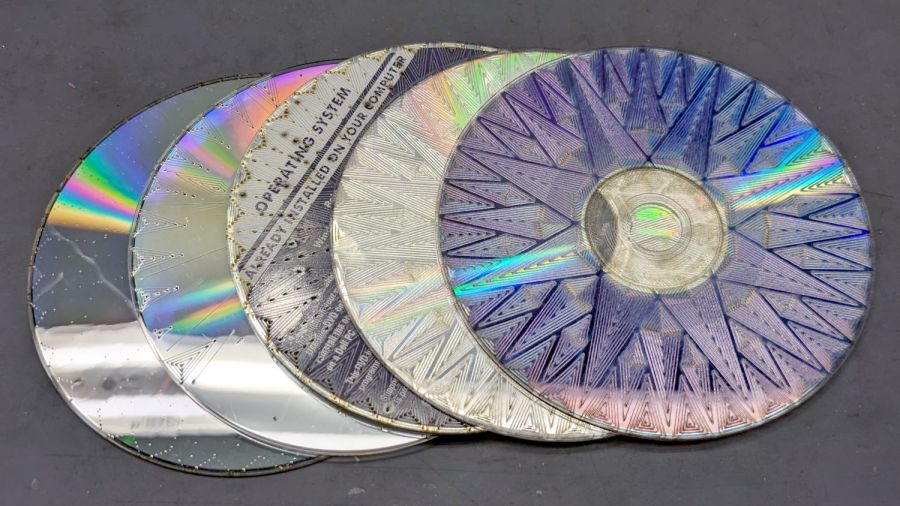
Those were test pieces to figure out speeds and powers starting from the polycarbonate settings used for the Guilloché DVD now serving as a coaster atop the laser.
When you’re looking to destroy the surface, then pretty doesn’t matter, but they come out surprisingly nice in a techie sort of way:
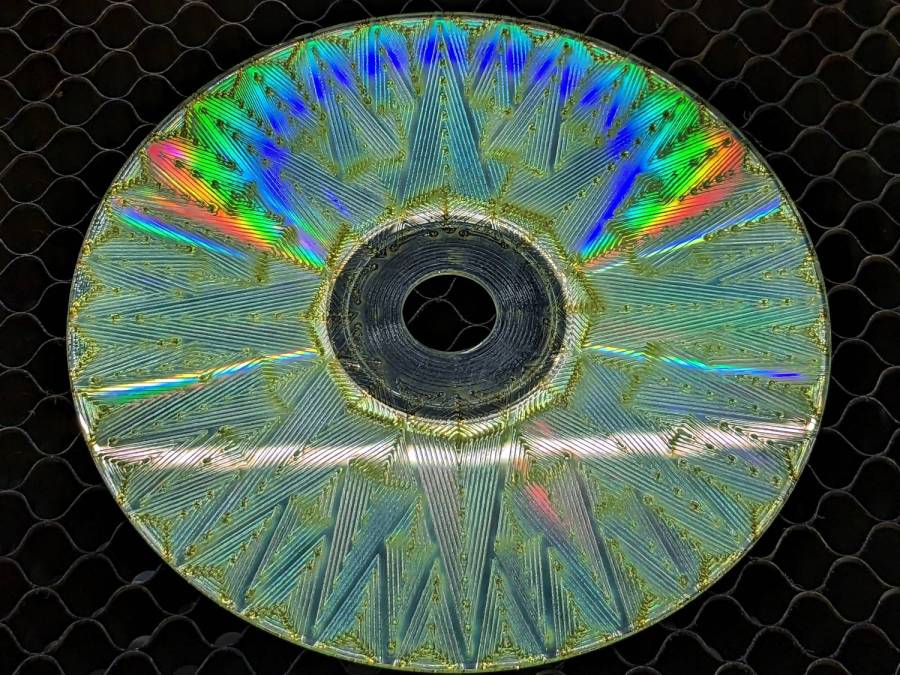
That’s burned into the clear side of the CD before I figured out how to control the power at the starting points.
This CD-R came out a nice silver, with the tracks burned into the data / label side:
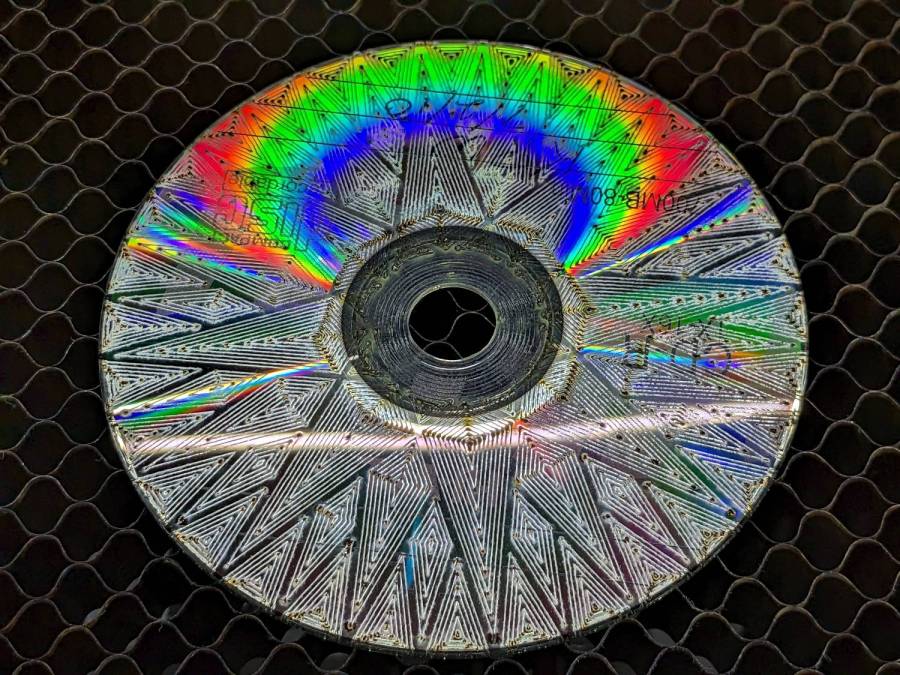
The polycarb tends to scorch & discolor at the starting point of each polygon, where the laser dwells momentarily after lighting up. Avoiding that requires setting the minimum layer power 1% below the Ruida controller’s minimum firing power. In this case, running the layer at 7% minimum with the controller set to fire at 8% completely eliminates the scorches.
The maximum power is about 10% for the clear side. The data side requires only 10% for lightly coated CD-R / CD-RW and maybe 25% for the heavily inked labels of pressed CDs (like the Dell reinstallation CD in the first picture). It helps to start with a vast supply of unwanted discs.
Suiting action to words:
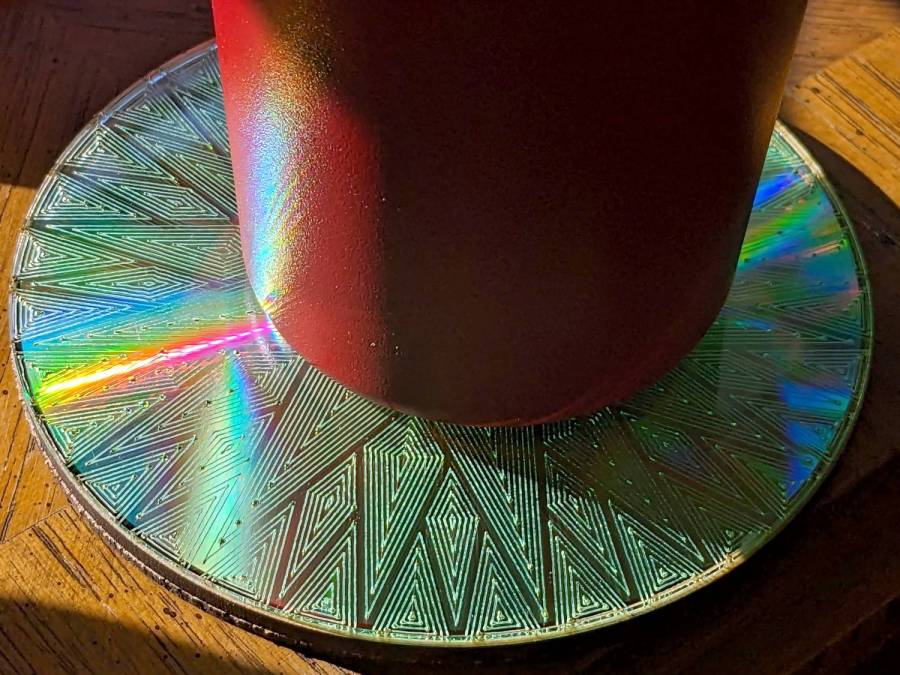
That’s a CD-R wrecked on the data side, stuck to an MDF disk with a cheap craft adhesive sheet and a cork disk wood-glued to the bottom. Carefully hidden here, the central hole sports a 15 mm chipboard disk contrasting horribly with the CD; it cannot be more than 1 mm thick to avoid having it stick up beyond the plastic surface and chipboard is what I have in that thickness.
The advantages of wrecking the data side:
- Leaving the clear side smooth, so crud won’t accumulate / grow in the grooves
- Absolutely, positively, utterly destroying the data track
The advantages of wrecking the clear side:
- Maybe breaking the seal formed by condensation under the mug / glass / cup
- Leaving the data side intact, so the coating won’t disintegrate and peel off the adhesive
In either case, however, I’m sure the data is gone.
 The Smell of Molten Projects in the Morning
Comments
3 responses to “CD/DVD Data Destruction: Mariner’s Compass Coasters”
[…] Wrecking scrap discs led to experimenting with the low-power behavior of my nominal 60 W CO₂ laser. I used the same inset version of the Mariner’s Compass quilting pattern as before: […]
[…] The blue layer runs at 300 mm/s at 10% PWM to carve trenches all over the CD / DVD surface, which should render it unreadable: […]
[…] Up to this point, I’d been making coasters with a layer of cork on the bottom, held in place with wood glue (for MDF or plywood tops) or an adhesive sheet (for acrylic or glass). Doing that with a CD produced the bottom coaster: […]