So the dishwasher ate another rack protector, which happens a few times a year. I’m getting low on spares, so maybe it’s time to run off a few in cyan PETG to see if the cute support structure will still be removable:

Anyhow, this time I used urethane glue, because the last of the acrylic caulk went into another project. I store the Gorilla Glue bottle upside-down so the entire top doesn’t cure solid, but:
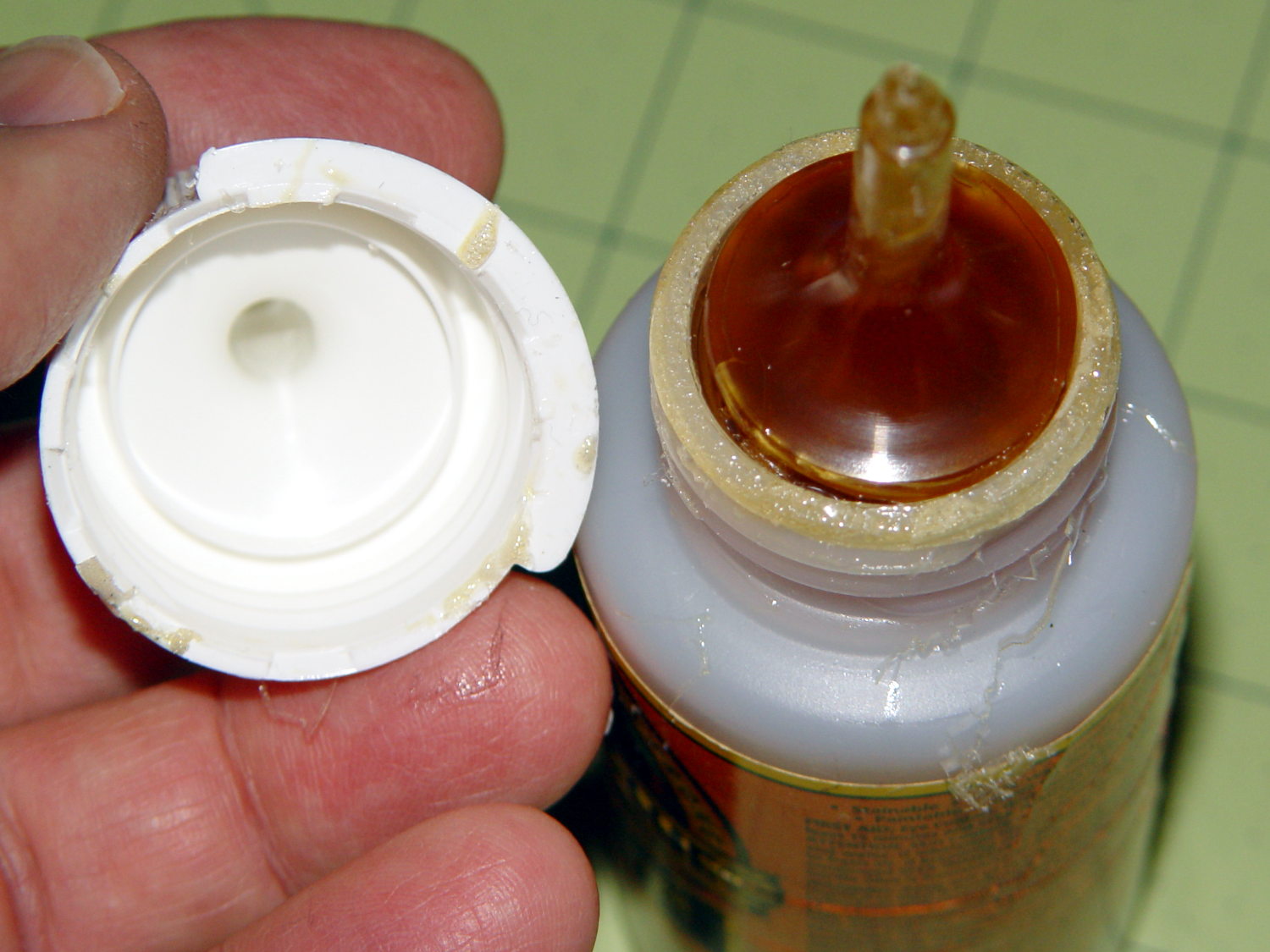
Usually, it’s just cured in the snout. This time, the layer across the bottom was a few millimeters thick and the glue below seemed rather thick. I tossed the solid lump, slobbered a dab of thick goo on the dishwasher rack, jammed the new protector in place, replaced the cap, and declared victory.
That’s why I no longer buy that stuff in The Big Bottle…
 The Smell of Molten Projects in the Morning
Comments
12 responses to “Gorilla Glue: Cured in the Bottle”
You could store it in your 0-humidity safe…
Aye! That’d really add to the disappointment of whoever breaks into it… [evil grin]
I’ve had the same disappointment with Gorilla Glue. Maybe the manufacturer could solve the problem by using a different package. Some wines are packaged in a cardboard box which contains a liquid-filled plastic bag. As wine is drawn out the bag collapses. Hence no air is drawn in. The product stays fresher.
Obviously, you’re not downing your hooch fast enough… [grin]
I have a 70F warming box for finishes and glue, especially when the barn/shop is 38F in winter. This wasn’t enough to keep Gorilla Glue from setting off, so I gave up on it. For outdoor woodworking, I’m trying Titebond Exterior, backed by a nail. Made it through the summer and fall, so far.
My dishwasher project is to degunk the drain pump/valve, since it’s running a bit slow. Didn’t RTFM thoroughly enough to note the filter that needs to be cleaned. Well water of unusual mineral content makes life interesting. [wince]
Sort of like the water around Saratoga that leaves mineral spots on your windshield…
Gorilla Glue has been the most disappointing of my growing collection of adhesives. The expansion makes it very messy, and it has a long full cure time. I guess the best use case is what you’re using it for here: where you don’t care how it looks, and need something waterproof.
Have you tried printing your protector without the support? I’ve found small arches can be formed surprisingly well without it. Maybe not in PETG.
That was originally in PLA (yeah, for a hot dishwasher!) and produced sad little lumps without the support; the arch just caved in. But that was on the Thing-O-Matic, back in the day, so …
Have you tried Supa-Fix? Normally these super-glues never work on the plastics I need to bond but this stuff has worked for me (eg I had a cracked oil filter housing which does not now need to be replaced). Unfortunately, the shelf life is unimpressive, regardless of how you store it …
Never heard of Supa-Fix before, which isn’t surprising, as it seems to be a European thing. I could get it from eBay: $13 + $30 shipping…
The data sheet suggests it’s cyanoacrylate applied to a powdered accelerant / gap filler. I’ve never liked cyanoacrylate adhesives, because they don’t fill voids and have poor impact resistance, plus I always have trouble aligning everything before the adhesive cures. From their description, I should like it, because the powder handles the void filling, provides enough structure for impact resistance, and I can fixture everything before applying the liquid.
Thanks for the tip… when it comes around, I’ll try some!
I get gel formulated cyanoacrylate locally. It’s pretty cool, works like the normal stuff (minus the leaky mess) and it can fill voids – tough probably not as good as this powdered stuff. I know woodworkers use CA glue with activator. Put one on part A, other on part B and press together.
Some time ago a friend introduced me to CA with applicator.
http://www.uhu.com/fileadmin/extern/hhr/htdocs/en-us/product/detail/productCategoryIndex/1/productIndex/super-glue-precision
No more messing with small tubes and getting glue on everything :)
That makes it sound so … simple!