Although I don’t have any data to support the idea, it seems that there’s far too much heat loss from the bottom of the HBP. Admittedly, air is a great insulator, so most of the energy should go into the aluminum plate, but having air blow over the bottom can’t be a Good Thing. There’s a very thin space between the bottom of the silicone heater element and the black aluminum spider supporting the corners, so I added a thin cardboard sheet:

The curiously shaped cutout clears the heater power wires, the thermistor in its lug, and the thermistor wires.
Atop that goes a pair of very thin cotton cloth sheets (again, not much to focus on, so it’s a bit blurry):
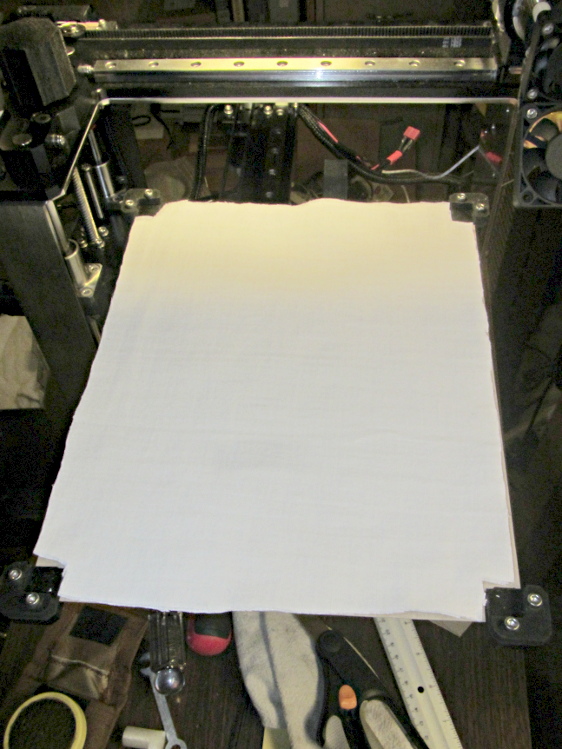
And then the plate fits atop the corner support pads as usual. I suppose the heater duty cycle should be lower at any given temperature, but I don’t have any records to compare against.
 The Smell of Molten Projects in the Morning
Comments
14 responses to “Makergear M2: Heated Build Platform Insulation”
Interesting. Since the early days with my Prusa I’ve been troubled by the thought of wasted energy in this area.
Seems like a deflector for air being exhausted from electronics box would be a benefit. Could be made from ordinary playing card. But this would only apply with bed at bottom … which is where mine is while waiting for warmup, but rarely during printing. Might be better to suspend bed at a higher level during warmup.
Now for some weirdness: Heater & spider removed & inverted. Apply “Great Stuff” foam to back (now top) of heater. Quickly position spider on back of heater, properly registering the corners. Weight spider to prevent expanding foam from moving it. After foam has set, trim excess.
Disadvantages / problems? Probably. Solutions? Possibly.
Unintended positive consequences? Possibly.
I put the fan in backwards, so it’s shoving air into the box; probably doesn’t make any difference to the electronics, but it did keep the wind off the platform.
Man, that’s irrevocable… [grin]
I almost sacrificed a high-temperature brazing pad for the cause, but it was a bit too thick. The ceramic furnace insulation is both too thick and too crumbly. I know enough not to use expanded polystyrene board. [wince]
Something better than cardboard and cotton will come along one of these days…
I bought strips of fiberglass insulation at the hardware store and stuffed them under my heated bed. Haven’t measured the heater duty cycle, but I do notice now that it takes much less time for the bed to reach working temperature before a print.
Sounds Promising.
I’m leery of unconfined glass fibers, but it definitely sounds like a step in the right direction.
I’d be skeptical about using Great Stuff. Dow’s FAQ doesn’t state the max use temperature of the cured foam, but it should be in one of the pdfs they have. (I’m not going to go through dialup hell for that issue….). A third party site says 120F is a reasonable max temperature. I use it at 115 (in a greenhouse) with no problem.
Playing the memory tape, Dow Corning used to advertise an insulation that was laminated foil and a non-heat transmission layer (memory from the late 1960s…). You might want to try to stick a bit of aluminum foil in that sandwich.
Thought on fiberglass–either glass cloth or a small chunk of woven roving might help. Tape could seal the edges. I don’t suppose you have any asbestos paper [whistles innocently].
The foil blocks radiant heat and the fuzz blocks transmission. Makes sense to me and it’s easy enough to do: done!
There’s just a whole bunch of stuff came with this house… [grin]
Actually, I think it’s a refractory board, not asbestos paper, but it’s certainly the thought that counts.
OK, I’ll collect some numbers… [grin]
I’m going to pick nits on myself. It was a Dow Chemical commercial, one of many they played on the science-ish show The 20th Century. My physics teacher used to play episodes (on 16mm film), and they’d leave the commercials in. The commercials were as entertaining and informative as the show, at least to us geeks in class…
On the laminate, they used a bunch of layers, maybe 1/4″ to 1/2″ thick. They had a box of the stuff in boiling water, and at the end, they opened the box and out walked a young chick. Cheep thrills. [grin]
Arggh! After 1967, it was The 21st Century sponsored by Union Carbide. Wikipedia to the rescue…
My wife uses one of these baking mats in out toaster oven: http://www.silpat.com/
Its about 0.025″ thick. Fiberglass reinforced silicone.
3D printing in a toaster oven?
Tell us more please.
[…] simple test of additional insulation below the Makergear M2′s heated build platform, measuring the time required to heat the […]
[…] adding the insulation below the M2′s build platform heater, I punched a hole in each of the support pads and inserted a 1/8 inch bearing […]