
It seems that Wouxun KG-UV3D HTs require nearly 0 V to activate the PTT input, which I discovered after the radio on Mary’s bike began acting intermittently. The TinyTrak3+ would transmit correctly, but the PTT button on the handlebar began to not work at all / work intermittently / work perfectly. The switch and cable were OK, pushing the button produced nearly 0 Ω at the 3.5 mm plug, the connections seemed solid, but the radio didn’t transmit reliably.
I finally got the thing to fail on the bench, which led to the discovery that:
- Shorting the PTT input to the GPS+voice adapter PCB to ground didn’t make the radio transmit and
- Data bursts from the TinyTrack3 worked perfectly
Gotcha!
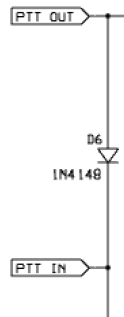
The TT3+ pulls its PTT OUT pin down from +5 V using a 2N2222A NPN transistor (off to the right in the schematic snippet), but, for reasons having to do with ESD, the input from the PTT switch on the handlebars goes through a 100 Ω series resistor, then passes to the TT3 board through PTT IN to D6 before joining the TT3 transistor collector. The low-active diode-ORed signal heads off through PTT OUT to a 10 Ω series resistor, thence to the KG-UV3D PTT input. D6 is an ordinary 1N4148, with the net result that the PTT input voltage at the radio dropped to 630 mV with the PTT button pressed.
Not finding anything else wrong, I replaced D6 with a BAT54 Schottky diode that pulled the PTT voltage down to 300 mV and the radio worked fine.
Of course, a BAT54 is a surface-mount diode, so I clipped off the unused no-connect lead (it’s the only way to be sure it doesn’t do anything) and tacked it down slaunchwise between the PCB thru-hole pads. If I had a BAT54C with common cathodes, I could replace both D5 and D6 in one shot, but D5 just pulls down a PIC input that has an ordinary logic-level threshold voltage.
I don’t know why the KG-UV3D PTT is so fussy, although it may really be a current-driven signal that requires more current than can flow through the 110 Ω + diode forward drop in series with the PTT button. Wouxun presents no specifications that I can find.
The identical circuitry on my bike works fine with the stock D6 diode and a presumably identical KG-UV3D. I should replace that diode before it gives me any trouble, but I’ll wait until I must take the box apart for some other reason.
 The Smell of Molten Projects in the Morning
Comments
9 responses to “Wouxun PTT Voltage Limit”
I’m running into a similar (but different!) problem for a propane stove in the house. It’s necessary that it works in a power outage, so it uses a millivolt thermostat system, but those beasties are very fussy about the resistance they see. Thermostat wire cable and a dumb thermostat can work fairly well, if all the contacts are perfect. I had a mercury ‘stat that worked for a while, but the anticipation resistor was giving lousy contact and the wires in the ‘stat were carefully designed to be resistant to soldering. (I don’t know of any millivolt-only thermostats on the market, and a smart ‘stat was a miserable failure.)
I’m getting so-so service from a new thermostat (non-mercury, so dust is an issue), but I’m seriously thinking of building an external circuit box with either a relay or transistor to short out the thermostat line. Hmm, have to hang the DVM on the millivolt thermopile lines to see what my options are.
Heaven forfend there be any mercury in the house! [sigh]
When we were kicking around ideas for the Longboard Lighting project, I described how a mercury-wetted reed switch would be perfect for the speed sensor: no contact bounce, no contact burn, perfect edges. Of course, it might require a bigger magnet than would fit in the wheel and it might not handle the top end of the speed range, but it’d be dead simple to set up. The Hall effect sensor won out, though, for obvious reasons…
Yeah, I simply couldn’t find a mercury thermostat. We’re not that far from Kalifornia, so some of the loonytunes attitudes about “dangerous” chemicals carry through. Hmm, must tell enviroMentals just what’s in an LED crystal someday. Might be fun.
BTW, I thought you can get bounce in a mercury switch. Not as bad as for a dry switch, but we had problems in some ancient testers we used. I used a reed driven odometer when I rode a lot of miles 20 some years ago. Not too bad for the magnet, and you could scavenge one from a Sonicare toothbrush head for an even smaller unit. Strong ones, those magnets. I do recall having to kick the reed every few hundred miles, but that’s another issue. I like the Hall sensor.
Or a photovoltaic cell…
Just try to set up a fab line in their back yard, even after they cover their garage roof with, uh, free energy. The stuff doesn’t grow on trees!
I used to work for HP when they were doing semiconductors. (The group got spun off to Agilent in the Great Breakup, then Agilent sold off the business and I got retired.) Doing a fab in San Jose gave the fire chief a bad case of the flutters, and the LED crystal growing side got them even worse. Back in Palo Alto in the 70s and 80s, I gathered that the crystal growers counted on one small explosion per month. Wasn’t so bad on the silicon side, but we contributed a fair amount of problems for the authorities. Note to agencies: never insist that semiconductor fluid tanks be buried in the ground. When they leak, they’ll cause a mess.
Between us, a biotech outfit and a dry cleaners, PA had some interesting ground water for a couple of years.
IBM spent a fortune doing that when they set up the East Fishkill site, back in the day, because it seemed like a Good Idea at the time. Spent an even larger fortune digging up the tanks, mounting them aboveground, and then drilling filtering wells all over the neighborhood, a few decades later…
But the dry cleaners were probably the worst offenders: lower budget and less attention to detail.
“never insist that semiconductor fluid tanks be buried in the ground” — later in the 80s I toured a brand new fab site that had been built after that lesson had finally been learned. Our guide pointed out all the piping running over our heads in the hallways and said that building code now required the nasty stuff to run in those pipes, on the theory that any leaks would drip on the heads of management and thus get fixed mucho pronto :-)
He also said that the effluent sent to the sewer system was so thoroughly scrubbed that you could use it for drinking water. Right.
Hello Ed, I am working on a project to expand my Wouxun UV3D capabilities while mobile. I got a dual band magnetic antenna, took the handmic from my TS-2000, bought some connectors, solder on, and made a nice little box to connect the HT to the car stereo, external antenna and hand mic. All fine, tested several times, except for the PTT control! The PTT works fine and make a solid short circuit, but the UV3D will not transmit unless I press it really fast/hard, which is really odd. I can’t find out. I thought it should be something related to a capacitive effect, and I see your post and figure it should be something related to 0V… I’ll do some more tests and let you know if I find out what’s going on. Any help would be great, thank you very much, 73, Dennis PY2DZA
That definitely points toward a bad connection between the PTT line (3.5 mm body) and the HT ground (2.5 mm body).
I’ve had problems with the terminals inside an audio plug not making good contact with the corresponding tip / ring / body parts; it seems they use a mechanical pressure fit rather than a soldered / welded joint and, sometimes, it just doesn’t work. Assuming that everything else in your setup works, I’d suspect the 3.5 mm plug’s body terminal first.
Rule of thumb: it’s always the connectors! [sigh]
Good hunting…