ABS plastic shrinks as it cools and large objects with thin sections tend to delaminate, as seen in the Barbie Pistol and a few other objects. The box for the GPS+voice interface is four threads thick and 35 mm tall, which provided enough energy to rip the side apart:

Solvent glue and a clamp shoved it back together again:
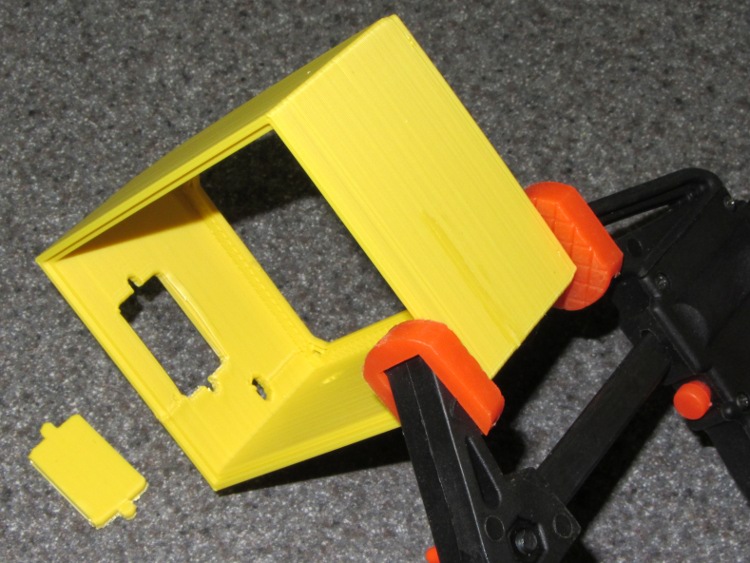
This one was extruded at 190 °C, which works fine for small objects and isn’t quite enough to fuse something like this. I’ll crank it up to 210 °C for the next iteration to see if that improves the result.
 The Smell of Molten Projects in the Morning
Comments
2 responses to “Thing-O-Matic: Delamination”
What is your W/T ? I found that the lower the W/T the worse the delamination problem was.
I think if the whole build volume could be enclosed and the temperature raised to ~100 C then the inter-layer bonding would be helped, and the warping would be reduced.
A generous 2.0 that lays down a thread just about as wide as the nozzle’s flat OD: 0.66 mm.
As soon as I’m done with the LILUG presentation, I’ll gird up my loins, swap in the 0.4 mm nozzle, and reset Skeinforge for 0.25 mm x 0.5 mm threads. That should screw up everything…
That’d wreak havoc on everything other than the extruded plastic. In particular, the wood-and-acrylic-and-ABS structure wouldn’t take kindly to being cooked; those plastics have glass transition temperatures just above 100 C. The steppers aren’t rated for 100 C ambient, either!
I do have acrylic sheets over the openings, with paper skirts under the filament lazy susan feeder, and the inside temperature stabilizes at a bit under 100 F (not C!) after perhaps half an hour, which is about as good as I think it can get. I should probably add a baffle on the exhaust fan’s inlet to reduce the breeze stirred up by the blades, although the Z-Axis side clearance really doesn’t permit much more than a hint of a baffle.
It’s a tricky problem!