I suppose I should have known better: the bottom of that heatsink wasn’t anywhere near flat. I think it mated directly with the top of the CPU through thermal grease, not a compliant pad.
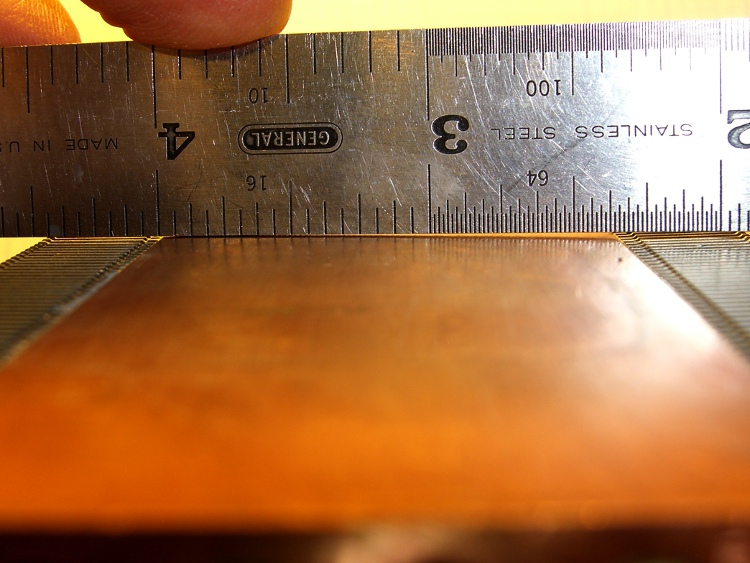
The obvious solution is to flycut the thing, which is where the Sherline’s limited Y-axis travel and teeny table put a cramp on your style. Normally, you’d put the length of the heatsink parallel to the X axis so the flycutter would clear on both ends, but there’s no obvious (read: quick and easy) way to clamp the thing that way.
So I mounted it parallel to the Y axis, which meant I couldn’t get the flycutter completely off the near end. The first pass at Z=-0.1 mm, however, showed that not only was the surface curved, but it wasn’t parallel to the top of the fins (which were flat on the tooling plate). I suppose I should have expected that.
This cut is has Z=-0.1 mm referred to the front end. It completely missed the other end:

I flipped the heatsink around, measured the front-to-back tilt (about 0.16 mm), stuck a couple of brass shims under the front, and the second pass at Z=-0.05 mm from the new low point did the trick. Copper is nasty stuff and I did these cuts dry: the chips visible near the front are stuck firmly to the surface.
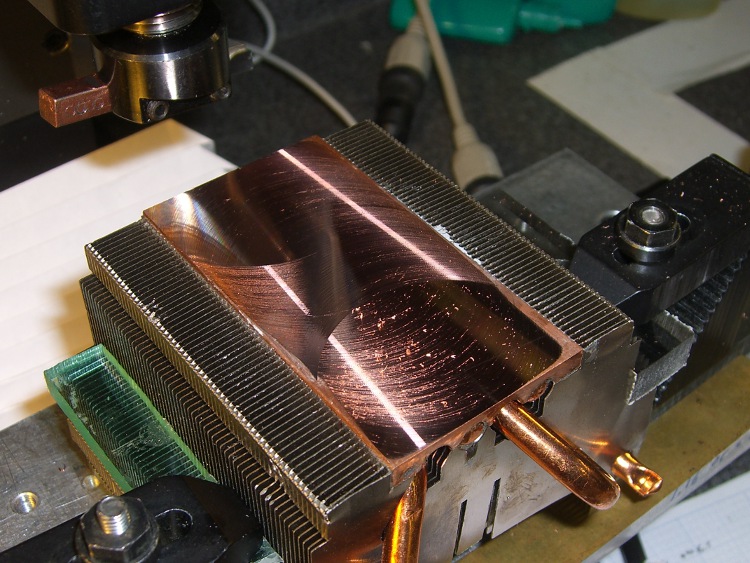
I scrubbed both the heatsink and the spreader plate on some fine sandpaper atop the sacrificial side of my surface plate until they were all good. I can see the remaining flycutter marks, but I can’t feel them, and the plates slap solidly together with a pffff of escaping air:
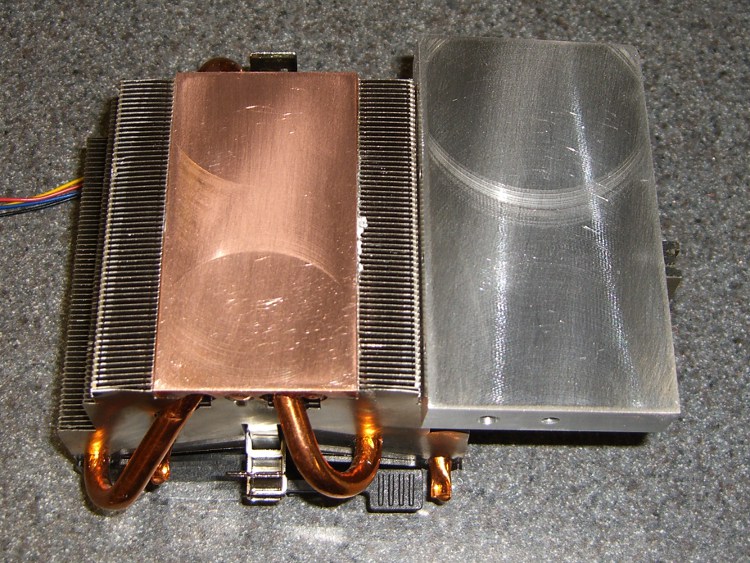
A dab of heatsink compound should work wonders; the maximum dissipation will be under 20 W, roughly comparable to that old K6 CPU, but now the heatsink will be contacting the entire hot surface.
 The Smell of Molten Projects in the Morning
Comments
7 responses to “CPU Heatsink: Flattening Thereof”
That’s a neat mod. Copper’s hard to work with. When I machine brass I use a negative-rake tool and it does great, but I’ve had better luck using a very sharp, slightly positive-rake tool on copper. I’d be interested in hearing what you used.
Last time I needed to flycut something large, I ended up doing it on the lathe, sort of: I built a toolpost grinder spindle a while back, so I mounted the flycutter in that, and bolted the thing I was flycutting to the lathe bed, behind the lathe, so I could use the whole length of the lathebed, like this. It worked surprisingly well, although it’s predicated on building an obscure accessory.
a very sharp, slightly positive-rake tool
Well, this was the stock Sherline large flycutter, which is basically a carbide lathe tool clamped in a hub. The face is angled back about 7 degrees, which is way too much for copper.
I probably should have used the small flycutter: a carbide insert in a holder. That’s about 2 degrees and wouldn’t be nearly so grabby. Alas, that cutter would require at least two passes and would reveal how long it’s been since I trammed the mill head…
Actually, I should have used the big manual mill, but right now it’s buried under an avalanche of 5-gallon buckets… which is entirely another story.
Worst part of the project: little copper curls everywhere! I’ll be vacuuming those things out of the keyboard for months.
I see a business opportunity here: milling heatsinks flat for the overclocker/high-performance PC crowd.
I am surprised at how badly curved the heatsink you have was, and I wonder if that is a common issue. The best thermal performance should be achieved with the tightest gap and the least thermal paste between CPU and heatsink, right?
I’d be astonished if somebody hasn’t already figured out how to get money from overclockers / modders by milling their heatsinks. That’d be a straightforward way to justify getting a bigger mill, fer shure, and paying it off in a matter of weeks!
The convex shape might be deliberate: it’d definitely seat on the CPU heat spreader right down the center, no matter what. More likely, though, that’s just how the copper slab warped when they were done brazing the heat pipes in place and it’s perfectly within tolerance. After all, how much trouble could a K6 CPU get into?
The ideal joint is metal-brazed-to-metal, but in real life you use thermal paste so you can take it apart again. Air is such a terrible conductor that anything is better, but I suspect the actual difference between, say, Vaseline and Arctic Silver 5 isn’t relevant…
I milled it flat mostly because I could… and because I hate thermal paste.
I’m guessing the convex shape is deliberate because if you use thermal paste you don’t want to trap bubbles. The convex shape will smoosh the paste outwards and make sure that at least at the very center you have good contact, and probably in the area around it. When you’re welding on a forge you slightly dome the points that you’re going to weld together and start the weld at the center, working outwards, so you can expel contaminants and get a good solid contact.
My friends with degrees in thermal management topics claim the thickness of the thermal paste is way more important than its thermal conductivity at this scale.
the thickness of the thermal paste is way more important than its thermal conductivity
Makes sense to me; I’d expect the CPU heat spreader would be happy if it could dump heat from the middle. Happier, perhaps, with a solid contact over the whole surface, but you work with what you get.
The entire non-flatness was on the order of 0.2 mm, more or less, so the paste wasn’t going to be very thick anywhere… but I’m sure it’d matter to an overclocker! [grin]
Air is such a terrible conductor that anything is better, but I suspect the actual difference between, say, Vaseline and Arctic Silver 5 isn’t relevant…
And you’d be right (toothpaste works pretty well, it turns out).