Ed Nisley's Blog: Shop notes, electronics, firmware, machinery, 3D printing, laser cuttery, and curiosities. Contents: 100% human thinking, 0% AI slop.
Mary quite deliberately brought home a pair of bedbugs… even knowing what we went through, you cannot imagine how dead those things had to be. She doesn’t just want them dead, she wants them extinct.
Anyhow.
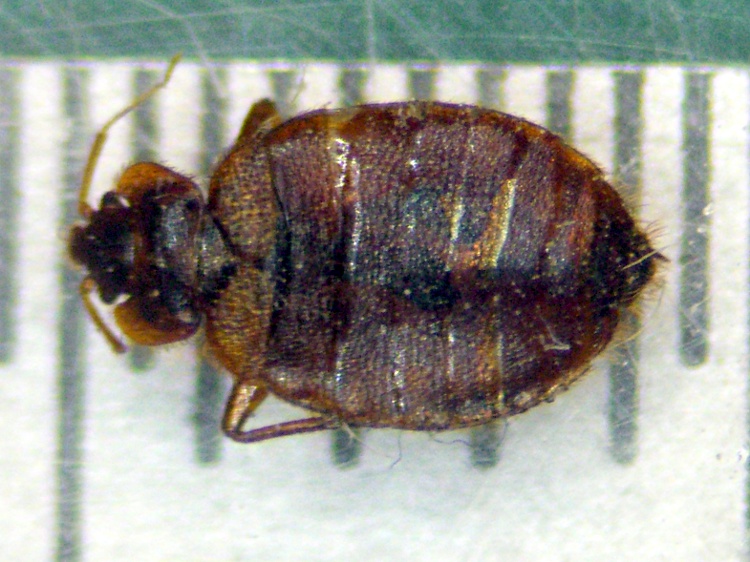
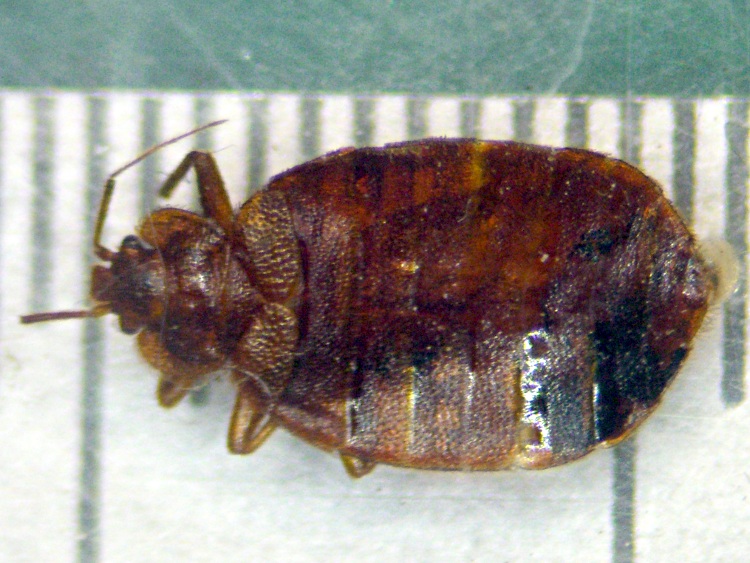
Some pix, atop a scale with 0.5 mm divisions:
Bedbug – 4 mm – dorsalBedbug – 4 mm – ventralBedbug – 6 mm – dorsalBedbug – 6 mm – ventralBedbug – 6 mm – mouthparts
They were actually on load from Cornell’s Co-op lab, having recently been distinguished from bat bugs.
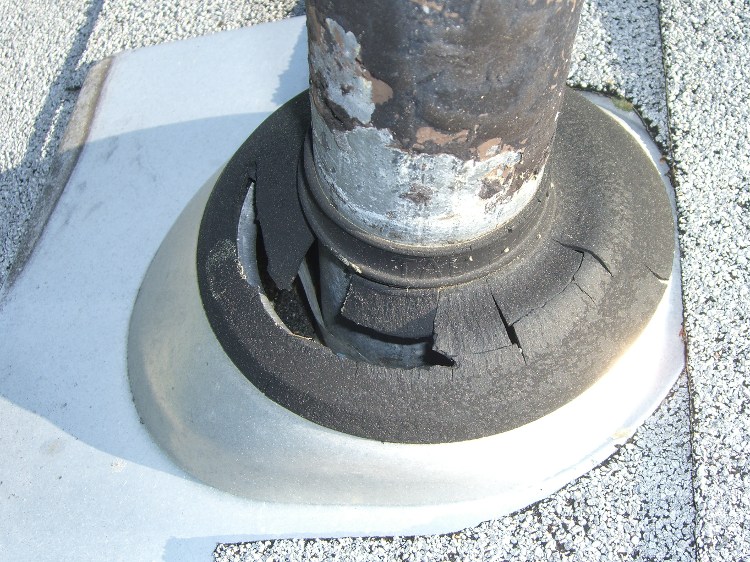
Part of the spring ritual involves cleaning the maple seeds out of the gutters, which also gives me an opportunity to inspect things up there. This year brought a revolting discovery:
Rotted vent stack gasket
It seems the rubber (?) seals around all three vent stack pipes have disintegrated. Now, the contractor installed these as part of the re-roofing project late in the last millennium, so it’s not like they came with the house. They’re an exact match for what’s currently available at Home Depot and I have no reason to believe new ones will last any longer. Sheesh.
The correct fix involves removing the shingles around the existing aluminum plates, installing new plates, and then replacing the shingles. That seems unwarranted, seeing as how the aluminum remains nicely bonded to everything, so I slipped some solid polyethylene shields around the vent stacks, tucked them under the uphill shingles, and hope that’ll suffice.
The discoloration on the roof is getting worse, except downhill from the chimney’s copper flashing. You can see one of the ugly new black plastic vent seals over on the right:
Copper effect on roof discoloration
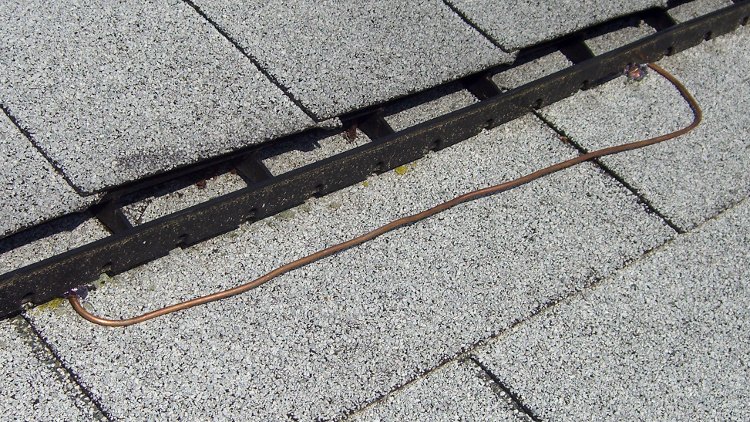
I suspect the copper ions kill off the fungus, so, invoking Science, I tucked a foot of copper wire under the ridge vent uphill from a patch of fungus:
Anti-fungal copper wire test
We’ll see if that makes any difference. I suppose the next time I’m up there I should tuck a strip of copper flashing under the shingle on the other side of the chimney to see if a bit more surface area will have more effect.
I intend to use an ATX power supply as a cheap source of bulk +12 V and +5 V power for the resistors on those heatsinks. I have a 250 W box on the shelf (harvested from a dead donor PC) that seemed ideal; they run more efficiently with higher loads and I only need 150-ish W.
Being that type of guy, I opened it up to see what’s inside…
Damaged ATX Supply
Huh. Looks like some small creature of the night immolated itself down there in the lower left corner, tucked against the transformer. There’s nothing more than black goo and charred filaments left over, with green-blue corrosion creeping up the resistor lead.
Or maybe it’s actually toxic snot from the manufacturing line. Hard to say at this point.
The power supply tester says the juice comes out fine & dandy, so I might use the thing after trying to get the gunk out.
So there you have it: the bugs that killed three months.
We’ve gone a month without a bite and are only now restoring furniture to the bedroom. Each piece goes up on powder traps and gets a week in isolation to reveal any bugs before we reload the drawers with clean clothing. After vacuuming and washing there shouldn’t be any bugs left on the furniture, if the piece had any to begin with. Almost certainly that is wasted effort, but …
Maybe next year we’ll buy new chairs and a couch for the living room. For sure, they won’t have plush, overstuffed upholstry.
With any luck (and the regular use of a hot box disinsector), you won’t go through what we did.
However, should you discover a row of bites across your body, the actions you take during the next few days will determine the level of catastrophe during your next year. The problem will not go away by ignoring it; if you get a breeding population going in your house / apartment / condo, you will definitely need a commercial pest-control service.
If you think tossing out some furniture to get rid of a few bugs is expensive: just wait.
Now, having seen what we’ve been living through, you might ask yourself
Wouldn’t It Be Nice If there was some way to be absolutely sure that mumble does not happen to me?
There isn’t, but you can stack the odds in your favor by disinsecting everything that enters your house. In particular, when you return from a trip, you must treat your luggage with the same casual regard as you apply to any lump of highly radioactive waste.
Because all bed bug stages die when exposed to temperatures over 45°C (113°F, which I round to 120°F), the simplest way to ensure that you’re not bringing any passengers home is to heat your luggage / packages / clothing / whatever to an internal temperature around 120°F, then let it soak for maybe an hour to ensure all the occupants get the message.
What you need is a box that gets hot on the inside, but not hot enough to set your luggage on fire. As with all things sold for bed bug problems, the commercial solution seems grossly overpriced for what looks like an uninsulated ripstop nylon bag containing a rack, a heater, and a fan.
It should come as no surprise that I built something that’s bigger, uglier, and harder to use… but it produces data and you can do science. And, with liberal use of my parts heap, the overall price is maybe 10 dB down from the commercial version…
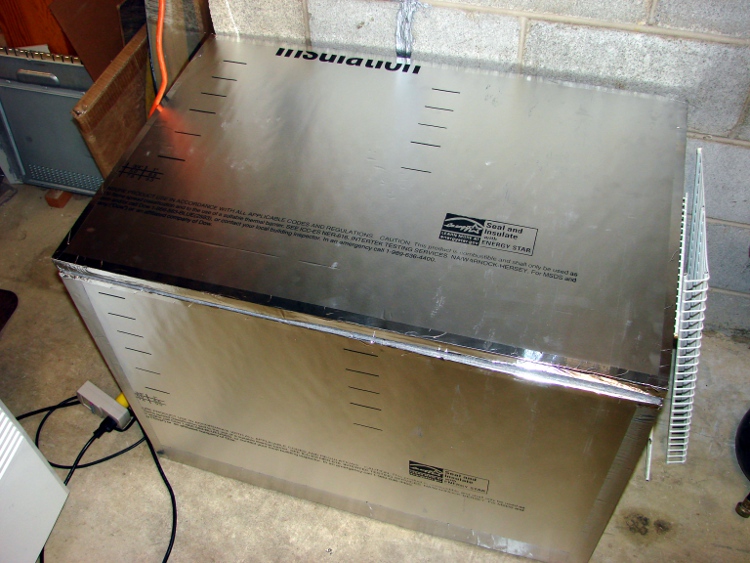
Hot box exterior
I figured that this widget is going to be a major part of our lives from now on, so a foldable / storable heater wasn’t particularly useful. In point of fact, we’ve been using it heavily and I don’t expect that to stop any time soon.
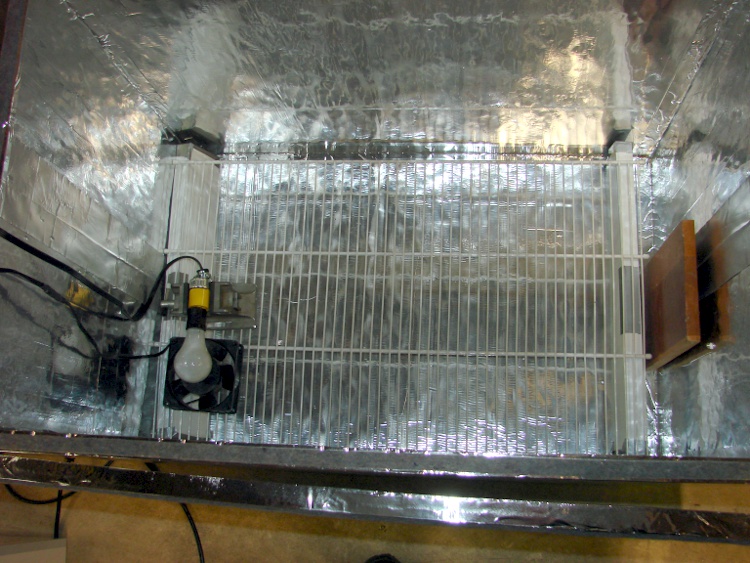
Inside, I used lengths of wire shelving to support the thing-to-be-baked. After we’ve used it a bit more, I’ll conjure up permanent supports for the second level shelving (stacked on the right of the exterior picture); right now, they’re supported on wood blocks as needed.
Hot box interiorHot Box – Dimension sketch
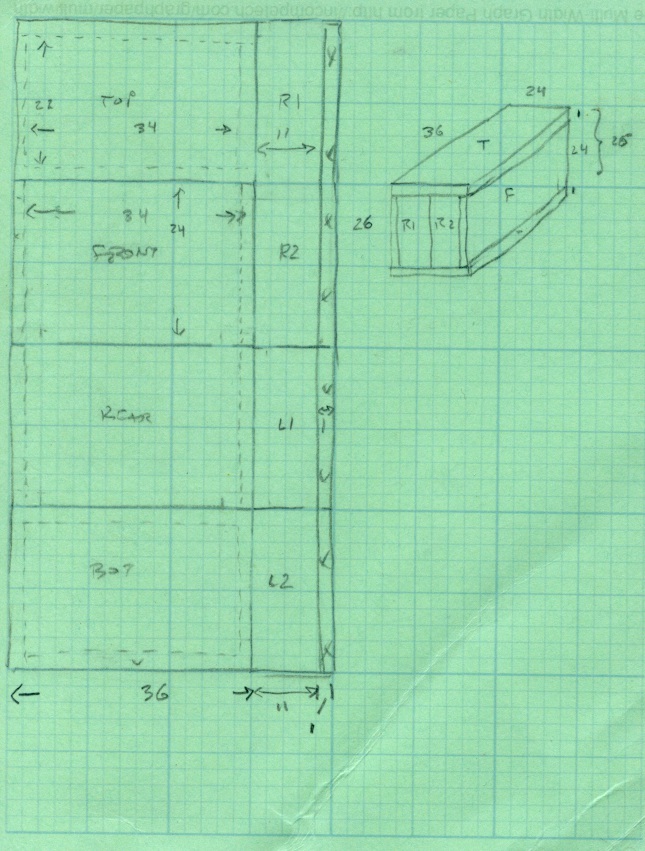
The interior dimensions work out to 34x22x24 inches: it’s made from a single 4×8 foot sheet of insulating board. Here’s my working sketch showing how the parts lay out and fit together. (clicky the pic for more dots).
The only waste is the 1-inch strip along the right edge; the slab I bought came with a molding imperfection, so discarding that edge was OK.
I cut the sheet into four 2×4 foot strips, cut a 13-inch strip off each plank, then trimmed the 1 inch waste. That seemed less prone to catastrophic blundering than (trying to) make a pair of 8-foot cuts and whack each resulting strip in quarters. An ordinary razor utility knife worked fine, although I found that making two passes along each cut produced cleaner results than trying to do it all in one.
I assembled it with the heavy / shiny aluminum foil side inward, although I doubt it makes any difference. Cover all the edges with tape, tape all the joints both inside and outside, and it becomes a nice rigid box when you’re done. Pay attention to getting the sides at right angles; I used a framing square.
The board allegedly has an insulating mojo of:
R = 6.5 ft2 • h • °F/Btu
Figuring a surface area of 32 ft2 and a temperature differential of 120 – 60 = 60°F, the box should require 295 BTU/hr = 87 W to maintain that temperature.
Which, as it turns out, is pretty close to how it worked out:
Hot Box – Temp vs Time – First light
The lower curve shows a 60 W bulb with a 10 W 120 VAC fan heats the interior to a bit over 100°F in 100 minutes, where it looks to be stabilizing. That was the first test and showed that I was on the right track.
The second test, with a pair of 60 W bulbs and the fan produced the two upper curves: one for air, the other inside some cloth jammed inside a plastic bucket to simulate a (tiny) suitcase. The combined 130 W heats the box over 150°F in two hours, with the somewhat insulated bucket trailing neatly behind as you’d expect.
Without opening the box, I connected the bulbs and fan to a Variac plugged into my Kill-A-Watt meter and dialed it for 100 W total dissipation. The temperature fell to slightly over 130°F in 80 minutes and looks like it would stabilize near there.
Ambient temperature was 67°F, so
R = 32 ft2 • 67°F / (341 BTU/hr) = 6.3
Close enough, I’d say. Given those few data points, it looks like the temperature sensitivity around 130°F is 0.7°F / W. [Update: typo in the equation. Doesn’t change the answer much at all.]
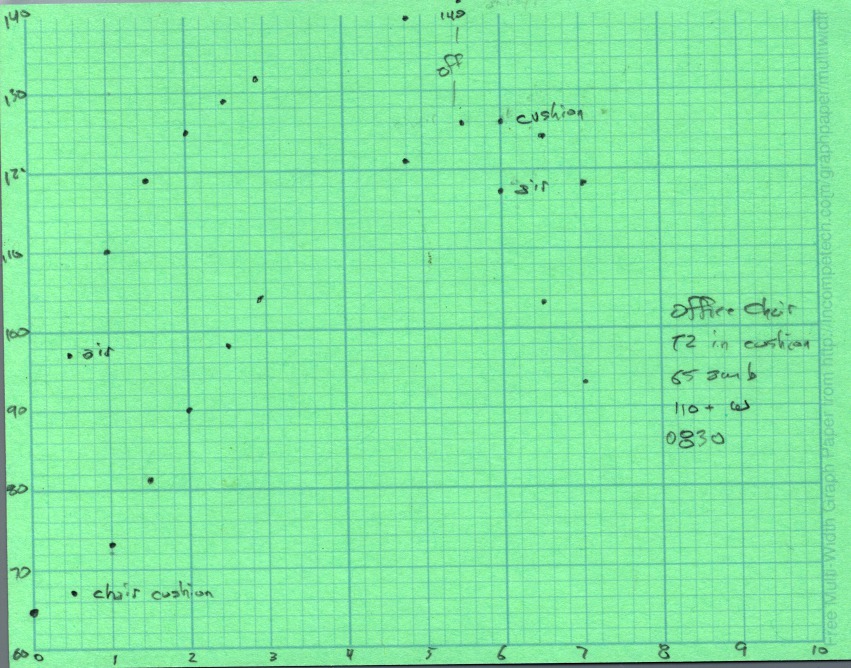
I swapped in a 100 W bulb, removed the Variac, and heated the cushions from my office chair.
Hot Box – Chair cushions
One thermocouple is hanging in mid-air, the other is wedged inside one of the cushions. After nearly 5 hours the cushion is up to killing temperature and I turned the heater off. The air temperature drops rapidly, but the cushion stays over 120°F for another two hours.
The light bulb is just a proof of concept, because it’s entirely too hot: if the fan fails, your luggage ignites. I plan to build a rather subdued heater with a surface temperature around 140°F and a controller that monitors several sensors to ensure the contents reach killing temperatures and stay there long enough.
But that’s a project for another day…
[Update: If you’re arriving from a link, start at the overview to get The Whole Story.]












 The Smell of Molten Projects in the Morning