The Smell of Molten Projects in the Morning

Ed Nisley's Blog: Shop notes, electronics, firmware, machinery, 3D printing, laser cuttery, and curiosities. Contents: 100% human thinking, 0% AI slop.

Tag: Wildlife

Other creatures in our world

  • Upholstered Mouse Nest

    After rearranging the pressure washer pipes, I hauled the grill out on the driveway and opened the lid. My Shop Assistant denied putting that ball of fuzz in there:

    Wool ball in propane grill
    Wool ball in propane grill

    Gingerly prying it open revealed a mouse-sized pocket in the middle:

    Wool ball interior
    Wool ball interior

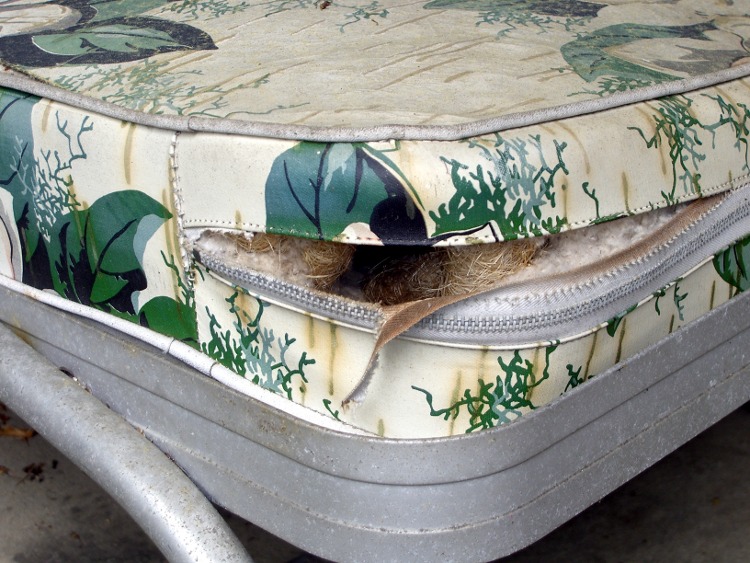
    And a bit of investigation uncovered the source of the batting. Evidently, the corner seam of the ancient lawn couch thing (which came with the house and has been unused for over a decade) sitting on the patio had burst, leaving just enough room for an industrious mouse:

    Source of the wool ball
    Source of the wool ball

    They’d been camping inside the cushion at least over the winter and evidently used the far corner as their latrine. We bagged the whole cushion and added it to the van full of trash headed for the town’s bulk collection, which fortunately occurred that weekend.

    Now, to haul the frame to the metal recycler and take advantage of the current commodity price bubble…

  • Monthly Aphorism: On Preventing Problems

    • You get one chance to throw the snake over the side

    The Great Greene grew up in the Midwest, with the type of summer job one might expect of a teen in an area surrounded by grain fields. One summer he found himself standing knee-deep in the wheat pouring into a cart beside a combine harvester, tasked with shoveling grain into the corners to level the load.

    In addition to combines, the fields were full of rattlesnakes.

    A rattlesnake adopts a characteristic pose when it senses a predator: body coiled, head and tail up, rattle vibrating vigorously. The smaller critters that dine on rattlesnakes (evidently, young rattlesnakes are tasty little pushovers) have figured out, over the course of their long shared evolutionary history, that such a display means this isn’t an immature rattlesnake and they should move along, move along. Raptors pay no attention, having invented the whole death-from-above thing long before we figured out powered flight.

    Combines, having not evolved alongside rattlesnakes and being entirely unaware of the threat display, also pay no attention and simply sweep the entire snake into the threshing machinery, where the snake’s characteristic writhing-ball-of-fury reponse to an attack only serves to give the machinery a better grip. The rattlesnake emerges from the combine’s front end as a snakeskin belt surrounded by gibbage.

    The combine’s sorters and sieves and transports that separate grain from straw don’t work well on rattlesnake remains, to the extent that much of the snake emerges from the conveyor belt as a damp blob dropped atop the pile of grain in the cart.

    In addition to leveling the grain, the Great Greene was responsible for tossing debris over the side. He observed that the machinery downstream of the combine couldn’t do much more than sort out the larger chunks (it’s not like you can wash grain), so if he missed a snake the smaller bits were certain to wind up in your breakfast cereal bowl.

    He said he got most of them…

  • Coopers Hawk

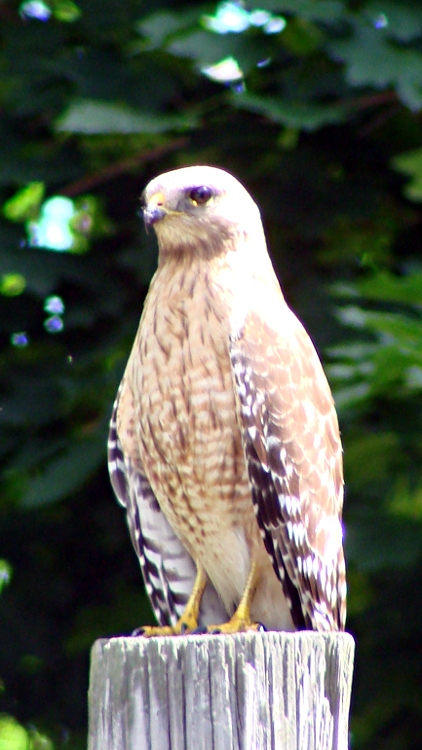
    Coopers Hawk on pole
    Coopers Hawk on pole

    The hawk who’s been keeping the chipmunks and squirrels under control paused for a moment atop the utility pole out by the garden. He left instantly after I appeared around the edge of the roof, leaving me no time to fight the camera automation into a better exposure, but it’s good to know he’s on patrol.

    A few months ago he had a squirrel in a Mexican standoff inside a pine tree, circling the trunk amid all the branches. Eventually the squirrel made a break for it, got about five feet out from the trunk, and wham that was the end of the story: once those claws go in, they don’t come back out.

    Notice the noonday sun refracted through his cornea onto his upper cheek (or whatever it is that birds have there). This was with the 1.7X tele-extender on the Sony DSC-H5 zoomed in pretty nearly all the way; if it weren’t for all fringing and blown highlights, it’d be a neat picture.

    Coopers Hawk - eye detail
    Coopers Hawk – eye detail
  • Cellular Slug

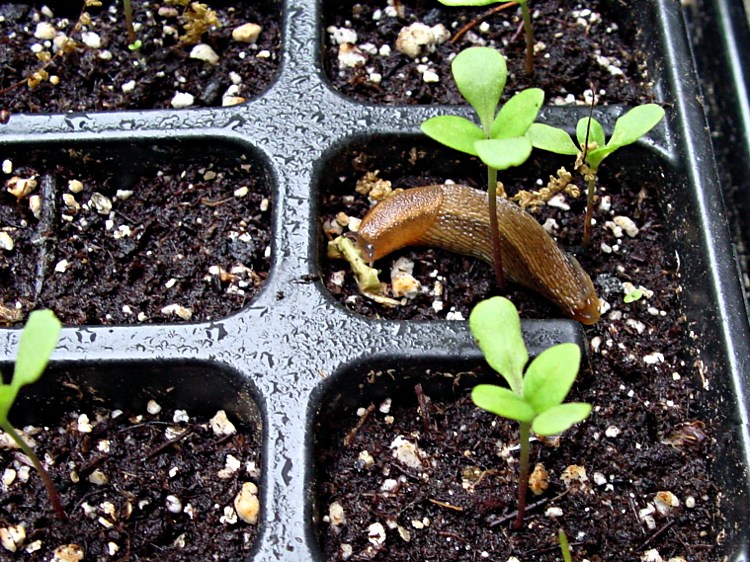
    Perhaps taking a cue from the Cellular Toad, a slug took up residence in one of Mary’s transplant trays:

    Cellular slug
    Cellular slug

    Unlike the toad, this one didn’t live to tell the tale…

  • Peacock in Deployed Mode

    I tagged along on a Master Gardener trip to Weathersfield and found this fellow confined to a cage:

    Peacock - stowed view
    Peacock – stowed view

    His companion was a pure white (leucistic, not albino) female:

    Leucistic Peahen
    Leucistic Peahen

    Shortly thereafter, he deployed for action. Part of the dance involves rattling all those quills:

    Peacock - side view
    Peacock – side view

    I had no idea peacocks have wooly white underwear!

    Peacock - stern view
    Peacock – stern view

    The female remained utterly uninterested throughout the entire show; evidently, one can get used to anything if it happens often enough.

    Raj, our correspondent from India, surely has these things like we have turkeys: enough to be a nuisance.

  • Bedbugs Redux

    Mary quite deliberately brought home a pair of bedbugs… even knowing what we went through, you cannot imagine how dead those things had to be. She doesn’t just want them dead, she wants them extinct.

    Anyhow.

    Some pix, atop a scale with 0.5 mm divisions:

    Bedbug - 4 mm - dorsal
    Bedbug – 4 mm – dorsal
    Bedbug - 4 mm - ventral
    Bedbug – 4 mm – ventral
    Bedbug - 6 mm - dorsal
    Bedbug – 6 mm – dorsal
    Bedbug - 6 mm - ventral
    Bedbug – 6 mm – ventral
    Bedbug - 6 mm - mouthparts
    Bedbug – 6 mm – mouthparts

    They were actually on load from Cornell’s Co-op lab, having recently been distinguished from bat bugs.

  • Roof Work: Vent Stack Gaskets and Shingle Fungus

    Part of the spring ritual involves cleaning the maple seeds out of the gutters, which also gives me an opportunity to inspect things up there. This year brought a revolting discovery:

    Rotted vent stack gasket
    Rotted vent stack gasket

    It seems the rubber (?) seals around all three vent stack pipes have disintegrated. Now, the contractor installed these as part of the re-roofing project late in the last millennium, so it’s not like they came with the house. They’re an exact match for what’s currently available at Home Depot and I have no reason to believe new ones will last any longer. Sheesh.

    The correct fix involves removing the shingles around the existing aluminum plates, installing new plates, and then replacing the shingles. That seems unwarranted, seeing as how the aluminum remains nicely bonded to everything, so I slipped some solid polyethylene shields around the vent stacks, tucked them under the uphill shingles, and hope that’ll suffice.

    The discoloration on the roof is getting worse, except downhill from the chimney’s copper flashing. You can see one of the ugly new black plastic vent seals over on the right:

    Copper effect on roof discoloration
    Copper effect on roof discoloration

    I suspect the copper ions kill off the fungus, so, invoking Science, I tucked a foot of copper wire under the ridge vent uphill from a patch of fungus:

    Anti-fungal copper wire test
    Anti-fungal copper wire test

    We’ll see if that makes any difference. I suppose the next time I’m up there I should tuck a strip of copper flashing under the shingle on the other side of the chimney to see if a bit more surface area will have more effect.