Ed Nisley's Blog: Shop notes, electronics, firmware, machinery, 3D printing, laser cuttery, and curiosities. Contents: 100% human thinking, 0% AI slop.
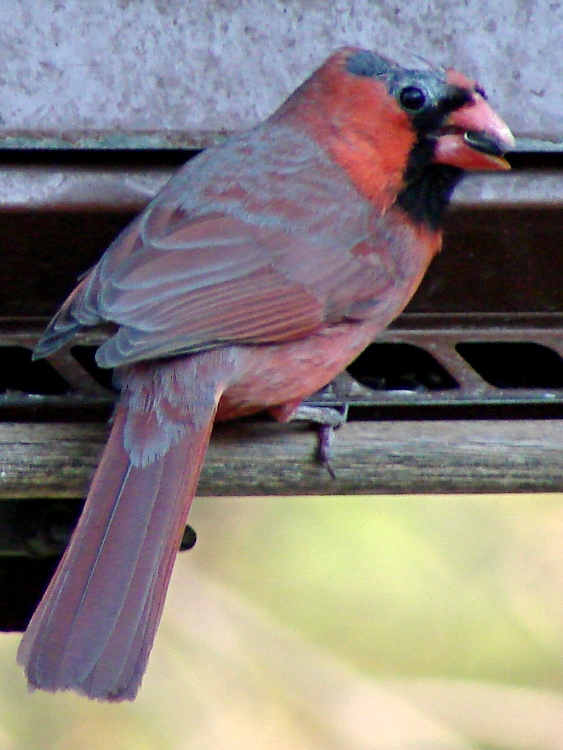
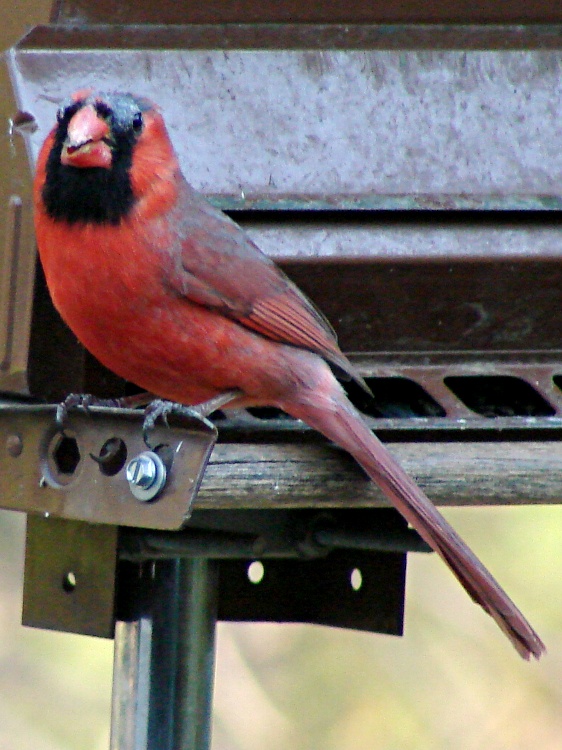
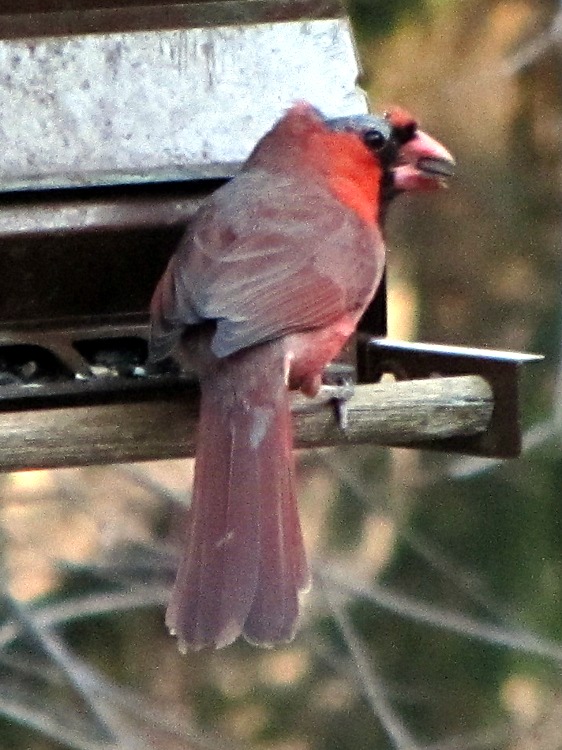
The top of his black mask has lost some feathers near the middle:
Bald Cardinal – front
The poor critter looks a bit like a vulture now:
Bald Cardinal – left side
These are tight crops from DSC-H5 images: 12X zoom with the 1.7 tele extender, taken from about 30 feet away, just before dusk. Turning off the focus assist LED let me stick the big lens out of the kitchen door, brace the affair on the door frame, and click away.
The bald cardinal still stops by the feeder in the evening. He’s now losing the smaller red feathers around his eye and above his beak. The black feathers bordering his beak seem unaffected, although it’s hard to tell through the window glass blur.
This image is a tight crop from the Sony DSC-H5, which has a lens about two stops faster than my Canon SX230HS pocket camera and is much better suited for evening photography. I’ll add the tele adapter to the stack and try to get a better picture from the door; I think the autofocus assist light spooks the poor bird.
That missing leg surely involves an accident, those missing feathers may be mites, but now we have a male Northern Cardinal with what looks like a tumor on his head:
Cardinal with tumor
It’s not obvious in that picture, but the black patch seems to be the rubbed-raw top of a growth.
Prior to these birds, in all the years we’ve been birdwatching we’ve never seen any damaged cardinals…
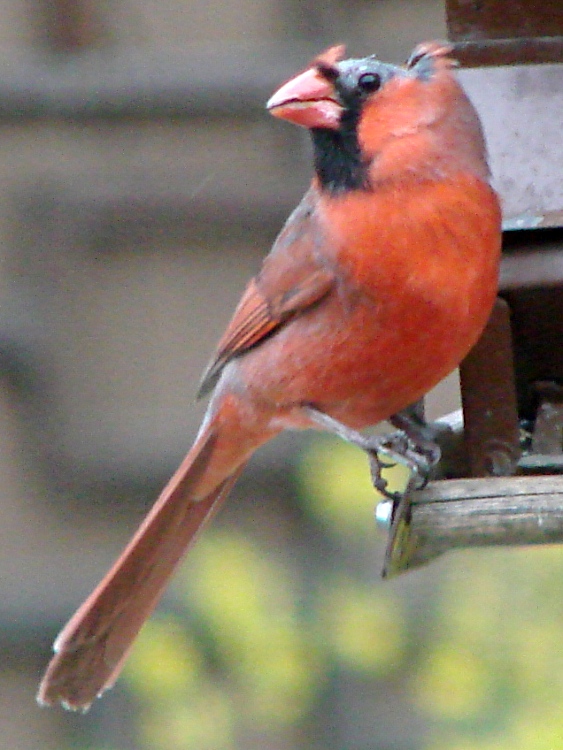
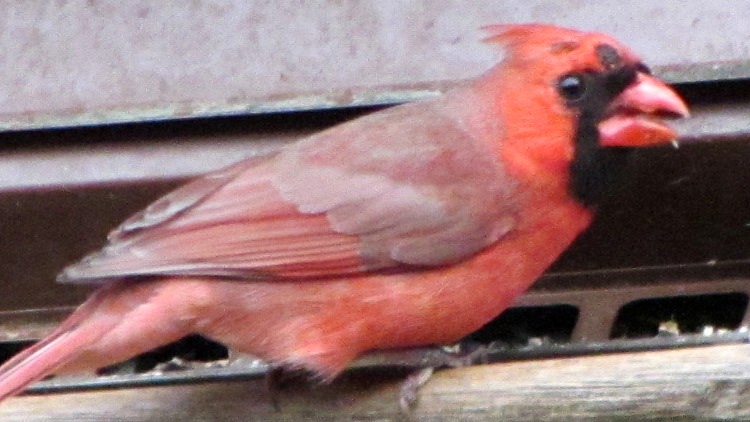
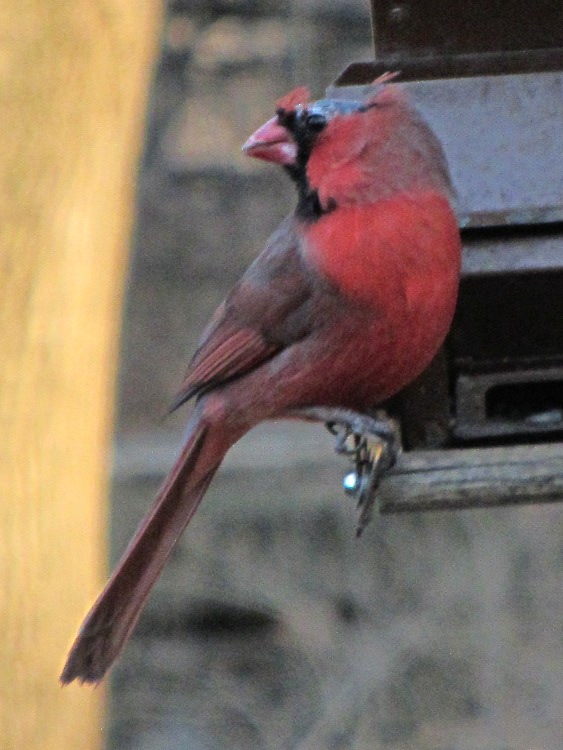
Something weird is going on with the Northern Cardinals at our feeder. First a female missing a leg, now a male minus his head feathers:
Bald Cardinal – right side
A view from the other side:
Bald Cardinal – left side
A bit of searching with the obvious keywords produced that writeup, which suggests feather mites or other parasites. Given that this was in March, that cardinal is definitely not molting!
Those pictures are tight crops from a hand-held Canon SX230HS at dusk, through two layers of 1950-vintage glass. Sorry about that, but the bird spooks whenever I crack the door open for a better view.
At some point we brought home a fruit fly starter kit that produced a zillion fruit flies in the worm compost bin; every time we opened the cover, half a zillion flies would emerge. After a bit of fiddling with the usual Internet recipes, I managed to produce something useful:
Fruit fly trap – overview
The trick involves making the liquid enticing enough to get the flies through the hole in the coffee filter top:
Frut fly trap – filter paper
I used about a cup of water, an ice cube of apple juice for sweetness (they are, after all, fruit flies), a tablespoon of vinegar for that delicious rotten aroma (they prefer damaged, easy to eat fruit), and a few drops of dishwashing detergent so when they hit the liquid they’re sunk.
The container must be tall enough to let them rise past the entrance opening on their way toward the light; I settled on the 2 pound ricotta cheese containers we have in abundance:
Fruit fly trap – results
That’s the catch after maybe a month at the end of the season, but it represents a week of activity back when we were breaking the infestation. I deployed four of those traps atop the compost bin to catch the half-zillion escaped flies and fired up the vacuum cleaner to extract the half-zillion remaining inside every time we opened the lid. After a few weeks of that, we’d managed to get ahead of their breeding cycle and the problem pretty much Went Away.
Having missed the fall driveway paving deadline, we will have a gravel section in the middle of the driveway until next spring. All the water from the garage downspouts and the back yard runs down the driveway, which dumps it directly into the gravel patch and the new retaining wall’s foundation. That means the gravel patch, at least, will become a mud hole, which I take to be a Bad Thing.
So I bandsawed some 4 inch DWV pipe & fittings in half lengthwise, glued them together as a gutter to capture the runoff and divert it into 80 feet of DWV pipe leading to the bottom end of the wall, then filled the half-pipes with gravel to let us drive right over the whole mess. Unfortunately, the top end of the gravel patch has the driveway ending in broken asphalt, Item 4 gravel, fine gravel, and rubble that make it impossible to snug the pipes up against the asphalt. That means the runoff would pretty much vanish before it reached the gutters.
So I excavated just barely enough gravel to ensure a downhill slope from the remaining asphalt, mixed up a random bag of mortar that’s been kicking around in the garage for a few years, and troweled an apron from the asphalt to the half-pipes. Generally I sign my work, but this kludge need last only a few months and I left it to cure.
The next morning I discovered one of the chipmunks felt the work really needed a signature:






 The Smell of Molten Projects in the Morning