The Smell of Molten Projects in the Morning

Ed Nisley's Blog: Shop notes, electronics, firmware, machinery, 3D printing, laser cuttery, and curiosities. Contents: 100% human thinking, 0% AI slop.

Tag: Thing-O-Matic

Using and tweaking a Makerbot Thing-O-Matic 3D printer

  • Thing-O-Matic: Lazy Susan Filament Spool

    All of those thermal tests on the MK5 head gave me plenty of time to ponder the problem of what to do with the filament bundle. Thingiverse has many plans for spools that fit over, under, or beside the printer, but they all seemed complex and fiddly. Besides, I didn’t have the printer running yet, so I couldn’t print up the parts… much less laser-cut anything.

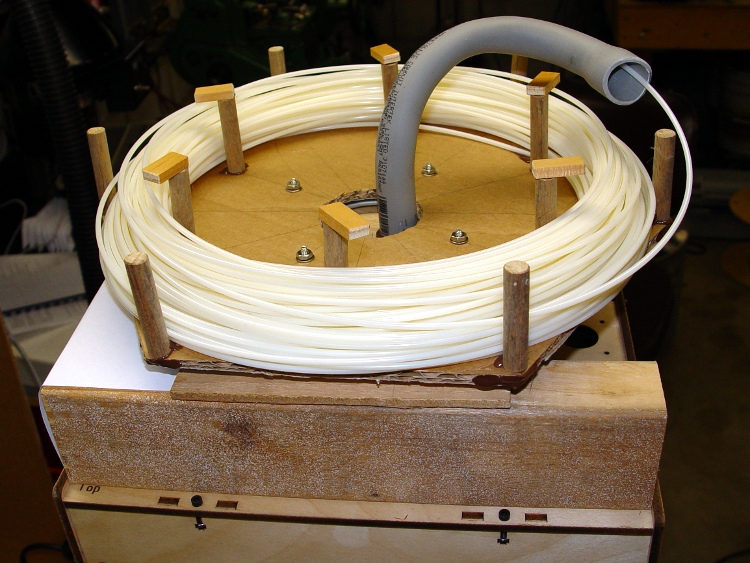
    The Parts Heap disgorged a 4-inch Lazy Susan bearing, some double-layer corrugated cardboard, and odd bits of wood. The end result fits neatly atop the Thing-O-Matic printer:

    Filament spool - front view
    Filament spool – front view

    The base is 2 x 3-inch (actually measuring 1.5 x 2.5 inch) lumber, cut to exactly fit between the front and back plates of the printer box. The boards also butt against the socket-head cap screws securing the printer’s side plates, so they’re not moving. A scrap of 1/4-inch plywood bridges the two; it’s held in place with hot-melt glue atop the lumber. The weight of all that wood holds the assembly in place; making it lighter might not be productive.
    Filament spool - left side
    Filament spool – left side

    The filament coil rests on a hexagon of double-thick corrugated cardboard, cut about 12 inches across the flats and 13 inches across the points; you could glue two single-thickness sheets together. I laid it out with compass-and-ruler techniques, but do what you like.

    The pegs are 7/16-inch wood about 2 inches tall; the outer ones are on the hexagon points and the inner pegs are on a circle 1.5 inches inside the outer pegs. The rectangular caps on the inner pegs prevent the filament from creeping upward while feeding and are angled to let it slide off into the conduit. They’re held in place with hot-melt glue, of course, and a bit more glue stiffens the hexagon points.

    The only store-bought part is the 90-degree PVC elbow originally intended for electrical work: it’s a “1/2-inch Schedule 40 Rigid Nonmetallic Conduit” elbow. I slipped a spring inside the bore to prevent collapse, applied a hot-air gun until it was flexy, bent the second right angle to align the end bell with the incoming filament, and introduced it to Mr Belt Sander to angle the entrance bell more-or-less at right angles to the incoming filament.

    The Lazy Susan bearing must be centered on the top of the printer, but the hole for the conduit must be forward of center to align with the MK5 Extruder head’s filament entry. As it turned out, butting the conduit against the forward rim of the bearing (the non-rotating base part) worked perfectly. More hot-melt glue holds it in place.
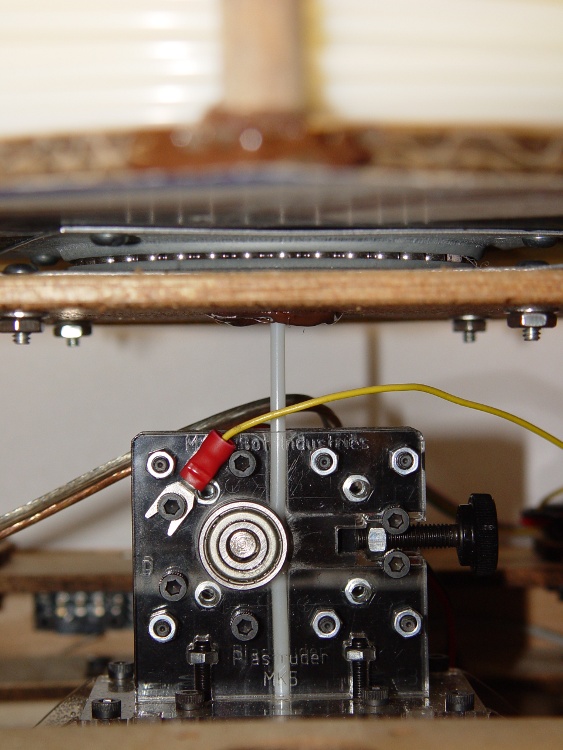
    Filament spool - front detail
    Filament spool – front detail

    This front view shows an out-of-focus peg and filament pile at the top, the Lazy Susan bearing between the plywood and cardboard, and the filament dropping straight into the MK5 head.

    The spool easily rotates backwards when the extruder motor reverses. You can lift the spool off, put it down next to the printer, fiddle with the extruder machinery, then replace the spool without cutting the filament. Trust me on this, I’ve done it a lot.

    If I hadn’t dropped the filament bundle, it would probably have slipped right into the spool without any fiddling; the coils are about a foot in diameter as shipped. I devoted a few minutes to feeding the greatly enlarged and somewhat tangled mess neatly into the spool, after securing the bitter end to the cardboard with (wait for it) a dab of hot-melt glue.

    If I ever build another spool, I’ll replace the cardboard with either 1/4-inch plywood or acrylic, then print up some better-looking peg-like objects. A shot coat of paint couldn’t possibly hurt its appearance in the least, either…
  • Seating Knob Heads and Suchlike

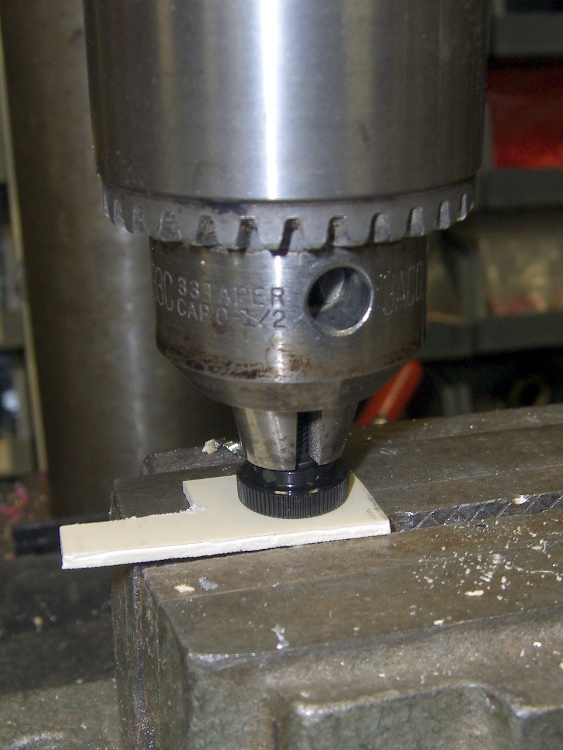
    The Thing-O-Matic instructions suggest crushing the knob heads onto socket-head cap screws using pliers. That’s a desperation move for when you have no alternative.

    Instead, if you have a drill press (and you should!), do it this way: lightly grab the cap screw threads in the chuck and squash it into the head.

    Seating knob head on SHCS
    Seating knob head on SHCS

    The same trick works for pressing pulleys and drive splines onto motor shafts.

    Seating extruder drive on motor shaft
    Seating extruder drive on motor shaft

    You shouldn’t use your drill press as a heavy-duty arbor press, but for pressing small circular things onto shafts, it’s hard to beat.

  • ATX Power Supply Dual +12 V Outputs: Fakery Thereof

    I wondered if the Thing-O-Matic would benefit from having its two high-current heaters on a separate +12 V supply than the DC Extruder, after finding that the heaters dragged the +12 V output down by nearly half a volt.

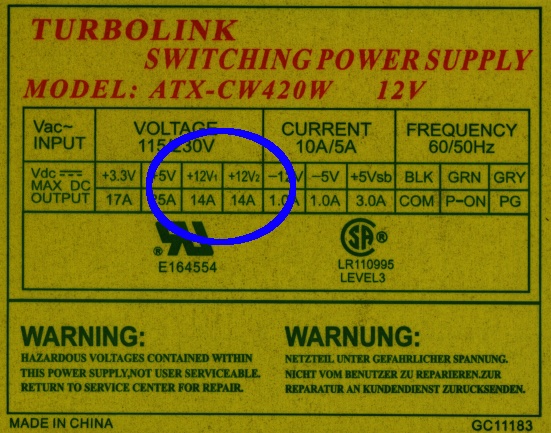
    A bit of rummaging turned up a suitable ATX supply with a data plate that might justifiably lead one to believe that the supply provides separate +12 V outputs:

    Turbolink ATX-CW420W power supply data plate
    Turbolink ATX-CW420W power supply data plate

    There’s no indication which of the four connectors might use +12V1 and +12V2, but, being that sort of guy, I applied an ohmmeter to the various yellow wires and found they were all exactly 0.0 Ω apart.

    Huh.

    So I opened the Warranty Void If Seal Removed top cover and found this situation:

    ATX with fake dual 12 V supplies
    ATX with fake dual 12 V supplies

    Nota bene:

    • All the yellow wires terminate in the same solder blob below the PCB
    • Two incoming wires got neatly spliced together in mid-air, despite having free holes in the PCB

    This may not come as much of a shock: they lie…

    Perhaps if you spend more money on your supply, it’ll actually live up to the data plate specs. Then, again, perhaps you’ll just be spending more money.

    And, if you swap in a fancy supply for the MBI-stock one, it might not make much difference at all. I suspect the various power levels and current capacities have pretty much the same degree of integrity…

  • Thing-O-Matic: Arduino Mega Heatsinking

    The Thing-O-Matic Motherboard rides atop an Arduino Mega (with the auto-reset option disabled), drawing most of its power from the hulking ATX connector at one end. The Mega draws power from the ATX +12 V supply and produces +5 V through its on-board regulator.

    As I noted there, that regulator runs surprisingly hot when fed from +12 V, even without any additional current flowing to the Mega’s pins. The solution here required another search through the parts heap, which eventually disgorged a small heatsink that was, I think, intended for a 16-pin DIP, although I obviously added the hole for some other, long-forgotten purpose.

    Motherboard regulator heatsink
    Motherboard regulator heatsink

    A bit of fin-bending to clear the (unused) power entry jack, a dab of JB Kwik epoxy, and a clamp to keep it in place while the epoxy cures:

    Clamping the Motherboard regulator heatsink
    Clamping the Motherboard regulator heatsink

    You won’t have such a heatsink, but any similarly shaped chunk of metal, even without fins, should suffice. Nothing critical about it, as long as it clears the Motherboard that will be plugged atop the Mega; you’re just increasing the surface area for heat dissipation.

    The Motherboard and Mega sit in the large opening across the Thing-O-Matic’s baseplate from the ATX supply’s fan intake, where they get plenty of cooling air. Do a before-and-after test with a fingertip on the regulator to feel the improvement for yourself.

    This is, admittedly, just a feel-good tweak, but a cool regulator is a happy regulator. Spread the joy…

  • Thing-O-Matic / MK5 Extruder: Cartridge Heater Doodles

    During the conversation following my original post on the MakerBot support forum, CodeRage suggested using cartridge heaters. I asked Eks about that and he said something along the lines of “Damn straight! We used ’em all over the place! Just do it!”

    CodeRage plans to retrofit his MK5 head with a pair of 230 V 150 W heaters running at 120 V to get a total of 75 W. I have qualms about running line voltage around the extruder head, but it’s certainly a better solution than toasting power resistors.

    The trouble with 1/2-inch models is that they don’t fit conveniently on the Thermal Core. I’d make an adapter block with a hole for the heater and two holes for the existing cap screws, but the screws don’t quite pass around a half-inch cartridge heater.

    He suggested 1/8-inch heaters from Sun Electric Heater Company, which look like just the ticket except that they’re nigh onto 40 bucks a pop. Ouch.

    High Temp Industries [Edit: new link 2013-12-27has 1/4-inch heaters for under $20 that will fit in the space available. If I understand the configuration options, you can even get 12 V 30 W heaters (the same power as the existing resistors) with a 1000 °F (call it 500 °C) temperature rating.

    So I think what’s needed is to get some of those heaters, machine blocks to hold them on each side of the Core, and see how that works. The heaters will fit between the resistor screw holes and the Core is just about exactly 1 inch long. What’s not to like?

    This might work… except for the fact that HTI has a $150 minimum order, which is somewhat off-putting even for me. Anybody up for a group buy of ten cartridge heaters?

    Note that if you swap in some cartridge heaters, you really should do the separate +12 V supply Extruder Controller hack described there.

    [Update: Zach @ MBI has ordered a stack of cartridge heaters for their internal testing (he promises to send me some), plans a retrofit kit, and may become a retail source for the heaters. He reports the lead time to get heaters in bulk is something over two weeks, which is a lot longer than I expected.

    In light of that, I will hold the “group order” until I have a better handle on what’s needed to retrofit cartridge heaters into the existing MK5 head, how they’ll actually work, and what PID loop retuning may be required. Once I know more about all that, we can proceed.

    Having MBI handle the ordering & shipping makes sense to me!]

  • Thing-O-Matic / MK5 Extruder: Resistor Wrapup

    Extruder resistor wiring
    Extruder resistor wiring

    As nearly as I can tell, using a pair of 10 W power resistors as 30 W heating elements in the Thing-O-Matic’s MK5 Extruder Thermal Core isn’t going to work, at least if you want even minimal reliability.

    The fundamental problem is that the resistor specification limits the dissipation to a few watts, tops, near 250 °C, where they must run in order to melt any of the plastic filaments.

    The Thermal Core requires 20-30 W to maintain 225 °C, so each resistor must dissipate an average of 10-15 W at that temperature. That’s half of the MK5 extruder’s original design point and still nearly a factor of 10 beyond the resistor rating.

    The original design runs at less than 50% duty cycle to maintain 225 °C, which agrees with my measurements:

    • 50% of 60 W = 30 W
    • 33% of 60 W = 20 W

    If you want to run at lower power, it’s a drop-in replacement. Change the original 5 Ω resistors to 2.5 Ω resistors (from Digikey / Mouser / wherever), change the wiring to put them in series (not parallel!), and see how long they last. They’ll certainly fare better than at 30 W, but I wouldn’t expect more than a few hours of lifetime. The specs give them 1000 hours at rated power, which this certainly is not.

    A series connection means that when one resistor fails, the heat goes off. The original parallel connection left one resistor carrying the load and, at 30 W, it can actually get the Core up to operating temperature and keep it there. Many folks have been baffled by that, but the diagnosis is simple. Measure the resistance of the parallel resistors at the Extruder Controller end of the wires:

    • 5 Ω → one resistor has failed
    • An open circuit (infinite resistance) → both are dead

    The problem with the lower power dissipation, whether from a failed resistor in the original design or my suggested change, is that the extruder head has a thermal time constant of 10-11 minutes. Lower power means a longer cold-start time; 30 W should get it up to 225 °C in about 20-30 minutes depending on the insulation. That’s not really a problem if you’re printing a series of objects, but might be objectionable for quick printing sessions.

    However, when a resistor fails, the heat goes off, the plastic stiffens up, the DC extruder motor stalls, and the essentially unlimited motor current kills the A3977 driver on the extruder board. My incandescent lamp workaround may alleviate that problem: when the light goes on, check for a failed resistor.

    I picked up a stock of 2-to-3 Ω power resistors and will do some further experimenting with power levels, insulation, and suchlike. This is a short-term fix to get my Thing-O-Matic running, but there’s a better long-term way to go: cartridge heaters on a modified Thermal Core, which I’ll discuss shortly.

    If you arrived by search engine, jump there for my earliest guesstimates, go there to the beginning of the Thing-O-Matic hardware hackage posts, then read until you get back here. The story will, perforce, continue…

  • Thing-O-Matic / MK5 Extruder: Thermal Core Time Constant

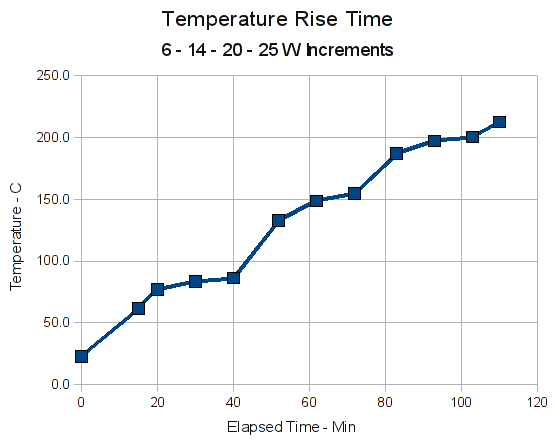
    The Thermal Core’s time constant falls neatly out of the high power measurements when they’re plotted against time:

    Thermal Core Rise Time
    Thermal Core Rise Time

    Rule of thumb:

    • Three time constants get you to 95% of the final value.

    The two plateaus for the 6 W and 14 W power inputs give enough information to pull out the time constant. They’re pretty much flat after 30 minutes (which is why I turned up the power then!), so the time constant is on the order of 10 minutes.

    Remember that the time constant doesn’t depend on the heater power. Higher power means the Core would stabilize at a higher temperature, but the overall curve would have the same time constant. What you’d see, though, is a faster rise to a given temperature, at which point the controller turns off the power to maintain the Core at that temperature.

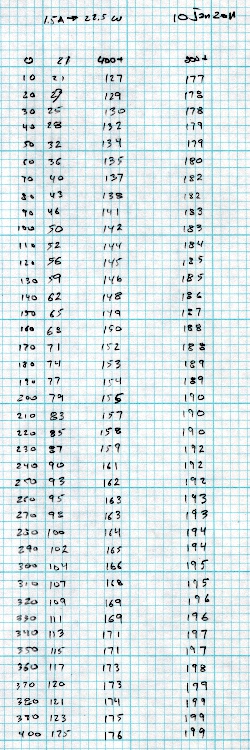
    Thermal Core time constant data
    Thermal Core time constant data

    In round numbers, a first-order exponential rises to 10% (really 9%) of its final value in the first 0.1 time constant. In this case, guesstimate a 10-minute time constant, apply power, measure the temperature rise after a minute, and the final temperature should be ten times that value above ambient. Various nonlinearities get in the way, but that’ll get you close to the right answer.

    Just for the amusement value, I applied 22.5 W to the extruder and recorded the temperature every 10 seconds for the first 1200 seconds. I’m not going to graph it, but the salient points are:

    • 21 °C — Ambient temperature
    • 199 °C — Final temperature (four consecutive dupes)

    So the final temperature rise is 178 °C above the 21 °C ambient. Multiply by 0.09 = 16 °C, so when the temperature passes 37 °C = (21 + 16) it’s 0.1 time constants from the start.

    Squint into that table and you’ll find the temperature is 36 °C at 60 seconds and 40 °C at 70 seconds, so the time constant is pretty nearly 625 seconds… call it 10.5 minutes, which I’d say is pretty close to my original eyeballometric guesstimate from that crappy graph up at the top.

    Dang, I love it when the numbers work out!

    You could do it in your head: 10% is 17.8, truncate to 17, add 21, get 38, interpolate 65 seconds. That’s just shy of 11 minutes, still close enough for what we’re doing.

    Now, the tradeoff is that you have a ten-minute delay before your MK5 Extruder can begin squeezing out parts. That may not be a big deal if you’re looking at an hour of extrusion for each part and, after the head is up to operating temperature, it just keeps on running.

    Adding more power increases the final equilibrium temperature and increases the initial temperature rise, so the head gets up to operating temperature faster. More power adds more stress to the resistors and shortens their life, which is nasty, brutish, and short even at the power levels I’m using.

    You can run the numbers the other way. Measure the temperature rise at 0.09 time constant, multiply by 10, and you’ve got the final temperature rise. If you’re running 60 W into those heaters, a firmware lockup or thermistor failure that leaves the heaters jammed on will stabilize at maybe 350 °C over ambient. Nope, the resistors aren’t going to survive that experience…