Ed Nisley's Blog: Shop notes, electronics, firmware, machinery, 3D printing, laser cuttery, and curiosities. Contents: 100% human thinking, 0% AI slop.
Some years back, NYSDOT resurfaced Rt 376 by laying an inch of asphalt atop the crumbling surface, but the underlayer continues to deteriorate and the top coat delaminates.
The situation at Westview Terrace, just south of Red Oaks Mill (clicky for more dots):
Delaminated Asphalt – Rt 376 at Westview Terrace
The patch just to my right is a hand-tamped cold patch job, which obviously isn’t sufficient to repair the damage.
Locator:
Delaminated Asphalt – Rt 376 at Westview Terrace – map
We’ve been told that NYSDOT no longer does proactive maintenance: until somebody calls in a problem, it’s not their problem. I’m starting to document problems here as part of the record.
It’s the start of a new riding season and we’re returning from a concert at Vassar. I’m cranking 20+ mph, pushed by a gusty tailwind.
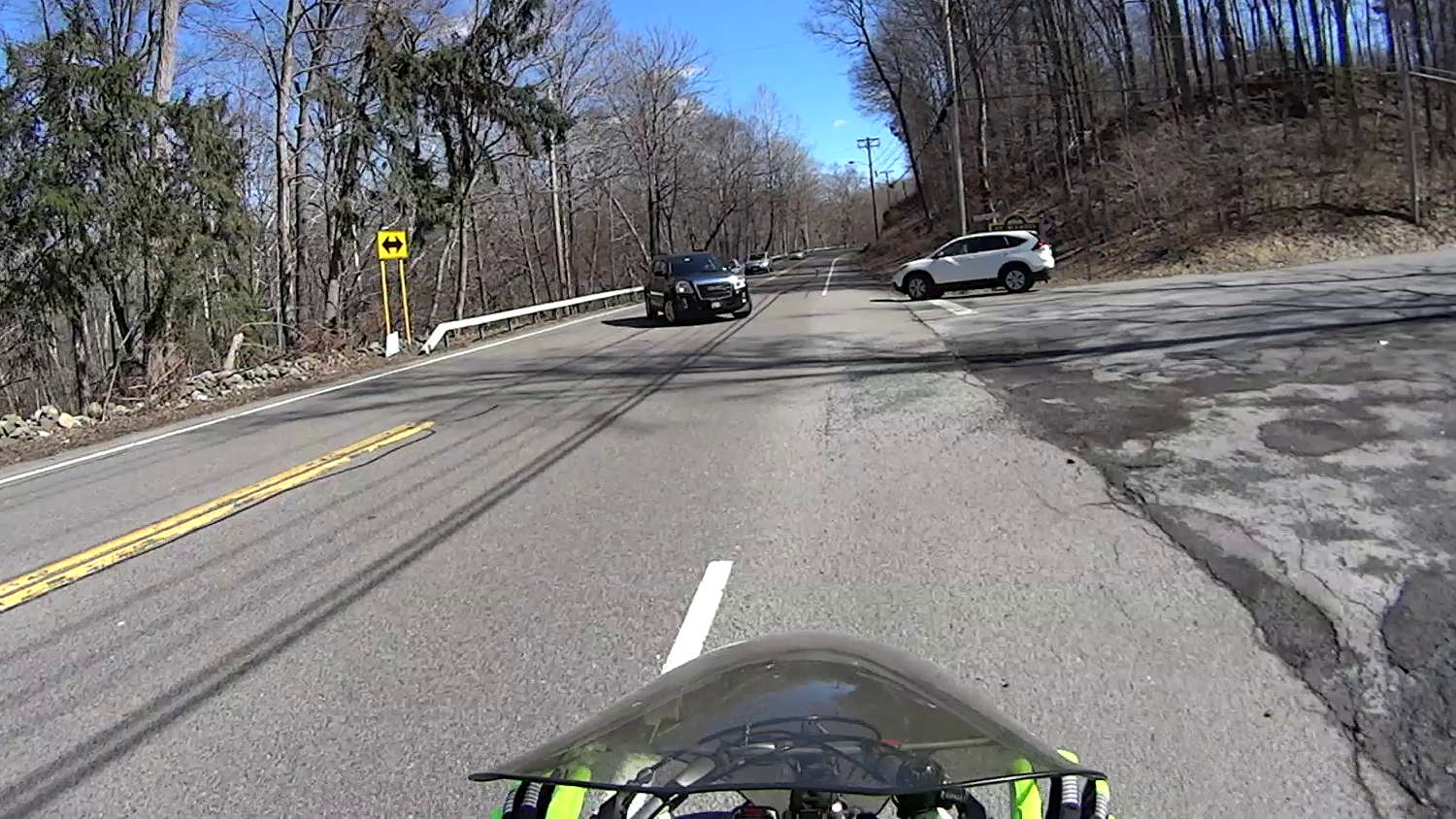
T minus 7 seconds:
Cedar Valley Rd – Left Cross – T-7
The white car approaches the intersection a bit faster than usual, which leads me to expect a New York State Rolling Stop-and-Go right turn directly in front of me.
T minus 5 seconds:
Cedar Valley Rd – Left Cross – T-5
The white car slows enough that I now expect a stop with the front end well onto the shoulder. A quick check in the mirror shows no traffic behind me: I can take the lane if needed. This intersection always has a large gravel patch spanning the shoulder, so I must move closer to the fog line anyway.
T minus 2 seconds:
Cedar Valley Rd – Left Cross – T-2
The white car comes to a full stop, not too far onto the shoulder, and my fingers come off the brakes. I gotta work on that fingers-up position, though.
… Whoops, a classic left cross from the black SUV!
T minus 1 second:
Cedar Valley Rd – Left Cross – T-1
I’m now braking hard, barely to the left of the gravel patch.
T zero:
Cedar Valley Rd – Left Cross – T-0
Well, that was close.
Somewhat to my surprise, the white car hasn’t crept any further onto the shoulder.
The SUV driver gives me a cheery wave, as if to thank me for not scratching the doors. I never make hand gestures, but I did tell him he does nice work.
It is, apparently, easy to mis-judge a bike’s speed, although driver-ed courses used to recommend that you err on the side of not trying to beat an oncoming vehicle. Perhaps that recommendation has become inoperative?
The corresponding maneuver by a car passing you is known as a right hook.
Memo to Self: Always look at the license plate to give the camera a straight-on picture.
The NYS DOT’s original planning documents said that roundabouts / rotaries weren’t optimal for pedestrians or bicyclists or large trucks, but, because DOT likes rotaries, that’s what they built on Raymond Avenue. However, they didn’t relocate the drainage lines under the road and left some catch boxes in awkward spots.
This Google Street View image from a few years ago shows the College Avenue intersection from northbound Raymond Avenue, with the catch box in the lane:
Google Street View – Raymond northbound at College
Raymond is basically the only bicycle route into Arlington from the south and has “shared roadway” signs, but the design flat-out doesn’t work for bikes and the implementation leaves a lot to be desired.
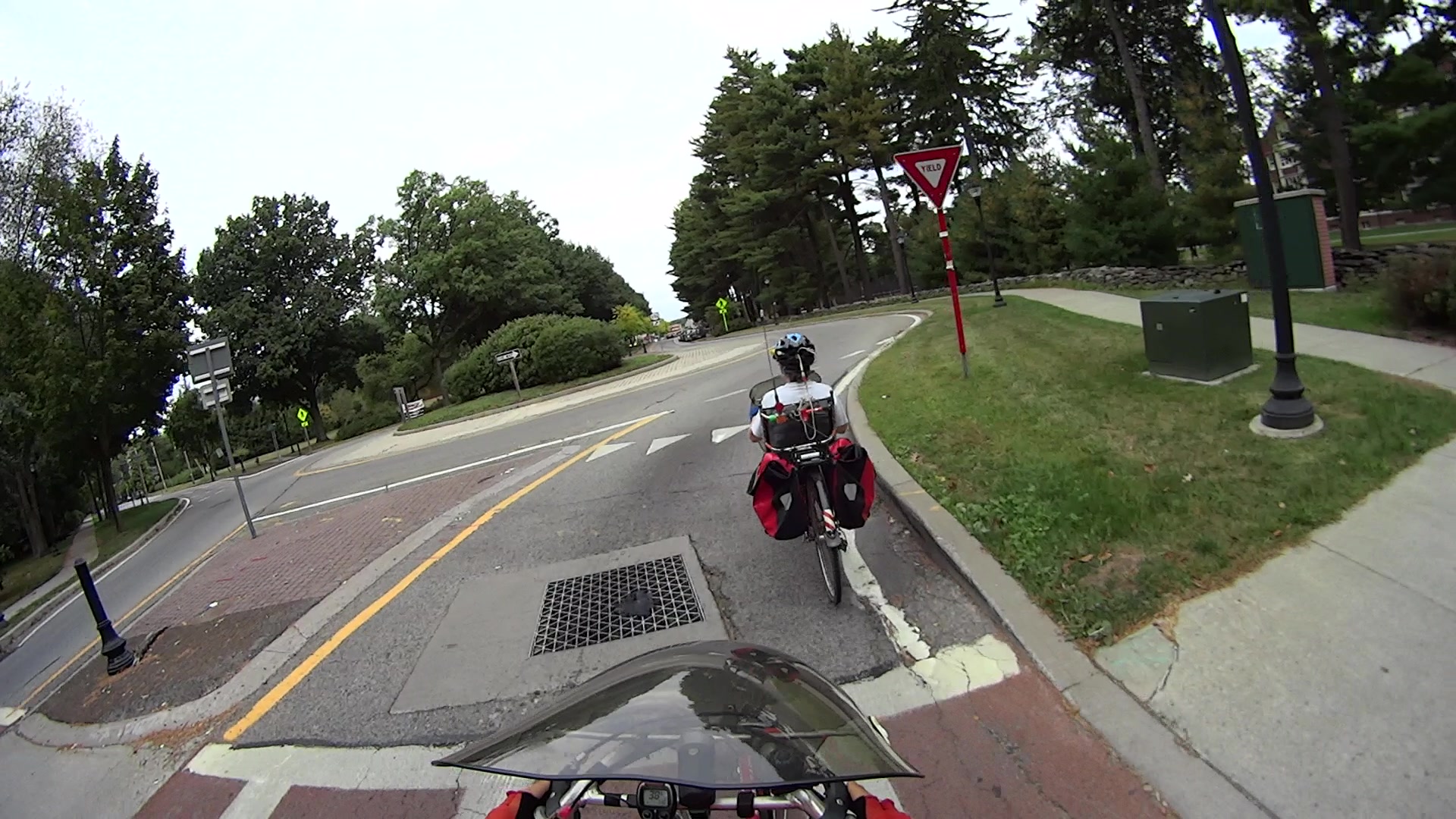
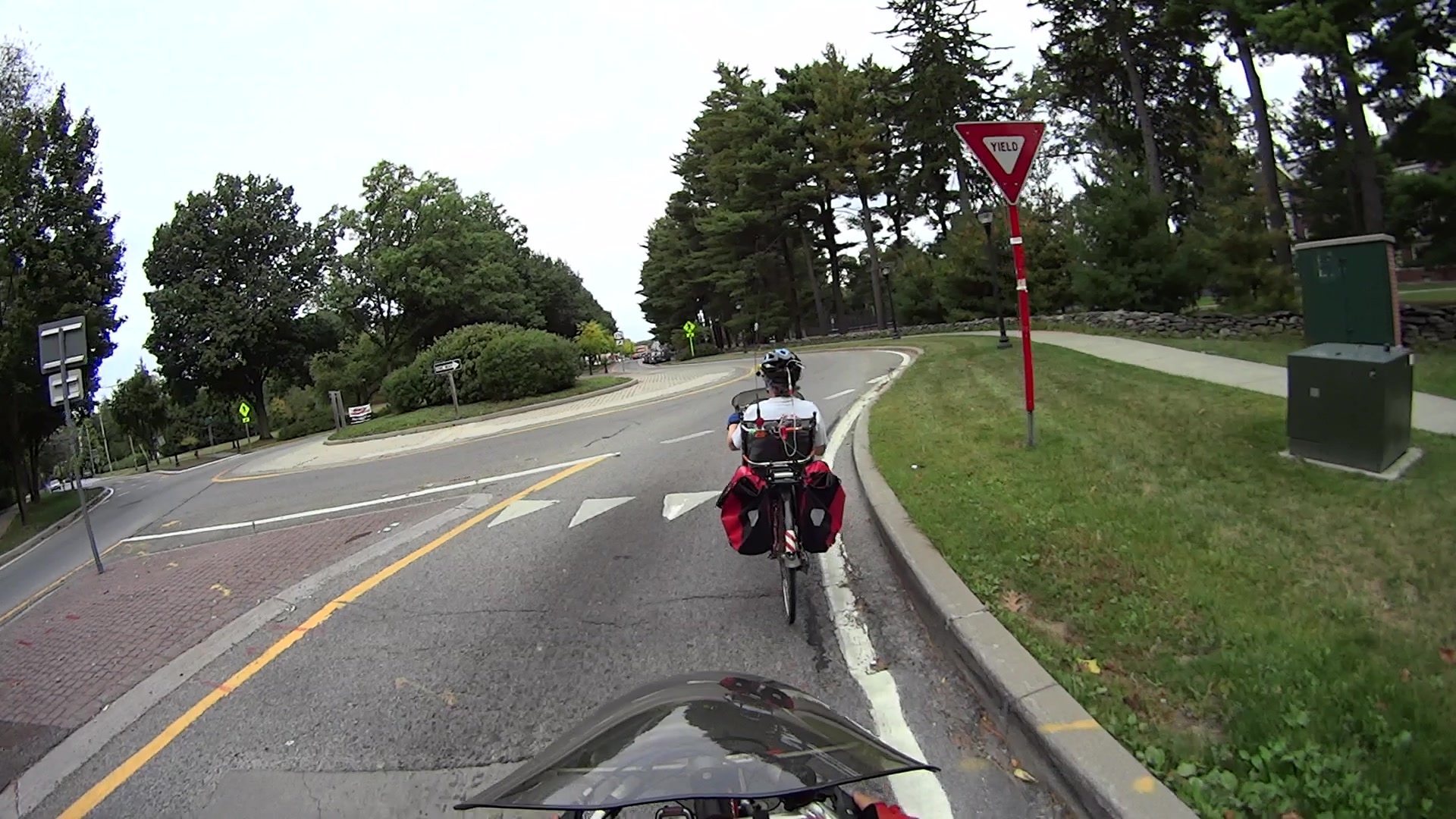
Here’s what it looks like from the bike:
MAH00138-2014-09-28-095
Note the deteriorated asphalt and longitudinal cracks near the white fog line next to the curb. That forces bike traffic another few feet into the deliberately narrowed traffic lane at the entrance to the intersection.
Mary’s about as far to the right as practicable (that’s a legal term):
MAH00138-2014-09-28-155
I’m angling over from the middle of the lane, because, unless I take the lane, motorists will attempt to pass us in the rotary entrances. The asphalt on the far side of the box has subsided several inches into a tooth-rattling drop, you can see the crevice adjacent to the right side of the box, and I know better than to cross steel grates while turning.
Notice that the Google view shows four bollards marking what DOT charmingly calls the “pedestrian refuge” in the median, but only two appear in my pictures. NYS DOT recently removed half the bollards from each refuge and relocated the remainder, apparently to reduce the number of street furniture targets. Early on, they were losing one bollard per intersection per year, but that’s slowed down now that they’ve stopped replacing smashed hardware.
It was never clear to me why putting nonreflective black bollards a foot or two from the traffic lane made any sense, but that’s how it was done. Most of the relocated bollards stand close to the center of the median, so maybe it didn’t make any sense.
Anyhow, bikes can’t stay too far to the right after the box, because the asphalt has crumbled away in furrows around Yet Another Crappy Patch:
MAH00138-2014-09-28-184
That’s pretty much the state of the traffic engineering art around here. A while back, the NYS DOT engineer in charge of the project assured me it’s all built in compliance with the relevant standards.
It’s worth noting that Mary’s on the Dutchess County Bicycle and Pedestrian Advisory Committee, so we volunteered to count cyclists and pedestrians on Raymond a few months ago. When I say that we’re essentially the only cyclists riding Raymond Avenue, we have the numbers to back it up. Everybody else rides on the sidewalks, despite that being of questionable legality and dubious for pedestrian safety, because, well, you’d be crazy to ride in the shared roadway.
After years of neglect, an NYS DOT crew started a really nice repair job on the inside edge of the curve just north of our house. They milled out the deteriorated road surface, cleaned out the debris, and laid in a patch flush with the road surface. That’s quite unlike their usual shovel-some-cold-patch / hand-tamp / drive-over-it process, made familiareverywhere elsearound here.
Unfortunately, for unknown reasons, they didn’t fill in the last two feet of the milled-out trench, leaving a tooth-shattering pair of perpendicular edges exactly where you’d least expect them:
Rt 376 north of Heathbrook – unfinished patch
Ran out of asphalt? Lunch break? Called off to another emergency? We’ll never know.
I sent a note, with that picture, to the NYS DOT Bicycle & Pedestrian Coordinator, asking what happened; perhaps they planned another layer atop the whole curve to seal the rest of the cracked pavement?
The next day a crew filled in the hole, which I find far more than coincidental.
Although it’s better than it was, there’s now a joint that will deteriorate more rapidly than the uniform asphalt layer they should have created.
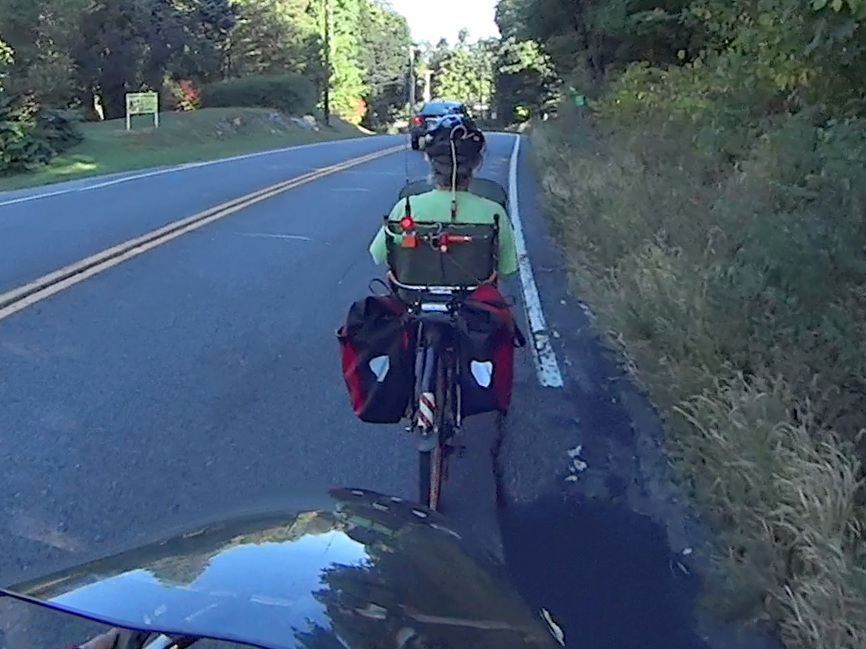
Mary finished out the National Bike Challenge with a rank of 3353 of 47 k riders, which, by my reckoning, is wonderfully good. She’s #1 in the Poughkeepsie area (admittedly, of only eight riders), with the second-place rider at 90% of her point score.
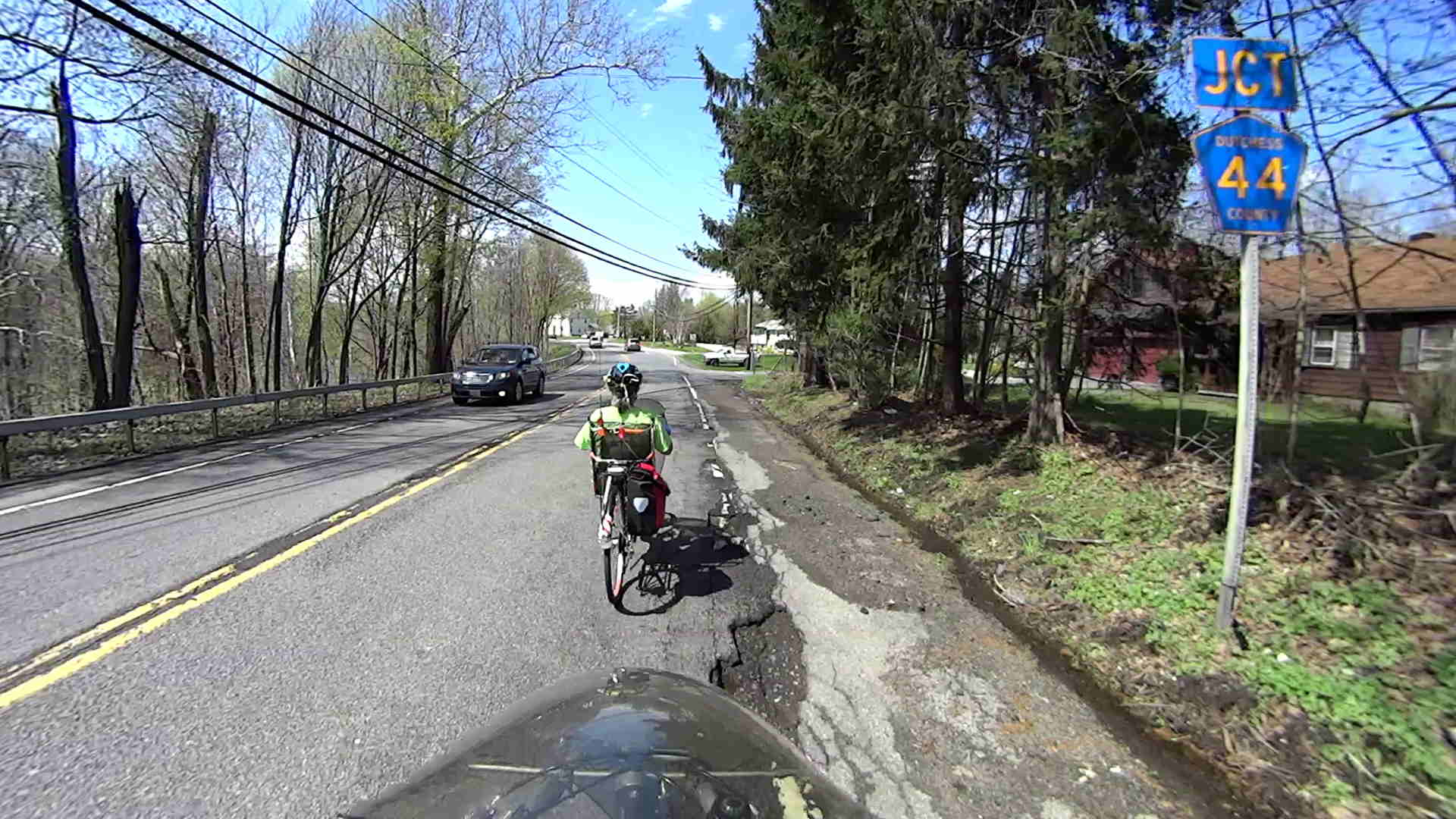
She did it by riding on her usual missions, along our usual routes, around the usual obstacles:
NYS Rt 376 at Westview Terrace
Her bike odometer recently rolled past 20 k miles; at least one battery change stole a pile o’ miles from her total, so the bike has accumulated more than that.
As the song goes, my gal is red hot… in the best way!
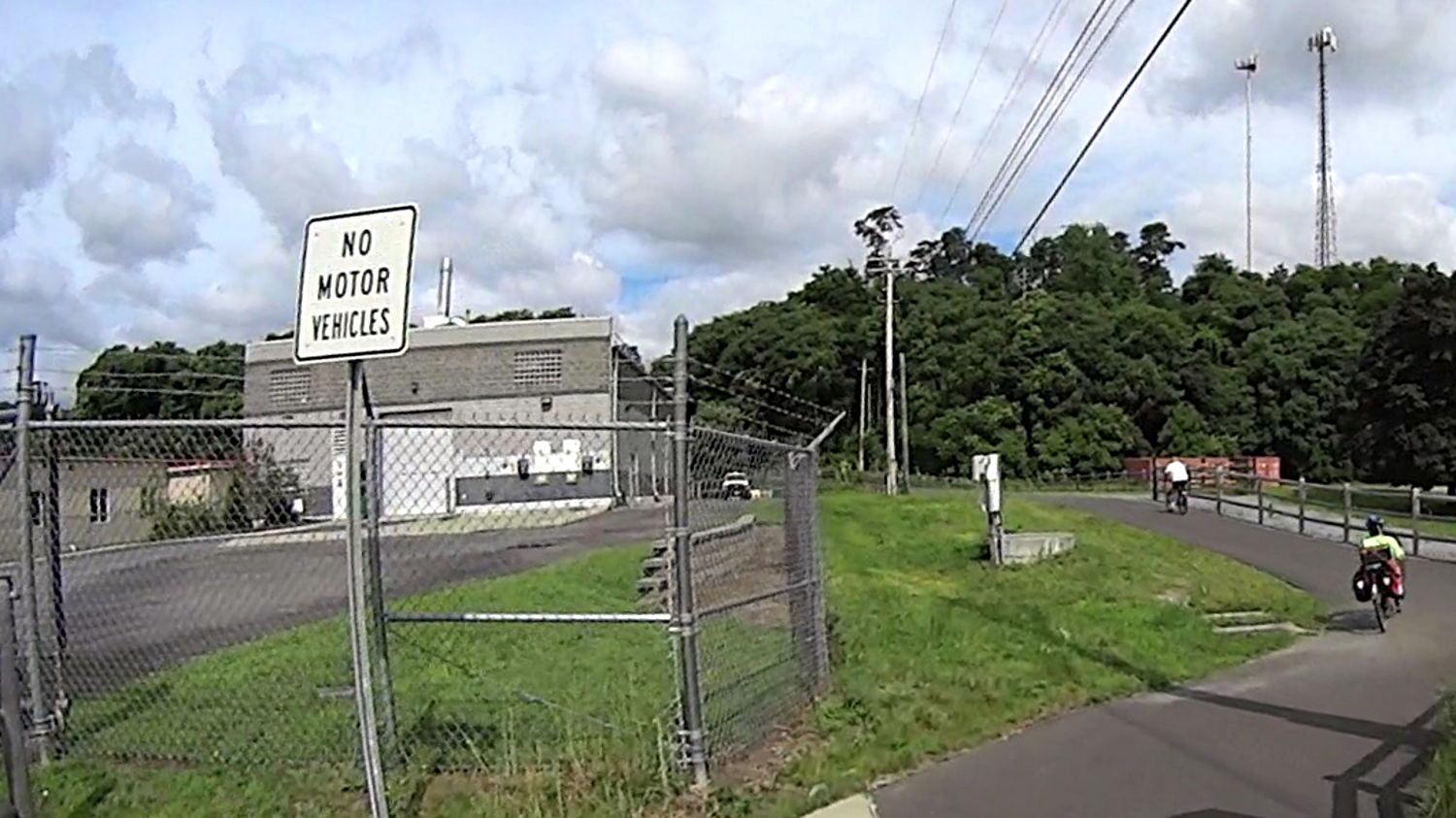
The signs at every Dutchess Rail Trail grade crossing and access point seem unambiguous:
DCRT – No Motor Vehicles
More specific signs appear at random intervals along the trail:
DCRT – All Terrain Vehicles Prohibited
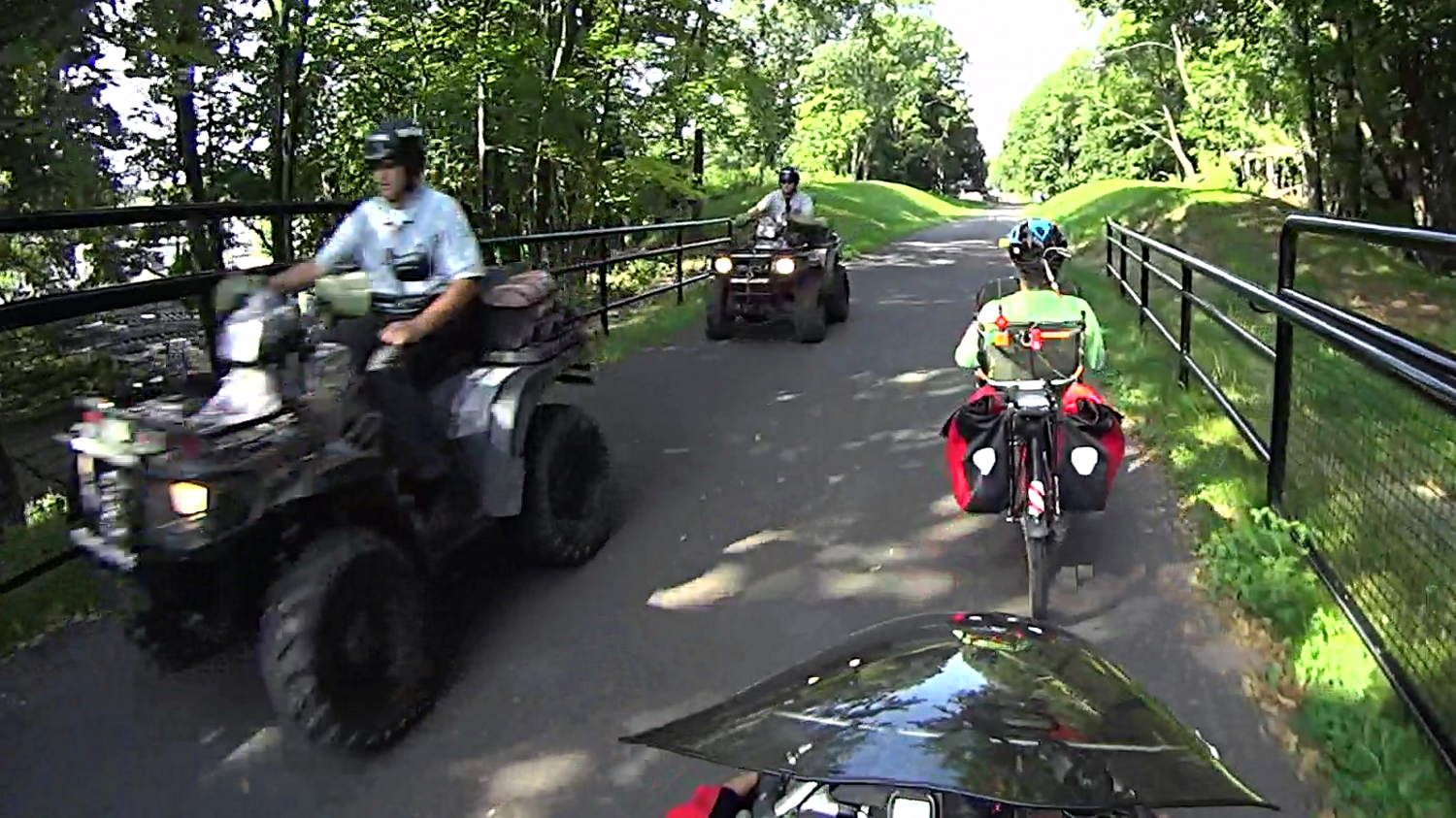
You can’t see it, but every sign includes an invisible asterisk introducing the invisible clause “Except Cops”:
DCRT – Sheriff ATV Convoy
Back when the Dutchess County deputy sheriffs rode huge ATVs that occupied nearly the entire paved trail and bulldozed everybody out of their way, I had the temerity to ask why they weren’t riding bikes. The deputy sheriff told me, rather condescendingly, that they had to be prepared for anything and that there had already been incidents.
These little ATVs aren’t quite so imposing and, more likely, also fit on the new bridges and between the bollards, which may explain everything.
I’ve seen what might be their best use case, although ambulances can attract your attention without an ATV escort:
DCRT – Sheriff ATV Leading Ambulance
Straight up, I have no objection to police patrols on the rail trail.
I do object to the official mindset that simply adds an invisible exception to any inconvenient rule.
As I see it, the root cause of the militarized police and extralegal government activities we’ve seen across the country in recent years boils down to “That law / regulation / rule does not apply to us, because we are the government.”
I can ride the length of the DCRT and back in about two hours, averaging 12 mph, without getting particularly sweaty in the process; the track in that link shows a three hour ride that includes the HVRT and a Walkway scrum, plus the ride from and to home. A police ATV can’t go much faster than that on the trail, even with lights and sirens, because oblivious pedestrians keep getting in the way.
If an officer on a bike can’t keep up with me, then something has gone badly wrong with the job requirements for becoming a deputy sheriff.
As far as “being prepared for anything” goes, the cargo capacity of those little ATVs rules out a bunch of hardware that fit in the big ones: anything seems an elastic concept. A bike can carry enough equipment for many incidents; my tool kit weighs more than some bike frames, the packs have plenty of room to spare, and there’s always the trailer option. I doubt genuine Mil-Spec assault rifles would come in handy on the rail trail.
It’s also not clear why an officer on a bike can’t call for the same backup as an officer on an ATV: those buggies lack fancy VHF antennas, so they’re using a hand-held radio or phone. The 5 W amateur radio on my bike, through a mobile VHF antenna on a crappy ground system, can easily reach local amateur radio repeaters and APRS nodes. Many pedestrians seem absorbed with their phones, so getting microwaves into and out of the trail doesn’t pose much of a problem.
Cops-on-bikes present a much less aggressive aspect than cops-on-ATVs who ignore the rules that apply to the rest of us.
A few weeks ago we ported our landline number to Ooma’s VOIP service, turned on their Community Blacklist, blacklisted a few pests that crept through, and … the scam calls vanished. For the first week, the only calls we received came from people we know.
Most of the Caller ID numbers seem faked, so one side effect of blocking them will be to prevent calls from real persons or businesses eventually assigned those numbers. In particular, I’ve set up a blacklist filter that kills calls from numbers that differ from ours in only the last few digits: at least one scammer combined the first several digits of the called number with some random digits at the end.
Obviously, it’s impossible to kill all the faked numbers. The filters work surprisingly well, though.
Killing nearly all the scam calls is worth ten bucks a month right there, even though it seems odd to pay a private party to prevent illegal action by somebody else. Used to be the government put our tax dollars to work and dealt with people who performed illegal actions, but … that was then, this is now.
As an aside, I wonder how the NSA handles all those scam calls. Given that the Feds regard anybody within three or four hops of a Person Of Interest to be a Person of Interest, not only should all the scammers have terrorist tags (they call everybody all the time, right?), we ordinary folks picking up the phones are now within a few hops of a known terrorist affiliate.
Conversely, if the NSA discards scam calls, then I know precisely how to set up the perfect terrorist communications network.
Verizon refunded $3.11 from our last bill and didn’t try to convince us to retain our landline service. They’d recently “upgraded” our copper line to fiber, so the basement has a nice Optical Network Terminal that I just unplugged; they don’t seem to want it back. Maybe I’ll harvest the 12 V 8 Ah (!) SLA battery for a project.
We’re not interested in the FiOS “Triple Play” special offers that hover around $90/month for two years, plus unknown equipment charges, plus a regional sports network surcharge, plus unknown taxes and fees, with or without a $250 gift card kickback, with or without a discounted tablet. The cable company recently boosted what we pay for 15/3 cable to $60/month, so we’re definitely trapped by a duopoly.
Some things (all, some, or none of which may be true) I learned while chatting with various contestants:
Overtalking them with “You may hang up at any time if you agree that you’re a scammer” produces either an immediate hangup (they agree!) or a very interesting discussion.
Starting with “You have sixty seconds to prove you’re not a scammer. Go!” generally produces an immediate hangup.
Setting up a call center “the size of your garage” costs about 85 kilobucks and provides seats for about a dozen “agents”.
It’s the best job you’ve had, if you’ve been unemployed for three years, because it’s minimum wage plus a bonus for every prospect you “qualify”, all without having to work in a retail environment. I was unable to discover when the bonus kicks in, but likely after the Level 2 closer sucks actual money out of the victim’s credit card account.
Some contestants sincerely believe they’re doing a Good Thing: helping people get lower interest rates on their credit card debt. Pointing out that I’ve asked my credit card issuer whether that works and getting a firm “No!” in reply doesn’t change their belief in the least.
It’s sad that getting a dead-end job in a scamming company might be the best thing that’s happened to some of those folks in a long time. Makes me almost regret having some of them break down and cry under interrogation…






 The Smell of Molten Projects in the Morning