The Smell of Molten Projects in the Morning

Ed Nisley's Blog: Shop notes, electronics, firmware, machinery, 3D printing, laser cuttery, and curiosities. Contents: 100% human thinking, 0% AI slop.

Tag: Rants

And kvetching, too

  • Toyota Sienna Brake Wear: No Trouble Found

    Over the decades, the same local repair shop has performed the annual NYS inspection on our cars; we started there when it was conveniently near to jobs at the IBM plant and continued out of habit. In the last, oh, five years or so, they’ve begun reporting all manner of Things That Need Work, ranging from “dirty fluids” to worn shocks. Oddly, none of those problems recurred from year to year and were never written up on the inspection summary; they were always phoned to Mary, who politely declined the service.

    On several occasions, I’d drop off the car and walk to the mall across the road to pick up this-and-that. They’d call Mary (I don’t carry the phone), she’d say she would pass the message to me, and they would never mention the problems when I picked up the car. Huh.

    Most recently, they told her the front brakes had “wafer thin” pads and the rotor disks were severely worn. She declined the service, as always. When I change the oil, I do an under-the-car lookaround and the brakes have always looked fine, but, being that type of guy, I pulled the front wheels and took a closer look at the situation:
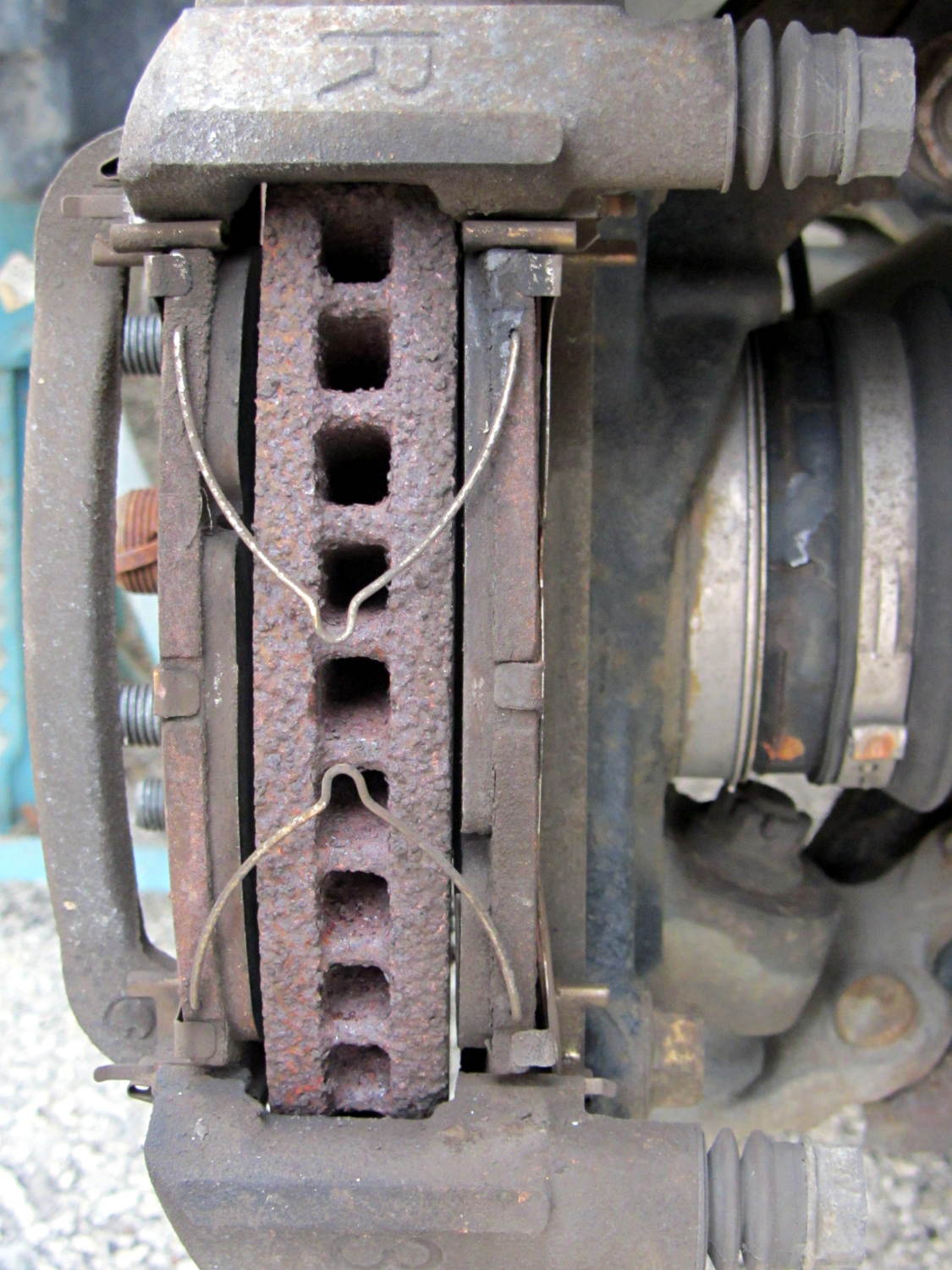
    Right Front Brake
    Right Front Brake

    The pads start at 7 mm and wear to a minimum thickness of 1 mm, at which point the cross-pad wear indicating groove will vanish and a little metal tab will touch the rotor and start screaming. These pads have about 2 mm left to the bottom of the grooves and are wearing evenly.

    The rotors start at 28 mm thick and wear to 26 mm. These rotors measure 27.73 mm and have no serious grooves or scars.

    Just for grins, I pulled the rotors and measured the thickness at the middle of the swept ring, aligned with the bolt holes:

    Sienna rotor thickness
    Sienna rotor thickness

    Bottom line: the rotors match to within 0.0015 inch = 0.04 mm and have 0.0005 inch = 0.013 mm of variation around the circumference.

    With 91 k miles on the OEM pads and rotors, I’d say they’re doing fine and that we don’t use the brakes nearly enough.

    It may be time to start patronizing a new shop…
  • Synchronized Subscription Scams

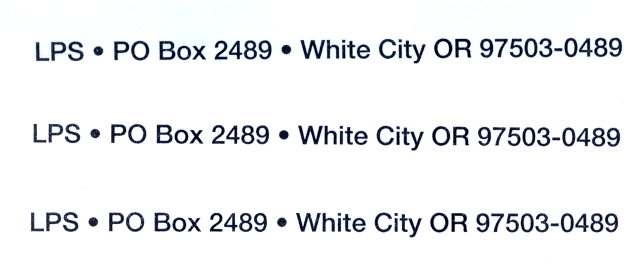
    Three envelopes arrived in the same mailing, all bearing the same return address across the back:

    PublishersPayment - Three Return Addresses
    PublishersPayment – Three Return Addresses

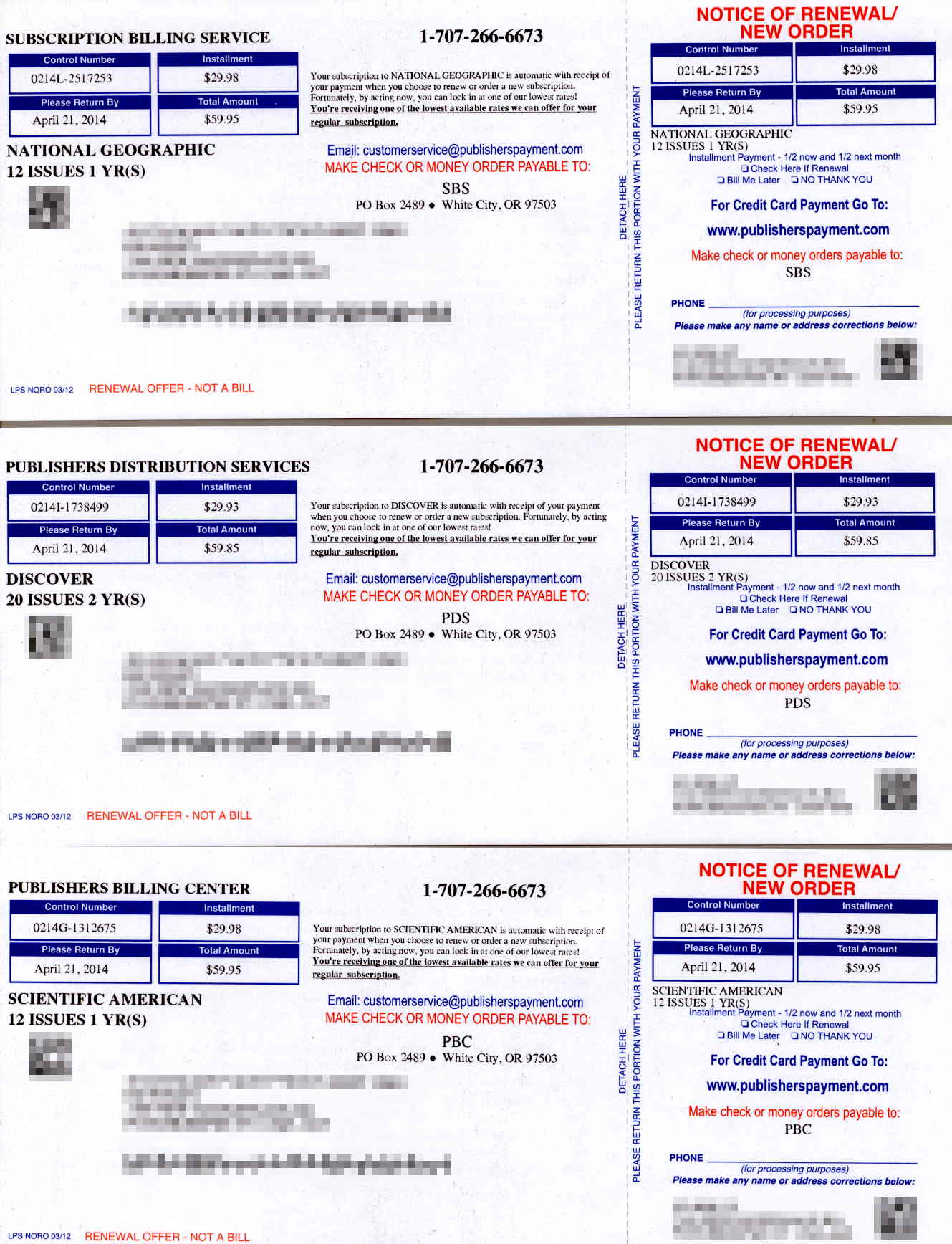
    By now, I know what’s inside the envelopes and simply toss them in the recycling, but getting three at once seemed worth investigating. Inside, they’re not quite identical:


    PublishersPayment - Three Renewal Scams
    PublishersPayment – Three Renewal Scams

    So SBS, PDS, and PBC are all snuggly in White City, Oregon, with LBS somewhere just offstage…

    Apparently enough people miss the warning on the back to justify the expense of the junk mailings.

    It’s nice work for someone with absolutely no ethics whatsoever. At least they’re not phoning us, so maybe they’re not complete asshats…

  • Reporting a Defective Traffic Signal: FAIL

    For the purposes of this discussion, let’s assume you wanted to report a defective traffic signal near Poughkeepsie, NY. You know, from previous experience, that it’s on a New York State Road, so you should contact the New York State Department of Transportation; you also know that you’re in DOT Region 8 and that you’re in the Poughkeepsie Residency, so you can find the right DOT branch.

    In this day and age, you might think the NYSDOT website would have a conspicuous link to a form that would let you report a problem. But, no.

    Failing that, you might think the website would have a link to the number you should call. But, no.

    Failing that, you might think that the search box would turn up useful results when fed the obvious keywords. But, no.

    Failing that, you might think calling various likely numbers in the Region 8 offices would produce the proper number. I won’t list the half-dozen numbers I’ve uncovered using that method, as none of them actually go to the right place.

    It is common for such numbers within NYSDOT to ring forever, regardless of the time of day or day of week. I am told that one number isn’t actually within DOT any more, so some poor schlub gets all their repair calls; it’s probably worse than having Rachael call you every day or two.

    My favorite dead end: an answering machine message telling you it’s not monitored and calls will not be returned, then giving an incomprehensible number-to-call and the usual “Leave your name and number after the beep” message, then beeping.

    To make a very long story very short, the Galactic Number that you call to report traffic signal problems on NYS DOT roads is:

    914-742-6100

    It’s not toll-free (not a big deal in this day and age, but, still) and, of course, you’ll get a contractor, so be polite & patient. Your call should generate a work order that will, in due time, dispatch a crew to repair the offending signal.

    It will be exceedingly helpful if you can report the number on the side of the signal control box, for which Google Streetview may reveal what you can’t see from any legal or safe position:

    Signal Control Box ID by Google Streetview
    Signal Control Box ID by Google Streetview

    If you want to report a pothole, on the other hand, they’ve got a hotline for that:

    1-800-POTHOLE

    Who’d’a thunk it?

  • Monthly Science: Early Lithium Cell Failures

    During my monthly data logging, I replace any weak CR2032 cells in the Hobo data loggers and, being that type of guy, I write the current date and the elapsed time since the last replacement on the top of the cells. This month I had to replace two cells:

    Energizer CR2023 - early failures
    Energizer CR2023 – early failures

    Huh.

    It seems the previous Energizer CR2023 cells in those loggers lasted for more than the usual year, but these cells from the same lot with the same date code failed in two weeks (my last monthly science was unusually late, because distraction). The YA date code (printed on the other side of the cell) isn’t helpful (that Q&A  list shows the problem), but they’re supposed to have an eight year shelf life. As nearly as I can tell, these are getting on toward five years on my shelf, so maybe they spent a bit more time on somebody else’s shelf than the seller claimed.

    I’d previously slandered one of the Hobo loggers by accusing it of high current drain, but it turned out to be different crappy batteries.

    I know they encrypt the date codes so we can’t buy the freshest retail batteries, but I don’t have to like it…

  • Can Opener Drive Gear: FAIL

    The fancy OXO can opener doesn’t work well on #10 cans, so we bought a not-bottom-dollar can opener with comfy handles to replace the one that convinced us to get the OXO. After maybe a year, tops, it gradually stopped working well, too, which prompted a trip to the Basement Shop Workbench.

    The symptoms:

    • The handle wouldn’t move the cutter during maybe 1/4 of its revolution
    • It pushed the handles apart during another quarter turn

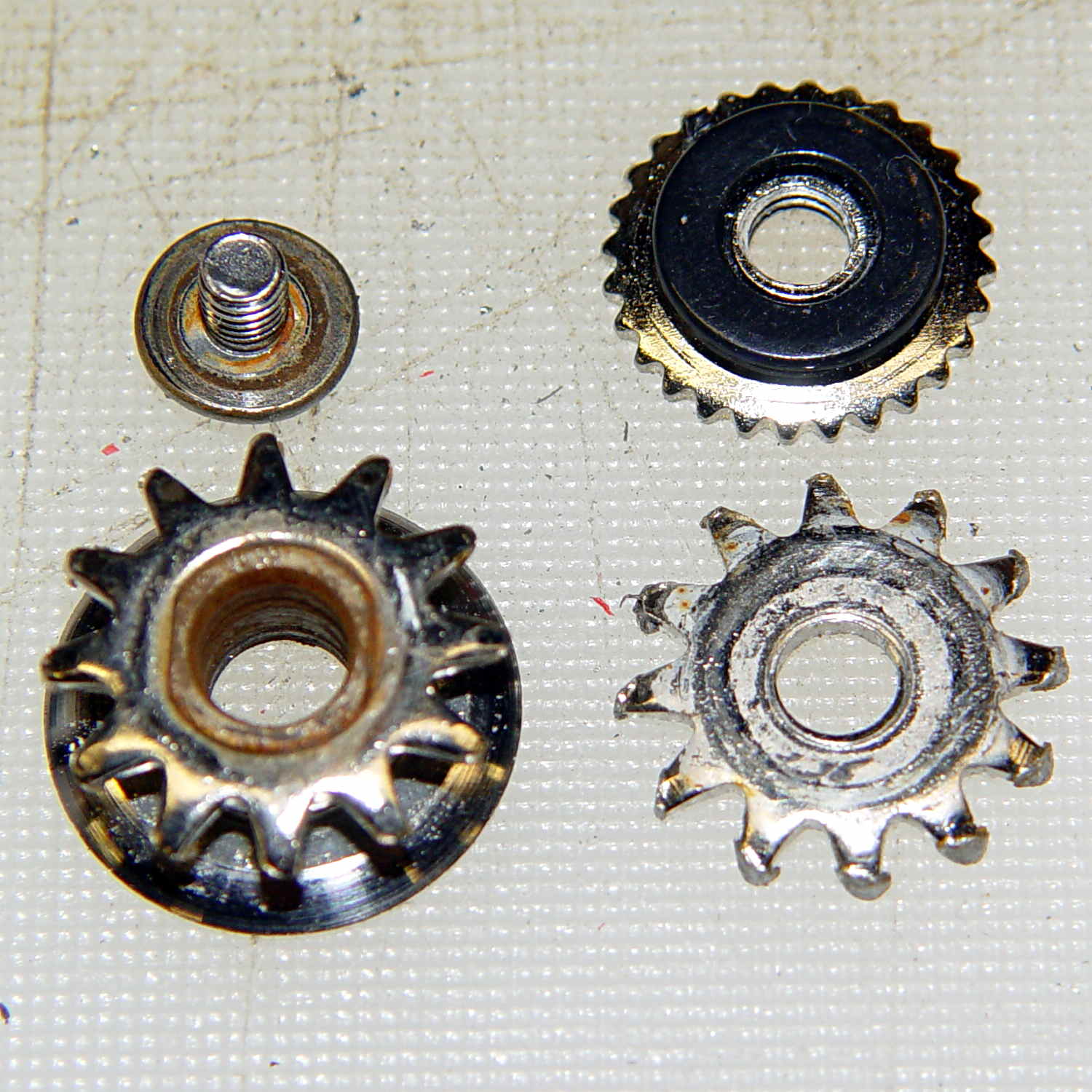
    Look carefully and you’ll see the teeth sticking out slightly more on the right side of the drive wheel:

    Can opener - drive gear misalignment
    Can opener – drive gear misalignment

    When those protruding teeth line up with the gear behind the cutter wheel, the handles open and the drive wheel loses its grip. When the low side lines up with the cutter gear, the gears very nearly disengage.

    Taking it apart shows that both “gears” (which is using the term loosely) have been pretty well chewed up:

    Can opener - gears and cutters
    Can opener – gears and cutters

    Destroying those gears should require a lot more strength than either of us can deploy on a regular basis, which suggests they used mighty soft steel. It’s not obvious, but the drive gear hole is just slightly larger than the screw thread OD; it doesn’t ride on an unthreaded part of the screw shaft.

    I’m not in the mood for gear cutting right now, so I filed down the wrecked teeth and buttoned them up with some attention to centering the gear. The can opener works, but sheesh this is getting tedious…

  • Why Friends Don’t Let Friends Run Windows: Bad Gadgets

    The Token Windows box (which runs the few programs that don’t get along with Linux) doesn’t get a lot of attention, but a recent update changed their stylin’ graphic CPU meter to something a bit less, mmm, smooth:

    Win 7 - CPU Meter
    Win 7 – CPU Meter

    Searching for the obvious keywords turned up an explanation from Microsoft:

    Windows Gadgets Have Been Discontinued - detail
    Windows Gadgets Have Been Discontinued – detail

    It seems they simply pushed an update that killed Gadgets, without explanation or warning.

    Who could have anticipated that allowing random strangers to run their code on a desktop PC would lead to security problems?

  • Canon vs. Wasabi NB-6LH Batteries

    Our Larval Engineer reported that her camera, which is my old Casio pocket camera, has begun fading away, so we’re getting her a shiny new camera of her very own. Being a doting father, I picked up a pair of Wasabi NB-6L batteries (and a charger, it not costing much more for the package) so she’s never without electrons, and did the usual rundown test on all three batteries:

    Canon NB-6L - 2014 OEM vs Wasabi
    Canon NB-6L – 2014 OEM vs Wasabi

    Fairly obviously, the Wasabi batteries aren’t first tier products, but they’re definitely better than that bottom-dollar crap from eBay.