You’re on the ground floor of a motel, on your way to your room on the second floor, and you’ve found the elevators:
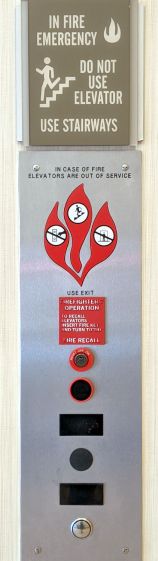
Which one of those six button-like objects will summon the elevator for a trip up to your room?
Quickly, press one of them!
The Smell of Molten Projects in the Morning
Ed Nisley's Blog: Shop notes, electronics, firmware, machinery, 3D printing, laser cuttery, and curiosities. Contents: 100% human thinking, 0% AI slop.
And kvetching, too

You’re on the ground floor of a motel, on your way to your room on the second floor, and you’ve found the elevators:
Which one of those six button-like objects will summon the elevator for a trip up to your room?
Quickly, press one of them!

The truck side marker lights I’m thinking of using as daytime running lights have a pentagonal lens, so they should have a pattern with a bright central beam surrounded by five lobes. The one on Mary’s Tour Easy produced an oddly shaped blotch on the garage wall, so I ran the others though a simple test setup:
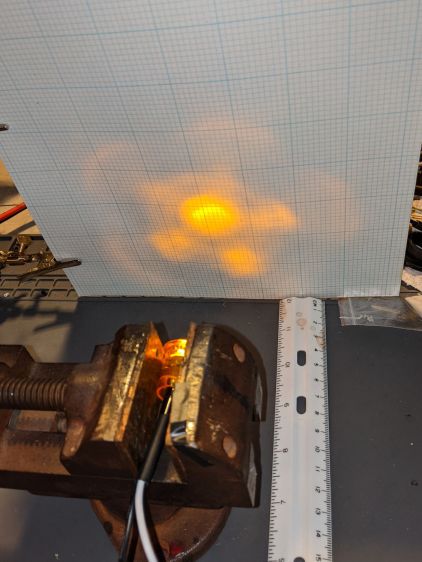
The lights sit horizontally in a small vise to keep them level and in the same position, although in no particular rotational orientation, and 100 mm from the graph paper. It’s running at 6 v to keep the brightness down enough to avoid blowing out the image. All of the images were exposed based on the central spot, so the surrounding paper gives some idea of the relative brightness: darker paper = brighter LED spot.
The front view of the lights comes from the stereo zoom microscope, with the wires gripped in a Third Hand and rotated to put the (inverted) TOP label where you’d expect it. They’re all roughly at the same position and pretty nearly lined up with the lens axis. The bubble-looking thing behind the central pentagon is the lens on the Piranha LED package, which should be centered but rarely is. You can see the dark orange square of the amber LED chip in some of the pictures.
Without further ado, the nine truck side marker lights that aren’t on her bike:


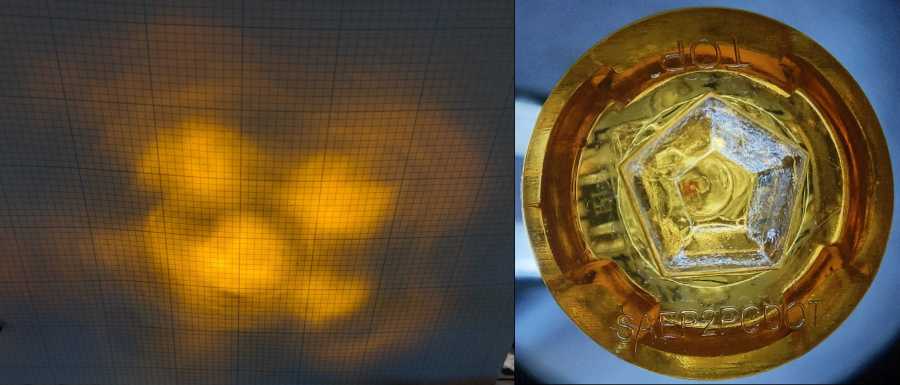
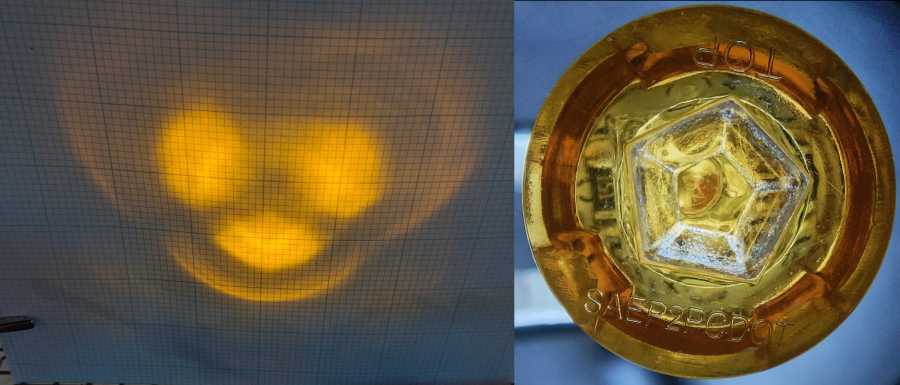


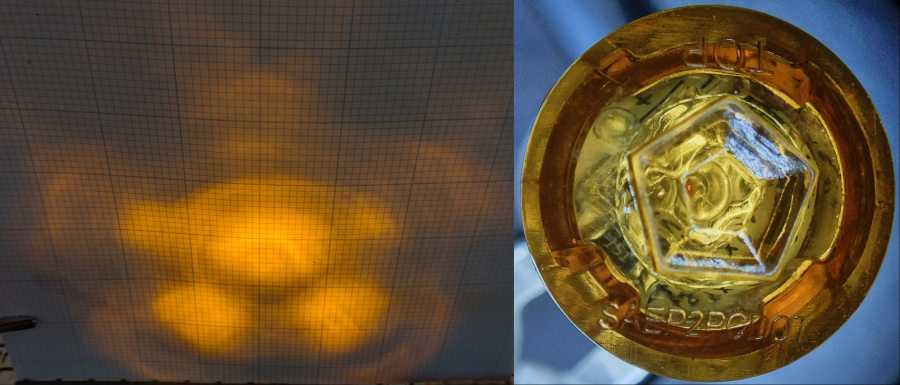

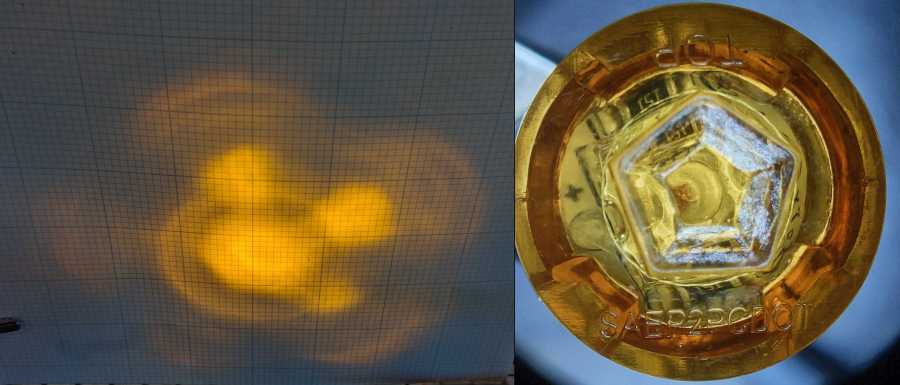
Side Marker E has a blob that looks like a cataract atop the LED lens, but it might be a mold imperfection.
Obviously, paying a buck a light doesn’t get you much in the way of build quality these days.

We recently installed a Dripworks drip irrigation system for Mary’s garden and, of course, pre-assembled the emitter / dripline tubing, fittings, and supply / filter / plumbing for each of the beds in the Basement Shop. A few days after burying the main lines, plumbing the filter + pressure regulator, and plugging in half a dozen bed assemblies, Mary noticed some emitter tubes weren’t delivering any water and other beds seemed too dry.
N.B.: We bought everything directly from Dripworks. This is not counterfeit crap from a sketchy Amazon seller.
I cut the dripline just downstream of the Micro-Flow valve on a completely dry bed, whereupon no water emerged. Cutting the supply tube just upstream of the valve produced a jet squirting halfway along the bed. I tried and failed to blow air through the valve: it was completely blocked despite being in the “open” position. I installed another valve and the emitter tube started working properly.
I sat down at the kitchen table with a bag of unused valves and peered through them (the pix are through the microscope):

That’s one of the better-looking valves, with only a little mold flash in the lumen.
Partially occluded lumens were more typical:
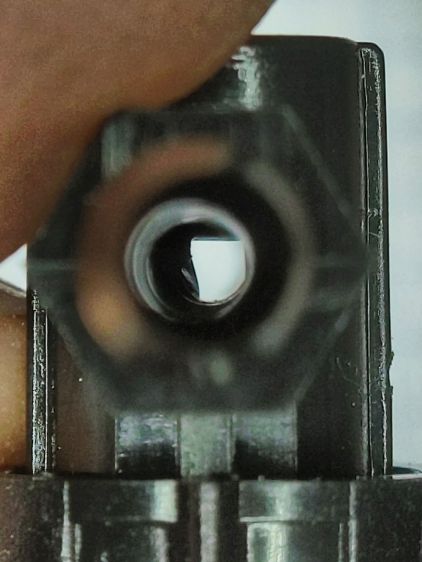
Quite a few were almost completely obstructed:

For lack of better instrumentation, I blew through the valves and sorted them by effort:

Two of the valves in the group on the left are completely blocked, with the others mostly blocked.
The middle group has enough mold flash to produce noticeable resistance to the air flow. I think water would have more trouble getting through, but the emitters would at least look like they’re delivering water.
The group on the right has mostly unblocked valves, with visible mold flash but little restriction.
I have no way to measure the actual water flow, so it’s entirely possible the QC spec allows considerable blockage while still delivering enough water to the emitters. More likely, the spec assumes a clear lumen and the mold flash is a total QC faceplant; it’s obviously not a controlled quantity.
Well, I can fix that:

That’s a 2.3 mm drill going straight through the valve body. I drilled the valves from both ends and blew out the swarf:

That produced twenty valves with clear lumens. Of course, the drill leaves a slightly rough interior surface, but it’s now much easier to blow air through them.
We hadn’t installed the driplines in two beds with three emitter tubes per bed. I cut out those six unused valves and sorted them by resistance:
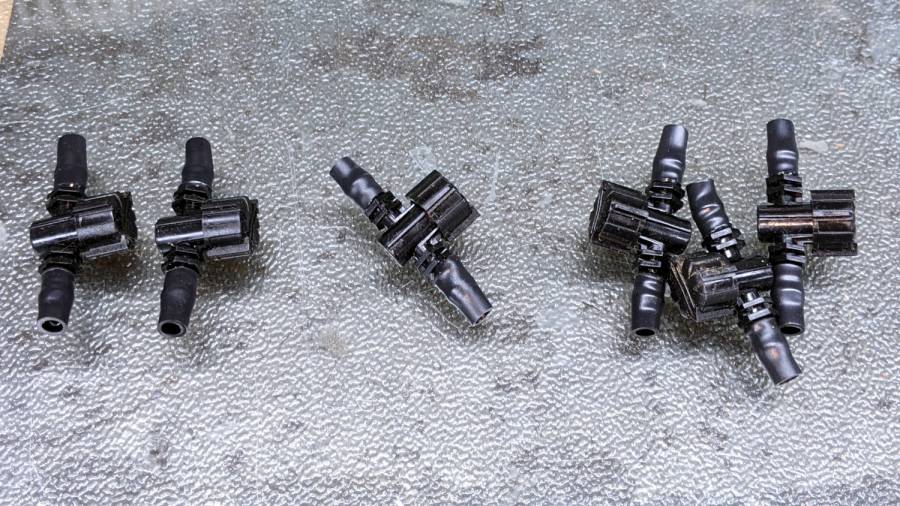
Both of the valves on the left are blocked, the three on the right are mostly OK, and the one in the middle is partially blocked.
With two dozen repaired valves in hand, we returned to the garden, I cut 22 valves out of the installed driplines and replaced them under field conditions. Returning to the Basement Laboratory, I blew the water out (*), sorted them by resistance, and produced a similar distribution, albeit with no pictorial evidence. Although we have no immediate need for the used valves, they’re drilled out and ready for use.
In very round numbers, you should expect:
Plan to drill out all the Micro-Flow valves before you assemble your driplines.
AFAICT, none of the other ¼ inch fittings we used have any interior flash, so it’s only a problem with the valves.
We are, as the saying goes, not amused.
(*) If you will eat a peck of dirt before you die, I’m well on my way.

We have just started rolling from Overocker Road and the traffic signal on Burnett Blvd at Rt 55 (on the far left) has just turned green for the single car on the sensor loop:
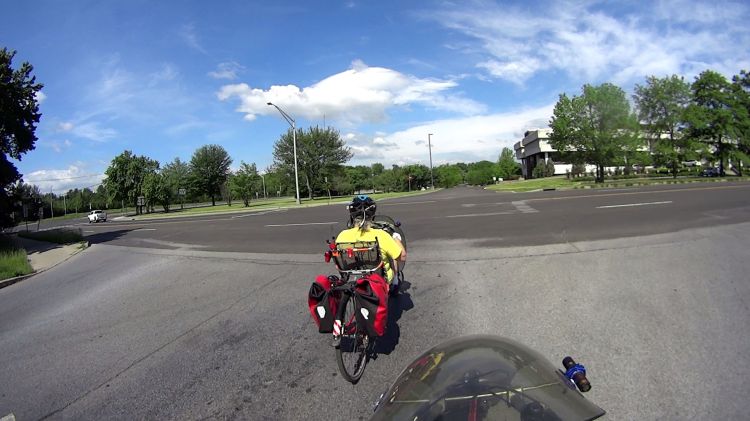
Much to our surprise, 17 s later the signal is still green:

As usual, the unmarked sensor loop doesn’t detect bicycles and the control doesn’t take our clearing time into account, so the signal turns yellow 5 s later (after 22 s from turning green) while we’re still in the intersection:
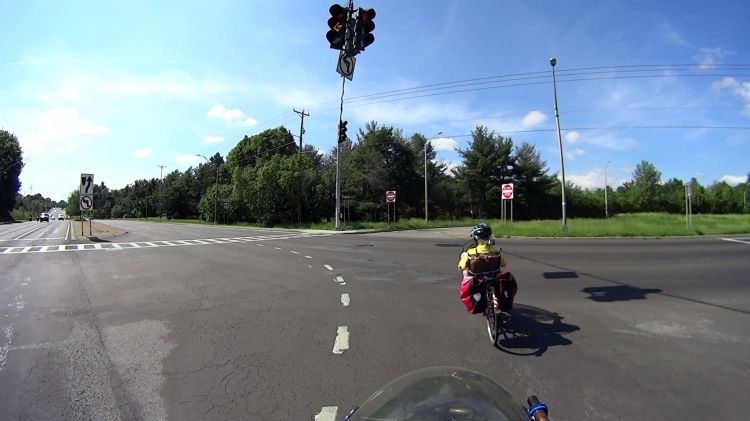
After another 6 s, though, we’re through the intersection and lined up on the right side of Rt 55, just as the Rt 55 signal turns green:

Note that the Burnett Blvd signal remained green for 22 s, much longer than in bygone years, and the green-to-green time is now 28 s. We got through the intersection without any difficulty, although the green-to-red clearance time remains scanty.
Those of long memory may recall my writeup of the timing in early November last year. That was with many cars triggering the sensor loops, so the timings from a trip last July with a single truck-and-trailer tripping the sensor may be more relevant. Or take your pick from other timings done during the last six years; there’s plenty of data to show something’s new and different.
Mary recently discovered a reason why NYS DOT may have suddenly changed the signal timing at the Burnett intersection after all those years:
During the incident, a black Nissan Titan, driven by a 51-year-old male resident of Lagrangeville, collided with a bicycle, ridden by a 58-year-old male resident of Poughkeepsie, in the area of the crosswalk on the southeast portion of the intersection, said the Town of Poughkeepsie Police.
The bicyclist sustained serious injuries and was transported to MidHudson Regional Hospital.
https://dailyvoice.com/new-york/putnam/police-fire/bicyclist-seriously-injured-after-crash-with-vehicle-in-area/798453/
The crosswalk mentioned in the article appears in the last picture.
The cyclist died of his injuries shortly after that article went live.
Mary knew him. He was one of the gardeners near her plot in the Vassar Community Garden who lived in the apartments a few hundred yards from that intersection, didn’t own a car, and, for years, rode through that intersection to the grocery store at the far end of Burnett Blvd (across another of DOT’s intersections). Everyone knew him as a nice, considerate guy.
When DOT tells you “Clearance times are determined based on speed, intersection dimensions, grade, and reaction time and cannot be adjusted” they don’t add “Because not enough people have died to get our attention.”
Death is the only thing that will convince NYS DOT’s engineers to change the signal timing at an intersection.
As far as I can tell, all of the other intersections along our usual routes still have the same inadequate clearance times. Evidently, the bicyclist death toll isn’t high enough to get their attention and evidence here doesn’t matter there, because motor vehicle traffic cannot be delayed, even for a few seconds, merely to protect the most vulnerable “users” of their facilities.
We’ve been bicycling all our adult lives and haven’t been killed yet, despite NYS DOT’s complete lack of attention. Our experiences justify my cynicism and bitterness.
I eventually figured out why no NYS DOT staffer will accompany me on bike trips along their “safe for all users” roads. If they did, they’d be unable to deny knowing how hazardous their engineering designs & maintenance practices are in real life, should the question come up in a court of law.
If you think that’s not the case, then let’s go riding together …
Road design, build quality, and attention to details matter, even though drivers and, yes, cyclists share some of the blame.
Sometimes I get text messages:

Bzzzz … click … NO CARRIER …
I’m reasonably sure “Caroline” is really a property flipper, so we’re not in “her” target market.
Should you be interested in moving into the Hudson Valley, we can probably make a mutually beneficial deal. Protip: use email.
If only Android allowed whitelisting SMS message sources.

We’re riding southbound on the recently opened section of the Empire State Trail, just south of Hopewell Junction, and are approaching a dog walker totally face-sucked by her phone in the middle of the path:
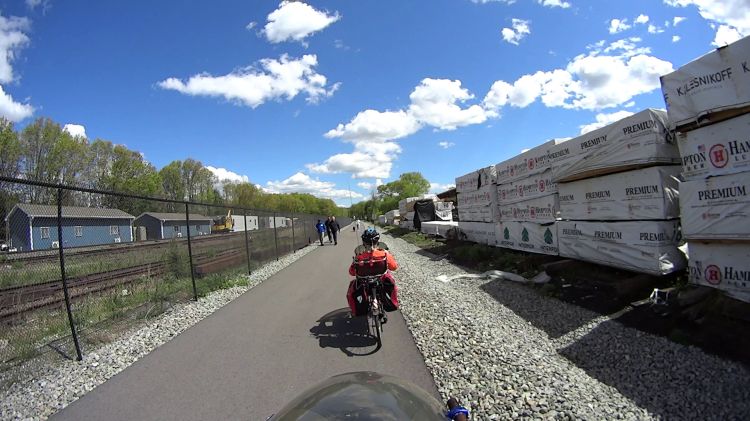
Mary has been dinging her bike bell for the last few seconds and finally manages to break through:
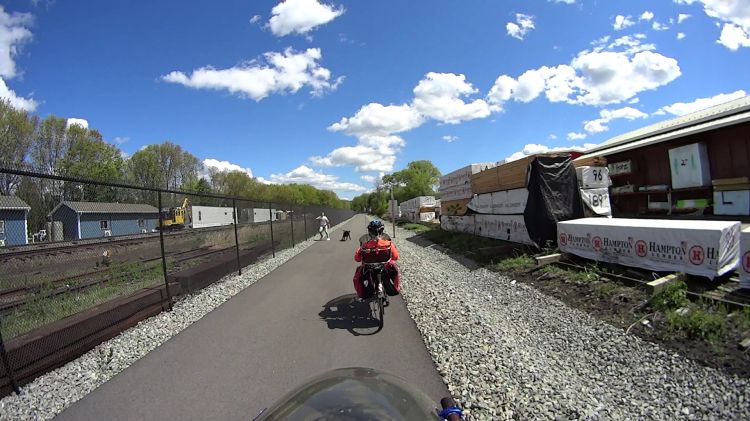
The dog walker leans against the fence while pulling on the leash as hard as she can, as if she knows the dog poses a threat:
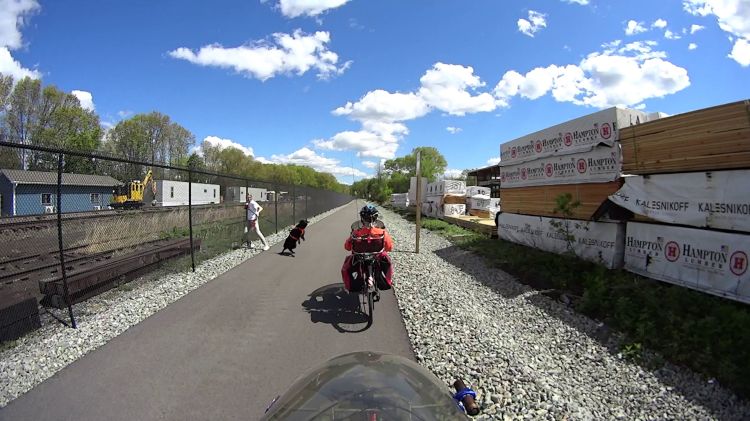
Which it does:
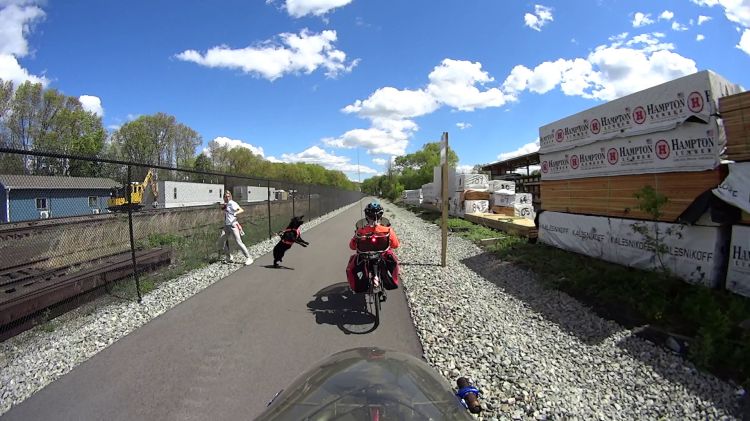
The leash is too long for close-quarters work:

Nice teeth, doggie:
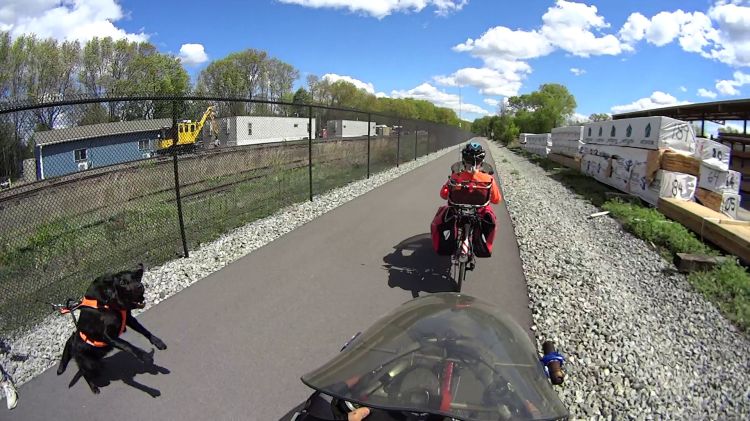
Surely, the dog just wants to lick me to death:

Tell me again how well-trained this dog is:
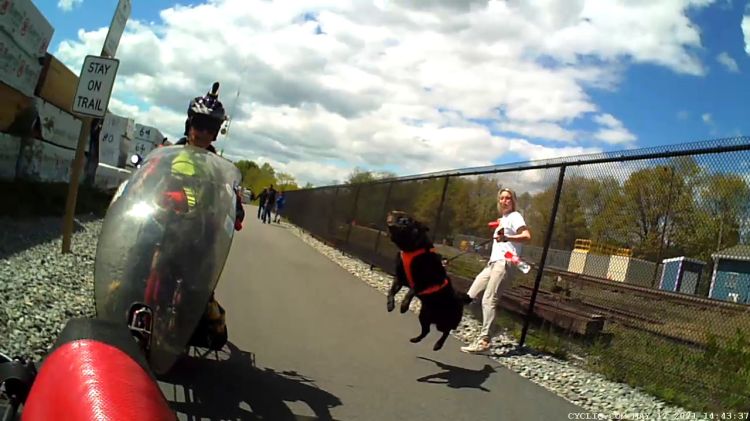
Seven seconds after the first picture:
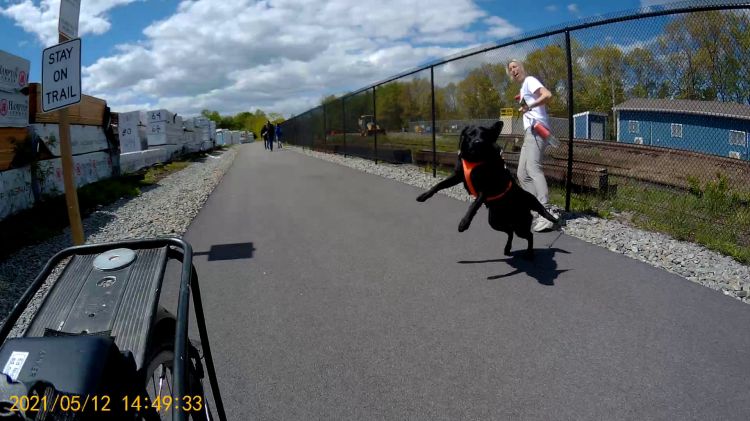
The dog also lunged at the pair of bicyclists following us, so perhaps this is how she makes sure it get its exercise during the walk.

I knew this would happen, so I made sure to not order anything that could possibly arrive at the same time:

I’ll apply the grease by hand, so the fact the cartridge cannot fit into a piston-fed gun doesn’t matter:

I recently placed one order for a BFW and another for four small bottles, all of which arrived in a single box with a thoroughly flattened air pillow strip. Fortunately, the bottles were plastic and survived unscathed, but I’m sure it got ugly in there.
Given that one order for multiple items has arrived in three different boxes on two different days, it’s exceedingly difficult to work around Amazon’s corporate-level indifference for safe packaging.
 The Smell of Molten Projects in the Morning