The Smell of Molten Projects in the Morning

Ed Nisley's Blog: Shop notes, electronics, firmware, machinery, 3D printing, laser cuttery, and curiosities. Contents: 100% human thinking, 0% AI slop.

Tag: Laser Cutter

  • Quilting Ruler Rack: Expedient Base

    Quilting Ruler Rack: Expedient Base

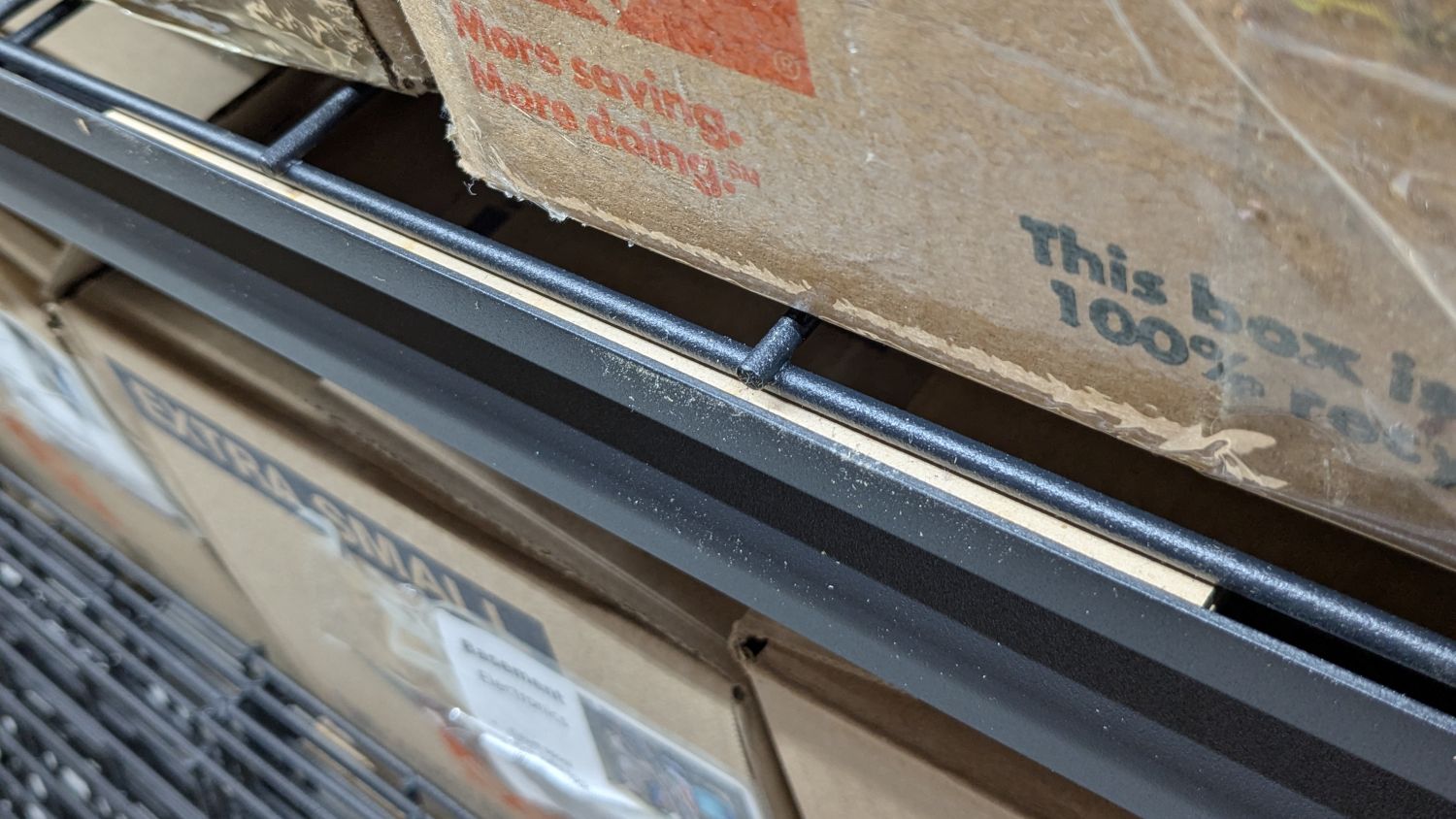
    Mary is at least the third owner of a steel rack, originally intended to hold packages of retail stuff, which now holds (much of) her collection of quilting rulers:

    Quilting Ruler Rack Base - overview
    Quilting Ruler Rack Base – overview

    Obviously, it was never intended to hold heavy acrylic sheets, but it worked surprisingly well, right up to the point where too many of the rulers collected on two adjacent columns of pegs and overbalanced the whole affair atop her while she attempted to remove a ruler.

    Subsequent accident recreation showed the rack toppled when the weight of the rulers on the two adjacent columns of hooks moved the center of mass outward, just inside the line between those feet, whereupon the slightest tug on a ruler pulled it over.

    Measurements revealed the four legs do not sit on a square contact patch, are not parallel to the radii from the center point, and are not uniformly distant from the center. Rather than committing to a finished product, I made a cardboard prototype to verify a bigger base would solve the problem and I could capture all those feet.

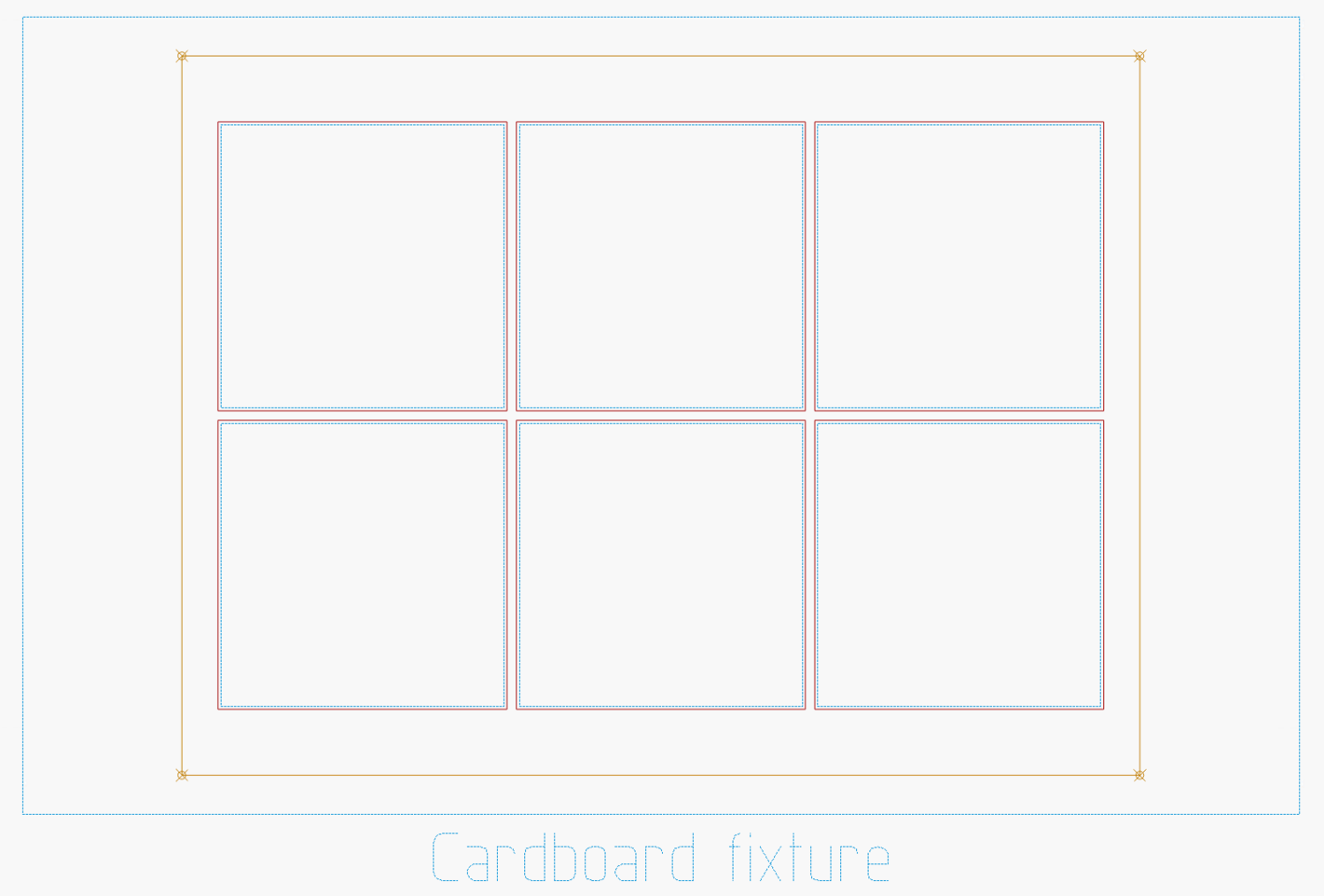
    You don’t have such a rack, so the exact dimensions don’t matter, but the LightBurn layout looks like this:

    Quilting Ruler Rack Base
    Quilting Ruler Rack Base

    The disk is two cross-laid sheets for stiffness, with marks burned on the top to help align the feet more-or-less around the center point.

    The oblong rings fit around the feet to capture them, so cut eight or twelve to make four stacks a bit taller than the wire diameter.

    The H shape then glues atop the rings to hold the feet in place. They’re not removable, but a razor knife will eventually solve that problem.

    I slobbered hot melt glue across the cardboard disks to hold them together, glued and aligned the rings where the feet dented the disks, stood the rack in the rings, and glued the H plates.

    About an hour elapsed from the sound of the crash to the rack once again standing quietly beside the fabric cabinets.

    We’ll run this for a while and eventually replace it with a plywood disk and screwed-in-place clamps for the feet, which will surely call for wood surface preparation / stain / seal treatment.

  • Roof Rake

    Roof Rake

    If they think you’re crude, go technical; if they think you’re technical, go crude. I’m a very technical boy. So I decided to get as crude as possible. These days, thought, you have to be pretty technical before you can even aspire to crudeness.

    William Gibson — Johnny Mnemonic

    Now that the trees have shed most of their leaves / needles, it’s time to get the accumulation off the roof edges. Fortunately, the upstairs windows overlook the biggest piles and, after I considered and rapidly rejected the notion of using the wind stick, Mary convinced me a roof rake would suffice by deploying a too-short broom.

    After considering and rejecting several decreasingly elaborate variations of 3D-printed pole-to-pusher-plate adapter nonsense that almost involved our pole saw, this happened:

    Roof Rake - in use
    Roof Rake – in use

    The wood pole comes from a left-behind assortment atop the garage’s open ceiling joists and the pusher plate comes from the cardboard box treasure trove.

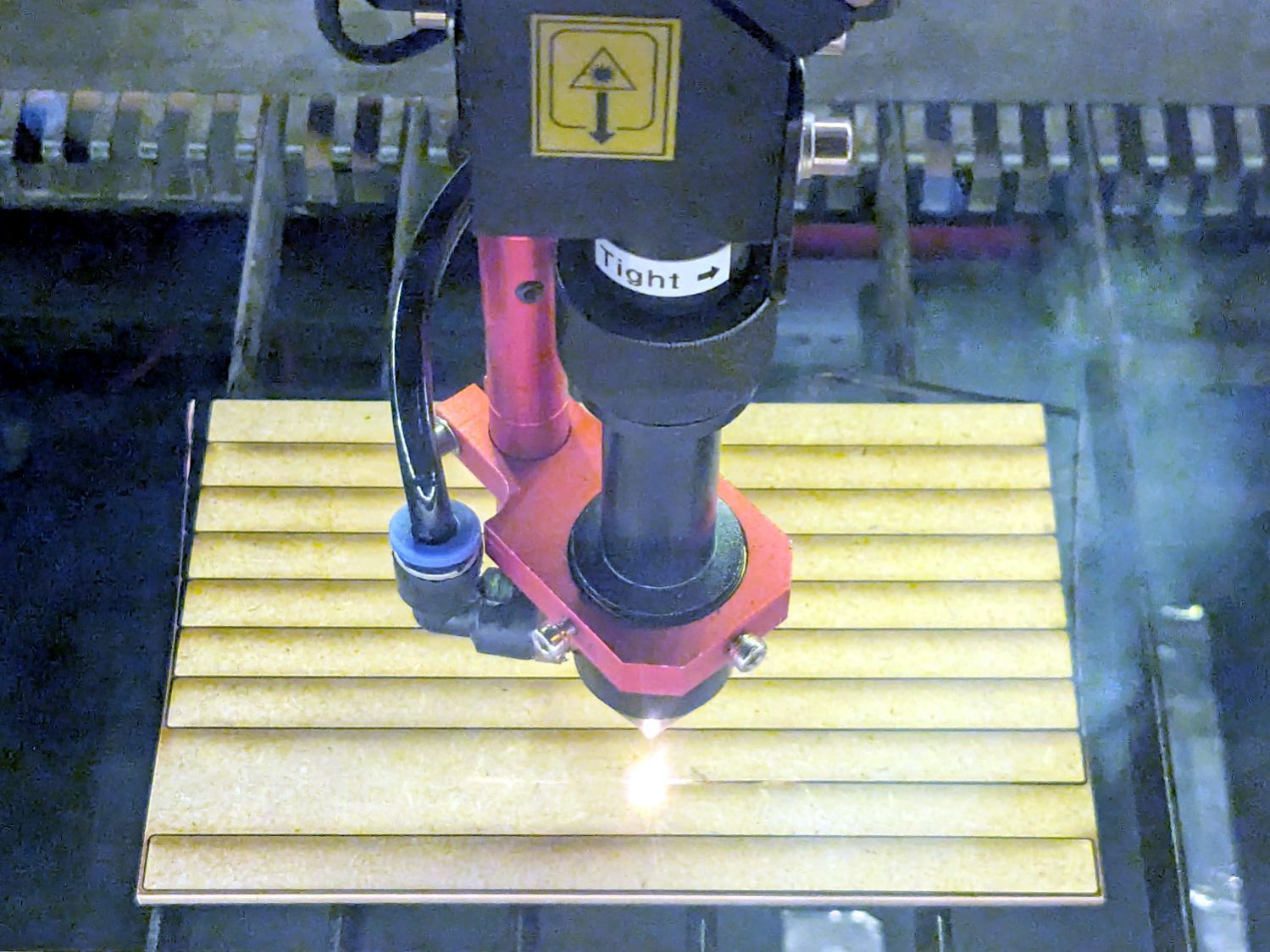
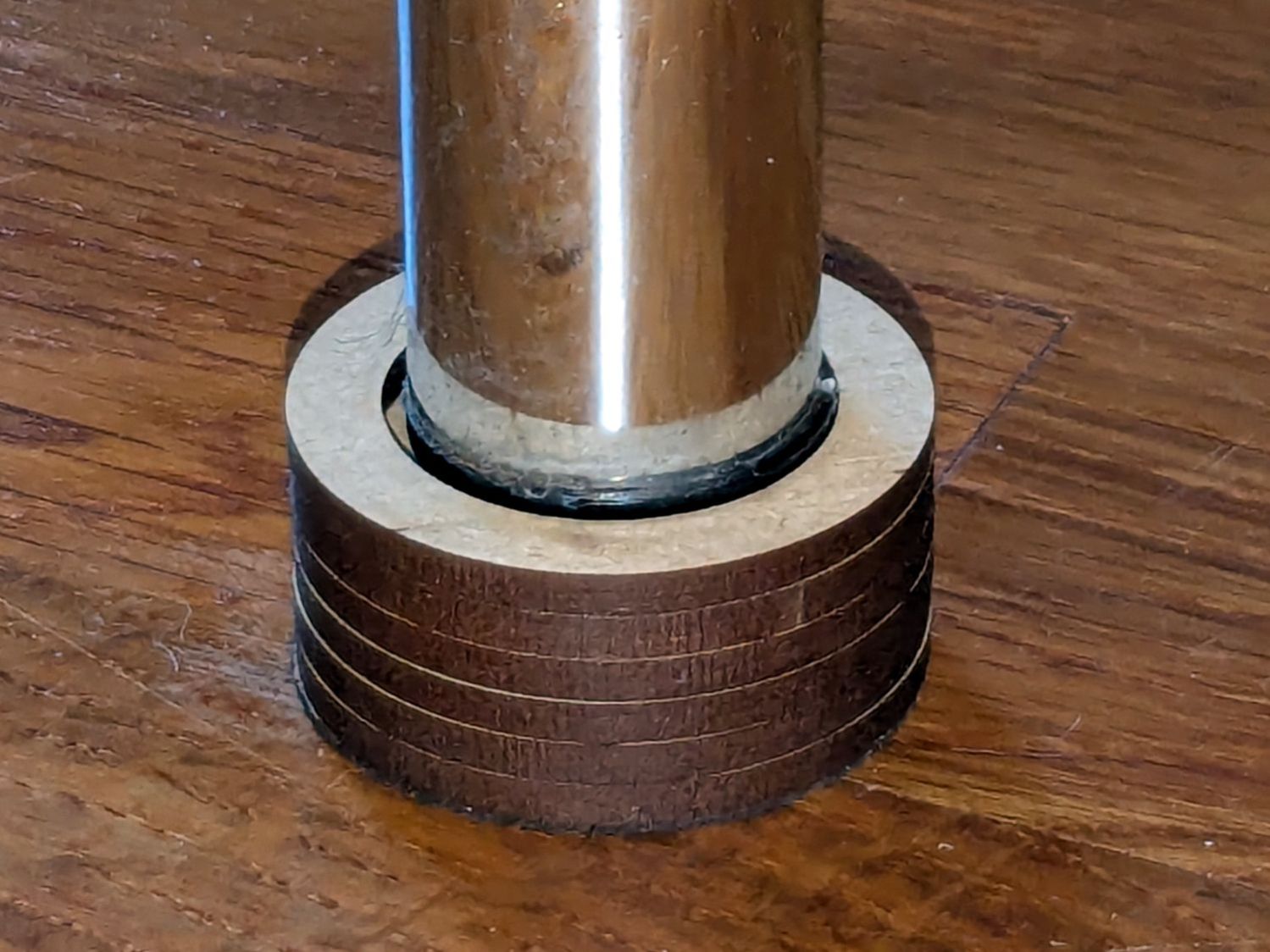
    A laser cutter makes close-fitting rings and hot-melt glue sticks those plates together with gleeful abandon:

    Roof Rake - detail
    Roof Rake – detail

    The blue-and-white cardboard plate consists of two box flaps glued together, the glued-up stack of half a dozen rings transfers the torque from the plate to the pole, and the whole affair took the better part of fifteen minutes from idea to cool-enough glue.

    It’s back on the garage joists for next year, unless we decide that pole has a higher purpose in life. Worst case, it loses two inches of length.

    Bonus: Chore accomplished before the predicted weekend snowfall!

  • Sears Sewing Table: Caster Pads

    Sears Sewing Table: Caster Pads

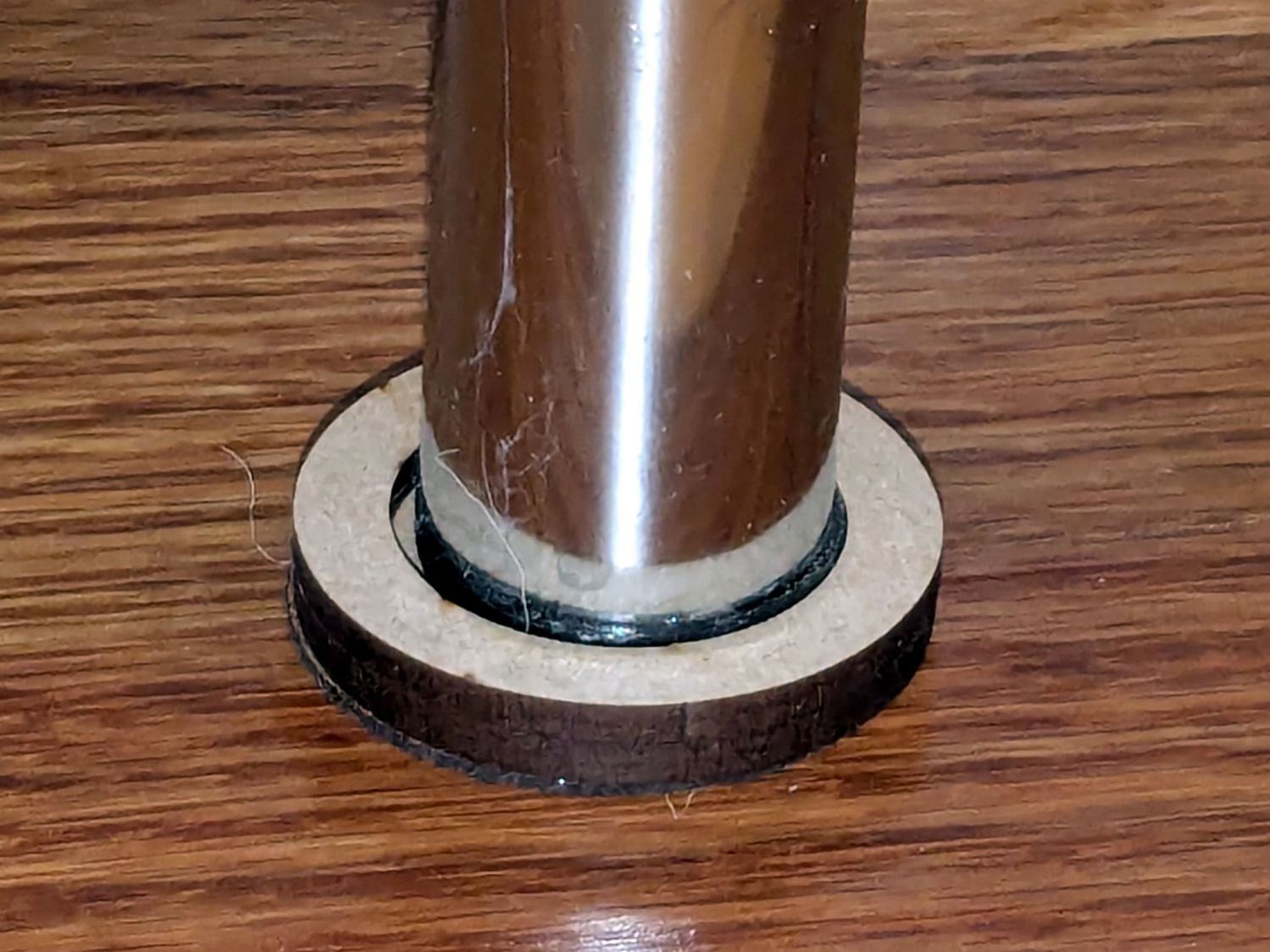
    Mary’s much-improved / -repaired Sears Sewing Table wanted to move around on the wood floor in the Sewing Room, so I captured its casters in little pads:

    Sears Sewing Table caster pad - installed
    Sears Sewing Table caster pad – installed

    A layer of 1 mm cork with PSA adhesive provides griptivity against the floor, a solid layer of 3 mm plywood spreads the wheel force over the cork, and a top ring of 3 mm plywood captures the wheel.

    Which looked like this during gluing:

    Sears Sewing Table caster pad - gluing fixtures
    Sears Sewing Table caster pad – gluing fixtures

    The scrap on the left served to align cork & plywood; it came from the plywood contributing the shapes. The ring around the cork is a glued-up pair of plywood rings (4 mm wide, outset from the perimeter of the pads) serving to align the two plywood layers.

    Verily: time spent making a fixture is never wasted!

    And having a laser cutter makes fixtures trivially easy, at least for simple fixtures like those.

  • Laser Cutter: Fourth Corner Fix Summary

    Laser Cutter: Fourth Corner Fix Summary

    A discussion on the LightBurn forum about a large-format machine with a misaligned beam prompted me to think through the whole “Fourth Corner” problem and come up with this summary based on my beam realignment adventure:

    Here’s what I think is going on, referring to the 4×8 foot (!) machine in that discussion and lightly edited to improve readability & fix minor errors …

    Mirror 1 alignment gets the beam parallel to the Y axis, averaged over the gantry travel between front and rear. The path length variation on your machine is four feet.

    Mirror 2 alignment gets the beam parallel to the X axis, averaged over the laser head travel from left to right. The path length variation on your machine is eight feet.

    When the laser head is in the left rear corner, the total path length is maybe a foot or two. When it’s in the front right corner, the total path length is upwards of twelve feet.

    The “Fourth Corner” problem comes from a slight angular misalignment of Mirror 1, because you (and I and everybody) must set it with a maximum path length around four feet (Mirror 1 to Mirror 2 with the gantry at the front end of the machine). But with the laser head in the right front corner, the path length (Mirror 1 to Mirror 3) is three times longer, so the error due to a slightly mis-set angle at Mirror 1 is correspondingly larger.

    A tiny tweak to Mirror 1 changes the spot position at Mirror 2 by very little, but moves the spot at Mirror 3 by much more due to the longer path length.

    Tweaking Mirror 1 cannot compensate for a warped machine frame, but it will get the beam alignment as good as it can be made.

    The next point of contention was my “middle of the mirror” suggestion. AFAICT, the spot burned into the target at each mirror marks only the useful part of the beam with stray energy in a halo around it. Centering the spot keeps that stray energy away from the mirror mounts, so it doesn’t cause unnecessary heating. This will be particularly important with a high-power laser.

    Angular adjustment of each mirror puts the beam parallel to the axes, but cannot also center it on the mirrors. After it’s aligned, the path from the laser tube through the nozzle depends on the position of the tube relative to the nozzle: moving the tube up/down and front/back moves the beam position on the mirrors and through the nozzle, but (in an ideal world) doesn’t change the angular alignment.

    So after aligning the beam parallel to the axes, you must move the laser tube, the mirrors (up/down left/right front/back), and maybe the laser head to center the beam in the mirrors and also in the nozzle. Because we don’t live in an ideal world, moving any of those pieces wrecks their angular alignment, so it’s an iterative process.

    The goal is to reach this point:

    Beam Alignment - Mirror 3 detail - 2023-09-16
    Beam Alignment – Mirror 3 detail – 2023-09-16

    Those are five separate pulses, one each at the four corners and center of the platform.

    The beam then goes pretty much through the center of the laser head and lens:

    Beam Alignment - Focus detail - 2023-09-16
    Beam Alignment – Focus detail – 2023-09-16

    Works for me, anyhow.

  • Layered Paper: Mariner’s Compass in Colors

    Layered Paper: Mariner’s Compass in Colors

    Having recently shotgunned Amazon’s selection of colored art paper, this becomes possible:

    Mariners Compass - inset browns
    Mariners Compass – inset browns

    It’s the same geometry as the plain white layered version, with somewhat more attention to detail, and consists of a dozen layers glued and stacked on an assembly fixture.

    The quilt-block version uses simple layering:

    Layered Paper - Mariners Compass - Beyer 133
    Layered Paper – Mariners Compass – Beyer 133

    No commercial potential, but I like the effect.

  • Curtain Rod Spring Pusher Block

    Curtain Rod Spring Pusher Block

    Spotted during Autumn Window Cleaning:

    Curtain rod pusher block - spring contortion
    Curtain rod pusher block – spring contortion

    That’s the compression spring inside the curtain rod over the kitchen sink, intended to push the ends against the cabinets on either side. The screw slides along the outer rod and when tightened, backstops the spring against the inner rod.

    The end of the spring is apparently intended to twist and jam inside the inner half of the rod, but that seemed so … unesthetic.

    Being in the midst of setting up a Windows 11 box for the laser cutter, I used it as an excuse to fiddle with the RDP configuration to get LightBurn running in full screen mode on the monitor atop my desk; more about all that later.

    The little pusher block is a hull around a pair of circles the same diameter as the smaller dimension of the inner rod, spaced apart enough to match its width, then laser-cut from a scrap of 1/4 inch acrylic:

    Curtain rod pusher block - overview
    Curtain rod pusher block – overview

    Which assembles as you’d expect:

    Curtain rod pusher block - installed
    Curtain rod pusher block – installed

    The spring seems much happier pushing against the block, doesn’t it?

    Admittedly, this was completely unnecessary, but if you think of it as a side effect of the Win 11 thing, it makes at least a little sense.

  • Laser Test Paper: Weathering

    Laser Test Paper: Weathering

    Three months of outdoor exposure suggest that laser test paper can survive use as a plant tag for one growing season, at least when it remains flat:

    Laser test paper - small plant labels - 3 month exposure
    Laser test paper – small plant labels – 3 month exposure

    The two upper tags demonstrated the paper has no flexibility worth mentioning, so it cannot become a tag wrapped around a stem.

    The two lower labels spent their time tucked into a window frame where they got plenty of sun & rain without the benefit of a backing plate. Looks good to me!

    Contrary to my expectation, the craft adhesive sheet behind this label survived intact, although the label itself took some damage, perhaps from the more direct sunlight out on the deck:

    Laser test paper - plant marker - 3 month exposure
    Laser test paper – plant marker – 3 month exposure

    In any event, they look Good Enough™ for our simple needs and next year’s plants will be properly labeled.