The Smell of Molten Projects in the Morning

Ed Nisley's Blog: Shop notes, electronics, firmware, machinery, 3D printing, laser cuttery, and curiosities. Contents: 100% human thinking, 0% AI slop.

Tag: Improvements

Making the world a better place, one piece at a time

  • Tour Easy: Bafang BBS02 Pedal Offset Fix

    Tour Easy: Bafang BBS02 Pedal Offset Fix

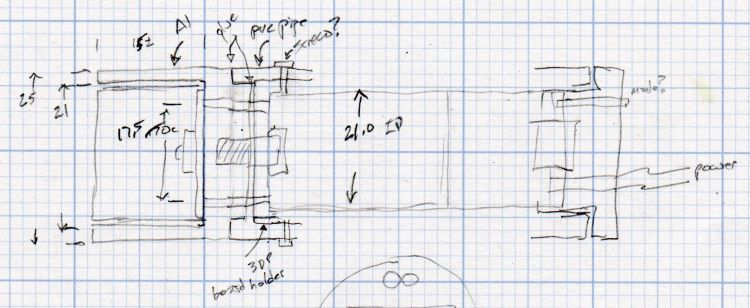
    For unknown reasons, the Bafang BBS02 motor puts the left pedal 15.5 mm closer to the frame than the right pedal:

    Bafang BBS02 dimensions
    Bafang BBS02 dimensions

    The diagram presents the motor assembly as seen from the bottom, lying on the ground looking upward with your feet forward around the front wheel.

    That much offset may be acceptable for some (upright?) bikes and some riders, but this seemed better for Mary:

    Tour Easy - Lekkie 160mm offset crank - installed
    Tour Easy – Lekkie 160mm offset crank – installed

    Lekkie Buzz Bars have a matching 15.5 mm offset in the left crank to center both pedals on the frame. She’s been pushing 165 mm cranks for long enough to know standard 170 mm cranks require too much leg travel, so that’s a 160 mm Lekkie crank.

    With cranks installed in the BBS02, measured from the frame tube to the inside of the crank at the pedal axis:

    • Bafang 170 mm: L 42, R 62
    • Shimano 105 triple 170 mm: L 46, R 67
    • Lekkie 160 mm: both sides 60

    For comparison, the Shimano 105 cranks on my Tour Easy measure 35 mm on both sides with an ordinary Shimano UM-BB72 bottom bracket cartridge, so the BBS02 + Lekkie cranks put each pedal 25-ish mm farther out. However,my pedals screw into 20 mm Kneesavers, putting them pretty close to the Lekkie spacing.

    We hope the additional space won’t make much difference to Mary; it’s certainly better than sitting offset to the right to match the pedals, as she’s found herself doing with both the Bafang and Shimano cranks on the BBS02. Her right shoe just barely tapped the crank, so we moved the cleat a few millimeters inboard and it’s all good again.

    The Cateye cadence sensor now has a rakish tilt to match the crank offset and looks scarily exposed. More riding is in order.

    The Lekkie cranks have a hollow cross-section that’s concave on the frame side, so the magnet sits on a simple riser to get it out where the sensor can experience it:

    Cateye Cadence Magnet mount - PS preview

    It’s held in place with good foam tape; the cable tie makes me feel better.

    The OpenSCAD code for the riser fits into the GitHub Gist:

    module CateyeMagnet() {
    
    OAL = 24.0;
    D1 = 14.0;
    D2 = 8.0;
    
        linear_extrude(height = 15.0)
            hull() {
                rotate(180/12)
                    circle(d=D1,$fn=12);
                translate([OAL - D1/2 - D2/2,0])
                    rotate(180/12)
                        circle(d=D2,$fn=12);
            }
    }
    
    … snippage …
    
        translate([0,-4*Block.x,0]) {
            rotate(-90)
                CateyeSensor();
            CateyeMagnet();
        }
    

    The build plate is getting crowded:

    Bafang Battery Mount - build view - cadence magnet
    Bafang Battery Mount – build view – cadence magnet

    In point of fact, that array pretty much fills the M2’s platform and would require over 11 hours of print time, which is just crazy talk. Have the slicer break it into separate parts, delete whatever you don’t want at the moment, print what’s left, and iterate until you have everything you need to finish the job.

  • Tour Easy: Bafang Mid-drive vs. Cateye Cadence Sensor

    Tour Easy: Bafang Mid-drive vs. Cateye Cadence Sensor

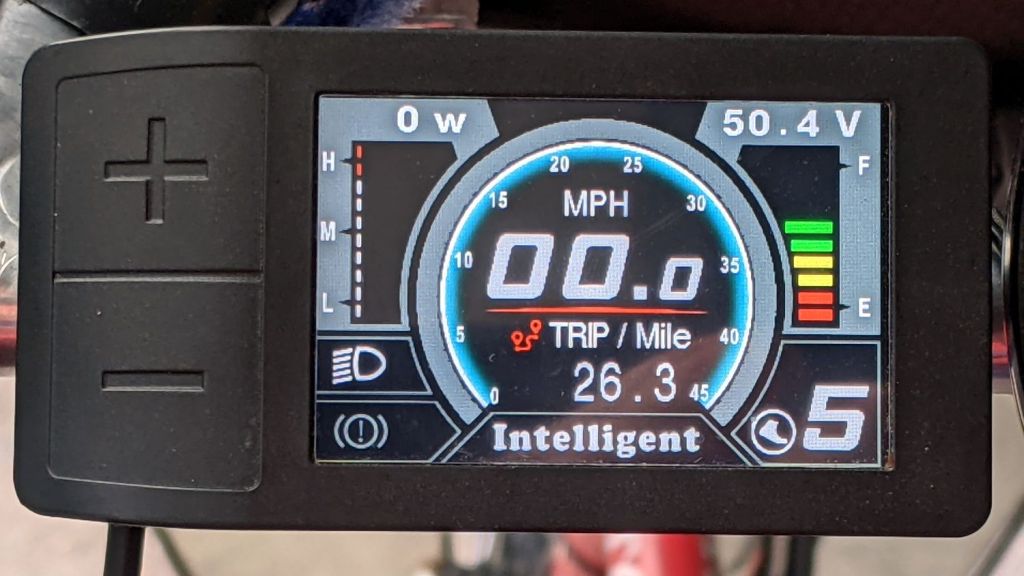
    For inscrutable reasons, the Bafang 500C display includes all stopped time in its average trip speed. While that is, in fact, the average speed over the entire trip, the Cateye cyclocomputers we’ve been using forever stop averaging after a few seconds at 0 mph.

    Bonus: Although the Bafang BBS02 motor knows the pedal cadence, it’s not part of the display.

    The Bafang BBS02 bottom bracket shaft put its pedal cranks much farther from the Tour Easy’s frame than the Shimano cranks, to the extent that the existing Cateye cadence sensor position just wasn’t going to work, so I printed a simple clip to fit over the motor’s “fixing plate”:

    Tour Easy Bafang BBS02 motor
    Tour Easy Bafang BBS02 motor

    It turns out putting a magnetic sensor immediately next to the winding end of a high-current three-phase motor isn’t the brightest idea I’ve ever had. The Cateye cadence display spent most of its time maxed out at 199 rpm, far faster than Mary can spin for, well, a single revolution.

    A somewhat more complex mount put the sensor roughly where it used to be:

    Cateye Cadence Sensor mount - installed
    Cateye Cadence Sensor mount – installed

    It looks precarious, but it spent nigh onto two decades there without incident, so we have precedent.

    Those are the original 165 mm Shimano cranks, because the 170 mm Bafung cranks threatened to lock out her knees. More on this in a while, as it’s a more complex issue than it may appear.

    The solid model looks about like you’d expect:

    Cateye Cadence Sensor mount - solid model
    Cateye Cadence Sensor mount – solid model

    The OpenSCAD code replaces the simple clip in the original GitHub Gist:

    // Cateye cadence sensor bracket
    
    LockRingDia = [44.0,46.0];
    LockRingLen = [4.0,6.5];
    LockRingOAD = LockRingDia[1] + 2*WallThick;
    LockRingOAL = LockRingLen[0] + LockRingLen[1];
    
    Notches = 16;
    SensorAngle = 3*360/Notches;
    SensorBase = 10.0;
    
    module Cateye() {
    
        difference() {
            union() {
                cylinder(d=LockRingOAD,h=LockRingOAL,$fn=Notches);
                translate([LockRingOAD/2 + LockRingOAL/2 - WallThick/2,0,LockRingOAL/2])
                    cube([LockRingOAL + WallThick,2*WallThick + Kerf,LockRingOAL],center=true);
          rotate(SensorAngle)
                    translate([LockRingOAD/2 + SensorBase - WallThick/2,0,LockRingOAL/2])
                        cube([2*SensorBase + WallThick,2*WallThick,LockRingOAL],center=true);
            }
            translate([0,0,LockRingLen[0]])
                PolyCyl(LockRingDia[1],LockRingOAL,Notches);
            translate([0,0,-Protrusion])
                PolyCyl(LockRingDia[0],2*LockRingOAL,Notches);
    
            translate([LockRingDia[0],0,0])
                cube([2*LockRingDia[0],Kerf,4*LockRingOAL],center=true);
            translate([LockRingOAD/2 + LockRingOAL/2,2*WallThick,LockRingOAL/2])
                rotate([90,0,0])
                    PolyCyl(3.0,4*WallThick,6);
    
            rotate(SensorAngle)
                translate([LockRingOAD/2 + 2*SensorBase - SensorBase/2,2*WallThick,LockRingOAL/2])
                    rotate([90,0,0])
                        PolyCyl(3.0,4*WallThick,6);
        }
    
    }
    
  • Tour Easy: Asymmetric Handlebar Grips

    Tour Easy: Asymmetric Handlebar Grips

    Installing the Bafang BBS02 motor on Mary’s Tour Easy replaced the triple chainring, so I removed the front derailleur and SRAM grip shifter. This produced enough room for the thumb throttle and a full-length handgrip on the left side:

    Tour Easy grips - left installed
    Tour Easy grips – left installed

    The round button is the PTT switch for the HT.

    The right handlebar still has the rear shifter, so it requires a shorter grip:

    Tour Easy grips - right installed
    Tour Easy grips – right installed

    Although it may be possible to buy such a grip and, thereby, get a backup pair of mismatched grips, it seemed easier straightforward to just shorten the grip to the correct length and be done with it.

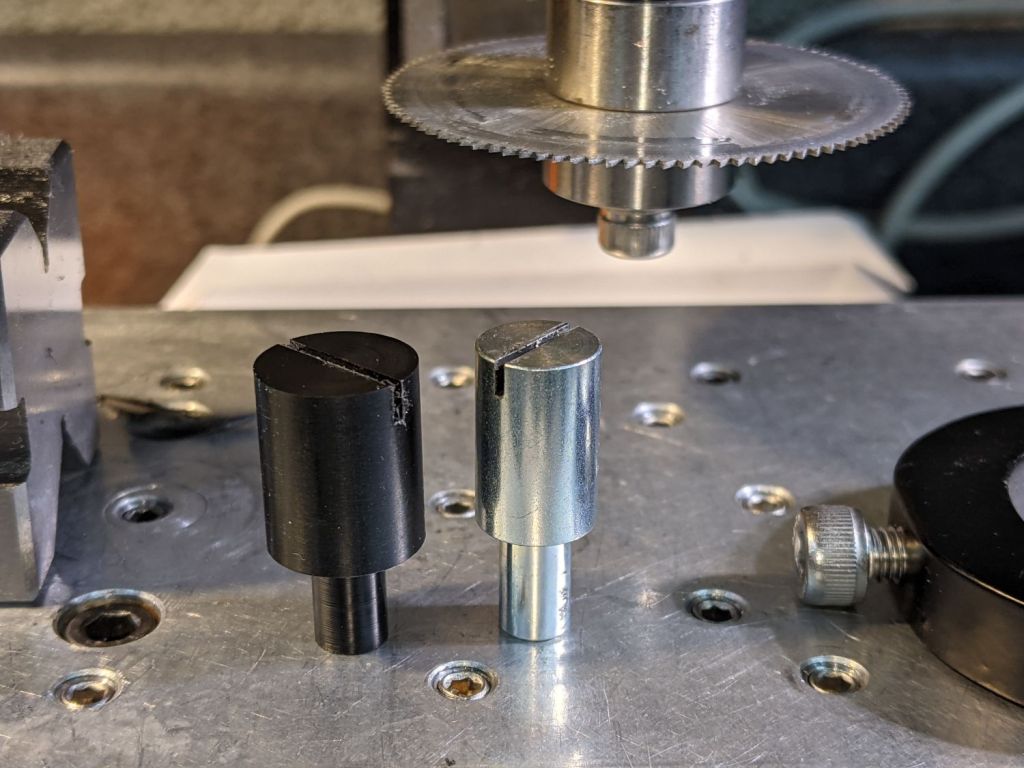
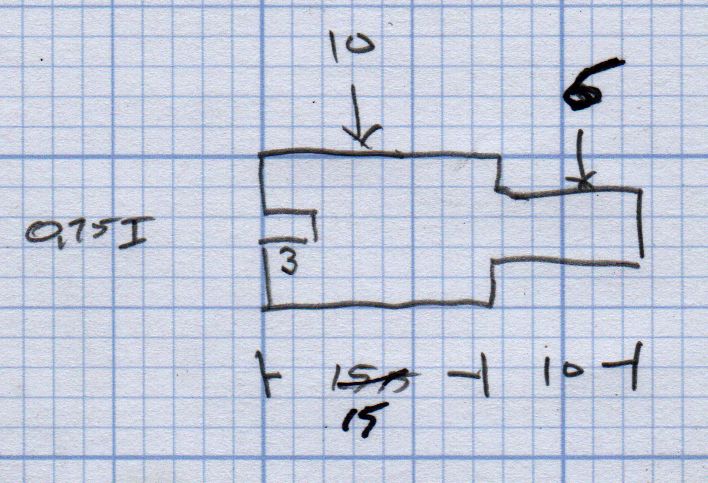
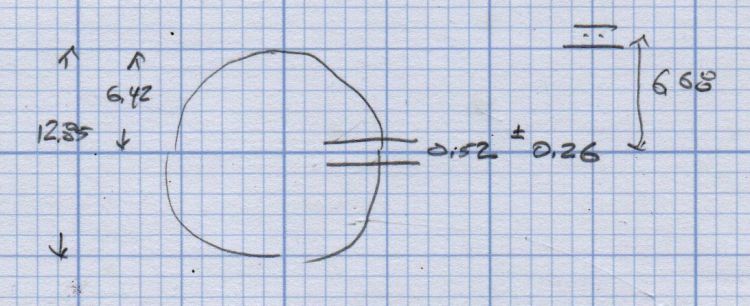
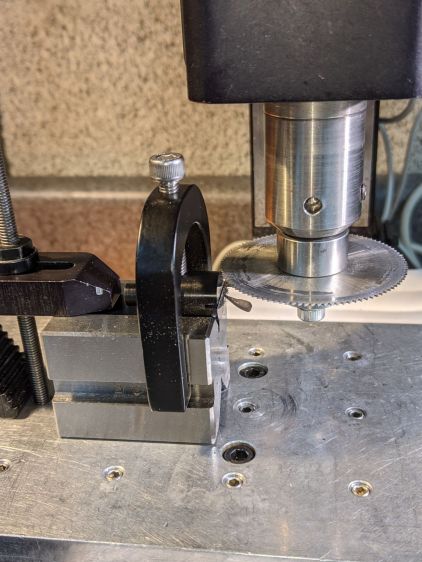
    Saw off a convenient length of aluminum rod:

    Tour Easy grips - mandrel sawing
    Tour Easy grips – mandrel sawing

    Although I actually used a steady rest to produce this, it happened during a remote Squidwrench meeting and I have no proof:

    Tour Easy grips - lathe mandrel
    Tour Easy grips – lathe mandrel

    The 22.2 mm = 7/8 inch end matches the more-or-less standard handlebar diameter, so the grip clamp can get a good hold:

    Tour Easy grips - right peeled
    Tour Easy grips – right peeled

    A live center supports the right end of the grip.

    The red coating seems to be gooey silicone rubber molded atop a PVC tube. Rather than (try to) use a lathe bit to cut through the silicone, I cut two slits with a utility knife and the spindle turning slowly in reverse, then peeled off the rubber between the slits.

    With the silicone out of the way, an ordinary cutoff tool made short work of the PVC:

    Tour Easy grips - right trimming
    Tour Easy grips – right trimming

    That was a cleanup pass with the utility knife, as the cutoff tool left a slight flange around part of the circumference. If I had the courage of my convictions, I could probably have cut the PVC with the knife.

    Chamfer the end of the cut, slide it on the handlebar, tighten the clamp, and it’s all good.

    The alert reader will note the clamp should go on first, but that would produce an inconvenient lump against the right shifter. Sliding them on backwards puts the clamp at the end of the handlebar and works out better in this admittedly unusual situation.

  • Bafang USB Programming Adapter

    Bafang USB Programming Adapter

    Changing (“programming”) the Bafang BBS02 motor controller parameters requires a USB-to-serial adapter with a connector matching the end of the cable from the motor to the display. While you can buy such things directly from the usual randomly named Amazon sellers, I happen to have a wide variety of bare adapter boards, so I just bought a display extender cable and cut it in half to get the connector; you can apparently buy pigtailed connectors (for more than the price of an extender) if you dislike cutting cables in half.

    Various documents provide versions of the canonical illustration of the motor end of the display cable, as ripped from Penoff’s original documentation:

    Bafang BBS02 display cable pinout
    Bafang BBS02 display cable pinout

    The pin colors correspond to the wiring inside the motor cable, but the extender uses different colors, because nobody will ever know:

    Bafang programmer - wire colors
    Bafang programmer – wire colors

    A bit of work with a continuity meter gave the pinout:

    Bafang BBS02 display extender - wire colors
    Bafang BBS02 display extender – wire colors

    Don’t trust stuff you read on the Intertubes: make your own measurements and draw your own diagrams!

    You want the cable end carrying the sockets to mate with the pins on the motor cable (coming in from the left):

    Bafang programmer - cable ends
    Bafang programmer – cable ends

    Soldering the cable to a known-counterfeit FTDI USB adapter went swimmingly:

    Bafang programmer - USB adapter wiring
    Bafang programmer – USB adapter wiring

    Note that the yellow-blue connection carries the full 48 V from the battery and may or may not have any current limiting / fusing / protection, so be a little more careful than usual in your wiring layout.

    The red jumper from DTR to CTS, shown in all the Amazon and eBay listIngs, turns out to be unnecessary.

    A quick and dirty case (eventually held together with generous hot-melt glue blobs) protects the PCB and armors the cables:

    Bafang USB-serial adapter interior
    Bafang USB-serial adapter interior

    The solid model over on the right looks about like you’d expect:

    Bafang Battery Mount - complete build view
    Bafang Battery Mount – complete build view

    Most of the instructions will tell you to hot-plug the cable to the motor with the battery connected, which strikes me as foolhardy; not all of those pins make contact in the right order, which means you will slap 50-odd volts across the wrong parts of the circuitry.

    Instead:

    • Disconnect the battery
    • Unplug the display
    • Plug the adapter cable into the motor connector
    • Plug the USB cable into the Token Windows Laptop
    • Reconnect the battery
    • Fire up the “programming” routine
    • Send the new configuration to the motor controller
    • Disconnect the battery
    • Unplug the adapter cable
    • Reconnect the display cable
    • Reconnect the battery

    Makes more sense to me, even if it’s more tedious.

    Tuck this OpenSCAD source code for the case into the original program that produces the battery mounts:

    Layout = "Build";               // [Frame,Block,Show,Build,Bushing,Cateye,Case]
    
    … snippage …
    
    // Programming cable case
    
    ProgCavity = [70.0,19.0,10.0];
    ProgBlock = [85.0,25.0,15.0];
    ProgCableOD = 4.0;
    
    module ProgrammerCase() {
    
        difference() {
            hull() {
                for (i=[-1,1], j=[-1,1])
                    translate([i*(ProgBlock.x/2 - CornerRadius),j*i*(ProgBlock.y/2 - CornerRadius),-ProgBlock.z/2])
                        cylinder(r=CornerRadius,h=ProgBlock.z,$fn=12);
                }
            translate([-ProgBlock.x,0,0])
                rotate([0,90,0])
                    PolyCyl(ProgCableOD,3*ProgBlock.x,6);
            cube(ProgCavity,center=true);
        }
    }
    
    // Half case sections for printing
    
    module HalfCase(Section = "Upper") {
    
        intersection() {
           translate([0,0,ProgBlock.z/4])
                cube([2*ProgBlock.x,2*ProgBlock.y,ProgBlock.z/2],center=true);
            if (Section == "Upper")
                translate([0,0,-Kerf/2])
                    ProgrammerCase();
            else
                translate([0,0,ProgBlock.z/2])
                    ProgrammerCase();
        }
    }
    
    … snippage …
    
    // tuck this into the Build conditional
    
        translate([0,3*Block.x,0]) {
    
            translate([gap*ProgBlock.x/2,0,ProgBlock.z/2])
                rotate([180,0,0])
                    HalfCase("Upper");
            translate([-gap*ProgBlock.x/2,0,0])
                HalfCase("Lower");
    

  • Tour Easy: Bafang Brake Sensors

    Tour Easy: Bafang Brake Sensors

    Over the decades, we have devoted considerable time and attention to adjusting the reach and travel of the brake levers on Mary’s bike, so I ordered a pair of brake sensors for the Bafang BBS02 motor to mount on the existing hardware:

    Tour Easy Bafang BBS02 - brake sensor - installed
    Tour Easy Bafang BBS02 – brake sensor – installed

    The sensor is the black block secured to the brake mount (with good outdoor foam tape), with the bar magnet similar secured to the handle. The magnet ended up slightly off-center from the switch due to the overlapping joint between the lever and the mount; I can’t detect any difference from having it centered.

    The Bafang switches included cute little disk-shaped neodymium magnets which weren’t suited for the levers and stuck out in all directions without getting particularly close to the sensor. As a result, the least pressure on the brake handle produced a hair-trigger switch activation.

    So I harvested two bar-shaped magnets from a defunct Philips Sonicare toothbrush head, reducing the rather large assortment I’ve been saving for just such an occasion by one item. Each brush head contains a pair magnets attached to a steel backing plate, seen here after removing the lower magnet:

    Tour Easy Bafang BBS02 - brake sensor - donor magnet assembly
    Tour Easy Bafang BBS02 – brake sensor – donor magnet assembly

    I don’t know how Philips attaches the magnets, but a few shots to the steel backing plate with a drift punch breaks the bond without any obvious damage:

    Tour Easy Bafang BBS02 - brake sensor - donor magnet loosened
    Tour Easy Bafang BBS02 – brake sensor – donor magnet loosened

    Neodymium magnets have a nickel plating to prevent corrosion, but AFAICT the only way to know whether I’ve cracked the plating is waiting to see if the magnet falls apart. If it does, I promise to be more careful with the next toothbrush head.

    They’re magnetized through the thinnest section, not along the length like an old-school bar magnet, but the disk magnets are similarly magnetized and I think the net effect is about the same.

    The bars fit the brake handles more closely, put more of the magnet closer to the switch, and allow about 5 mm of travel before tripping the switch.

    Pending more road testing, the switches seem more usable.

    Protip 1: Demagnetize your tools after working with neodymium magnets.

    Protip 2: Don’t put a loose magnet anywhere near your bench block, because it will shatter when it snaps onto the block from a surprising distance.

  • Tour Easy: Bafang Shift Sensor

    Tour Easy: Bafang Shift Sensor

    The shift sensor detects motion of the rear derailleur cable so the Bafang BBS02 can briefly cut motor power while the chain moves across the sprockets:

    Tour Easy Bafang BBS02 - shift sensor - installed
    Tour Easy Bafang BBS02 – shift sensor – installed

    This should be a drop-in fit on most bikes, but the Tour Easy’s front brazed cable stop is a little shorter than the ferrule. Trimming a plastic tube poses little problem:

    Tour Easy Bafang BBS02 - shift sensor - bushing
    Tour Easy Bafang BBS02 – shift sensor – bushing

    The ferrule now fits neatly in the stop, although the sensor casing sits at a slight angle because the stop’s centerline puts the cable slightly closer to the frame than the back of the sensor body will allow. You could mount it elsewhere, but the cable stop sits directly above the motor and doesn’t require an extension cable.

    The sensor works wonderfully well, with the motor pausing for perhaps a second during the shift: just shift normally and it’s done.

    A red LED (the small dot to the right of the label) blinks when the sensor detects a shift, so you can verify its operation on the work stand.

  • Tour Easy: Bafang 48 V 11.6 A·h Battery Mount

    Tour Easy: Bafang 48 V 11.6 A·h Battery Mount

    Bafang BBS02 batteries should mount on the water bottle bosses along a more-or-less standard bicycle’s downtube, which a Tour Easy recumbent has only in vestigial form. The battery does, however, fit perfectly along the lower frame tubes:

    Tour Easy Bafang mid-drive - battery
    Tour Easy Bafang mid-drive – battery

    You might be forgiven for thinking Gardner Martin (not to be confused with Martin Gardner of Scientific American fame) designed the Tour Easy frame specifically to hold that battery, but the design dates back to the 1970s and it’s just a convenient coincidence.

    The battery slides into a flat baseplate and locks in place, although it’s definitely not a high-security design. Mostly, the lock suffices to keep honest people honest and prevent the battery from vibrating loose while riding:

    Tour Easy Bafang battery mount - baseplate installed
    Tour Easy Bafang battery mount – baseplate installed

    The flat enclosure toward the rear was obviously designed for more complex circuitry than it now contains:

    Tour Easy Bafang battery mount - interior
    Tour Easy Bafang battery mount – interior

    Those are all neatly drilled and tapped M3 machine screw holes. The cable has no strain relief, despite the presence of suitable holes at the rear opening. I tucked the spare cable inside, rather than cut it shorter, under the perhaps unwarranted assumption they did a good job crimping / soldering the wires to the terminals.

    The red frame tubes are not parallel, so each of the four mounting blocks fits in only one location. They’re identified by the side-to-side tube measurement at their centerline and directional pointers:

    Bafang Battery Mount - Show bottom
    Bafang Battery Mount – Show bottom

    The first three blocks have a hole for the mounting screw through the battery plate. The central slot fits around the plate’s feature for the recessed screw head. The two other slots clear the claws extending downward from the battery into the plate:

    Bafang Battery Mount - Show view
    Bafang Battery Mount – Show view

    The rear block has a flat top and a recessed screw head, because the fancy metal enclosure doesn’t have a screw hole:

    Tour Easy Bafang battery mount - top detail
    Tour Easy Bafang battery mount – top detail

    I thought of drilling a hole through the plate, but eventually put a layer of carpet tape atop the block to encourage it to not slap around, as the whole affair isn’t particularly bendy. We’ll see how well it works on the road.

    I had intended to put an aluminum plate across the bottom to distribute the clamping force from the screw, but found a suitable scrap of the institutional-grade cafeteria tray we used as a garden cart seat:

    Tour Easy Bafang battery mount - bottom detail
    Tour Easy Bafang battery mount – bottom detail

    I traced around the block, bandsawed pretty close to the line, then introduced it to Mr Disk Sander for final shaping.

    The round cable runs from the rear wheel speed sensor through all four blocks to join the motor near the bottom bracket. Because a recumbent bike’s rear wheel is much further from its bottom bracket, what you see is actually an extension cable with a few extra inches doubled around its connection just ahead of the battery.

    Each of the four blocks takes about an hour to print, so I did them individually while making continuous process improvements to the solid model:

    Bafang Battery Mount - Build view
    Bafang Battery Mount – Build view

    The heavy battery cable runs along the outside of the left frame tube, with enough cable ties to keep it from flopping around:

    Tour Easy Bafang battery mount - bottom view
    Tour Easy Bafang battery mount – bottom view

    I wanted to fit it between the tubes, but there just wasn’t enough room around the screw in the front block where the tubes converge. It’s still pretty well protected and should be fine.

    The chainline worked out much better than I expected:

    Tour Easy Bafang battery mount - chainline
    Tour Easy Bafang battery mount – chainline

    That’s with the chain on the lowest (most inboard) rear sprocket, so it’s as close to the battery as it gets. I’m sure the battery will accumulate oily chain grime, as does everything else on a bike.

    Lithium batteries have a vastly higher power density than good old lead acid batteries, but seven pounds is still a lot of weight!

    The OpenSCAD source code as a GitHub Gist:

    // Tour Easy Bafang Battery Mount
    // Ed Nisley KE4ZNU 2021-04
    Layout = "Build"; // [Frame,Block,Show,Build,Bushing,Cateye]
    FrameWidths = [60.8,62.0,63.4,66.7]; // last = rear overhang support block
    Support = true;
    //- Extrusion parameters must match reality!
    /* [Hidden] */
    ThreadThick = 0.25;
    ThreadWidth = 0.40;
    HoleWindage = 0.2;
    Protrusion = 0.1; // make holes end cleanly
    inch = 25.4;
    function IntegerMultiple(Size,Unit) = Unit * ceil(Size / Unit);
    ID = 0;
    OD = 1;
    LENGTH = 2;
    //———-
    // Dimensions
    // Bike frame lies along X axis, rear to +X
    FrameTube = [350,22.6 + HoleWindage,22.6 + HoleWindage]; // X = longer than anything else
    FrameAngle = atan((65.8 – 59.4)/300); // measured distances = included angle between tubes
    TubeAngle = FrameAngle/2; // .. frame axis to tube
    FrameSides = 24;
    echo(str("Frame angle: ",FrameAngle));
    SpeedOD = 3.5; // speed sensor cable along frame
    PowerOD = 6.7; // power cable between frame tubes
    BatteryBoss = [5.5,16.0,2.5]; // battery mount boss, center is round
    BossSlotOAL = 32.0; // .. end bosses are elongated
    BossOC = 65.0; // .. along length of mount
    LatchWidth = 10.0; // battery latches to mount plate
    LatchThick = 1.5;
    LatchOC = 56.0;
    WallThick = 5.0; // thinnest wall
    Block = [25.0,78.0,FrameTube.z + 2*WallThick]; // must be larger than frame tube spacing
    echo(str("Block: ",Block));
    // M5 SHCS nyloc nut
    Screw = [5.0,8.5,5.0]; // OD, LENGTH = head
    Washer = [5.5,10.1,1.0];
    Nut = [5.0,9.0,5.0];
    // 10-32 Philips nyloc nut
    Screw10 = [5.2,9.8,3.6]; // OD, LENGTH = head
    Washer10 = [5.5,11.0,1.0];
    Nut10 = [5.2,10.7,6.2];
    Kerf = 1.0; // cut through middle to apply compression
    CornerRadius = 5.0;
    EmbossDepth = 2*ThreadThick; // lettering depth
    //———————-
    // Useful routines
    module PolyCyl(Dia,Height,ForceSides=0) { // based on nophead's polyholes
    Sides = (ForceSides != 0) ? ForceSides : (ceil(Dia) + 2);
    FixDia = Dia / cos(180/Sides);
    cylinder(d=(FixDia + HoleWindage),h=Height,$fn=Sides);
    }
    // clamp overall shape
    module ClampBlock() {
    difference() {
    hull()
    for (i=[-1,1], j=[-1,1])
    translate([i*(Block.x/2 – CornerRadius),j*(Block.y/2 – CornerRadius),-Block.z/2])
    cylinder(r=CornerRadius,h=Block.z,$fn=4*8);
    translate([0,0,-(Block.z/2 + Protrusion)])
    rotate(0*180/6)
    PolyCyl(Screw[ID],Block.z + 2*Protrusion,6);
    cube([2*Block.x,2*Block.y,Kerf],center=true);
    translate([0,-(Block.y/2 – PowerOD + Protrusion/2),-PowerOD/2])
    cube([2*Block.x,2*PowerOD + Protrusion,PowerOD],center=true);
    }
    }
    // frame tube layout with measured side-to-side width
    module Frame(Outer = FrameWidths[0],AdjustDia = 0.0) {
    TubeOC = Outer – FrameTube.y/cos(TubeAngle); // increase dia for angle
    for (i=[-1,1])
    translate([0,i*TubeOC/2,0])
    rotate([0,90,i*TubeAngle]) rotate(180/FrameSides)
    cylinder(d=FrameTube.z + AdjustDia,h=FrameTube.x,center=true,$fn=FrameSides);
    }
    // complete clamp block
    module Clamp(Outer = FrameWidths[0]) {
    TubeOC = Outer – FrameTube.y/cos(TubeAngle); // increase dia for angle
    difference() {
    ClampBlock();
    Frame(Outer);
    translate([0,(TubeOC/2 – FrameTube[OD]/2),-SpeedOD/2])
    cube([2*Block.x,2*SpeedOD,SpeedOD],center=true);
    translate([0,15,Block.z/2 – EmbossDepth/2 + Protrusion])
    cube([9.0,8,EmbossDepth],center=true);
    translate([0,22,-Block.z/2 + EmbossDepth/2 – Protrusion])
    cube([9.0,26,EmbossDepth],center=true);
    if (Outer == FrameWidths[len(FrameWidths) – 1]) { // special rear block
    translate([0,0,Block.z/2 – 2*Screw10[LENGTH]])
    PolyCyl(Washer10[OD],2*Screw10[LENGTH] + Protrusion,6);
    }
    else { // other blocks have channels
    translate([0,0,Block.z/2 – BatteryBoss[LENGTH]/2 + Protrusion])
    cube([BossSlotOAL,BatteryBoss[OD],BatteryBoss[LENGTH] + Protrusion],center=true);
    for (i=[-1,1])
    translate([0,i*LatchOC/2,Block.z/2 – LatchThick/2 + Protrusion])
    cube([BossSlotOAL,LatchWidth,LatchThick + Protrusion],center=true);
    }
    }
    translate([0,15,Block.z/2 – EmbossDepth])
    linear_extrude(height=EmbossDepth)
    rotate(90)
    text(text="^",size=5,spacing=1.00,font="Bitstream Vera Sans:style=Bold",
    halign="center",valign="center");
    translate([0,22,-Block.z/2])
    linear_extrude(height=EmbossDepth)
    rotate(-90) mirror([0,1,0])
    text(text=str("^ ",Outer),size=4.5,spacing=1.00,font="Bitstream Vera Sans:style=Bold",
    halign="center",valign="center");
    if (Support)
    color("Yellow") {
    NumRibs = 7;
    RibOC = Block.x/(NumRibs – 1);
    intersection() {
    translate([0,0,Block.z/2 + Kerf/2])
    cube([2*Block.x,2*Block.y,Block.z],center=true);
    union() for (j=[-1,1]) {
    translate([0,j*TubeOC/2,Kerf/2])
    cube([1.1*Block.x,FrameTube.y – 2*ThreadThick,4*ThreadThick],center=true);
    for (i=[-floor(NumRibs/2):floor(NumRibs/2)])
    translate([i*RibOC,j*TubeOC/2,0])
    rotate([0,90,0]) rotate(180/FrameSides)
    cylinder(d=FrameTube.z – 2*ThreadThick,h=2*ThreadWidth,$fn=FrameSides,center=true);
    }
    }
    }
    }
    // Half clamp sections for printing
    module HalfClamp(i = 0, Section = "Upper") {
    render()
    intersection() {
    translate([0,0,Block.z/4])
    cube([Block.x,Block.y,Block.z/2],center=true);
    if (Section == "Upper")
    translate([0,0,-Kerf/2])
    Clamp(FrameWidths[i]);
    else
    translate([0,0,Block.z/2])
    Clamp(FrameWidths[i]);
    }
    }
    // Handlebar bushing for controller
    BushingSize = [16.0,22.2,15.0];
    module Bushing() {
    difference() {
    cylinder(d=BushingSize[OD],h=BushingSize[LENGTH],$fn=24);
    translate([0,0,-Protrusion])
    cylinder(d=BushingSize[ID],h=2*BushingSize[LENGTH],$fn=24);
    translate([0*(BushingSize[OD] – BushingSize[ID])/4,0,BushingSize[LENGTH]/2])
    cube([2*BushingSize[OD],2*ThreadWidth,2*BushingSize[LENGTH]],center=true);
    }
    }
    // Cateye cadence sensor bracket
    module Cateye() {
    Pivot = [3.0,10.0,8.0];
    Slot = [4.2,14.0,14.0];
    Clip = [8.0,Slot.y,Slot.z + Pivot[OD]/2];
    translate([0,0,Clip.z])
    difference() {
    union() {
    translate([0,0,-Clip.z/2])
    cube(Clip,center=true);
    translate([-Clip.x/2,0,0])
    rotate([0,90,0])
    cylinder(d=Clip.y,h=Clip.x,$fn=12);
    }
    translate([-Clip.x,0,0])
    rotate([0,90,0]) rotate(180/6)
    PolyCyl(3.0,2*Clip.x,6);
    translate([0,0,-(Clip.z – Slot.z/2)])
    cube(Slot + [0,Protrusion,Protrusion],center=true);
    }
    }
    //———-
    // Build them
    if (Layout == "Frame")
    Frame();
    if (Layout == "Block")
    ClampBlock();
    if (Layout == "Bushing")
    Bushing();
    if (Layout == "Cateye")
    Cateye();
    if (Layout == "Upper" || Layout == "Lower")
    HalfClamp(0,Layout);
    if (Layout == "Show") {
    Clamp();
    color("Red", 0.3)
    Frame();
    }
    if (Layout == "Build") {
    n = len(FrameWidths);
    gap = 1.2;
    for (i=[0:n-1]) {
    j = i – ceil((n-1)/2);
    translate([-gap*Block.y/2,j*gap*Block.x,0])
    rotate(90)
    HalfClamp(i,"Upper");
    translate([gap*Block.y/2,j*gap*Block.x,0])
    rotate([0,0,90])
    HalfClamp(i,"Lower");
    }
    }