-
Air-gapped Ferrite Toroid Data
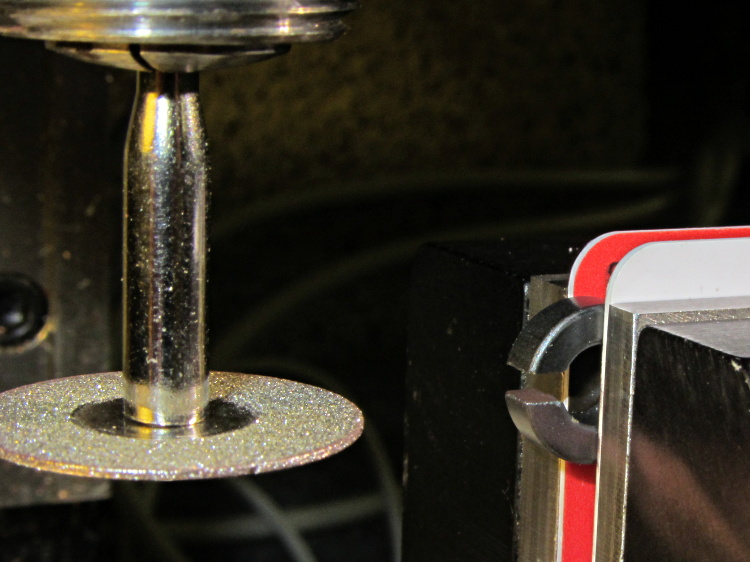
For an upcoming Circuit Cellar column on Hall effect current sensing, I slit another pair of toroids:
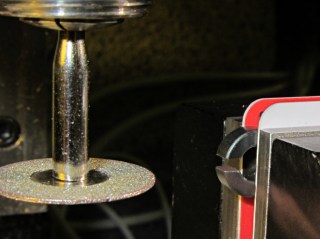
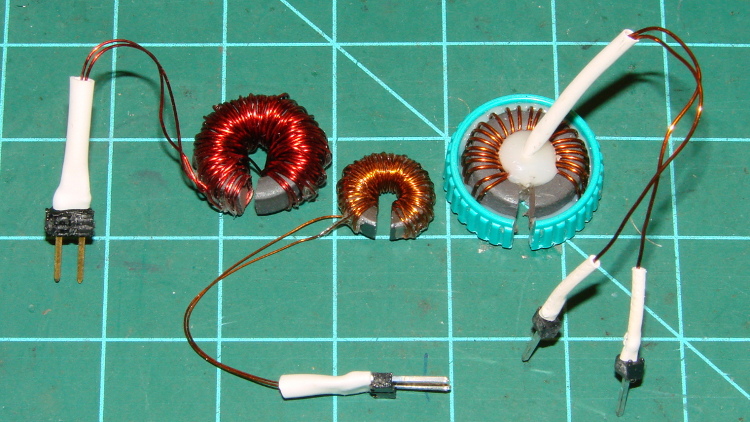
Slitting FT37 ferrite toroid Then wound them with grossly excessive amounts of wire (the up-armored core on the right appeared earlier):
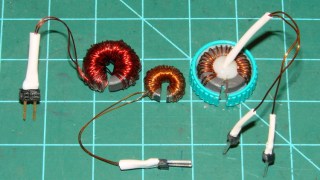
Slit Ferrite Toroid current sensors The smaller toroid is an FT37-43 that barely covers the active area of an SS49-style Hall effect sensor, but experience with the FT50 toroid suggests that’ll be entirely enough:
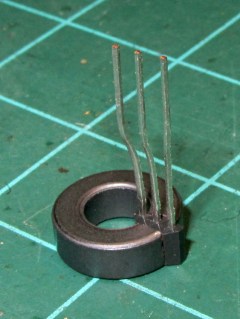
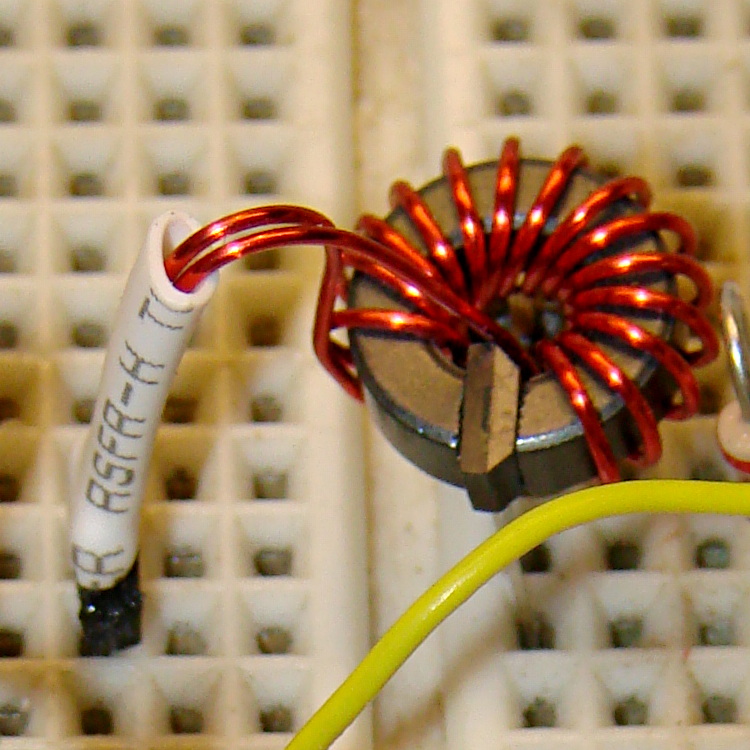
slit FT37 toroid trial fit to SS48-style Hall effect sensor Data on the uncut toroids:
Property FT50-61 FT37-43 Outer diameter (OD) – inch 0.50 0.375 Inner diameter (ID) – inch 0.281 0.187 Length – inch 0.188 0.125 Cross section area – cm2 0.133 0.133 Mean path length (MPL) – cm 3.02 2.15 Volume – cm3 0.401 0.163 Relative Permeability (μr ) 125 850 Saturation flux G @ 10 Oe 2350 2750 Inductance factor (AL) – nH/turn2 68.0 420 Those overstuffed windings improved the sensitivity, but increased the winding resistance far beyond what’s reasonable.
Data on the slit toroids:
Toroid ID FT50-61 FT37-43 FT50-61 Measured air gap – cm 0.15 0.15 0.17 Winding data Turns 120 80 25 Wire gauge – AWG 28 32 26 Winding resistance – mΩ 530 920 100 Predicted B field – G/A 872 660 163 Hall effect sensor @ 1.9 mV/G Predicted output – mV/mA 1.7 1.3 0.31 Actual output – mV/mA 1.9 1.9 0.37 Actual/predicted ratio – % +12 +46 +19 The last few lines in that table show the transimpedance (transresistance, really, but …) based on the winding current to Hall sensor output voltage ratio (in either mV/mA or V/A, both dimensionally equivalent to ohms), which is why the toroid’s internal magnetic flux doesn’t matter as long as it’s well below saturation.
Gnawing the 80 turn winding off the FT37-43 toroid and rewinding it with 15 turns of 24 AWG wire dropped the winding resistance to 23 mΩ and the transimpedance to 0.36 mV/mA:
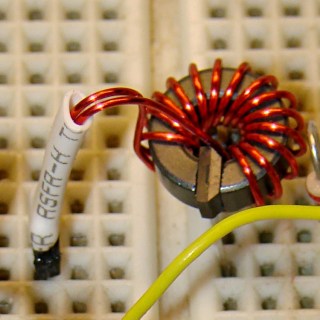
FT37-43 with 15 turns 24 AWG – Hall sensor However, applying a voltage gain of about 28 (after removing the sensor’s VCC/2 bias) will produce a 0-to-5 V output from 500 mA input, which seems reasonable.

-
Subscribe
Subscribed
Have a WordPress.com account? Log in now.

