-
LF Crystal Tester: Resonance Frequencies vs CX
Adjusting the series capacitor produces pretty much the expected results, with the parallel resonance still tracking the series peak.
CX = 19.3 pF

Fs peak: 59996.18 Hz 80.4 dbV

Fc peak: 59998.19 Hz 78.2 dbV

Delta frequency: 2.01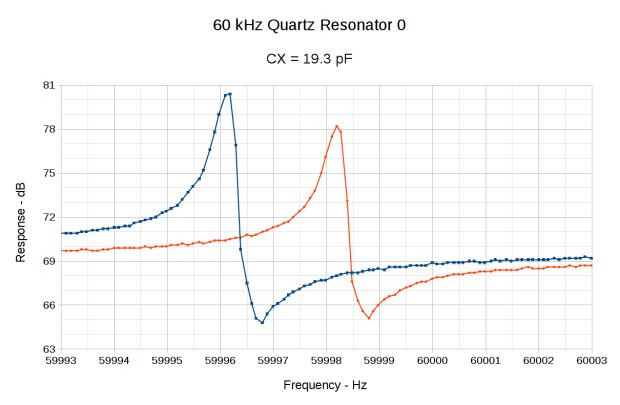
60 kHz Quartz Resonator 0 – CX 19.3 pF CX = 9.9pF
Fs peak: 59996.19 Hz 79.4 dbV
Fc peak: 59999.97 Hz 75.8 dbV
Delta frequency: 3.78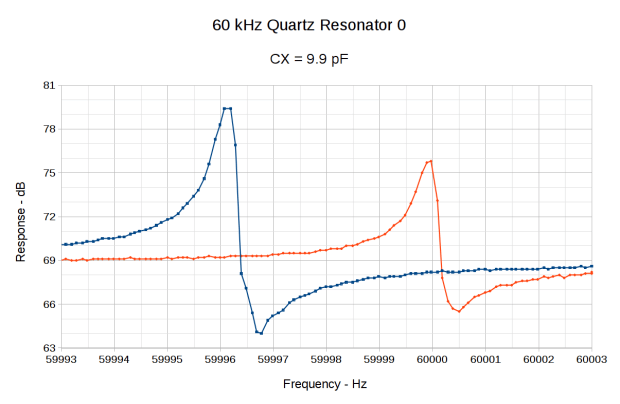
60 kHz Quartz Resonator 0 – CX 9.9 pF CX = 6.8 pF
Fs peak: 59996.10 Hz 80.3 dbV
Fc peak: 60001.48 Hz 74.6 dbV
Delta frequency: 5.38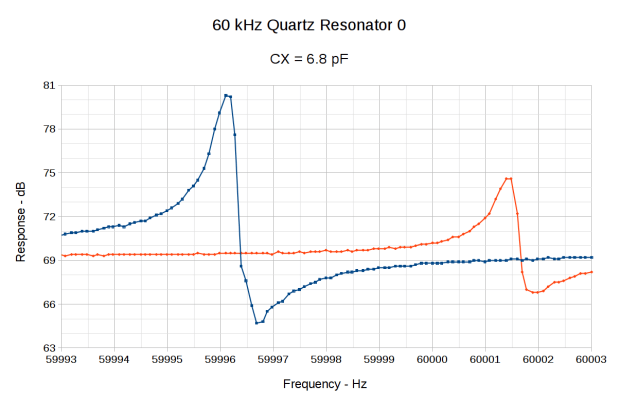
60 kHz Quartz Resonator 0 – CX 6.8 pF At the frequency resolution of these graphs, none of the standard equations are helpful; this is definitely a “tune for best picture” situation.
So, assuming the same general conditions apply in a filter, a series capacitance around 10 pF should pull the resonant peak to 60.000 kHz. Unfortunately, the cheery 76 dB level is relative to the AD8310‘s nominal -108 dBV intercept at 4 μV: the log amp sees 25 mV after the MAX4255 op amp applies 40 dB (×100) of gain to the 250 μV coming from the resonator. The resonator drive is 1 μW = 150 mV, so the resonator produces a 55 dB loss for a signal dead on frequency.
The off-peak attenuation looks like a mere 7 dB, although I hope plenty of noise masks the true result in this circuit.
Phew & similar remarks.


-
Subscribe
Subscribed
Have a WordPress.com account? Log in now.

