Ed Nisley's Blog: Shop notes, electronics, firmware, machinery, 3D printing, laser cuttery, and curiosities. Contents: 100% human thinking, 0% AI slop.
Category: Science
If you measure something often enough, it becomes science
The underside of a spinach leaf makes a fine place for a spider to guard her egg sac, right up until the leaf arrives on the kitchen cutting board just before breakfast:
Spider guarding egg sac
We deported her (and her incipient family) to the flower garden just outside, wished her well, and continued with breakfast.
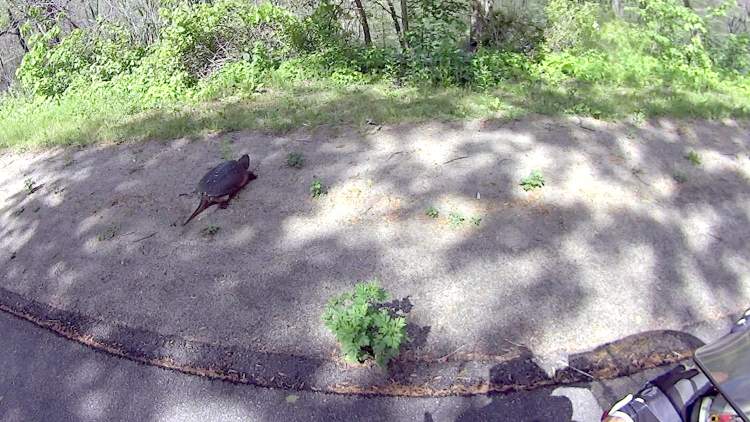
A snapping turtle headed toward the beaver pond on the Dutchess County Rail Trail:
Snapping Turtle – DCRT – 2021-05-26
At this time of year and phase of the moon, she is most likely in search of a good spot for a nest and her clutch of eggs. Being an aquatic creature, she and her progeny surely benefit from Team Beaver’s engineering.
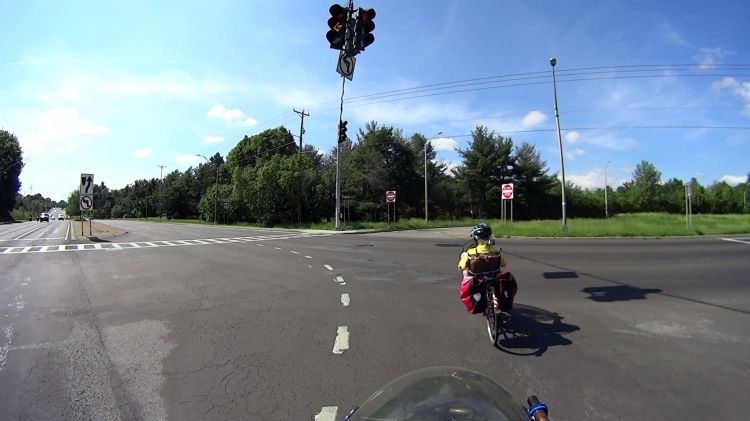
We have just started rolling from Overocker Road and the traffic signal on Burnett Blvd at Rt 55 (on the far left) has just turned green for the single car on the sensor loop:
Burnett Blvd Rt 55 – 2021-05-23 – 0 s
Much to our surprise, 17 s later the signal is still green:
Burnett Blvd Rt 55 – 2021-05-23 – 17 s
As usual, the unmarked sensor loop doesn’t detect bicycles and the control doesn’t take our clearing time into account, so the signal turns yellow 5 s later (after 22 s from turning green) while we’re still in the intersection:
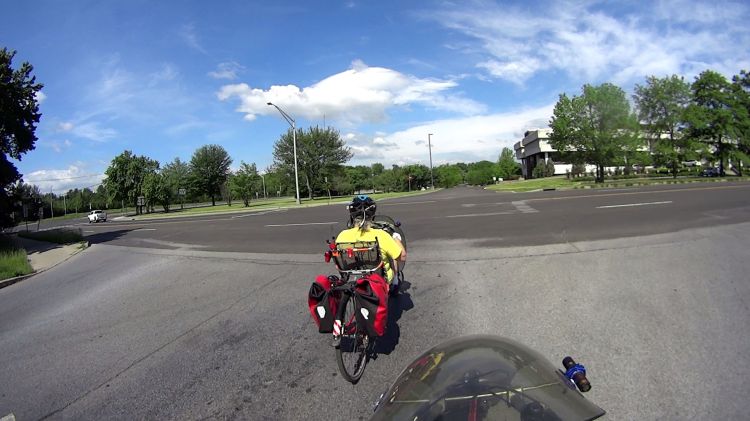
After another 6 s, though, we’re through the intersection and lined up on the right side of Rt 55, just as the Rt 55 signal turns green:
Burnett Blvd Rt 55 – 2021-05-23 – 28 s
Note that the Burnett Blvd signal remained green for 22 s, much longer than in bygone years, and the green-to-green time is now 28 s. We got through the intersection without any difficulty, although the green-to-red clearance time remains scanty.
Mary recently discovered a reason why NYS DOT may have suddenly changed the signal timing at the Burnett intersection after all those years:
During the incident, a black Nissan Titan, driven by a 51-year-old male resident of Lagrangeville, collided with a bicycle, ridden by a 58-year-old male resident of Poughkeepsie, in the area of the crosswalk on the southeast portion of the intersection, said the Town of Poughkeepsie Police.
The bicyclist sustained serious injuries and was transported to MidHudson Regional Hospital.
The crosswalk mentioned in the article appears in the last picture.
The cyclist died of his injuries shortly after that article went live.
Mary knew him. He was one of the gardeners near her plot in the Vassar Community Garden who lived in the apartments a few hundred yards from that intersection, didn’t own a car, and, for years, rode through that intersection to the grocery store at the far end of Burnett Blvd (across another of DOT’s intersections). Everyone knew him as a nice, considerate guy.
Death is the only thing that will convince NYS DOT’s engineers to change the signal timing at an intersection.
As far as I can tell, all of the other intersections along our usual routes still have the same inadequate clearance times. Evidently, the bicyclist death toll isn’t high enough to get their attention and evidence here doesn’t matter there, because motor vehicle traffic cannot be delayed, even for a few seconds, merely to protect the most vulnerable “users” of their facilities.
We’ve been bicycling all our adult lives and haven’t been killed yet, despite NYS DOT’s complete lack of attention. Our experiences justify my cynicism and bitterness.
I eventually figured out why no NYS DOT staffer will accompany me on bike trips along their “safe for all users” roads. If they did, they’d be unable to deny knowing how hazardous their engineering designs & maintenance practices are in real life, should the question come up in a court of law.
If you think that’s not the case, then let’s go riding together …
Road design, build quality, and attention to details matter, even though drivers and, yes, cyclists share some of the blame.
Mary spotted a White-breasted Nuthatch facing off against a red squirrel on the patio near the birdfeeder, wherein the nuthatch spread its wings to look as fearsome as possible. The squirrel seemed unfazed, perhaps because a bird the size of my thumb simply doesn’t pose much of a threat.
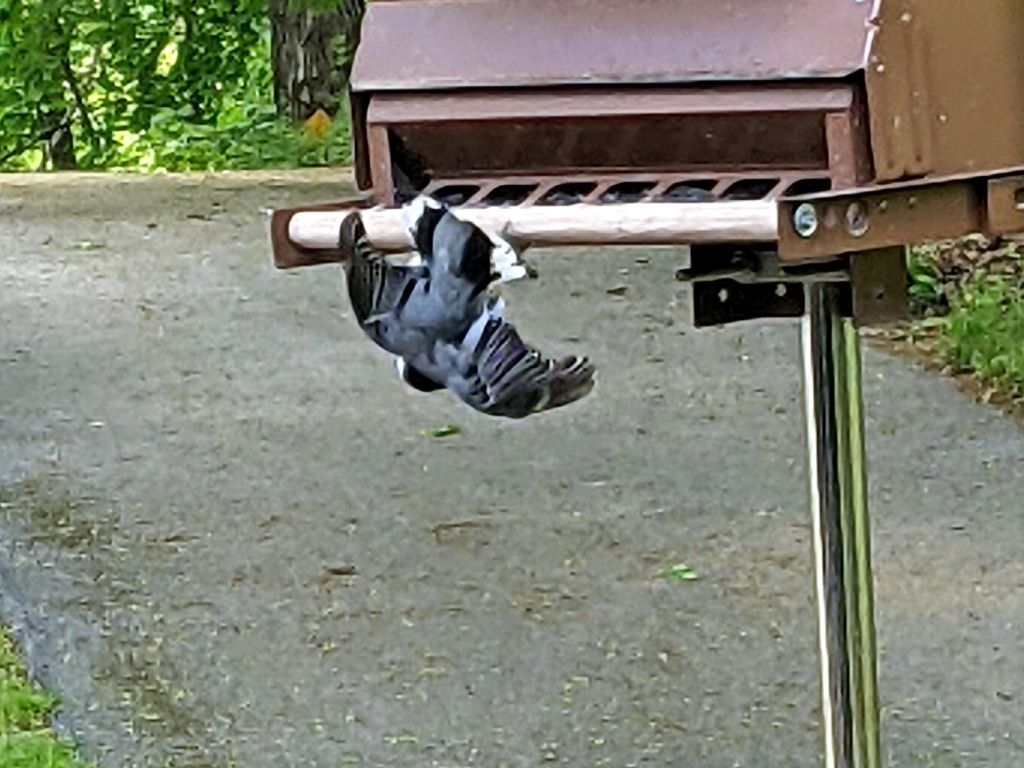
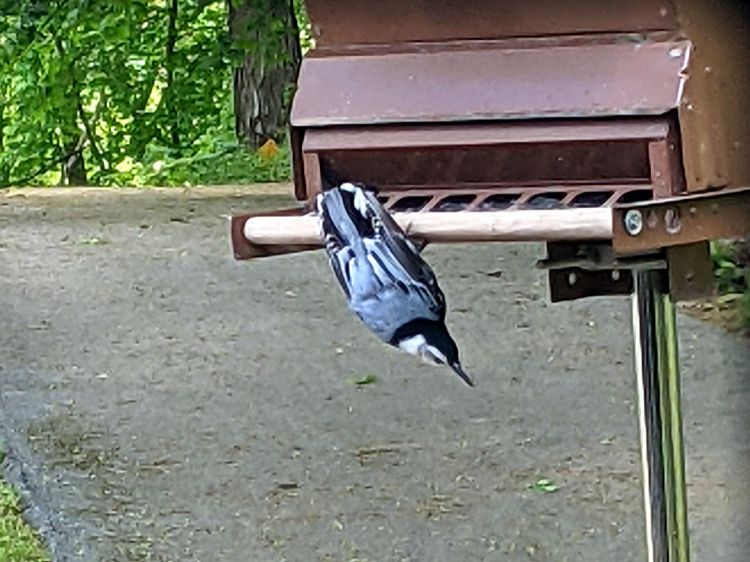
A few minutes later, the nuthatch repeated the display from the feeder, starting with a hostile side-eye:
Nuthatches are perfectly happy hanging upside-down from any convenient perch, so it’s not quite as ungainly as it may seem. However, the threat bounced off the squirrel, which continued stuffing itself from seeds scattered by none other than the nuthatch.
The nuthatch threat display seems identical to the nuthatch courtship display, so we may have been witnessing an offer for rishathra.
Ya never know!
Taken through two layers of 1955 window glass with the Pixel 3a zoomed all the way, then ruthlessly cropped.
As mentioned earlier, the Bafang brake sensors on Mary’s Tour Easy require a magnet on the brake levers to activate the switches. They arrived with disk magnets that did not suit the levers, so I used neodymium “bar magnets”:
Tour Easy Bafang BBS02 – brake sensor – installed
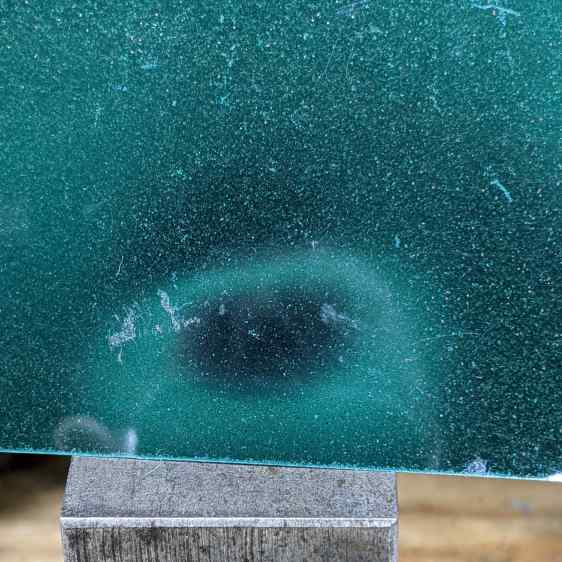
That worked for a few rides, but the alignment turned out to be entirely too critical, because the magnetization is through the bar’s thin dimension, rather than along its length, making the field weakest in the direction of the switch.
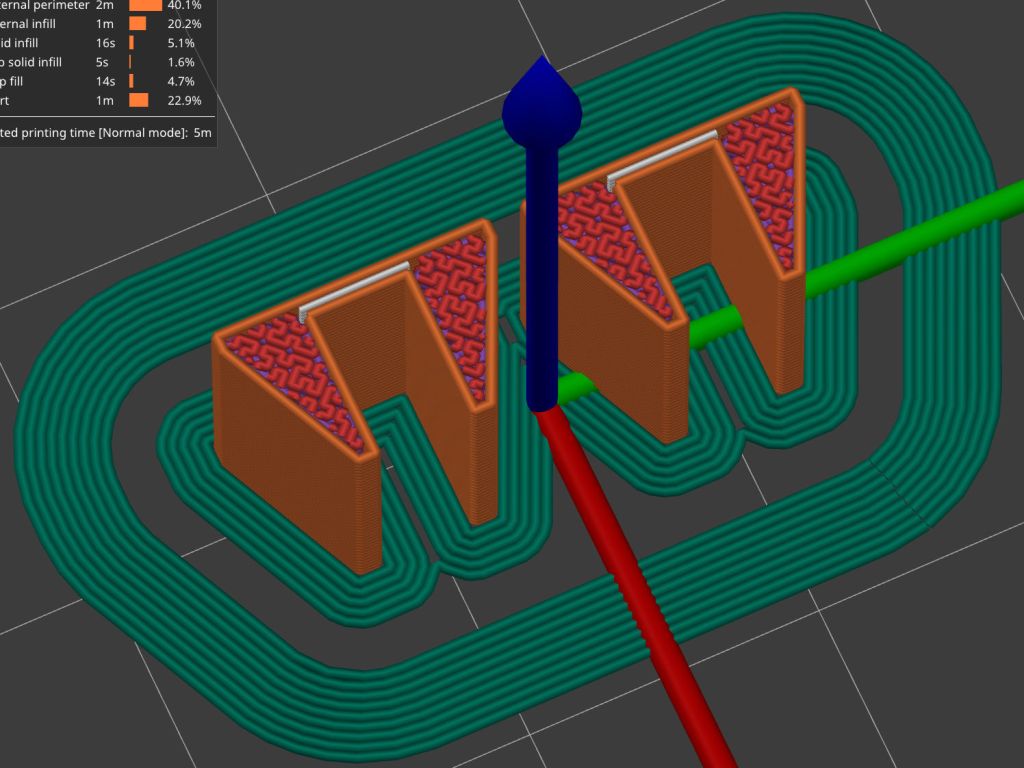
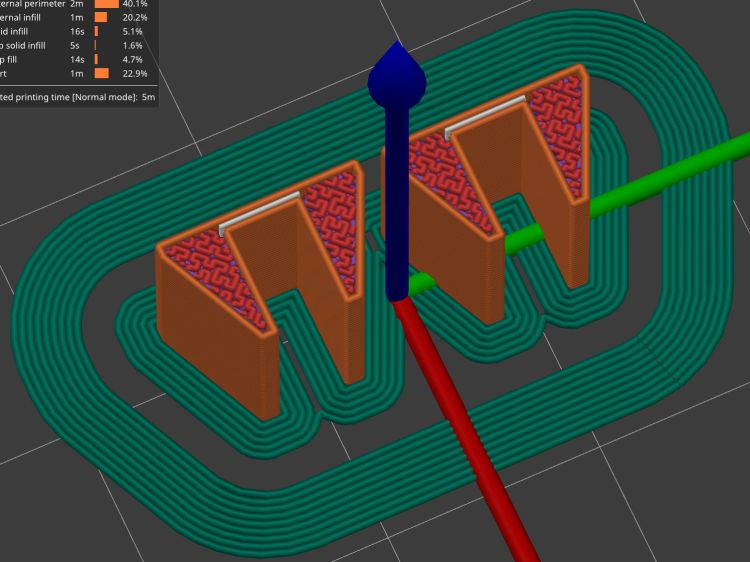
That’s a slightly shorter magnet from a different toothbrush head, cemented edgewise into a holder conjured from the vasty digital deep:
Brake Magnet Mount – PrusaSlicer prevew
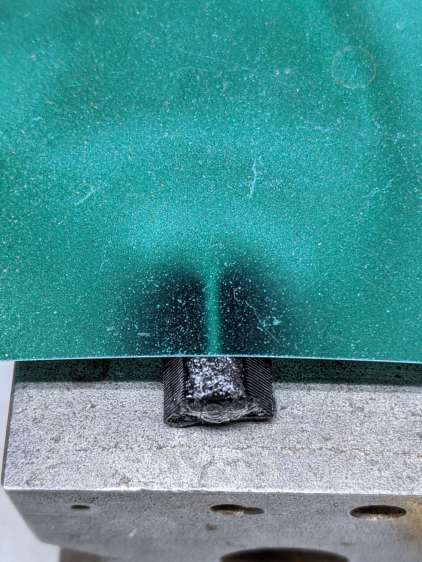
The field is much more uniform on the flat side of the bar:
Neodymium bar magnet – side field
Some double-sided foam tape snuggles the sensor and the magnet together on the brake lever:
Bafang Brake Sensor – released detail
I coated the magnet with JB Plastic Bonder urethane adhesive in the hope of filling any gaps in its nickel coating caused while extricating it from the toothbrush head.
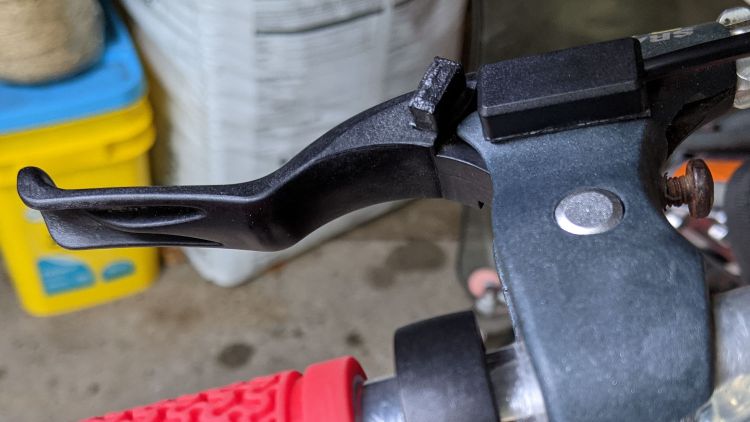
The rusty screw head in the upper right positions the lever at the proper distance from the grip to suit Mary’s hand. An earlier version of the holder shows the alignment:
Bafang Brake Sensor – released position
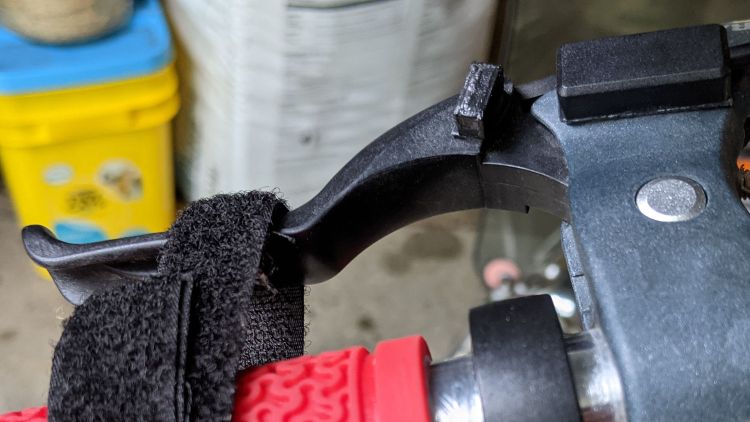
The switch trips (opens) with the lever roughly parallel to the grip, again with the earlier holder:
Bafang Brake Sensor – activated position
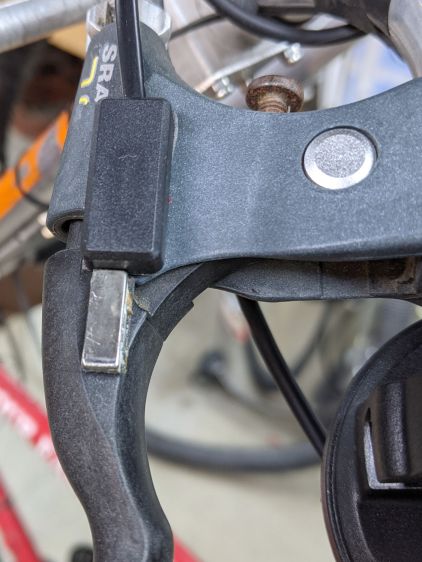
A detailed view of the gap with the lever at the tripped position:
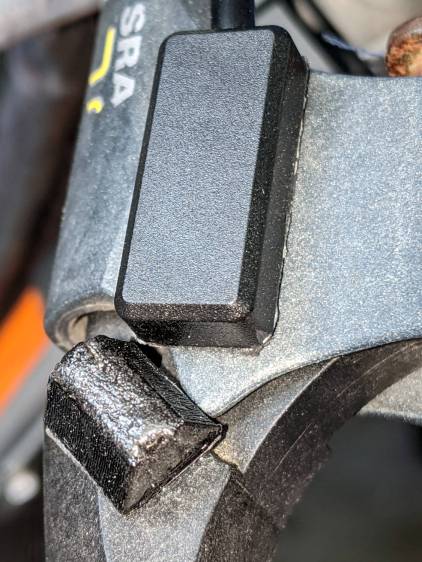
Bafang Brake Sensor – activated detail
The levers have enough travel to prevent accidental trips due to light finger pressure, which turned out to be a problem with the original end-on alignment.
The brake pads don’t quite touch the rim when the switch trips, so the motor has plenty of time to shut off before the brakes take effect. It also stops when the pedals stop turning, so we should not see any disagreement between motor and brakes as to the bike’s momentum.
The wider base on the new mounts makes them much more stable on the levers, although I don’t like having them stick up so far. Mounting everything underneath the levers would look better, but any problems will be more obvious with everything in plain sight.
I may affix the magnets directly to the levers with Plastic Bonder if the foam tape doesn’t live up to its reputation. Removing them would be more challenging; a shot with a small chisel should suffice.
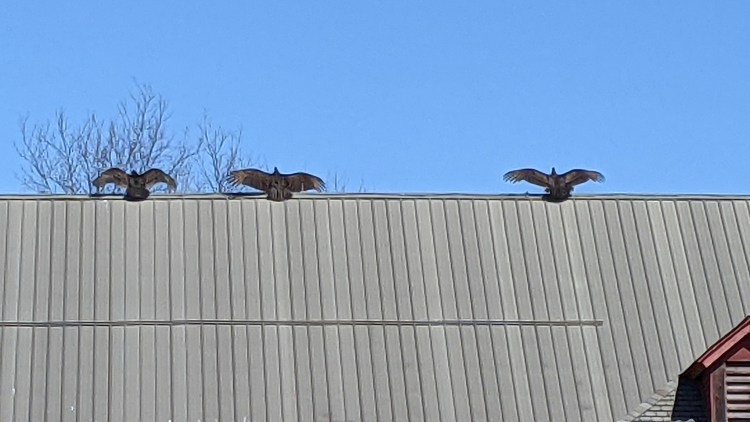
Spotted after pre-season prep at Mary’s Vassar Farms garden:
Vultures sunning
It must feel really good up there atop the old barn, even if they’re sunning themselves to kill off parasites.
Taken with the Pixel 3a zoomed all the way in at 7× from a bit over 200 feet:
Vultures sunning – photo range
Then cropped and sharpened just a smidge. Not a great picture, but good enough for practical purposes; the Good Camera + Big Glass takes better pix and is too awkward to carry in my pocket.











 The Smell of Molten Projects in the Morning