The Smell of Molten Projects in the Morning

Ed Nisley's Blog: Shop notes, electronics, firmware, machinery, 3D printing, laser cuttery, and curiosities. Contents: 100% human thinking, 0% AI slop.

Category: Science

If you measure something often enough, it becomes science

  • BatMax vs. Newmowa NP-BX1 Camera Batteries: 2022

    BatMax vs. Newmowa NP-BX1 Camera Batteries: 2022

    Two years ago, a quartet of new BatMax NP-BX1 batteries performed about as well as could be expected and, by last fall, had deteriorated about as much as expected:

    Batmax NP-BX1 - 2021-09 vs 2020-03
    Batmax NP-BX1 – 2021-09 vs 2020-03

    In round numbers, the total capacity declined from 3.25 W·hr to 2.5 W·hr, which means a single battery can’t quite power the camera for the duration of our normal hour-long rides. I do not know what voltage trips the camera’s decision, but the batteries definitely shut down sooner.

    So, based on their previous track record, I bought another quartet of Batmax batteries. Being that type of guy, I tested both the old (2020) and new (2022) sets:

    NP-BX1 - BatMax 2022 vs 2020 - used-new
    NP-BX1 – BatMax 2022 vs 2020 – used-new

    The blue traces are the C/D batteries from the as-new tests back in early 2020, the green traces are C/D after two years of use, and the red traces are the “new” quartet after their first charge in the Official BatMax Charger.

    It looks very much like BatMax is selling used batteries repackaged as new items, because they are indistinguishable from my used ones. They definitely are not the “Premium Grade A cells” touted in the description.

    I returned them for a refund and sent the test results to BatMax; they sent “new replacements” even though I said I would not pay for any future shipments. The batteries had a slightly different wrapper, but the test results were still indistinguishable from used batteries. I offered to return the package and was told that would not be needed.

    Just a few more batteries for the blinkies.

    So I bought a trio of NP-BX1 batteries from Newmowa, an Amazon supplier with a few more vowels than usual, and repeated the exercise:

    NP-BX1 - Newmowa 2022 ABC - 2022-06-29
    NP-BX1 – Newmowa 2022 ABC – 2022-06-29

    It seems three good batteries now cost about as much as four crap batteries, under the reasonable assumption chargers are essentially free.

    Three batteries isn’t quite enough for my usual rotation and, for unknown reasons, one cannot buy only batteries, so in short order I will have two chargers and six batteries.

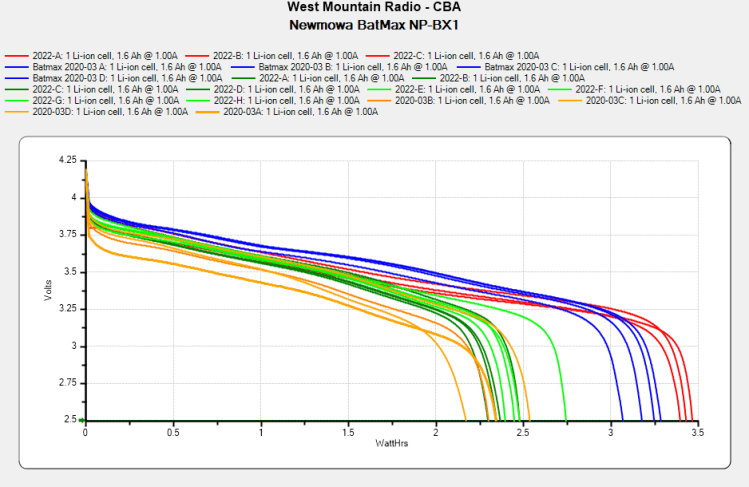
    The consolidated test results:

    NP-BX1 - Newmowa Batmax 2022 comparison
    NP-BX1 – Newmowa Batmax 2022 comparison

    The color code:

    • Newmowa: red
    • BatMax 2020 new: blue
    • BatMax 2020 used: orange
    • BatMax 2022 new: green + lime

    I stopped writing Amazon reviews after having a few detailed-writeups-with-graphs rejected for the usual unspecified reasons. As the Finn put it, “You wanna download, you know the access code already.”

  • Please Close The Gate Signage: Painted

    Please Close The Gate Signage: Painted

    It seems two months of sunlight will fade laser charred MDF down to its original state:

    Please Close The Gate - unpainted faded
    Please Close The Gate – unpainted faded

    That’s through a thick layer of indoor urethane sealant slathered over MDF without any surface prep. Obviously, not removing the char had no effect on the outcome. On the upside, the urethane did a great job of protecting the MDF from rainfall.

    So. Back to the shop.

    Lacking wider masking tape, two strips of tape laid along a cut-to-suit slab of fresh MDF will serve as a paint mask:

    Please Close The Gate - masked engraving
    Please Close The Gate – masked engraving

    Belatedly I Learned: cut the tape close to the edge, then fold it under so the autofocus pen can’t possibly snag it en passant.

    Shoot the entire surface with a couple of black enamel rattlecan coats:

    Please Close The Gate - masked paint
    Please Close The Gate – masked paint

    Yes, the engraved areas look reddish, most likely due to another complete lack of surface prep. Perhaps brushing / vacuuming / washing would remove some of the char, but let’s see how it behaves with no further attention.

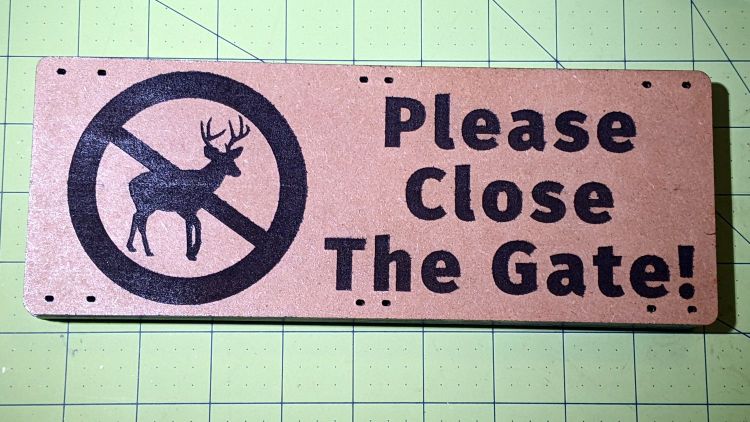
    Peel the tape, weed the letters / antlers, slather on a coat of urethane, and it looks downright bold:

    Please Close The Gate - sealed
    Please Close The Gate – sealed

    Of course, if those two tape strips don’t exactly abut, the paint produces a nasty line:

    Please Close The Gate - mask gap
    Please Close The Gate – mask gap

    Should you overlap the strips a wee bit to ensure cleanliness, the engraved surface will then have a noticeable (in person, anyhow) discontinuity due to the laser losing energy in two tape layers, which wouldn’t matter in this application. We defined the few paint lines as Good Enough™ for the purpose; a strip of absurdly wide masking tape is now on hand in anticipation of future need.

    Burnishing the tape might have prevented paint bleed around the engraved areas:

    Please Close The Gate - paint creep
    Please Close The Gate – paint creep

    But, given that I was painting raw / unfinished MDF with an unsmooth surface, burnishing probably wouldn’t produce a significantly better outcome.

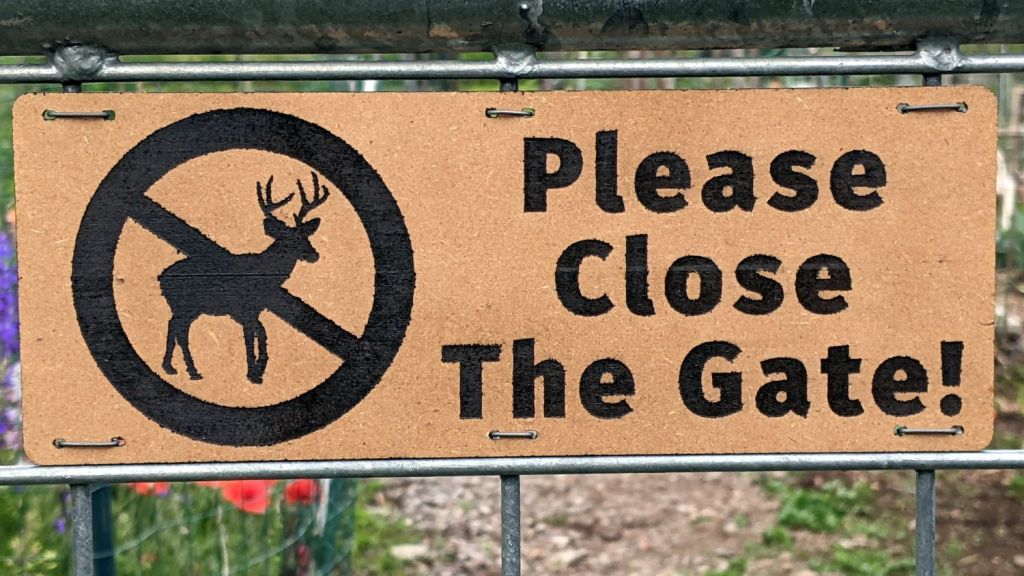
    By popular request, the new signs sit a few grids lower on the gates:

    Please Close The Gate - fresh painted
    Please Close The Gate – fresh painted

    Perhaps these will outlast the garden season …

  • LED Bulb Life Data Point

    LED Bulb Life Data Point

    A rare trip to the Poughkeepsie Railroad Station provided an opportunity to check out the LED bulbs in the chandeliers:

    • Pok RR Station - Chandelier A
    • Pok RR Station - Chandelier B
    • Pok RR Station - Chandelier C

    The 108 bulbs had only one deader (lower left in chandelier C).

    I have no way of knowing if they’re the same bulbs from six years ago, but the accumulation of bugs / dust / crud inside the (what I would expect to be) sealed envelopes suggests they’ve been hanging there for quite a while:

    Pok RR Station - Chandelier B - detail
    Pok RR Station – Chandelier B – detail

    The dark cruciform patches might come from failed LED chip strings, although the bulbs all had the same eyeballometric brightness. The patches all seem to have a hard lower edge, so we may be seeing shadows from dust accumulating atop the chips on the PCB.

    They’re a definite step up from CFL bulbs, although still not as pleasant as OG incandescent filaments.

  • Nothing Lasts, Chemical Edition

    Nothing Lasts, Chemical Edition

    Cleanup after painting the hairlines involved opening the cap of the rarely used can of methyl ethyl ketone:

    MEK can - fractured cap
    MEK can – fractured cap

    It seems white-tinted polyethylene deteriorates after a dozen years of exposure to concentrated MEK fumes, suggesting I don’t use nearly enough enamel paint.

    The Container Stockpile disgorged a pair of pure polyethylene jars that should last another decade.

  • Onion Maggot Flies vs. Sticky Traps: Round 1

    Onion Maggot Flies vs. Sticky Traps: Round 1

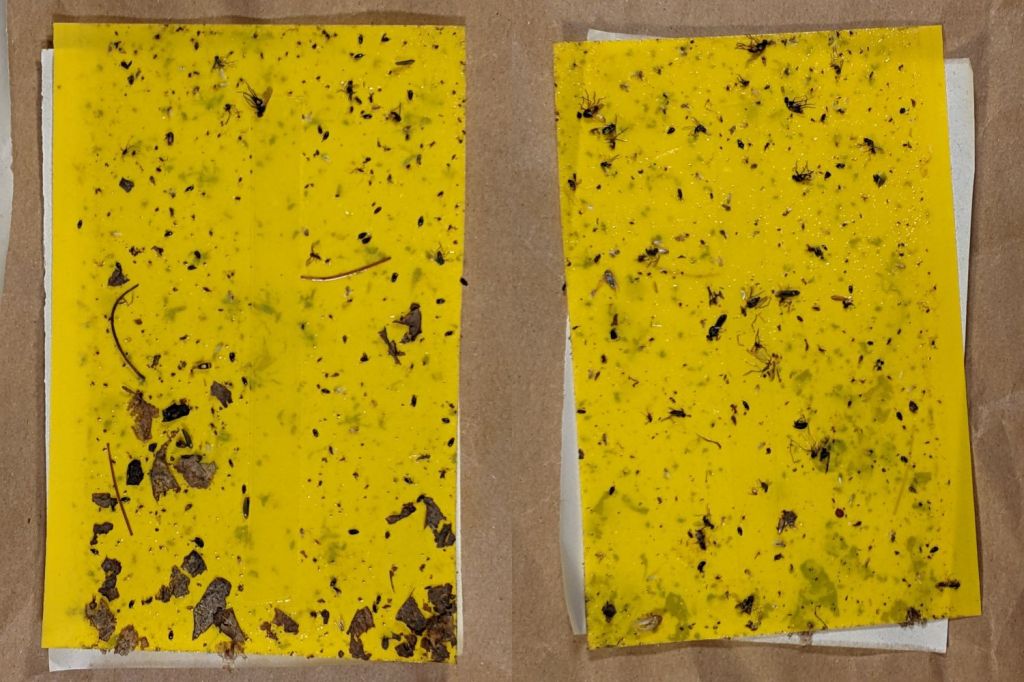
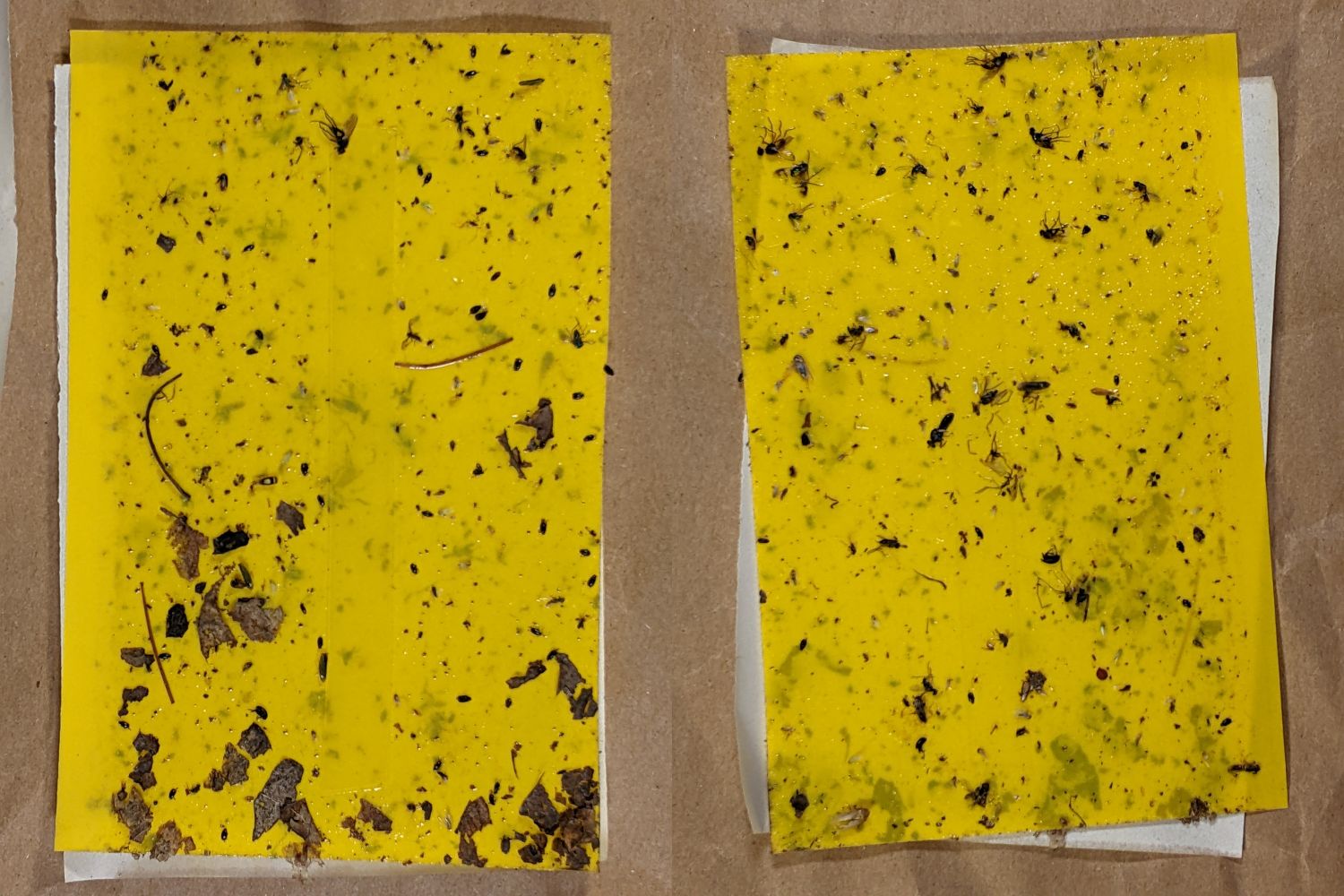
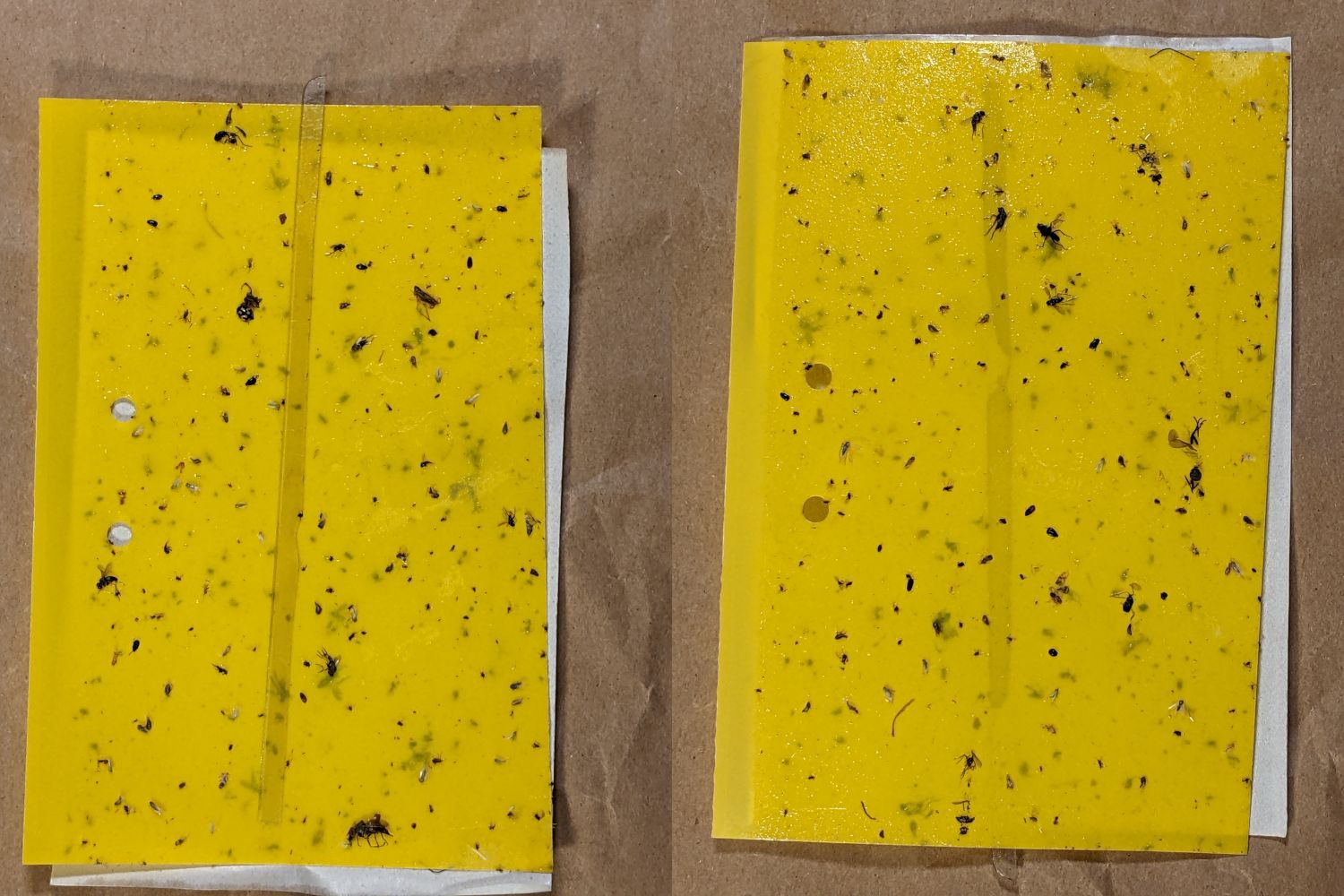
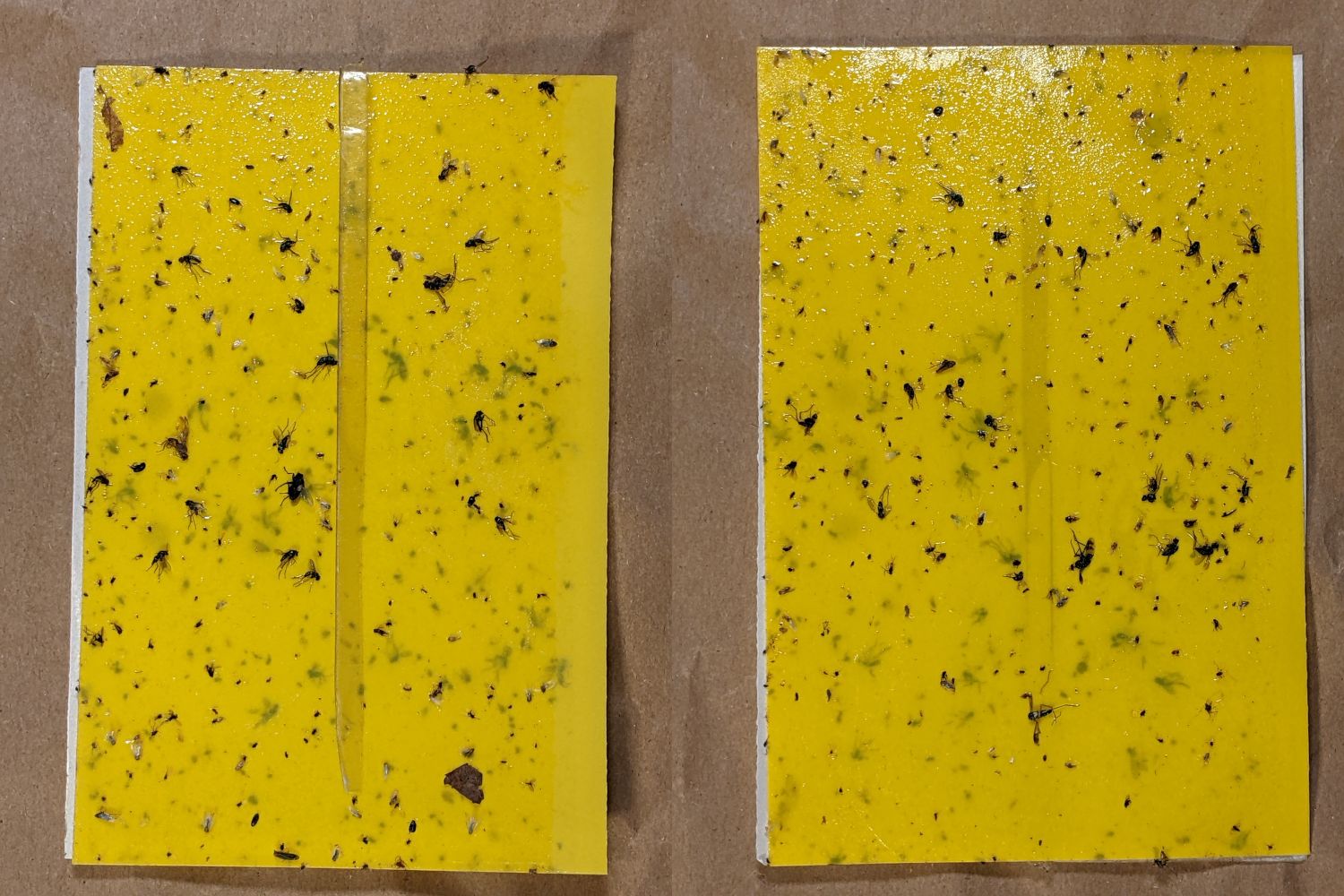
    We deployed six sticky traps in the onion patch immediately after planting in late April and replaced the cards in mid-June. The first set of cards collected a considerable number of what resemble, to my untrained eye, onion maggot flies and the onion plants remain healthy:

    • VCCG Onion Card A
    • VCCG Onion Card B
    • VCCG Onion Card C
    • VCCG Onion Card D
    • VCCG Onion Card E
    • VCCG Onion Card F

    Each image shows both sides of a single card.

    The cards sit a foot above the shredded leaf mulch and I managed to drop at least one of the cards while extracting it from the cage, but they all have plenty of onion maggot flies in addition to the random debris.

    The cards inside their cages have not accumulated larger insects like honeybees / moths / butterflies, although the tiniest specks are definitely mini-critters along the beetle / gnat / aphid / mosquito axis.

    Unlike last year, the second set of cards will remain in place until harvest to maintain continuous pressure on the fly population.

    If you’re really interested, the dozen original camera images have more detail.

  • OMTech 60 W Laser: Wood Cutting

    OMTech 60 W Laser: Wood Cutting

    Just to see how the OMTech 60 W laser cuts wood:

    Laser cut wood samples
    Laser cut wood samples

    From left to right:

    • 5.3 mm oak plywood: 10 mm/s 70% (1/4 inch)
    • 7.7 mm plywood: 6 mm/s 70% (from OMTech crate)
    • 19 mm pine: 2 mm/s 70-80% (3/4 inch)
    • 20 mm oak: 2 mm/s 70% (3/4 inch lovely wood)
    • 19 mm maple: 2 mm/s 80% (3/4 inch shelving)
    • 20 mm plywood: fail at 2 mm/s 90% two passes

    I thought a pine plank would cut faster than oak, but they’re equally stubborn.

    Maple requires slightly more power, with the glued butt joints between the slabs putting up a stiff resistance.

    A sheet of 3 mm MDF cuts well at 20 mm/s 60% and I expect 3 mm plywood might need similar numbers.

    A pervasive odor of burned wood seems to be the only downside; if you think a wood stove is a good idea, you’ll love laser cutting the stuff. Sanding the blackened perimeter and sealing the surface surely helps, but it’s feasible only for the kind of simple convex shapes you don’t really need a laser to cut.

  • Gentec ED-200 Optical Joulemeter: Oscilloscope Comparison

    Gentec ED-200 Optical Joulemeter: Oscilloscope Comparison

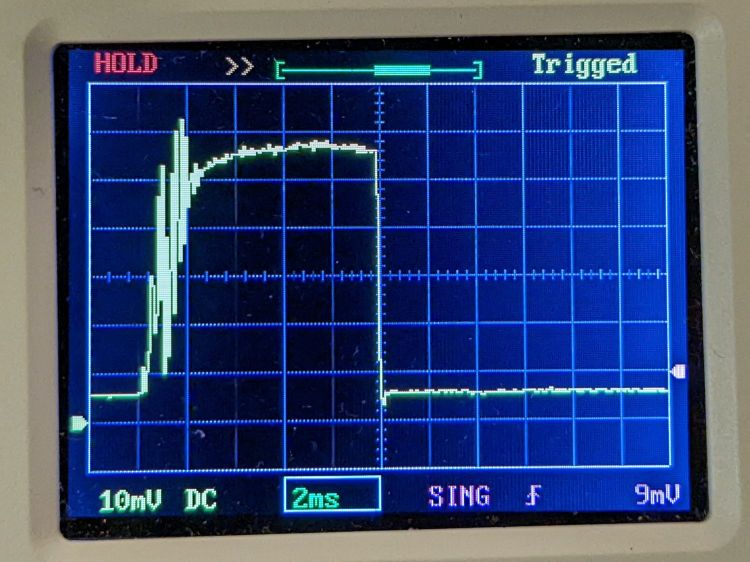
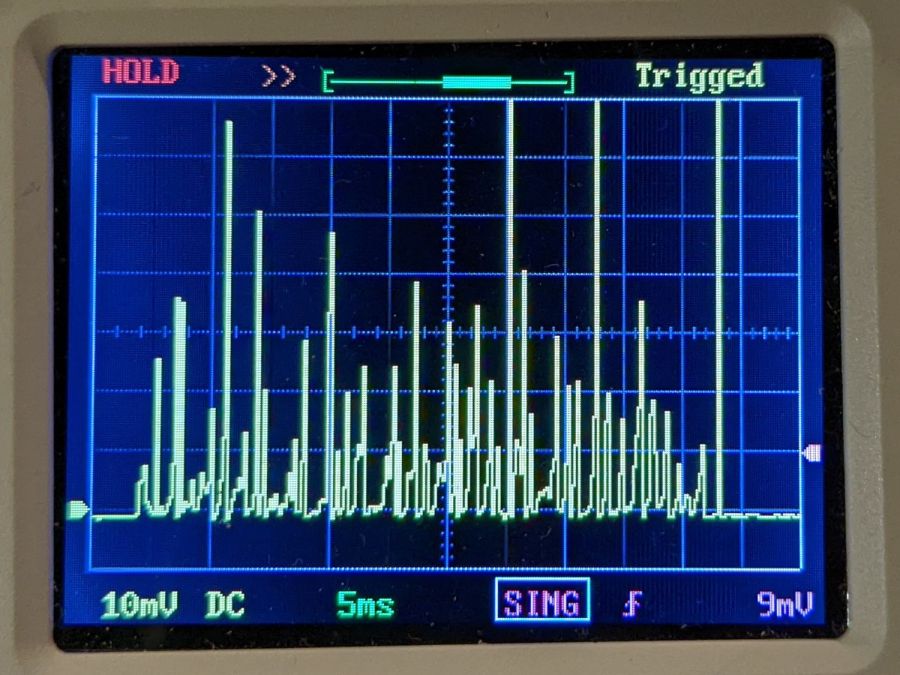
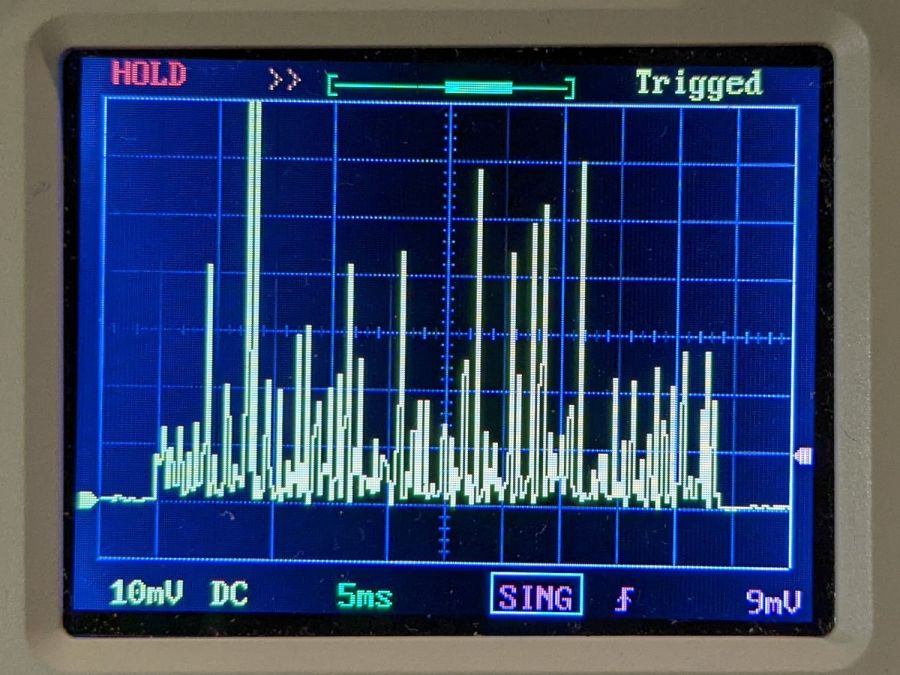
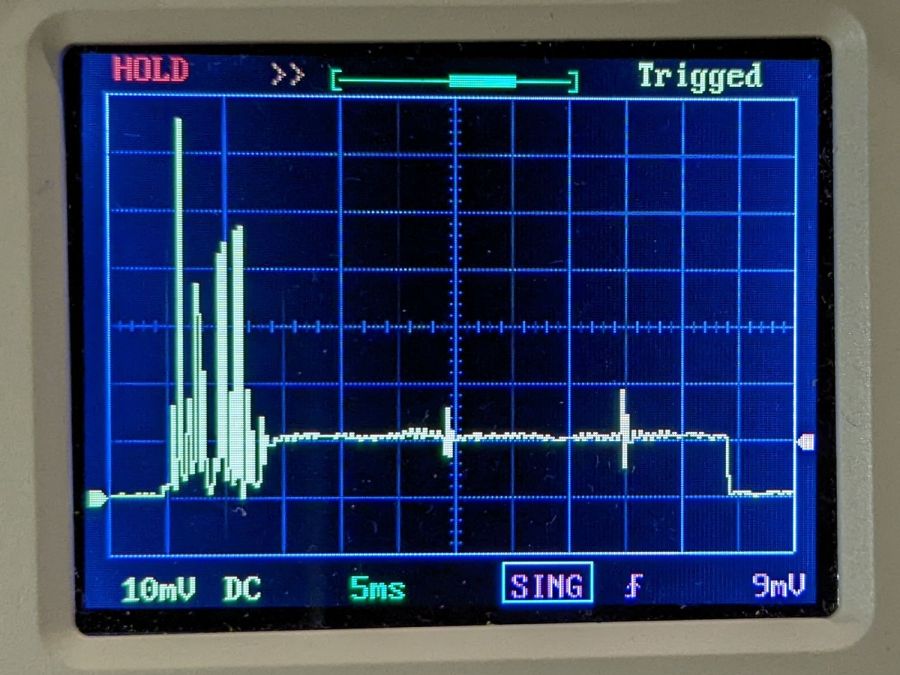
    The little DSO-150 oscilloscope has a 1 MΩ || 20 pF input with a 200 kHz bandwidth that should be entirely adequate for the OMTech laser’s millisecond-scale modulation signals from the Gentec ED-200 Optical Joulemeter. There is, however, only one way to be sure:

    Gentec ED-200 - scope test setup
    Gentec ED-200 – scope test setup

    The two scope inputs are in parallel, so the joulemeter over on the far right sees a 500 kΩ load, half of the specified 1 MΩ load, with at least twice the capacitance. If the two scopes display pretty much the same result, then it’s good enough.

    A 50 ms pulse at half power looks the same on both scopes:

    • Gentec ED-200 - 50 ms - DSO-150
    • Gentec ED-200 - 50 ms - Siglent

    A 50 ms pulse at full power doesn’t quite top out:

    • Gentec ED-200 - 11V 50ms - DSO-150
    • Gentec ED-200 - 11V 50ms - Siglent

    Given that the pulse duration should be less than the detector’s 1.5 ms risetime, using a 50 ms pulse is absurd. Right now I’m just looking at the overall waveform and detector range, not trying to get useful numbers out of the poor thing.

    All in all, the DSO-150 will do just fine.