The Smell of Molten Projects in the Morning

Ed Nisley's Blog: Shop notes, electronics, firmware, machinery, 3D printing, laser cuttery, and curiosities. Contents: 100% human thinking, 0% AI slop.

Category: Recumbent Bicycling

Cruisin’ the streets

  • Byonics TinyTrak3+ GPS Power Control

    GPS power from MOSFET relay
    GPS power from MOSFET relay

    The Byonics TinyTrak3+ GPS encoder has a “Power Control” output that can switch the power to a radio or GPS interface. J6 provides the interface: pin 1 = common, pin 2 = high active.

    With the “Power Switch” option enabled in the config program, you can set the number of seconds to allow the GPS unit to get up to speed before the next scheduled transmission.

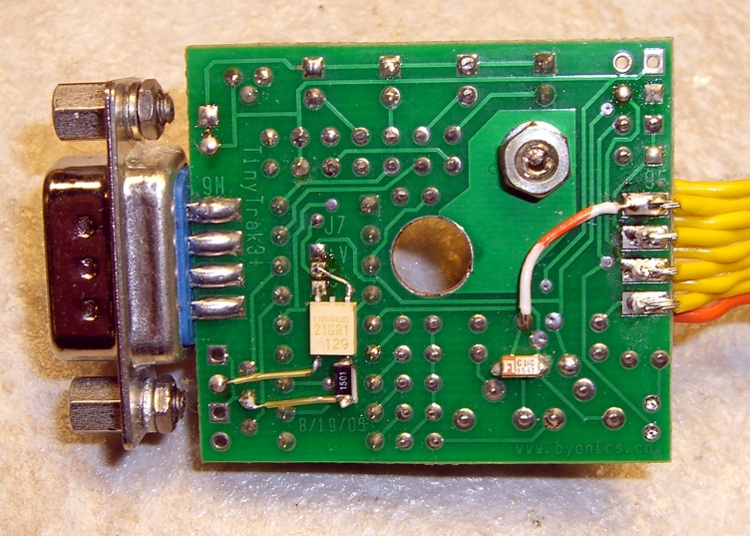
    I glued a surface-mount MOSFET relay to the back of the PCB with urethane adhesive; it fits neatly between the DIP microcontroller’s pins with one output lead soldered to the 5V pad of J7. The other lead goes to the center +V pad; because the relay uses back-to-back MOSFETs, the polarity doesn’t matter.

    That replaces the normal solder bridge across J7 that provides power (on pin 4) to the GPS2 plugged into the DB9 connector. When the relay’s on, it connects the GPS to the power supply. When it’s off, the GPS goes dark.

    The relay input is an LED with a forward drop of 1.3 V max and requires 4 mA to turn on: figure 3.7 V / 4 mA = 925 Ω max. I kludged an 890 Ω resistor by paralleling (stacking!) 1.5 k and 2.2 k resistors; you could probably use anything near that and it’d work fine.

    The relay is an OMRON G3VM-21GR1, part number A11171 from Electronics Goldmine, but I suspect any teeny little solid-state relay would work. The max on resistance is about 1 Ω and the receiver draws about 65 mA. I measured about 20 mV of drop, so the actual resistance is a lot lower than the spec.

    I initially set the power-on delay to 10 seconds, which seemed to be OK: the GPS (green) LED would blink a few times, then go solid. Alas, the warm-start spec for the Byonics GPS2 (see the GPS3 for details) receiver is really 38 seconds, average, and it was definitely producing bogus position data. So I set the delay to 60 seconds and we’ll see how that works; early reports indicate the coordinates still have plenty of jitter.

    [Update: 60 seconds is iffy. 90 seconds seems to work pretty well. A bit of rummaging says that the satellites broadcast their ephemeris data every 30 seconds, so 90 seconds allows for two complete update cycles. Maybe 100 seconds would be even better. Some old background info for Garmin hand-held receivers is there.]

    It’s obviously a tradeoff between accuracy and battery life. This is for use on a bicycle and, believe me, I don’t want to tote a huge battery!

    If the control signal was low-active, then you could use a cheap PNP transistor as a high-side power switch.

    The white/orange wire routes regulated 5 V through an otherwise unused pin to the homebrew interface that combines the GPS data with helmet mic audio. The tiny rectangle is a 1 µF cap that helps cut down digital noise. There’s no need for a connector on that end, as it’s wired directly to the interface circuit board inside a small enclosure.

  • Tour Easy: Fitting Novara Transfer Bike Panniers

    Mary recently replaced her well-worn REI packs with a pair of Novara Transfer panniers, chosen because they’re just about the biggest packs available without insanely specialized world-touring features. They seem rather less rugged than the older ones, so it’s not clear how long they’ll last.

    They fit her Tour Easy recumbent fairly well, but there’s always a bit of adjustment required.

    Ramp on front edge of lower clamp rail
    Ramp on front edge of lower clamp rail

    She hauls tools and clothing and veggies to & from her gardens, food from the grocery store, and the Token Windows Laptop to presentations. She brings the packs inside, rather than leave them on the bike, so they get mounted & dismounted for every ride.

    The packs hang from the top bar of the rear rack, with a sliding clamp near the bottom of the pack that engages the rack’s vertical strut. I adjusted the clamp to the proper fore-and-aft position, but we found that the front end of the rail holding the clamp jammed against the seat support strut. That’s not a problem found on a diamond-frame bike.

    The top picture shows the solution: Mr Pack, meet Mr Belt Sander. A ramp chewed onto the front end of the rail lets it slide neatly over the strut and all is well. The only trick was to avoid sanding through the pack fabric: the line perpendicular to the rail is sanding dust, not a gouge!

    Acorn nut caps inside pack
    Acorn nut caps inside pack

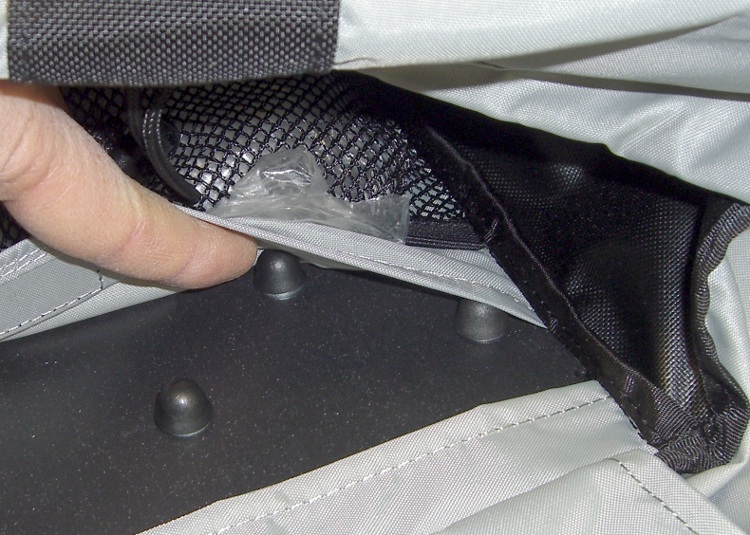
    Each top rack hanger mounts to the plastic pack frame with three bolts covered by plastic acorn nuts on the inside; the acorns cover actual metal nuts, so it’s a lot more secure than it looks. Three more bolts secure the bottom rail to the frame, with three more acorns poking into the pack, for a total of nine acorn nuts.

    Most folks carry clothing and suchlike in their packs, so the 10 mm bump at each acorn presents no problem. Unfortunately, those things look like a nasty bruising hazard for soft veggies and groceries.

    Top hanger pad - outside view
    Top hanger pad – outside view

    I sliced up some closed-cell foam packing material (everybody saves some of that stuff, right?), punched holes at the appropriate locations, and tucked the pads over the acorns. An inner fabric layer covering the frame and nuts should hold the pads in place.

    Bottom pads with hole punch
    Bottom pads with hole punch

    It’s not clear the bottom pads will stay in position, but I wanted to try this without adhesives, mostly because I doubt any adhesive can secure polyethylene foam to whatever plastic the pack frame is made from or coated with. Perhaps double-sided foam tape will work?

    Top pad - with tools
    Top pad – with tools

    So far, the early reviews are good …

  • Tour Easy Coily Lock Holder

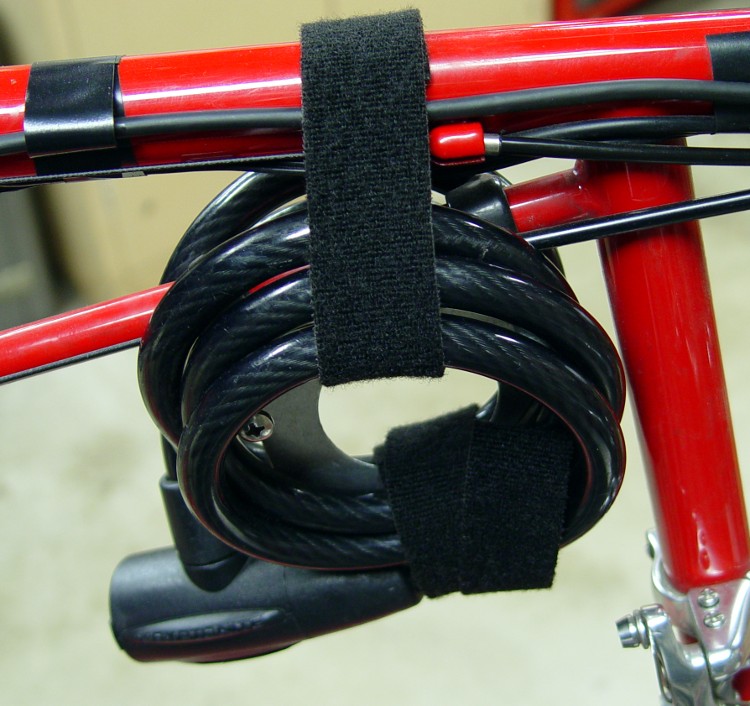
    Coily-cable bike lock holder
    Coily-cable bike lock holder

    Although I’m pretty sure nobody would think of stealing my Tour Easy (“How long did it take you to learn to ride that thing?”), it’d be a shame to be wrong. So I carry a coily-cord lock and lash the bike to a post or, for lack of anything better, the front wheel to the frame.

    If they can figure out how to get the back wheel out in less than ten minutes without a work stand, they’re a damn sight better mechanic than I!

    Anyhow, the trouble with a coily lock is that it’s far too heavy and sinks to the bottom of whatever pack you put it in, crushing the groceries on the way down.

    So I built a small plate, tucked into the corner above the bottom bracket, to hold the lock out of the way and within easy reach.

    dsc03596-lock-holder-right
    Lock holder – right side

    It’s a 1/16-inch aluminum plate held to the bike frame with a pair of padded clamps. I applied a hole saw to the middle to get a way to lash the lock to the plate with two more of those ubiquitous Velcro straps.

    The 2.5-inch 10-32 machine screws support the cable coils; the lock already has a plastic coating, so I didn’t bother putting any padding on the screws. Nuts on both sides compress the clamps and support the plate.

    The small aluminum plate sticking up prevents the lock coils from pressing the brake cable against the frame. If you forget that, your back brake won’t release completely.

    Lock holder - left side
    Lock holder – left side

    There’s nothing fancy on the left side…

    Put Loctite on the threads under the nuts to ensure nothing rattles loose!

    The black cable taped to the top frame tube carries the push-to-talk button back to the amateur radio behind the seat. That’s a story for another time.

  • Recumbent Bicycle Chain Catcher

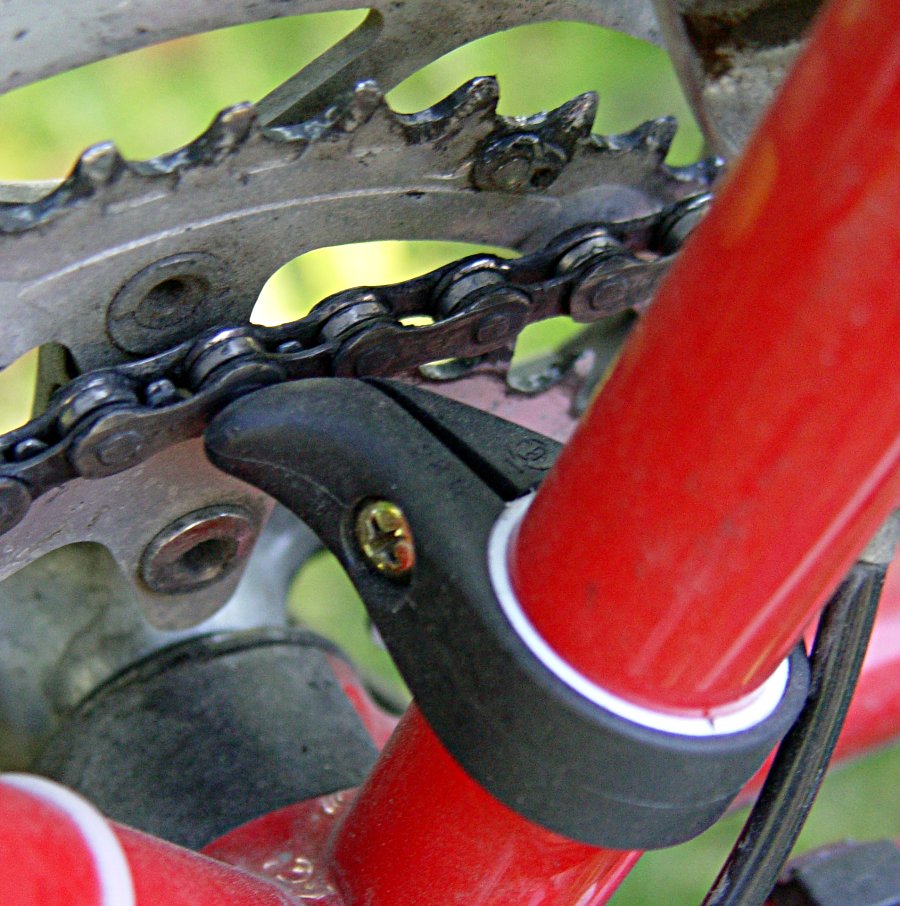
    Chain catcher
    Chain catcher

    You’re puffing up a serious hill, finally downshift to the smallest chainring, and the chain falls off on the inside. You’re already at stalling speed, so you stop abruptly and gracelessly. If you haven’t used up your weekly luck allotment, you neither fall over nor get rammed by the rider behind you.

    Not to be endured, sez I.

    The solution is the Chain Catcher from Bike Tools Etc. It normally attaches to the seat tube of diamond-frame bikes and prevents the chain from falling off inside the smallest chainring, but it works fine on ‘bents, too.

    Alas, their smallest Chain Catcher, part number CC-04A, fits a 28.6 mm seat tube: it’s much too large for the 1-inch tube on a Tour Easy.

    Never fear! Go to your local home-repair store with ruler in hand and examine the plumbing aisle’s plastic fittings. I used a sink drain tailpiece, but any tube with an outside diameter over 1-1/4” and 1/16” walls will work. Buy one, take it home, cut off a ring as wide as the Chain Catcher with a saw or a razor knife, and smooth the edges. Cut the ring lengthwise, slip it over the bike tube, mark the spot where the ends cross, remove it, and trim to fit neatly on the tube.

    If you make a mistake, you have spares aplenty…

    (This is trivially easy with a lathe, but you need not go full-on geek for this project.)

    Install the Chain Catcher over your shim with its thumb pointing forward and align it with the chain’s rivets, not quite touching the chain on the smallest ring. Firmly tighten the Catcher’s mounting screw.

    This won’t fix a badly adjusted front shifter, but it does eliminate those occasional glitches.

    Ride on!

  • Tour Easy Handlebar Hydration Mount

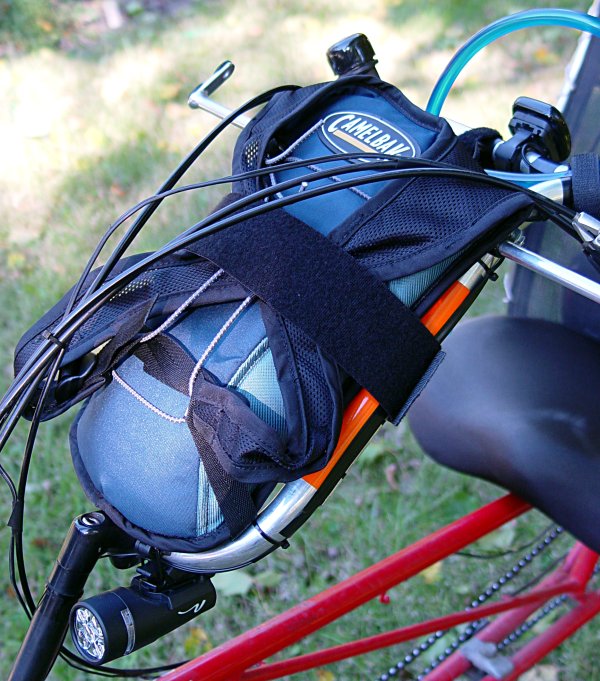
    Handlebar-mounted hydration pack
    Handlebar-mounted hydration pack (fairing removed for visibility)

    My esteemed wife returned from a shopping expedition with the crushed remains of a water bottle that fell out of her Tour Easy’s under-handlebar cage. Fortunately, the truck flattened the bottle, not her, but Something Had To Be Done. She also had trouble maneuvering those newfangled long-body bottles around the rear edge of the Zzipper fairing.

    My TE has a hydration pack attached behind the seat with the hose passing around my arm to a Velcro (nah, it’s generic hook-and-loop) strip safety-pinned to my shirt. Mary didn’t like that arrangement, because it required some fiddling when she sat down and poked pinholes in her shirt. She wanted an arrangement that Just Worked.

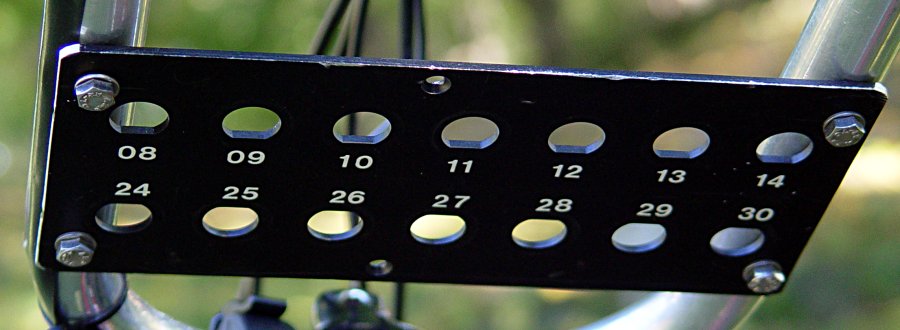
    Recycle pack support plate
    Recycled pack support plate

    I removed the under-the-handlebar bottle cages from her bike and bolted a salvaged aluminum plate to the four tapped ferrules. The numbered holes on the plate originally held coaxial cable connectors, but I think they give the plate that snooty, high-tech, drilled-out, weight-weenie look.

    A 50-ounce hydration pack (“Styled for women!”) fits neatly atop the plate, below the cables, and between the handlebars. We wrapped a two-inch-wide Velcro bellyband around the pack, Velcroed the bag’s top loop to the handlebar’s crosspiece, and secured the valve with another Velcro strap that doubles as her parking brake. The whole affair looks quite tidy under the fairing.

    Now she simply picks up the hose and takes a sip: no acrobatics, no dropped bottles, no hassle. Life is good!

  • Recumbent Bike Kickstand Ground Plate

    Kickstand ground plate in action
    Kickstand ground plate in action

    Have you ever done this? You pull up to a rest stop, flip down the kickstand, walk off to snarf some snackage, and crash your ‘bent falls over behind your back. Not only is it tough to look cool when that happens, even a zero-mph drop can scuff up your bike.

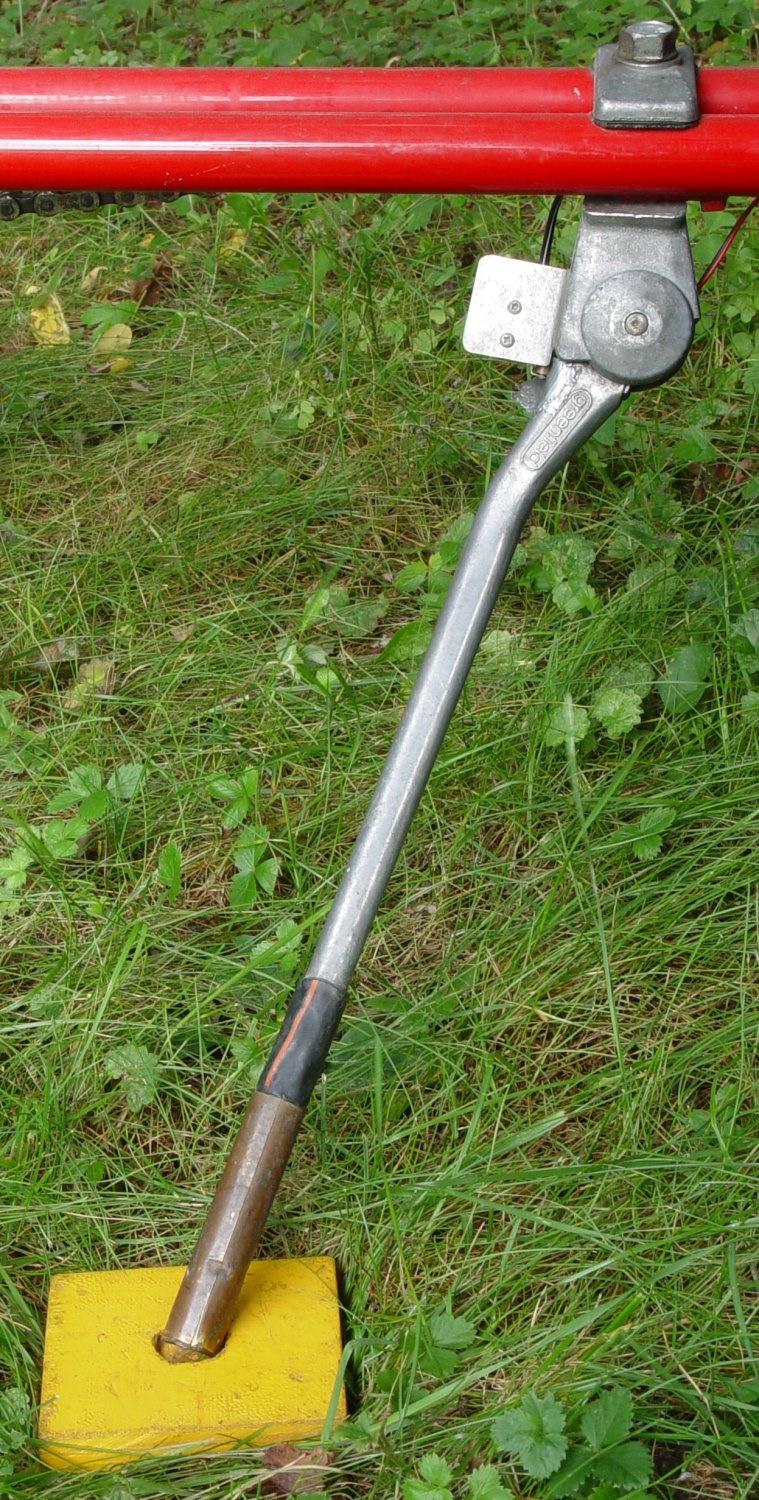
    A long recumbent leaning heavily on its kickstand will inexorably push that spike right into mowed turf, bike-tour mire, or sun-softened asphalt. The small plywood square shown in the first photo solves that problem: the kickstand fits into a shallow recess and the plate spreads the bike’s weight so it simply can’t penetrate the ground.

    The plate is a 3-inch square of 1/2” plywood, painted bright forget-me-not yellow. I used a 3/4” Forstner bit to drill a flat-bottomed recess through the top veneer layer, but you can poke several shallow holes with a 1/4” drill and then carve out the rest with a knife or chisel. The recess captures the end of the kickstand so the bike can’t slide off the block.

    The parking brake shown in the second photo will keep your bike firmly in place even when you park on a slope. It’s a hook-and-loop (a.k.a Velcro) strip pulling the brake lever to the handgrip. Your nearby big-box retail store’s computer department mislabels these as “cable organizers” and a single package will provide enough parking brakes for your entire fleet.

    Bicycle parking brake strap
    Bicycle parking brake strap

    Notice that dark extension on the kickstand? Just after I got my Tour Easy, I decided that the kickstand was about an inch too short. Rather than buy a new kickstand, I jammed a few inches of 1/2” copper water pipe on the end, trimmed it to the proper length, and sealed the top with glue-filled heatshrink tubing. Aluminum plus copper equals corrosion, but that lasted for about five years before the entire kickstand failed.

    The small plate on the kickstand hinge holds a switch that lights an LED on the handlebars when the kickstand is down. It’s surprising how far you can slide on your forearms along a steep downhill asphalt road when you forget to flip the kickstand up, but that’s a story for another time.

    A slightly different version of this note appeared in Recumbent Cyclist News back in early 2006, more or less, but everybody keeps asking me about that little yellow plate when we’re on organized rides.

  • Tour Easy Rack Mounting Hack

    Photo 1 - Spherical Washer
    Photo 1 – Spherical Washer in Action

    A recumbent’s comfy seat doesn’t have a seat post, so standard rear racks don’t fit very well. The usual solution involves nylon cable ties and some cursing, but that just didn’t appeal to me. Here’s how I mounted an ordinary JandD rear rack on our Tour Easy ‘bents.

    Because both the angle and position of the seat support struts changes change with each seat adjustment, you can’t simply bolt the rack to a plate across the struts. This is a job for spherical washers, as shown in Photo 1, which allow both angular adjustment and rigid mounting.

    Photo 2 - Rack Mount Parts
    Photo 2 – Rack Mount Parts

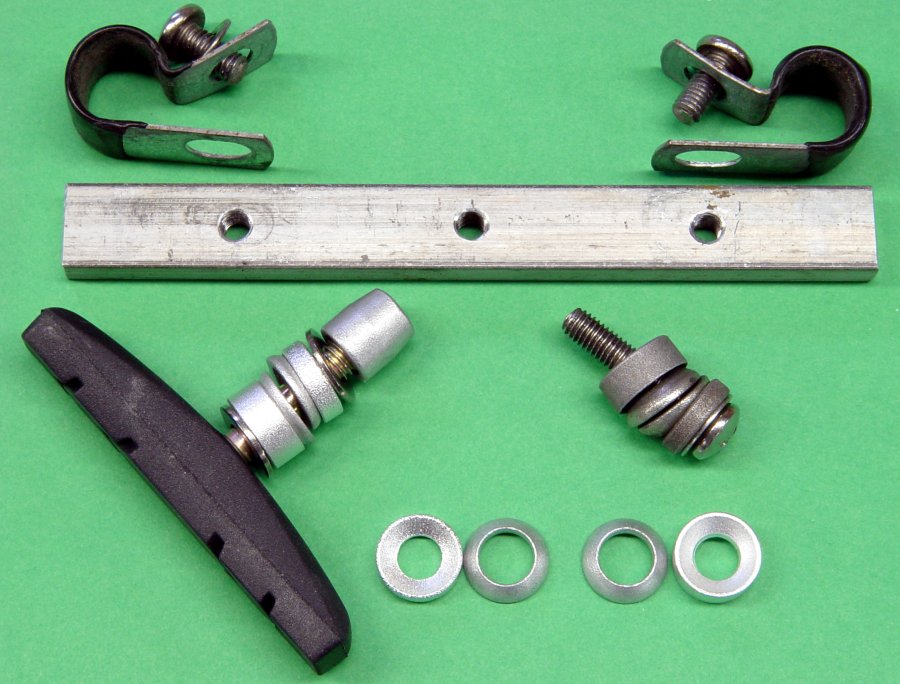
    Even if you’ve never heard of a spherical washer before, your bike parts box may already have some: one old brake pad provides the two washers you’ll need for one rack. Each washer has one convex and one concave piece, which you must assemble with the curved surfaces nested together and the flat sides out. You need one washer on each side of the angled plate. The six spherical washers in Photo 2 show the details.

    You’ll also need a ¼x½-inch rectangular aluminum bar long enough to span the seat support struts just in front of the rack, three 10-32 or 5-mm stainless-steel machine screws and washers, and a pair of padded tubing clamps. You can get all that from your favorite home-repair store.

    Drill a hole in the middle of the bar and a matching hole in the middle of the rack’s front face. I used a 10-32 tap to put threaded holes in the rod, but you can drill clearance holes and use nuts.

    Photo 3 - Mounting Screw
    Photo 3 – Mounting Screw

    Put a spherical washer on a screw, insert the screw through the rack, add another washer, put the screw into the crossbar, align the crossbar on the seat struts, and finger-tighten the screw. Photo 3 shows the screw from the top of the rack.

    Slip the tubing clamps on the seat struts as shown in Photo 4, mark the clamp openings on the crossbar, remove the crossbar, and drill the two holes.

    Photo 4 - Bottom View
    Photo 4 – Bottom View

    Reassemble everything, apply Loctite to the threads, and tighten the screws. Remember to loosen all three screws before you adjust your seat position!

    I wrote this a while back for the late, lamented Recumbent Cyclist News, but it never got into print. I found the files while looking for something else; seems like this might be useful to somebody.