Ed Nisley's Blog: Shop notes, electronics, firmware, machinery, 3D printing, laser cuttery, and curiosities. Contents: 100% human thinking, 0% AI slop.
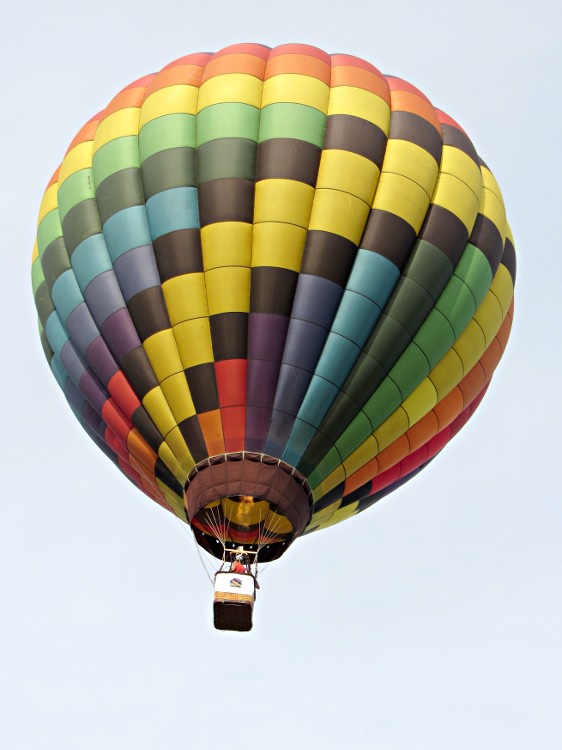
The local Chamber of Commerce sponsors a hot-air balloon weekend that always seems to attract terrible weather; we got to see one of the launches at a nearby park on a hot afternoon before the storms.
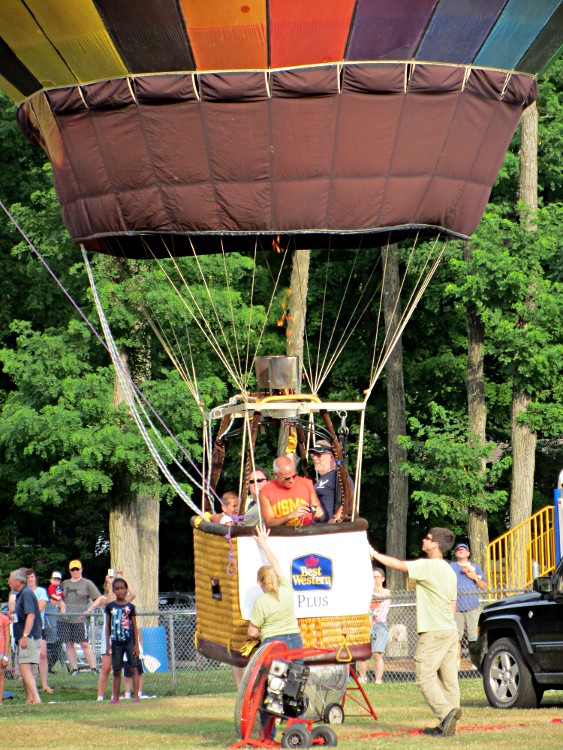
The crew cold-inflates the balloon with a roaring gasoline-powered blower:
Balloon – cold inflation
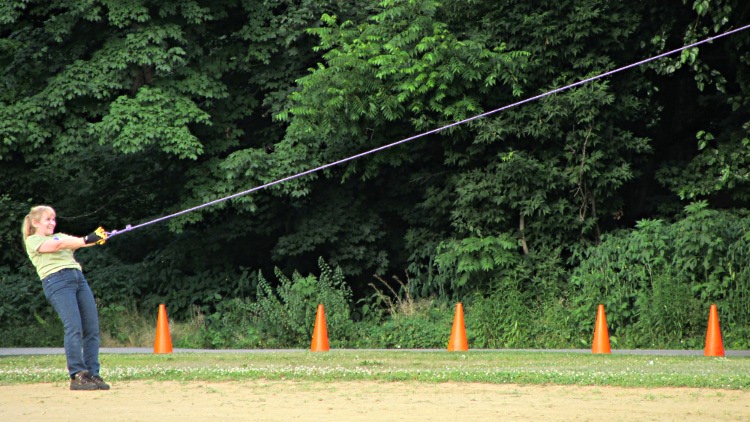
Way over there on the left, almost out of sight, one of the ground crew tethers the top of the balloon:
Balloon – anchoring the top
When it’s mostly inflated, they fire the burners for the hot inflation:
These are all hand-held with the Canon SX230HS at looong telephoto, with a bit of cropping & tweaking. They’re the usual low-res blog pix, but the originals aren’t much less gritty… the camera you have is better than the camera you don’t: we were out and about on other errands.
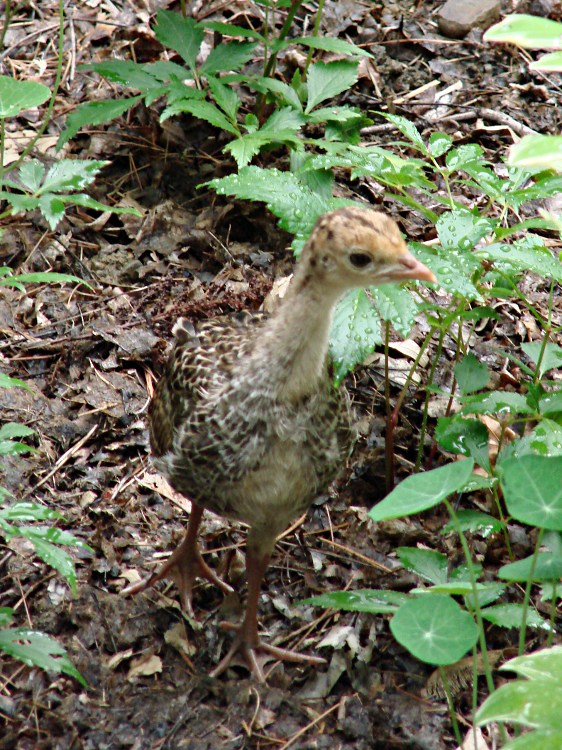
Some years ago we would see two or three turkey hens leading a creche of two dozen chicks. We haven’t seen that many chicks lately, which we attribute to the fox that’s been trotting through the yard and the hawks patrolling the treetops. Recently, a hen guided her five chicks (four visible here) across the front lawn:
Turkey hen with chicks in grass
The family proceeded along the flowerbed at the top of the new wall at the driveway, where the chicks showed that their camouflage works really well against leaf mulch:
Two turkey chicks
If they keep their heads down, that is:
Turkey chick in flower garden
The hen jumped off the wall and flapped down to the driveway, which is no big deal for such a large bird. It provoked a bit of discussion and hesitation among the chicks, who eventually followed her lead:
Turkey chicks can fly
Except for the last and smallest chick, who walked along the wall until the poor thing ran out of wall. It finally showed that it can fly just as well as its siblings:
Last turkey chick flying
Admittedly, turkeys don’t fly all that well, but they get the job done; those chicks can fly up to a branch and snuggle under their mother’s wings, safe from the foxes.
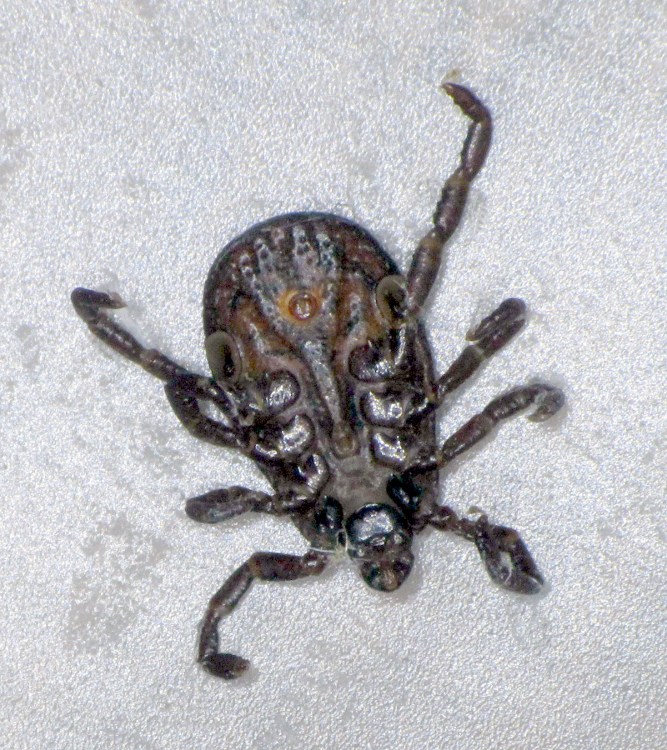
There I was, in the kitchen, minding my own business, when I felt something crawling up my shin…
Dog Tick – Ventral
It’s 5 mm from snout to rump, so it’s most likely a dog tick, not a deer tick, not that that makes me feel much better. It’s stuck to a strip of adhesive tape to prevent it from going anywhere and was flat enough to have not fed on anybody recently.
That picture didn’t require focus stacking, although I gave it a try anyway with inconclusive results. I must conjure up a much more rigid camera mount before that works well; a mini tripod isn’t good enough.
Mary took me along on a Master Gardener tour of the plantings at Quaker Hill Native Plant Gardens (*) in Pawling, NY. We saw plenty of good-looking plants with enough light to make hand-held pictures come out wonderfully well, at least when my other mistakes canceled out.
This is an Echinacea, part of a much larger planting.
It’s cropped from the original image, resized slightly to 1050×1680, and now serves as a screen backdrop on the portrait monitor.
(*) The owners are among the 100 richest people in the country, so a staff of 70 maintaining the estate seems perfectly normal. Over the last two decades, they reshaped the entire 400-odd acre landscape to make the property look exactly right, to the extent that the many (synthetic) cliffs & (pumped) waterfalls consist of enormous boulders that a stone dresser reassembled and blended together from the largest sections that could be trucked in. The water features are visible from low earth orbit…
The stereo zoom microscope over the electronics bench lives on the end of long support arm that tends to be just slightly wobbly. Part of the problem is that the far end is anchored on the sponge-backed laminate flooring I put atop the bench, but it’d be slightly wobbly even with a firm base on the plywood bench top.
So I prop up the microscope with a machinist’s jack and it’s all stable & good.
This one happens to be from an ancient Starret 190 set that I accumulated along with some other tooling, but any of the cheap imitations would work just as well.
The two bubble level vials help get the microscope axis exactly perpendicular to the bench surface, which makes the difference between good overall focus and a blurred image with a single line in focus. Here the jack is vertical and the microscope is tilted slightly toward the edge of the bench; the jack has a pivot below its knurled top plate.
The motivation for gutting that Dell laptop battery was to find out if the cells could become a higher-capacity external battery for the Canon SX230HS camera. Those discharge curves suggest they can’t, but I also want to know what voltage levels correspond to the various battery status icons, which means I must feed an adjustable power supply into the camera… so I need a fake NB-5L battery with a cheater cord.
The first step: crack the case of the worst of the eBay junkers. I squeezed it in the bench vise to no avail, then worked a small chisel / scraper (*) into the joint. The lid was firmly bonded to the case, but it eventually came free:
NB-5L Battery – opened
The protective PCB sits at one end of the cell, with a strip of black foam insulating the components from the nickel strips:
NB-5L – protective PCB
It turns out that the cell’s metal shell is the positive contact, which I didn’t expect.
The component side of the PCB has a 10 kΩ resistor connected between the center and negative contacts. That should be a thermistor, but it’s a cheap eBay knockoff and I suppose I should be delighted that there’s not a gaping hole where that contact should be. The PCB fits against the small notch in the case and is held in place by small features on the top and bottom. The negative contact is on the far left:
NB-5L – PCB interior view
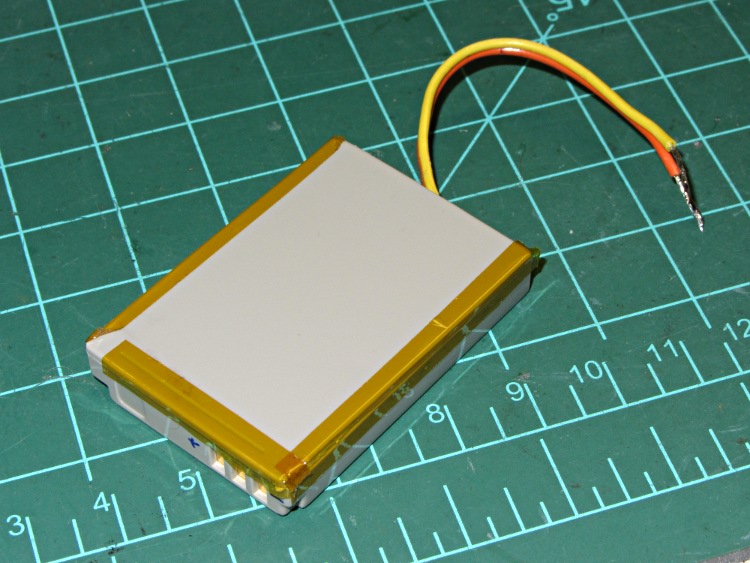
Canon sells an AC adapter for the camera that includes an empty battery with a coaxial jack that aligns with a hole in the battery compartment cover. I soldered a pair of wires to the PCB, drilled a hole in the appropriate spot, added some closed-cell foam and hot-melt glue to anchor the PCB, and made a cheater adapter. For the record, the orange wire is positive:
NB-5L – gutted case with pigtail
It turns out that the camera battery cover must be closed and latched before the camera will turn on, but the sliding latch mechanism occludes the hole. This cannot be an inadvertent design feature, but I managed to snake the wire out anyway.
Connecting that up to a bench supply (with a meter having 0.1 V resolution) produces the following results:
Voltage
Result
3.8
Full charge
3.7
2/3 charge
3.6
Blinking orange
3.5
“Charge the battery”
The camera draws about 500 mA in picture-taking mode, about 300 mA in display mode, and peaks at around 1 A while zooming.
The Genuine Canon NB-5L is good for 800 mA·h to 3.6 V, as are the two best pairs of the Dell cells. The latter remain over 3.7 V for 500 mA·h, which suggests one pair would run for about an hour before starting to blink. Maybe that’s Good Enough, but … a new prismatic battery is looking better all the time.
(*) Made by my father, many years ago, with a simple wood handle that eventually disintegrated. I squished some epoxy putty around the haft and covered it with heatshrink tubing, but (now that I have a 3D printer) I really should print up a spiffy replacement. I’ve been using it to pry objects off the printer’s build platform, so that’d be only fitting…








 The Smell of Molten Projects in the Morning