One of the three Supermoons in late 2016 rose over the end of our driveway:

Moonrise always looks bigger in person, particularly through all those trees, and we always enjoy watching …
The Smell of Molten Projects in the Morning
Ed Nisley's Blog: Shop notes, electronics, firmware, machinery, 3D printing, laser cuttery, and curiosities. Contents: 100% human thinking, 0% AI slop.
Who’d’a thunk it?
One of the three Supermoons in late 2016 rose over the end of our driveway:

Moonrise always looks bigger in person, particularly through all those trees, and we always enjoy watching …
The Mighty Wappinger Creek runs low after months with very little rain and we saw more of the rocky streambed than any time in recent memory:

Much of the deteriorated Red Oaks Mill Dam stands high and dry:

Just upstream from the bridge, you can see how water carves potholes into the rock:
Back in the day, my parents took us to see the far more impressive Susquehanna River potholes (*) near Harrisburg. They range from finger-size pits up to craters large enough to comfortably hold an adult. I’m sure one of their photo albums, now tucked in our closet, contains similar pictures of those holes.
Searching for red oaks mill dam will turn up previous posts and pictures for comparison.
(*) Exploration of the pages linked there will show how, with sufficient mental effort, one can force-fit a non-erosion-based explanation of eroded potholes to match a pre-conceived timeline and narrative. Your opinion of that narrative and the effort required to fit evidence into it may differ from mine.
This arrived a week ago:

You cannot imagine my excitement when the actual survey arrived, complete with a crisp $5 bill:

These folks are cheapskates; Nielsen paid better, although I haven’t gotten anything further from them.
It didn’t take long to fill out; my fat Sharpie slashed through the NO columns at a pretty good clip. I did attach a note saying we didn’t have a TV and regarded all TV programs as crap, just in case they didn’t get the message.
Now they know.
FWIW, I did not fill out the form that would enter us in a drawing for one of five $500 prizes, because that would let them associate my name with my response without fattening my wallet. The survey itself probably encodes my identity, even though it didn’t have any obvious bar codes or other ID; they could simply print the questions in a unique order in each survey.
With RF projects looming on the horizon, now seemed like a good time to restock the silver-mica capacitor supply:

That’s 150-ish little brown envelopes, found on eBay in the lowest-entropy state I can imagine, with about 11 pounds of caps delivered for a bit under $5/pound.
The envelopes bear date stamps from the mid- to late-60s:

I think these came directly from the Electro-Motive Mfg Co production line or QC lab, because some of the envelopes have notes about “WE”, “Bell Labs”, and suchlike. They seem to be special-production items, not the usual caps from your usual distributor.
The values and tolerances are weird beyond belief:

If you’re taking notes, 6160 pF lies halfway between the 6120 and 6190 values in the E192 series.
And, yes, that’s a cap with ½% tolerance (forgive the bright-red color imbalance):

Most of the caps are 1%, which is kinda-sorta typical for silver-mica. Then you find something unbelievable:

Stipulated, I’ve lived a sheltered existence. Have you ever seen a 0.1% tolerance cap? The assortment has more of those, scattered throughout the range.
Regrettably, the entire decade from just over 300 pF to just under 3000 pF has gone missing: somewhere out there, someone has another box from the room that housed this collection. So it goes; given the plethora of values, I can always make series-parallel combinations to get what’s needed.
This appeared on The Mighty Thor’s phone during a Squidwrench meeting:

“To maintain a secure banking environment” seems diagnostic of a scam.
Discouragingly, some of our banks still send emails with clicky links using third-party mail servers, so checkonlineinfo.com doesn’t seem any more suspicious than, say, Schwab’s customercenter.net.
A pox on their collective backsides!
I found this antique on eBay for (somewhat) under HP’s 1980-era $35 price:

The prevailing price for HP 09872-60066 Digitizing Sights seems to be $100 and upwards, with outliers in both directions, so I just couldn’t pass it up.
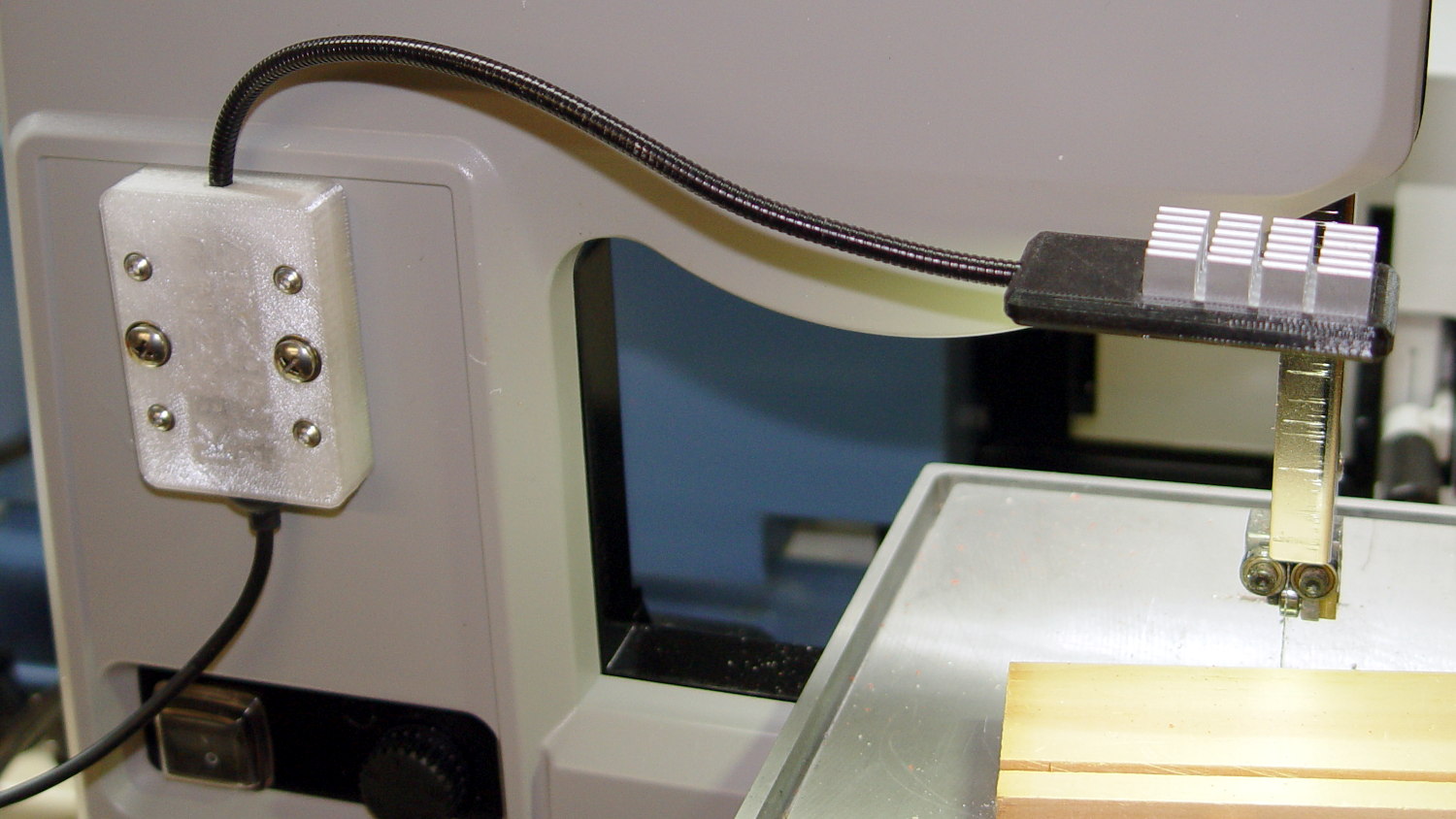
Anyhow, the fiber optic pipe still works just like it did, back in the day:

The small dot in the middle is actually a paint-filled indentation on the bottom surface:

With the bottom flat on the target, the relayed image is in perfect focus:

The bezel recesses the top surface by 25 mil to protect the imaging plane.
OK, it’s a gadget gloat; I have absolutely no intention of ever chucking a piece of paper in the plotter and digitizing any points.
A long long time ago, we bought a kitchen spatula that’s served us well ever since:

To give you an idea of how old that poor thing is, the back of the handle bears a Japan stamp. I’ve re-set the rivets several times, the blade has rusted as badly as you think, and we recently, very reluctantly, decided it has passed its best-used-by date.
The 3 x 4.5 inch blade is 19 mil = 0.45 mm plated carbon steel, stiff enough to remain flat and springy enough to bend a little, with a 9 inch = 230 mm steel handle ending in a plastic overmold.
These days, it’s essential to the cutting, flipping, and serving of the morning’s omelet-like substance, made of eggs, bacon, veggies, green leafy things, plus this-and-that, in the cast-iron pan. Mary chops the disk into quarters with the reasonably sharp edge, maneuvers the reasonably bendy blade under each quarter, flips them over, tops with bacon & cheese, pauses for consolidation & melting, then pops them onto plates. Yum!

So we set out to buy a replacement.
Here’s what we’ve tried and rejected so far:

I’ve used this one for many years to flip pancakes on a succession of non-stick griddles, a service at which it excels. The edge isn’t sharp enough to cut the green-and-leafy and the completely inflexible blade cannot be maneuvered under the omelet quarters:

This one gets deployed for burgers and their ilk, also in the cast-iron pan. The blade, although sharp enough, is completely rigid:

On the other paw, a slightly concave 7 mil = 0.18 mm spring steel blade is much too thin and, well, springy. Although very sharp, you cannot apply enough cutting force without suddenly bending the blade and, if the omelet quarter isn’t positioned exactly right, the blade will bend underneath it and dump breakfast on the stovetop. The alert reader will notice a missing weld between the blade and the bottom wire handle:

This very thin plastic blade has similar problems with poor cut-ability and excessive flexibility:

This one looked really promising and worked almost perfectly. Regrettably, its nylon blade bears a 400 °F rating and the bottom of the omelet reaches nearly 450 °F. You can see what happens to the reasonably sharp edge as it scrapes across the pan:

The omelet cooks at the temperature it cooks at, which part of the specifications is not subject to further discussion.
So, we’re stumped. Having trawled the usual online and big-box stores, we’ve been unable to find a replacement. Simple steel blades aren’t available. Trendy silicone-bonded stainless steel blades combine the worst of all worlds: won’t cut and won’t flip. Pretty nearly anything you don’t see above seems obviously unsuitable for our simple needs: too big, too small, or too melty.
We’ll consider all recommendations and suggestions! Thanks …