Ed Nisley's Blog: Shop notes, electronics, firmware, machinery, 3D printing, laser cuttery, and curiosities. Contents: 100% human thinking, 0% AI slop.
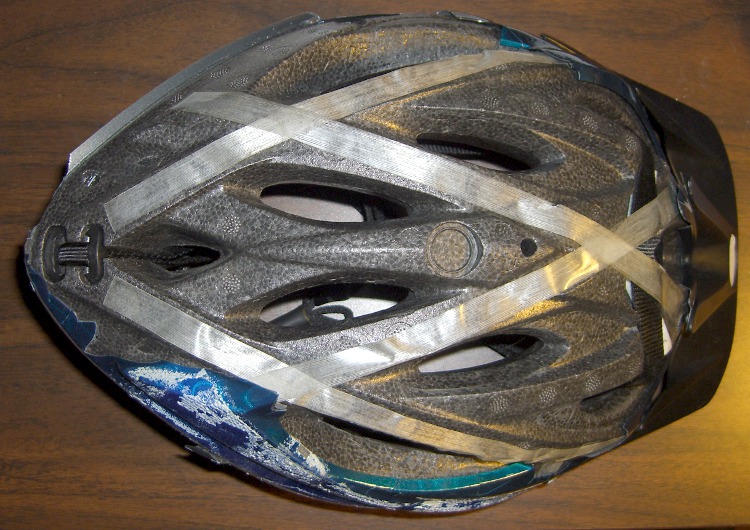
Having gotten our new helmets up & running, I decided to tear down my old helmet to see what’s inside. The thin plastic shell was already cracked (and probably brittle from years of sun), so it tore off very easily. The foam structure was in good shape, but I was surprised to see that everything’s held in place by glass filament tape!
Peeled bike helmet
The straps pass through an H-shaped locking clip tucked into a recess in the rear apex (to the left in the picture). The front strap simply loops over the foam shell (to the right of the tape crossing on the right), where it’s held in place on double-sided adhesive foam tape by the glass filament tape.
All in all, a low-cost, low-weight design that works just fine.
The Third Eye Hardshell Mirror was designed back in the day when Bell Helmets had actual hard plastic shells over a foam core, with a lip around the shell’s edge. These days, helmets consist of an elaborate foam structure with a paper-thin plastic covering. Mary’s helmet is like that, but it has a visor and I figured the mounting clamp might grab onto that.
It almost worked, but the edge of the clamp tapered the wrong way: tightening the screw tipped the clamp away from the visor lip.
Solution: chop off the offending part of the clamp, file off the sharp edges, and screw it in place. Works like a champ.
I’m not convinced this mount will survive the test of time, though. We already know that the clever ball joint will eventually lose its griptivity, but that’s fixable.
This pic shows that the mirror attaches to the boom through a clever ball joint that allows both rotation around the mirror’s long axis and a slight amount of tilt. Unfortunately, after a few years, the ball stem breaks and at least one of the socket petals snaps. It’s a nice plastic design that’s totally unsuited to a few years of more-or-less daily bicycle travel.
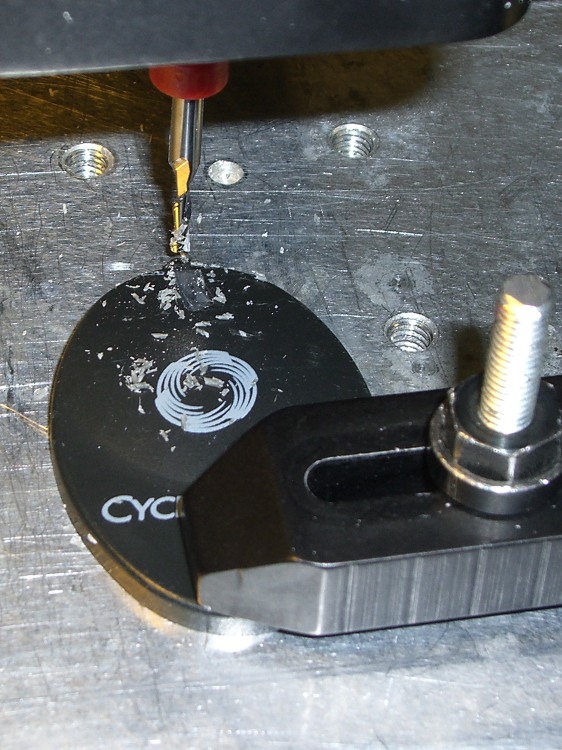
The repair was easy enough, particularly because I think the boom has enough adjustment range to handle the job on its own (and I don’t care about how it looks). I filed off the stem stub and milled a slot for a 2-56 machine screw along the back edge.
Milling slot for screw
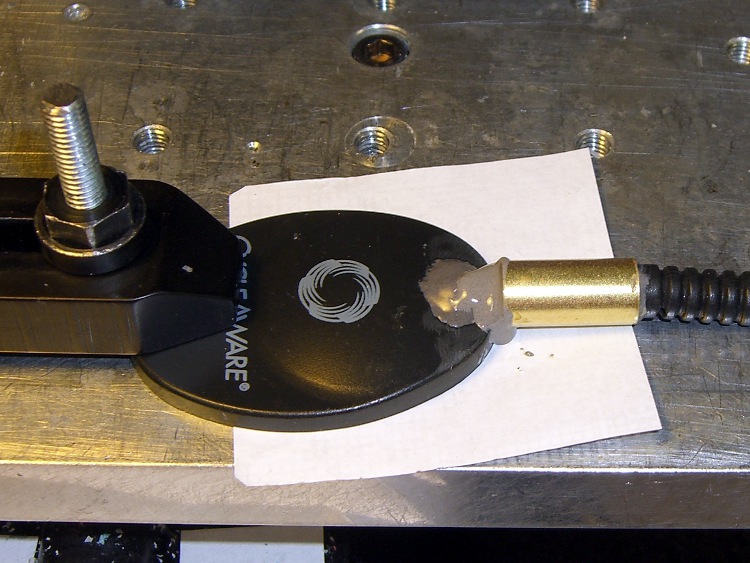
Then you just slide a brass tube from the cutoff box over the end of the boom around some JB Weld epoxy, shove the screw into the blob, align the mirror with the boom, and let it cure.
Reinforced attachment
Although it’s not shown here, the helmet attachment is aligned with the mirror at right angles to the helmet bracket. That puts it in roughly the proper position with the boom bent as usual.
I don’t actually plan to use this one for anything, but if I need a somewhat scuffed mirror in a pinch, well, it’s in the box!
Having recently converted to EMC 2.4 and switched the tool table to the new format, I took the opportunity to add a few useful drills.
Low numbers are random end mills & suchlike. Number drills run from 100 to 180, and I’ll add more as I need ’em. Fraction drills run from 201 through 264, although it’s highly unlikely I’ll ever fit a 64/64-inch drill in a chuck that also fits in the Sherline spindle.
All the Z lengths are exactly 1, because I now have a tool length probe that is absolutely wonderful.
In practice, I use the tool table mostly to tell Axis how to draw the tool cylinder in the backplot, because I feed in most diameters directly in the G-Code. The Axis “manual toolchanger” routine prompt will now serve as a mnemonic for the actual size, but I write the G-Code to emit a (debug, #Drill_Size) message for clarity.
The Sherline.ini file references the tool table with the line:
It turns out that the tool table has an undocumented limit of 50-some-odd entries, at least in EMC2 2.4.1. That puts the kibosh on my plans to add a bunch of entries to cover all the drill sizes Eagle might require for a PCB. More on that in a while …
The shop spec says the lug nut torque shall be 104 newton·meter or an equally odd 77 lb·ft. Let’s not get into quibbles about the differences between lb·ft and ft·lb here, OK?
Anyhow, based on the wildly differing and grossly excessive tire pressures left by the guys who installed the new tires, I figured the lug nuts would be over-torqued… as, indeed, they were. My bending-beam torque wrench goes up to 140 n·m and didn’t even come close to breaking those puppies loose.
So I deployed a manly breaker bar and applied most of my weight to the far end. A back of the envelope guesstimate says they were well over 200 n·m, with a few grunt outliers.
Yes, the breakaway torque can be higher than the tightening torque, but they were far beyond even that level.
Lubed the threads, tightened to spec, and it’s all good. I’ll check them next week just to be sure, but sheesh if we had to fix a flat on the road, it would have gotten ugly.
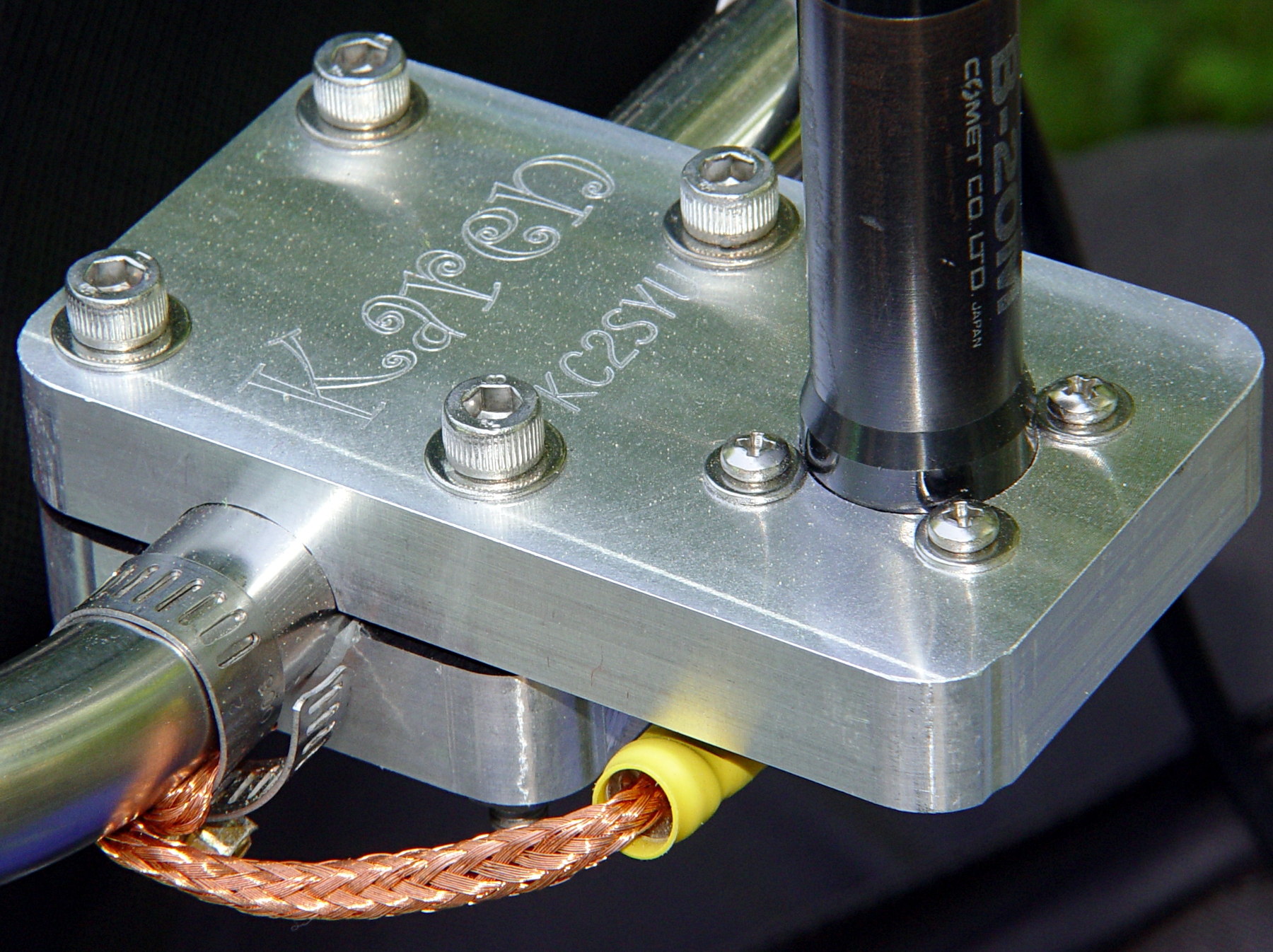
Quite a while ago, I built this slab mount to hold an amateur radio antenna on our daughter’s Tour Easy. It worked fine until the bike blew over and whacked the antenna whip against something solid, at which point the mast cracked.
The antenna screws into an ordinary panel-mount UHF connector secured to the bottom of the slab, with a hole through the slab just large enough to accept the antenna mast. That put all the mechanical stress on the slab, not the connector.
Modified antenna mounting plate
Alas, the new antenna had a slightly different mast outside diameter, so I machined a new adapter to clamp the connector atop the slab. The antenna screws down into the adapter against a brass washer, again keeping the strain on the fitting.
I recently found the commercial mobile antenna cable that I’d been meaning to use on her bike, which required Yet Another Modification to that slab. It turns out that the UHF connector on the cable expects to be secured to sheet metal found in a car body, rather than a half-inch aluminum plate: the threads aren’t long enough!
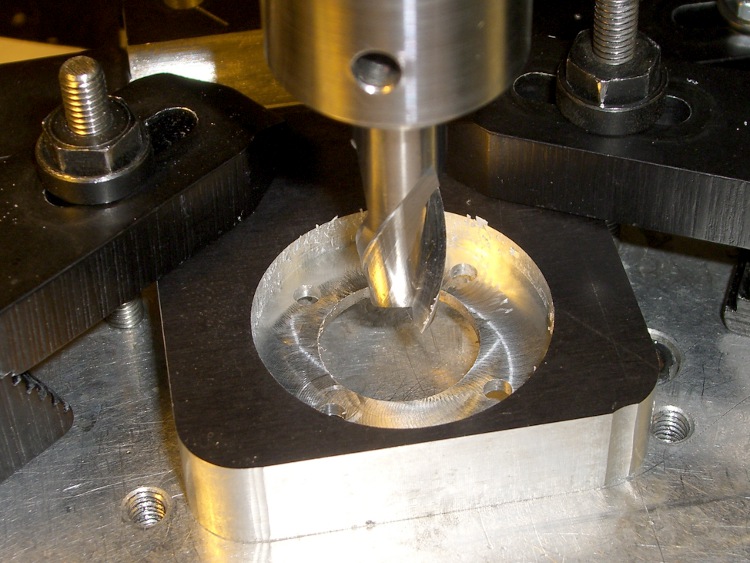
So I machined circular recesses on the top and bottom to hold the mounting nut and washer, respectively, with 2 mm of aluminum remaining in the middle of the slab.
Milling top recess
The recesses are just fractionally larger than the nut & washer, so most of the stress gets transmitted directly to the slab. Even in the high-vibration bicycle environment, I think there’s enough meat in there to prevent fatigue fractures.
Milling bottom recess
I recycled a G-Code routine I’d written to chew out circular recesses. It does a bit of gratuitous (for this application, anyway) spiraling in toward the center, but got the job done without my having to think too much.
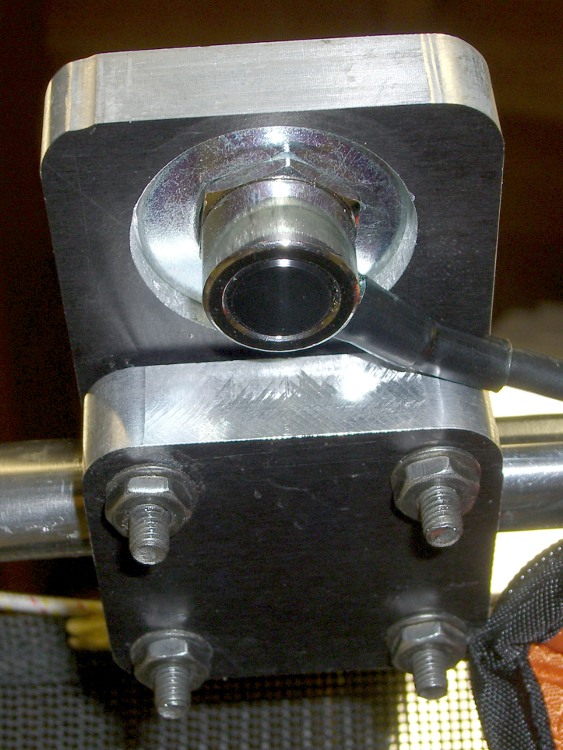
The bottom view shows the washer in action. The recess is deep enough that the cable just barely clears the slab.
Modified mounting plate – bottom
The top view shows the recessed mounting nut. The nut has an O-ring around the connector threads, but the water will probably drain out through the four through-holes left over from the old panel-mount connector.
Modified mounting plate
I turned the top nut down as far as I could with a wrench & (ugh) needle-nose pliers, then tightened the bottom nut about 1/3 turns with a wrench.
You’re not supposed to notice the crispy edges on the PVC bushing holding the reflector to the antenna mast. The high setting on that heat gun is a real toaster…





 The Smell of Molten Projects in the Morning