The Smell of Molten Projects in the Morning

Ed Nisley's Blog: Shop notes, electronics, firmware, machinery, 3D printing, laser cuttery, and curiosities. Contents: 100% human thinking, 0% AI slop.

Category: Machine Shop

Mechanical widgetry

  • GPS+Voice Interface for Wouxun KG-UV3D: PCB in a Box!

    It always feels good when the parts fit together, even if they don’t actually do anything yet…

    Bare PCB in Wouxun HT battery case
    Bare PCB in Wouxun HT battery case

    That’s the bare PCB in the first-pass 3D-printed battery case adapter, both of which need quite a bit more work. In particular, the case desperately needs some sort of latch to hold the yet-to-be-built contacts against the HT’s battery terminals.

    Amazingly, all the holes lined up spot on, although I think the lower battery contact could move half a millimeter closer to the base of the radio. The battery case contacts are large enough to work as-is and, for what it’s worth, the Wouxun battery cases seem to differ slightly among themselves, too.

    The PCB itself came out about as well as any homebrew PCB I’ve ever made, after getting the Logitech Joggy Thing working again to line the Sherline up for hole drilling:

    Wouxun HT GPS-Audio PCB - copper
    Wouxun HT GPS-Audio PCB – copper

    The circuit has provision for pairs of SMD caps on all the inputs, with which I hope to squash RFI from both the VHF and UHF amateur bands by choosing their self-resonant frequencies appropriately.

  • Garden Sprayer Valve Spring Replacement

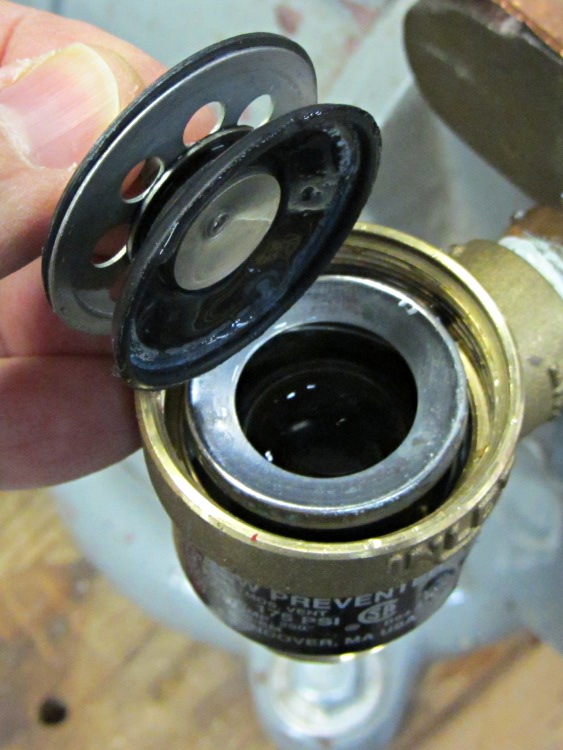
    A garden sprayer awaiting repair emerged from the benchtop clutter. It’s an old one, with a metal shell and actual screws, so I could dismantle it to reveal the problem:

    Garden sprayer valve - rusted spring
    Garden sprayer valve – rusted spring

    It’s evidently impossible to make a good, cheap, corrosion-resistant spring (pick any two, I suppose):

    Garden sprayer valve - wreckage
    Garden sprayer valve – wreckage

    Some rummaging in the Big Box o’ Medium Springs produced a slightly smaller spring that should last for a while; it’s good, free, and rust-able, if a bit too short.

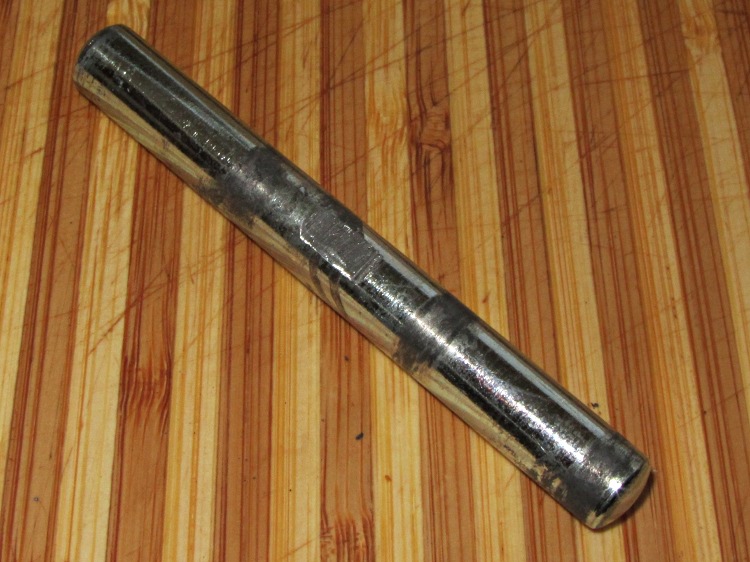
    Much to my astonishment, I found a length of 3/8 inch Marine Bronze rod in the stockpile and made a bushing to take up the remainder of the space:

    Garden sprayer valve - new spring and bushing
    Garden sprayer valve – new spring and bushing

    It won’t get a good test until gardening season opens next year, but it seems to seal well enough.

  • Dragonfly Garden Ornament – Eyeball Repair

    This brass dragonfly has graced our garden for some years, but what seemed like a gentle tap during fall cleanup knocked both eyeballs out. The original adhesive looked like urethane, so I cleaned the sockets, applied a layer around the rim, and popped the marbles back in place.

    The clamping looks painful…

    Dragonfly Ornament - eyeball repair
    Dragonfly Ornament – eyeball repair

    Of course, that’s an unbroken Harbor Freight clamp

  • Thing-O-Matic: Large Hole Calibration

    Flushed with success on the small-hole front, I conjured up a large hole testpiece using the same HoleAdjust function that proved unnecessary with the little ones:

    Circle Calibration - solid model
    Circle Calibration – solid model

    The first version didn’t have the cross bars, which turned out to be a mistake, because the individual rings distorted even under minimal pressure from the calipers:

    Large circle cal - unlinked rings
    Large circle cal – unlinked rings

    However, measuring as delicately as I could, the holes seemed a scant 0.20 mm too small, more or less, kinda-sorta:

    Nominal Nom+0.0
    10 9.83
    20 19.75
    30 29.85
    40 39.84
    50 49.84
    60 59.72
    70 64.76
    80 79.28
    90 89.77

    So I fed in HoleFinagle = 0.20 and the second iteration looks like it’d make a great, albeit leaky, coaster:

    Large Circle Calibration object - HoleFinagle 0.20
    Large Circle Calibration object – HoleFinagle 0.20

    Measuring those holes across the center with the calipers on facets (rather than vertices), produced somewhat more stable results:

    Nominal Nom+0.20
    10 10.08
    20 20.17
    30 30.08
    40 40.08
    50 50.00
    60 60.02
    70 70.05
    80 79.98
    90 90.07

    Frankly, I don’t believe those two least-significant digits, either, because a different set of measurements across different facets looked like this:

    Nominal Nom+0.20
    10 10.13
    20 20.11
    30 29.84
    40 39.90
    50 49.88
    60 59.90
    70 69.84
    80 79.82
    90 89.66

    I also printed a testpiece with HoleFinagle = 0.25 that averaged, by in-the-head computation, about 0.05 larger than that, so the hole diameter compensation does exactly what it should.

    Applying the calipers to the 10.0 mm hole in the small-hole testpiece gives about the same result as in this one. The fact that HoleFinagle is different poses a bit of a mystery…

    The only thing I can conclude is that the measurement variation and the printing variation match up pretty closely: the actual diameter depends more on where it’s measured than anything else. The holes are pretty nearly the intended size and, should the exact size matter, you (well, I) must print at least one to throw away.

    All in all, a tenth of a millimeter is Good Enough. Selah.

    Oh. The ODs are marginally too small, even using PolyCyl.

    The OpenSCAD source, with both adjustments set to neutral:

    // Large circle diameter calibration
    // Ed Nisley KE4ZNU - Nov 2011
    
    //-------
    //- Extrusion parameters must match reality!
    //  Print with +1 shells, 3 solid layers, 0.2 infill
    
    ThreadThick = 0.33;
    ThreadWidth = 2.0 * ThreadThick;
    
    HoleFinagle = 0.00;
    HoleFudge = 1.00;
    
    function HoleAdjust(Diameter) = HoleFudge*Diameter + HoleFinagle;
    
    Protrusion = 0.1;			// make holes end cleanly
    
    function IntegerMultiple(Size,Unit) = Unit * ceil(Size / Unit);
    
    //-------
    // Dimensions
    
    Width = 2.5;
    Thickness = IntegerMultiple(2.0,ThreadThick);
    
    DiaStep = 10.0;
    
    NumCircles = 9;
    
    echo(str("Width: ",Width));
    echo(str("Thickness: ",Thickness));
    
    BarLength = (NumCircles + 1)*DiaStep;
    
    //-------
    
    module PolyCyl(Dia,Height,ForceSides=0) {			// based on nophead's polyholes
    
      Sides = (ForceSides != 0) ? ForceSides : (ceil(Dia) + 2);
    
      FixDia = Dia / cos(180/Sides);
    
      cylinder(r=HoleAdjust(FixDia)/2,h=Height,$fn=Sides);
    }
    
    module ShowPegGrid(Space = 10.0,Size = 1.0) {
    
      Range = floor(50 / Space);
    
    	for (x=[-Range:Range])
    	  for (y=[-Range:Range])
    		translate([x*Space,y*Space,Size/2])
    		  %cube(Size,center=true);
    
    }
    
    //------
    
    module Ring(RingID,Width,Thick) {
    
      difference() {
    	PolyCyl((RingID + 2*Width),Thick);
    	translate([0,0,-Protrusion])
    	  PolyCyl(RingID,(Thick + 2*Protrusion));
      }
    }
    
    //------
    
    ShowPegGrid();
    
    union () {
      for (Index = [1:NumCircles])
    	Ring(Index*DiaStep,Width,Thickness);
      for (Index = [-1,1])
    	rotate(Index*45)
    	  translate([-BarLength/2,-Width/2,0])
    		cube([BarLength,Width,Thickness]);
    }
    
  • Thing-O-Matic: Small Hole Calibration

    The macro lens & microscope adapters for the Canon SX230HX camera required a bunch of large and fairly precise circles. The first-pass prints of the main tube and snouts came out with diameters about 2% too small, so I changed the hole diameter compensation to include a first-order Fudge Factor as well as the simple zero-order HoleWindage Finagle Constant I’d been using. In the process, I cooked up a simple OpenSCAD function with new coefficient names reflecting their order:

    HoleFinagle = 0.20;
    HoleFudge = 1.02;
    function HoleAdjust(Diameter) = HoleFudge*Diameter + HoleFinagle;
    

    That solved the immediate issue, but I wondered whether I was working on the right problem.

    In the past, nophead’s polyholes testpiece showed the need for the 0.2 mm HoleWindage adder to make small holes turn out correctly. I rewrote his code to:

    • Use my HoleAdjust function
    • Lay the two rows out nose-to-tail
    • Add a bit more clearance between the holes

    Which came out like this:

    Small Hole Calibration - solid model
    Small Hole Calibration – solid model

    To find out where I’m starting from, I printed it (0.33 mm x 0.66 mm, 30 mm/s, 200 °C / 110 °C) with both correction factors set to “no change” and got a nice-looking plate that didn’t require any cleanup at all:

    Small Hole Calibration object - HoleFinagle 0.00
    Small Hole Calibration object – HoleFinagle 0.00

    Note that the similar-looking holes in the two rows aren’t the same size: the row with the tiny triangle has *.0 mm holes, the tiny square marks the *.5 mm holes.

    The Skirt thread thickness was 0.31 to 0.38 mm, so this object’s size should be about as good as it gets.

    The point of the game is to circumscribe polygonal holes around a cylinder of a given diameter. I don’t have a set of metric drills (or drill rods), so I bracketed the holes with the nearest sizes of hard-inch number and letter drills:

    Nominal Free fit Snug fit
    1.00 0.98 1.04
    2.00 2.05 2.18
    3.00 2.93 3.03
    4.00 3.99 4.04
    5.00 5.06 5.13
    6.00 6.21 6.23 no-go
    7.00 6.98 7.12
    8.00 7.50 8.19
    9.00 8.77 9.05
    10.00 9.92 10.19 tight

    The “snug fit” column means the holes are definitely smaller than that measurement, so the maximum hole size comes out just about spot on; an error of 0.1 mm or so seems too small to quibble over.

    So, for whatever reason, my previous Finagle Constant of 0.20 seems no longer necessary and, for sure, the Fudge Factor doesn’t bring anything to the table at this scale.

    It’s definitely true that the height of the first layer affects the hole size for the next few layers, even with the Z-minimum switch measuring the build plate height. The Skirt threads generally measure within ±0.05 mm of the nominal 0.33 mm and I think much of that variation comes from residual snot on the nozzle when it touches the switch. I have no idea what the firmware’s resolution might be.

    Given that I’ve been adding 0.2 mm to small-hole diameters all along, I suspect all these errors are now of the same general size:

    • Print-to-print variation (layer thickness, ABS variations)
    • Hole tolerance (size vs plastic vs speed)
    • Measurement error (digital caliper vs drills vs objects)

    All in all, it’s pretty good.

    The OpenSCAD source code, with the hole adjustment factors set to neutral:

    // Small circle diameter calibration
    // Adapted from Nophead's polyholes testpiece
    // Ed Nisley - KE4ZNU - Nov 2011
    
    //-------
    //- Extrusion parameters must match reality!
    //  Print with +1 shells, 3 solid layers, 0.2 infill
    
    ThreadThick = 0.33;
    ThreadWidth = 2.0 * ThreadThick;
    
    HoleFinagle = 0.00;
    HoleFudge = 1.00;
    
    function HoleAdjust(Diameter) = HoleFudge*Diameter + HoleFinagle;
    
    Protrusion = 0.1;			// make holes end cleanly
    
    function IntegerMultiple(Size,Unit) = Unit * ceil(Size / Unit);
    
    //-------
    // Dimensions
    
    DiaStep = 1.0;
    
    NumHoles = 10;
    
    Border = 5*ThreadWidth;
    
    AllHoleLength = DiaStep*(NumHoles*(NumHoles + 1)/2) +	// total hole dia
    				(NumHoles + 1)*Border +					// total border size
    				DiaStep*NumHoles/2;						// radius of largest hole
    
    BlockLength = AllHoleLength + 2*Border;
    BlockWidth = 2*NumHoles*DiaStep + 2*Border;
    BlockThick = IntegerMultiple(1.0,ThreadThick);
    
    //-------
    
    module PolyCyl(Dia,Height,ForceSides=0) {			// based on nophead's polyholes
    
      Sides = (ForceSides != 0) ? ForceSides : (ceil(Dia) + 2);
    
      FixDia = Dia / cos(180/Sides);
    
      cylinder(r=HoleAdjust(FixDia)/2,h=Height,$fn=Sides);
    }
    
    module ShowPegGrid(Space = 10.0,Size = 1.0) {
    
      Range = floor(50 / Space);
    
    	for (x=[-Range:Range])
    	  for (y=[-Range:Range])
    		translate([x*Space,y*Space,Size/2])
    		  %cube(Size,center=true);
    
    }
    
    //------
    
    module HoleRow(DiaDelta) {
    
      translate([-AllHoleLength/2,
    			  0,0])
    	for (Index = [1:NumHoles])
    	  translate([(DiaStep*(Index*(Index + 1)/2) + Index*Border),0,-Protrusion])
    		PolyCyl((Index*DiaStep + DiaDelta),(BlockThick + 2*Protrusion));
    }
    
    //------
    
    ShowPegGrid();
    
    rotate(90)
      difference() {
    	translate([-BlockLength/2,-BlockWidth/2,0])
    	  cube([BlockLength,BlockWidth,BlockThick]);
    	for (Index = [0,1])
    	  translate([0,((2*Index - 1)*DiaStep*NumHoles/2),0])
    		rotate(Index*180)
    		  HoleRow(Index*0.5);
      }
    
  • Basement Safe Humidity

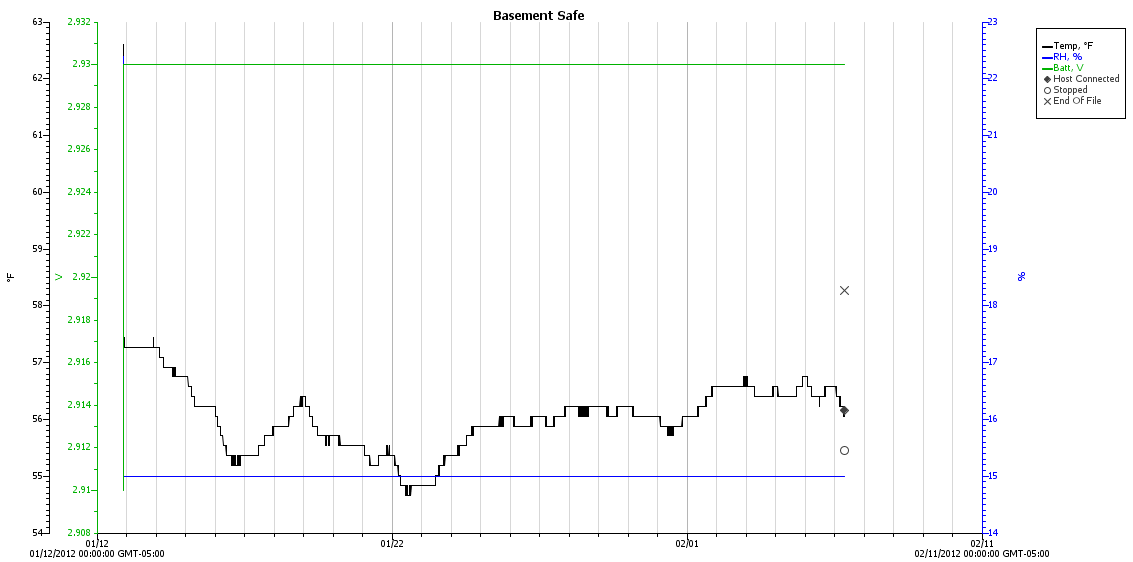
    The discussion about drying my silica gel stash prompted me to toss a Hobo datalogger into the safe along with the desiccant bag. We now have enough data to spot a trend:

    Basement Safe Humidity - Oct-Nov 2011
    Basement Safe Humidity – Oct-Nov 2011

    Verily, one measurement trumps a thousand opinions: I was totally wrong about the door seal. Either that or the safe’s contents started out a lot wetter than I thought.

    The basement humidity runs about 55% RH, pumped down by a dehumidifier in the summer and ambient air in the winter, which (I think) sets the upper limit. Modulo having hygroscopic stuff like paper in the safe, I suppose.

    I’ll toss a fresh bag in there, tape over the door crack, and see what happens during the next month.

    FWIW, the Onset HOBOware program doesn’t run under Wine and Wine doesn’t support USB hardware anyway, which is one of the few reasons I have a Token Windows Laptop. I’ve set it up to automagically export the data into CSV files, from which this went into OpenOffice 3.2 for a quick look. Surprisingly, HOBOware is a Java program, but evidently written specifically to avoid portability; they have Windows and Mac versions and that’s all. Worse, there’s no way to extract data from the loggers without using that program, because Onset doesn’t document the interface protocol. Enough said.

    Memo to Self: measure it!

  • EMC2 HAL Configuration by Eagle Schematics: The Code

    As part of that renaming adventure with the Logitech Gamepad configuration, I realized I hadn’t put my version of Martin Shoeneck’s Eagle-to-HAL conversion script anywhere useful.

    Herewith, the script that you’ll apply to schematics built with parts from the hal-config-2.4.lbr.odt library (which you must rename to get ride of the ODT extension):

    /******************************************************************************
     * HAL-Configurator
     *
     * Author: Martin Schoeneck 2008
     * Additional gates and tweaks: Ed Nisley KE4ZNU 2010
     *****************************************************************************/
    #usage "<h1>HAL-Configurator</h1>Start from a Schematic where symbols from hal-config.lbr are used!";
    
    string output_path =    "./";
    string dev_loadrt =     "LOADRT";
    string dev_loadusr =    "LOADUSR";
    string dev_thread =     "THREAD";
    string dev_parameter =  "PARAMETER";
    
    string dev_names[] = {
    "CONSTANT",								// must be first entry to make set_constants() work
    "ABS",				// 2.4
    "AND2",
    "BLEND",			// 2.4
    "CHARGE-PUMP",		// 2.4
    "COMP",
    "CONV_S32_FLOAT",	// 2.4
    "DDT",				// 2.4
    "DEADZONE",			// 2.4
    "DEBOUNCE",			// 2.4
    "EDGE",
    "ENCODER",			// 2.4
    "ENCODER-RATIO",	// 2.4
    "ESTOP-LATCH",
    "FLIPFLOP",
    "FREQGEN",			// 2.4
    "LOWPASS",
    "MULT2",			// 2.4
    "MUX2",
    "MUX4",				// 2.4
    "MUX8",				// 2.4
    "NEAR",				// 2.4
    "NOT",
    "ONESHOT",
    "OR2",
    "SAMPLER",			// 2.4
    "SCALE",			// 2.4
    "SELECT8",			// 2.4
    "SUM2",
    "TIMEDELAY",		// 2.4
    "TOGGLE",			// 2.4
    "WCOMP",			// 2.4
    "XOR2",				// 2.4
    ""					// end flag
    };
    
    /*******************************************************************************
     * Global Stuff
     ******************************************************************************/
    
    string FileName;
    string ProjectPath;
    string ProjectName;
    
    void Info(string Message) {
    	dlgMessageBox(";<b>Info</b><p>\n" + Message);
    }
    
    void Warn(string Message) {
    	dlgMessageBox("!<b>Warning</b><p>\n" + Message + "<p>see usage");
    }
    
    void Error(string Message) {
    	dlgMessageBox(":<hr><b>Error</b><p>\n" + Message + "<p>see usage");
    	exit(1);
    }
    
    string replace(string str, char a, char b) {
    	// in string str replace a with b
    	int pos = -1;
    	do {
    		// find that character
    		pos = strchr(str, a);
    		// replace if found
    		if(pos >= 0) {
    			str[pos] = b;
    		}
    	} while(pos >= 0);
    
    	return str;
    }
    
    // the part name contains an index and is written in capital letters
    string get_module_name(UL_PART P) {
    	// check module name, syntax: INDEX:NAME
    	string mod_name = strlwr(P.name);
    	// split string at the : if exists
    	string a[];
    	int c = strsplit(a, mod_name, ':');
    	mod_name = a[c-1];
    	// if name starts with '[' we need uppercase letters
    	if(mod_name[0] == '[') {
    		mod_name = strupr(mod_name);
    	}
    
    	return mod_name;
    }
    
    string comment(string mess) {
    	string str = "\n\n####################################################\n";
    	if(mess != "") {
    		str += "# " + mess + "\n";
    	}
    
    	return str;
    }
    
    // if this is a device for loading a module, load it (usr/rt)
    string load_module(UL_PART P) {
    	string str = "";
    
    	// it's a module if the device's name starts with LOADRT/LOADUSR
    	if((strstr(P.device.name, dev_loadrt) == 0) ||
    	   (strstr(P.device.name, dev_loadusr) == 0)) {
    
    		// now add the string to our script
    		str += P.value + "\n";
    	}
    
    	return str;
    }
    
    // count used digital gates (and, or, etc) and load module if neccessary
    string load_blocks() {
    	string str = "";
    
    	int index;
    
    	int dev_counters[];
    	string dname[];
    
    	// count the gates that are used
    	schematic(S) { S.parts(P) {
    		strsplit(dname,P.device.name,'.');		// extract first part of name
    		if ("" != lookup(dev_names,dname[0],0)) {
    			for (index = 0;  (dname[0] != dev_names[index]) ; index++) {
    				continue;
    			}
    			dev_counters[index]++;
    		}
    	} }
    
    // force lowercase module names...
    
    	for (index = 0; ("" != dev_names[index]) ; index++) {
    		if (dev_counters[index]) {
    			sprintf(str,"%sloadrt %s\t\tcount=%d\n",str,strlwr(dev_names[index]),dev_counters[index]);
    		}
    	}
    
    	return str;
    }
    
    string hook_function(UL_NET N) {
    	string str = "";
    
    	// is this net connected to a thread (work as functions here)?
    	int    noclkpins       = 0;
    	string thread_name     = "";  // this net should be connected to a thread
    	string thread_position = "";
    	N.pinrefs(PR) {
    		// this net is connected to a clk-pin
    		if(PR.pin.function == PIN_FUNCTION_FLAG_CLK) {
    			// check the part: is it a thread-device?
    			if(strstr(PR.part.device.name, dev_thread) == 0) {
    				// we need the name of the thread
    				thread_name = strlwr(PR.part.name);
    				// and we need the position (position _ is ignored)
    				thread_position = strlwr(PR.pin.name);
    				thread_position = replace(thread_position, '_', ' ');
    			}
    		} else {
    			// no clk-pin, this is no function-net
    			noclkpins++;
    			break;
    		}
    	}
    
    	// found a thread?
    	if(noclkpins == 0 && thread_name != "") {
    		// all the other pins are interesting now
    		N.pinrefs(PR) {
    			// this pin does not belong to the thread
    			if(strstr(PR.part.device.name, dev_thread) != 0) {
    				// name of the pin is name of the function
    				//string function_name = strlwr(PR.pin.name);
    				string function_name = strlwr(PR.instance.gate.name);
    				// if functionname starts with a '.', it will be appended to the modulename
    				if(function_name[0] == '.') {
    					// if the name is only a point, it will be ignored
    					if(strlen(function_name) == 1) {
    						function_name = "";
    					}
    					function_name = get_module_name(PR.part) + function_name;
    				}
    				str += "addf " + function_name + "\t\t" + thread_name + "\t" + thread_position + "\n";
    			}
    		}
    	}
    
    	return str;
    }
    
    string set_parameter(UL_NET N) {
    	string str = "";
    
    	// is this net connected to a parameter-device?
    	int    nodotpins       = 0;
    	string parameter_value = "";
    	N.pinrefs(PR) {
    		// this net is connected to a dot-pin
    		if(PR.pin.function == PIN_FUNCTION_FLAG_DOT) {
    			// check the part: is it a parameter-device?
    //			str += "** dev name [" + PR.part.device.name + "] [" + dev_parameter + "]\n";
    			if(strstr(PR.part.device.name, dev_parameter) == 0) {
    				// we need the value of that parameter
    				parameter_value = PR.part.value;
    //				str += "**  value [" + PR.part.value +"]\n";
    			}
    		} else {
    			// no clk-pin, this is no function-net
    			nodotpins++;
    			break;
    		}
    	}
    
    	// found a parameter?
    	if(nodotpins == 0 && parameter_value != "") {
    		// all the other pins are interesting now
    		N.pinrefs(PR) {
    //			str += "** dev name [" + PR.part.device.name + "] [" + dev_parameter + "]\n";
    			// this pin does not belong to the parameter-device
    			if(strstr(PR.part.device.name, dev_parameter) != 0) {
    				// name of the pin is name of the function
    				//string parameter_name = strlwr(PR.pin.name);
    				string parameter_name = strlwr(PR.instance.gate.name);
    				// if functionname starts with a '.', it will be appended to the modulename
    //				str += "** param (gate) name [" + parameter_name + "]\n";
    				if(parameter_name[0] == '.') {
    					// if the name is only a point, it will be ignored
    					if(strlen(parameter_name) == 1) {
    						parameter_name = "";
    					}
    					parameter_name = get_module_name(PR.part) + parameter_name;
    //					str += "** param (part) name [" + parameter_name + "]\n";
    				}
    				str += "setp " + parameter_name + "\t" + parameter_value + "\n";
    			}
    		}
    	}
    
    	return str;
    }
    
    // if this is a 'constant'-device, set its value
    // NOTE: this is hardcoded to use the first entry in the dev_names[] array!
    string set_constants(UL_PART P) {
    	string str = "";
    
    	// 'constant'-device?
    	if(strstr(P.device.name, dev_names[0]) == 0) {
    		str += "setp " + get_module_name(P) + ".value\t" + P.value + "\n";
    	}
    
    	return str;
    }
    
    string connect_net(UL_NET N) {
    	string str = "";
    
    	// find all neccessary net-members
    	string pins = "";
    	N.pinrefs(P) {
    		// only non-functional pins are connected
    		if(P.pin.function == PIN_FUNCTION_FLAG_NONE) {
    			string pin_name =  strlwr(P.pin.name);
    			string part_name = strlwr(P.part.name);
    			pin_name =  replace(pin_name,  '$', '_');
    			part_name = replace(part_name, '$', '_');
    			pins += part_name + "." + pin_name + " ";
    		}
    	}
    
    	if(pins != "") {
    		string net_name = strlwr(N.name);
    		net_name = replace(net_name, '$', '_');
    		str += "net " + net_name + " " + pins + "\n";
    	}
    
    	return str;
    }
    
    /*******************************************************************************
     * Main program.
     ******************************************************************************/
    // is the schematic editor running?
    if (!schematic) {
    	Error("No Schematic!<br>This program will only work in the schematic editor.");
    }
    
    schematic(S) {
    	ProjectPath = filedir(S.name);
    	ProjectName = filesetext(filename(S.name), "");
    }
    
    // build configuration
    
    string cs = "# HAL config file automatically generated by Eagle-CAD ULP:\n";
    cs += "# [" + argv[0] + "]\n";
    cs += "# (C) Martin Schoeneck.de 2008\n";
    cs += "# Mods Ed Nisley 2010\n";
    
    FileName = ProjectPath + ProjectName + ".hal";
    
    cs += "# Path        [" + ProjectPath + "]\n";
    cs += "# ProjectName [" + ProjectName + "]\n";
    
    //cs += "# File name: [" + FileName + "]\n\n";
    
    // ask for a filename: where should we write the configuration?
    
    FileName = dlgFileSave("Save Configuration", FileName, "*.hal");
    
    if(!FileName) {
    	exit(0);
    }
    
    cs += "# File name   [" + FileName + "]\n";
    cs += "# Created     [" + t2string(time(),"hh:mm:ss dd-MMM-yyyy") + "]\n\n";
    
    schematic(S) {
    	// load modules
    	cs += comment("Load realtime and userspace modules");
    	S.parts(P) {
    		cs += load_module(P);
    	}
    
    	// load blocks
    	cs += load_blocks();
    
    	// add functions
    	cs += comment("Hook functions into threads");
    	S.nets(N) {
    		cs += hook_function(N);
    	}
    
    	// set parameters
    	cs += comment("Set parameters");
    	S.nets(N) {
    		cs += set_parameter(N);
    	}
    
    	// set constant values
    	cs += comment("Set constants");
    	S.parts(P) {
    		cs += set_constants(P);
    	}
    
    	// build nets and connect them
    	cs += comment("Connect Modules with nets");
    	S.nets(N) {
    		cs += connect_net(N);
    	}
    }
    
    // open/overwrite the target file to save the configuration
    output(FileName, "wt") {
    	printf(cs);
    }