Ed Nisley's Blog: Shop notes, electronics, firmware, machinery, 3D printing, laser cuttery, and curiosities. Contents: 100% human thinking, 0% AI slop.
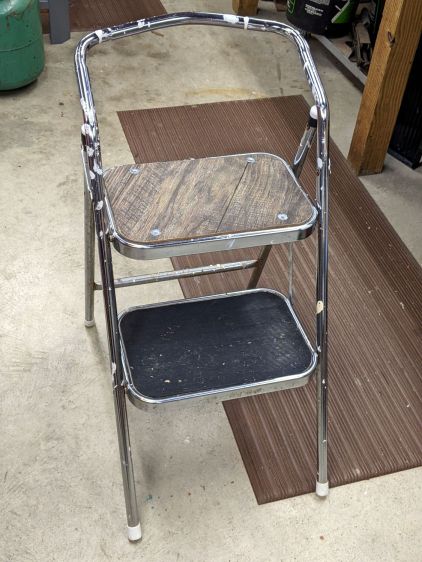
The top step of a folding step stool we’ve been (ab)using forever finally wore out, mostly because it was covered in vinyl and intended as a seat. We always used it as a step, despite knowing you should never stand on the top rung of a ladder: “Do not stand on or above this level”.
I tossed the ripped vinyl and warped particle board, cut a random chunk of wood-textured paneling (which Came With The House™) to fit, match-drilled four holes, and it looks OK:
Folding step stool – reseated
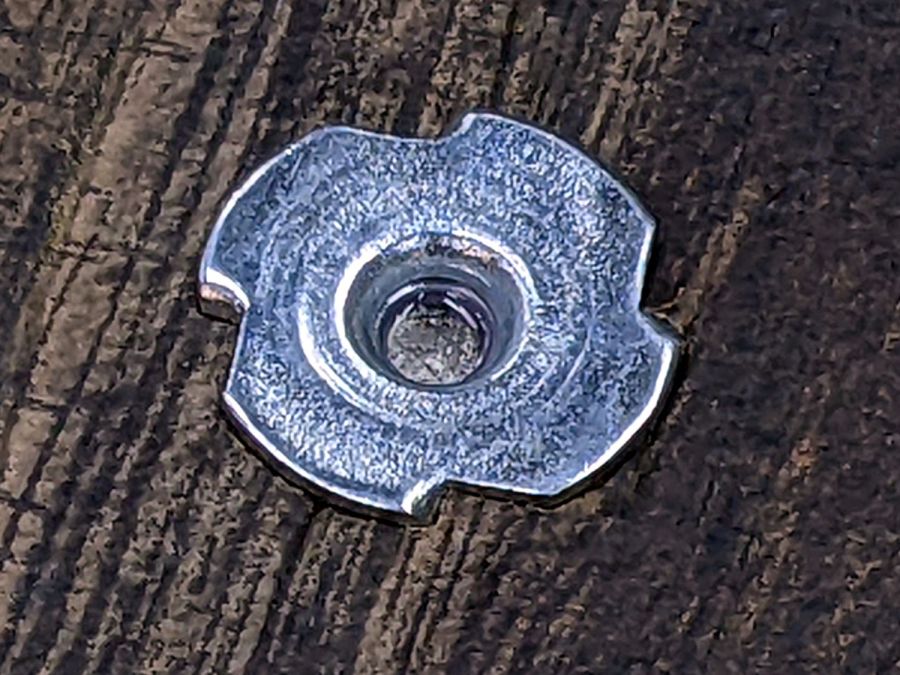
The original seat / step / whatever used press-fit studs with a flat flange covered by the vinyl, but I just slammed 10-32 tee nuts into the paneling:
Folding step stool – tee nut installed
That’s a ring of low-strength threadlock around the inside of the nut; I do not expect the screws to come out ever again.
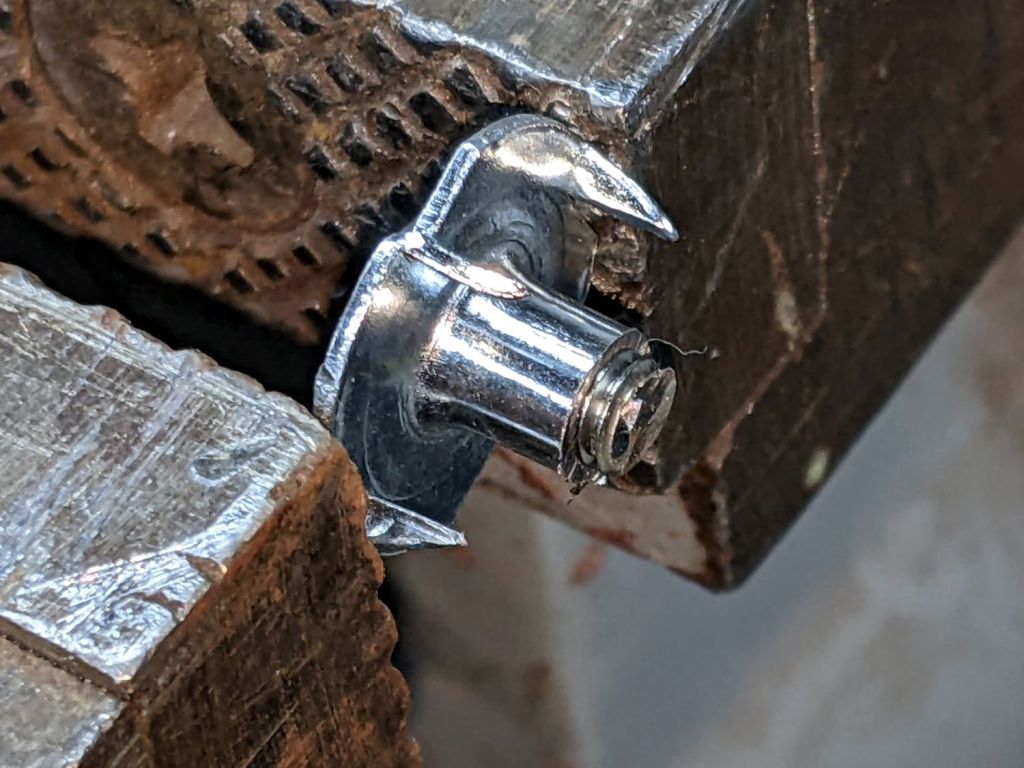
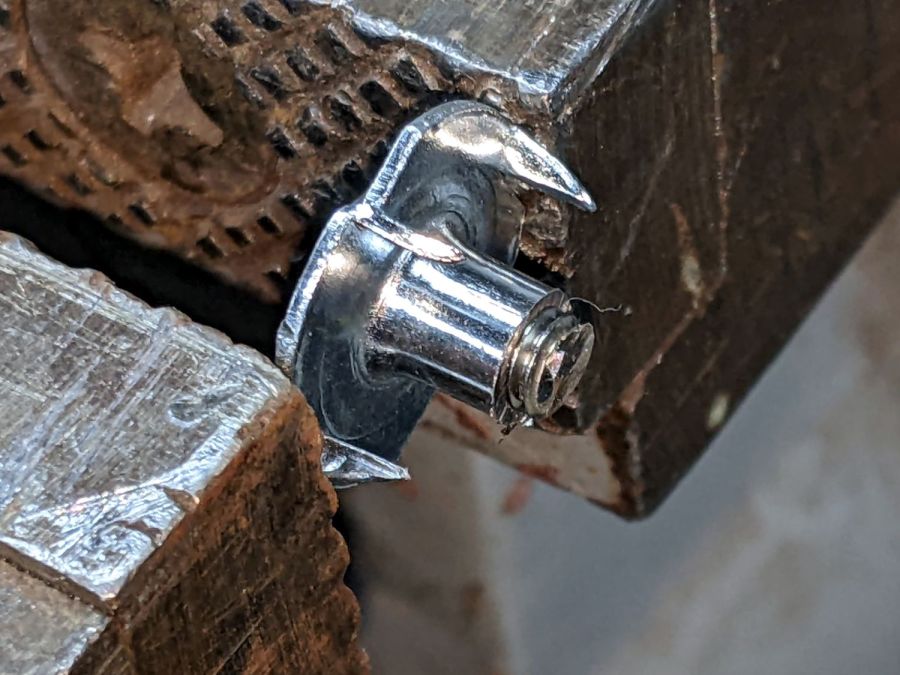
I cut the screws to length with a Dremel cutoff wheel using a slightly shortened tee nut as a fixture:
Folding step stool – screw shortening fixture
Not visible: the vacuum hose clamped to the vise sucking up all the abrasive + metal dust.
Good for an hour of Quality Shop Time™ on a cold winter morning!
A lithium battery management system can (and should!) disable the battery output to prevent damage from overcurrent or undervoltage, after which it must be reset. The inadvertent charge port short may have damaged the BMS PCB, but did not shut down the battery’s motor output, which means the BMS will not should not require resetting. However, because all this will happen remotely, it pays to be prepared.
For this battery, the positive terminal is on the right, as shown by the molded legend and verified by measurement.
A doodle with various dimensions, most of which are pretty close:
Bafang battery – connector dimension doodle
Further doodling produced a BMS reset adapter keyed to fit the battery connector in only one way:
Bafang battery – adapter doodle
Which turned into the rectangular lump at the top of the tool kit, along with the various shell drills and suchlike discussed earlier:
Bafang battery tools
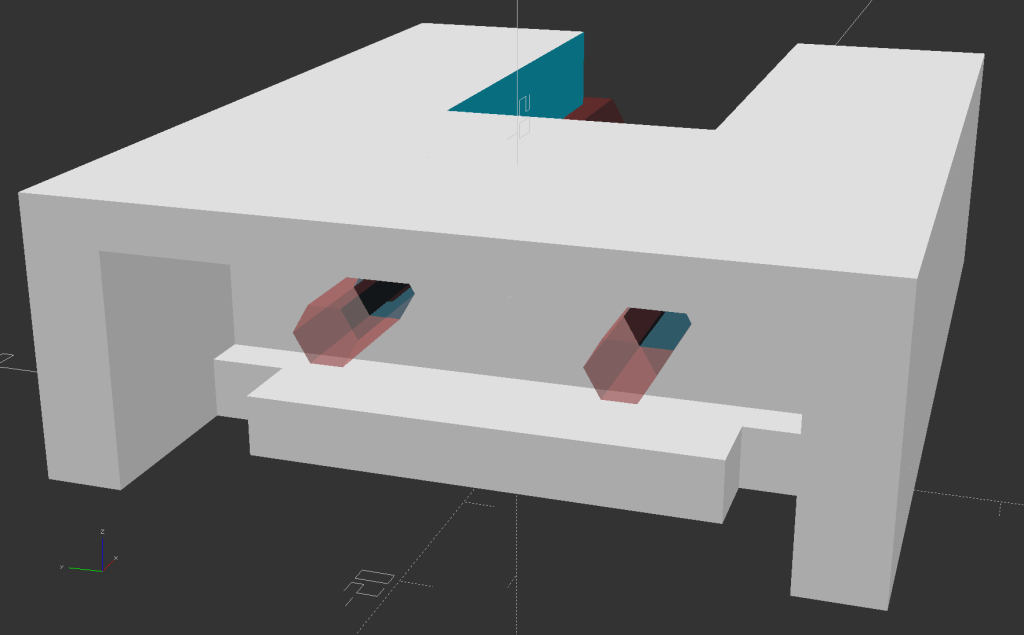
Looking into the solid model from the battery connector shows the notches and projections that prevent it from making incorrect contact:
Battery Reset Adapter – show front
The pin dimensions on the right, along with a mysterious doodle that must have meant something at the time :
Bafang battery – adapter pin doodle
The pins emerged from 3/16 inch brass rod, with pockets for the soldered wires:
Bafang battery – reset tool – pins
The wires go into a coaxial breakout connector that’s hot-melt glued into the recess. The coaxial connectors are rated for 12 V and intended for CCTV cameras, LED strings, and suchlike, but I think they’re good for momentary use at 48 V with minimal current.
I printed the block with the battery connector end on top for the best dimensional accuracy and the other end of the pin holes held in place by a single layer of filament bridging the rectangular opening:
Bafang battery – reset tool – hole support layer
I made a hollow punch to cut the bridge filaments:
Bafang battery – reset tool – pin hole punch
The holes extend along the rectangular cutout for the coaxial connector, so pressing the punch against the notch lines it up neatly with the hole:
Bafang battery – reset tool – hole punching
Whereupon a sharp rap with a hammer clears the hole:
Bafang battery – reset tool – hole cleared
A dollop of urethane adhesive followed the pins into their holes to lock them in place. I plugged the block and pins into the battery to align the pins as the adhesive cured, with the wire ends carefully taped apart.
After curing: unplug the adapter, screw wires into coaxial connector, slobber hot melt glue into the recess, squish into place, align, dribble more glue into all the gaps and over the screw terminals, then declare victory.
It may never be needed, but that’s fine with me.
[Update: A few more doodles with better dimensions and fewer malfeatures appeared from the back of the bench.]
This file contains hidden or bidirectional Unicode text that may be interpreted or compiled differently than what appears below. To review, open the file in an editor that reveals hidden Unicode characters.
Learn more about bidirectional Unicode characters
That’s our undamaged battery, now sporting labels inspired by my friend’s mishap.
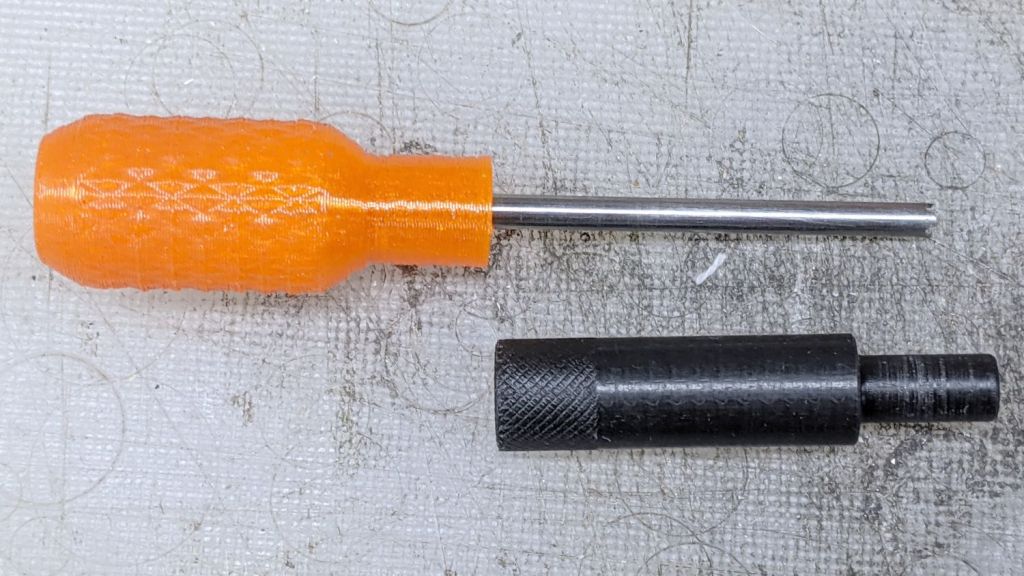
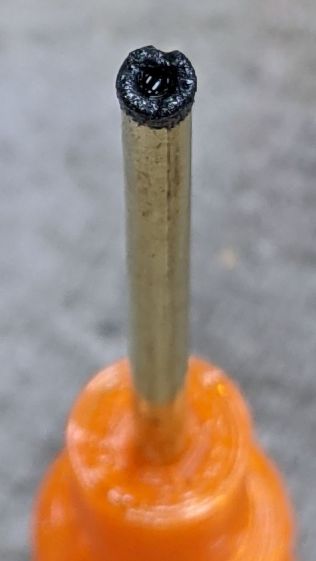
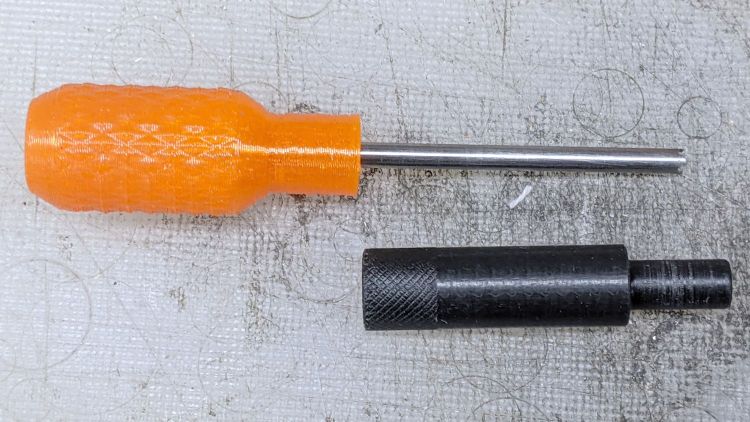
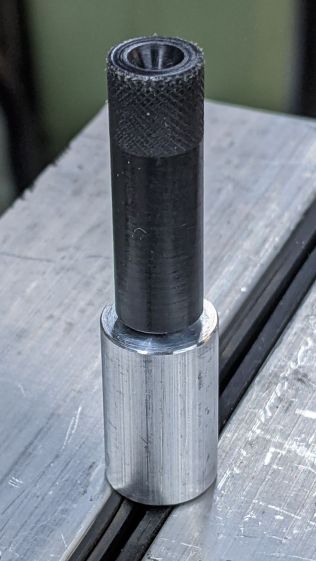
The first pass was a 3 mm (actually, 1/8 inch) brass tube rammed into a printed handle descending from the Sherline Tommy Bar handles:
Bafang battery – brass shell grinder – grit load
The black stuff is coarse grinding compound held on by a dot of oil, with a pair of notches filed into the tip for a little griptivity.
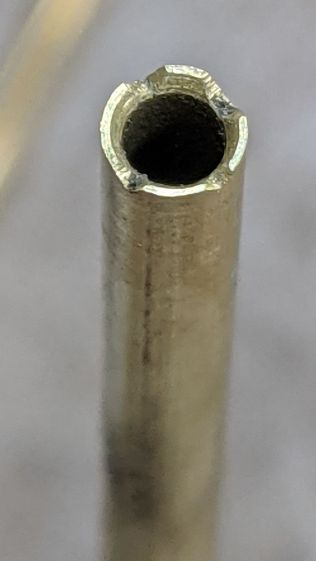
This worked surprisingly well, at least if you weren’t in much of a hurry, although the grinding compound also erodes the drill:
Bafang battery – brass shell grinder – tip wear
I hadn’t thought this through enough to realize there’s no good way to convince the grit to not work its way up into the acetal bushing and jam the rod. While this might be good for final polishing, it’s not going to work well against the nugget, so it’s time for a harder drill with real teeth.
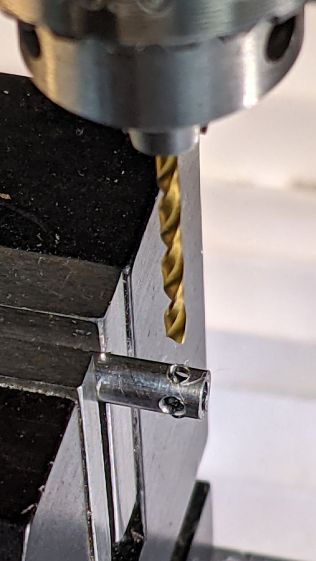
Drilling a 2.3 mm hole into the end of some non-hardened 3 mm (for real!) ground rod provided enough clearance for the charge port pin and a pair of cross-drilled holes laid the groundwork for a shell drill:
Bafang battery – steel shell drill – raw holes
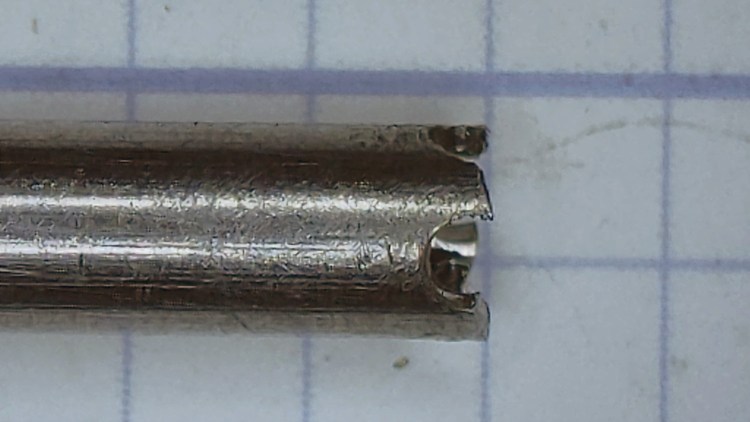
I filed the end off down to leave about 3/4 of the holes, then applied a Swiss pattern file with a safe edge to cut some relief behind the tips:
Bafang battery – shell drill detail
It would be better to harden the end of the rod, but this is a single-use tool.
Ram the shank into another printed handle:
Bafang battery – shell drill – guide
The new drill is long enough to reach past the wounded end of the pin and short enough to not bottom out inside the connector.
A few minutes of twirling and re-filing the tiny teeth improved the cut enough to produce a convincing result in the simulated connector:
Bafang battery – shell drill – test results
I’m reasonably sure the ID of the acetal bushing won’t fit over the nugget, but that’s easy enough to drill out while leaving an insulating shell.
The charge port’s center pin probably can’t withstand too much torque, so the drill must take small cuts.
Vacuuming out the chips while cutting will be critical, as you don’t want an accumulation of conductive chaff down in the hole!
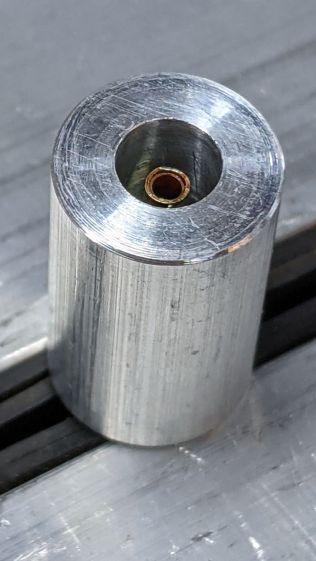
Rather than poke things into the undamagedcharge port of our battery, I built a quick-and-dirty mechanical duplicate:
Bafang battery – charge port simulator
The “center pin” is a snippet of what’s almost certainly 5/64 inch brass tube measuring Close Enough™ to 2.1 mm, with a few millimeters of 3/32 inch tube soldered on the end to simulate the nugget.
The aluminum rod has a 5.5 mm hole matching the coaxial jack’s diameter and depth, with a smaller through hole for the “pin” and a dab of Loctite bushing adhesive.
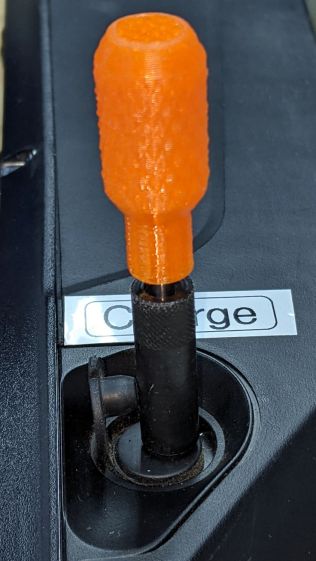
Then I turned the end of a 3/8 inch acetal rod down to a 5.5 mm bushing that completely fills the jack:
Bafang battery – guide bushing – dummy jack
It has a 3 mm hole down the middle to aim homebrew shell drills directly at the pin, while preventing a short to the side contact.
The first test looked encouraging:
Bafang battery – shell drill – test results
The nugget in the damaged jack is definitely larger than my soldered brass tube, but this was in the nature of exploratory tinkering while mulling the problem.
Short-circuiting the Bafang battery’s charge port may have done anything from completely destroying the battery management circuit to just welding a brass nugget onto the port’s center pin. The main output to the bike motor remained functional, so my friend used it on rides over the next few days to reduce the charge level.
Meanwhile, I peeked inside the undamaged battery on Mary’s bike:
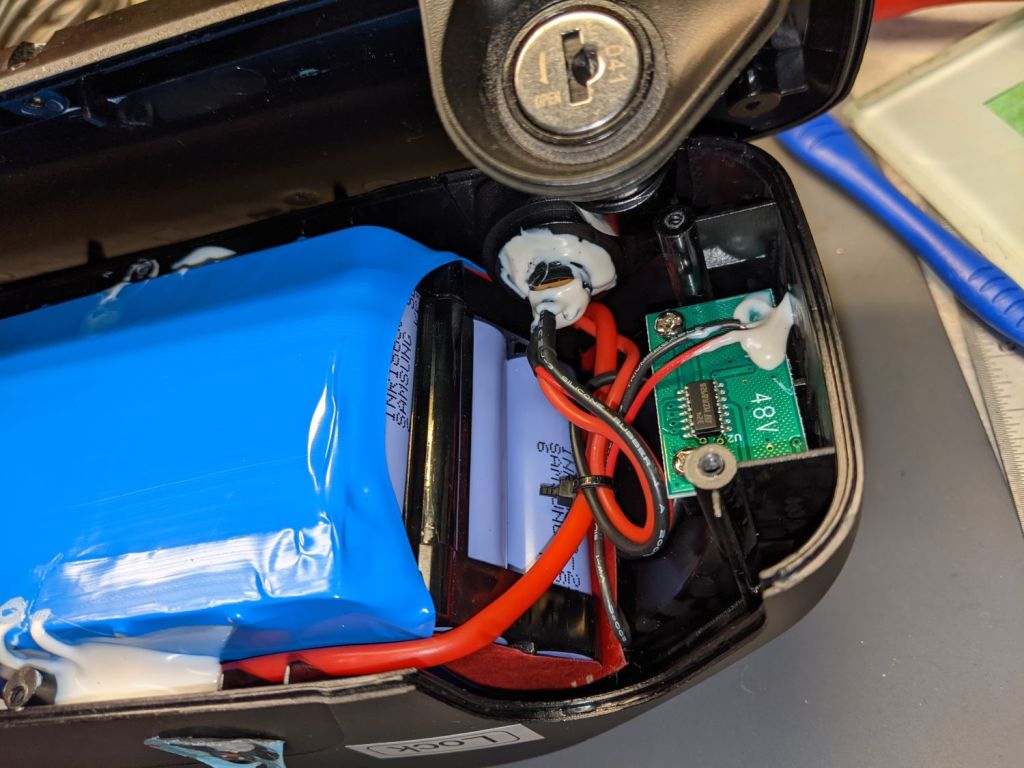
Bafang battery interior – overview
The battery pack is neatly shrink-wrapped and firmly glued into the plastic shell, with the battery management PCB on the other side of the battery. Some gentle prying suggests it will be difficult to disengage the adhesive, so getting the pack out will likely require cutting the blue wrap, extricating the cells as an unbound set, then cutting the blue wrap to release the wires.
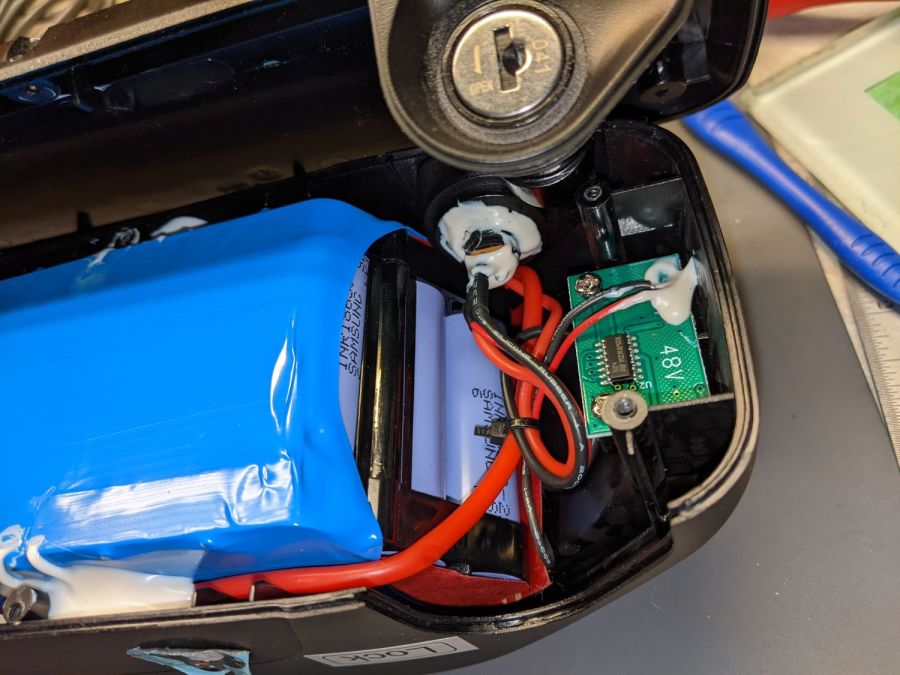
A closer look at the nose of the battery:
Bafang battery interior – front
The large red wire entering on the left comes from the motor connector, loops around the nose of the battery, and probably connects to the battery’s most positive terminal or, perhaps, to the corresponding BMS terminal.
The medium black wire from the side contact of the coaxial jack (atop the pair of red wires) burrows under the battery and likely connects to the most negative battery terminal. This is the charger plug’s outer terminal.
The small red wire from the center contact of the coaxial jack (between the medium black and red wires) goes to the charge indicator PCB in the nose of the battery. This is basically a push-to-test voltmeter with four LEDs indicating the charge state from about 40 V through 54 V. The small black wire from that PCB burrows under the battery on its way to the BMS.
The medium red wire from the center contact goes to the BMS.
There is no way to determine how much damage the short might have done, although the silicone-insulated wires should have survived momentary heating, unlike cheap PVC insulation that slags down at the slightest provocation.
Removing and replacing the coaxial jack requires Cutting Three Wires then rejoining them, a process fraught with peril. You must already have a profound respect for high voltages, high currents, and high power wiring; this is no place for on-the-job learning and definitely not where you can move fast and break things.
With this in mind, the only hope is to remove the nugget and see if the battery charges properly.
The trick will be to do this without any possibility of shorting a metallic tool between the center pin and the side contact.
The lock might deter casual thievery, but really prevents the battery from bouncing out of its mounting plate while riding.
The right side has a charge port closed with a rubber plug:
Bafang battery – charge port – closed
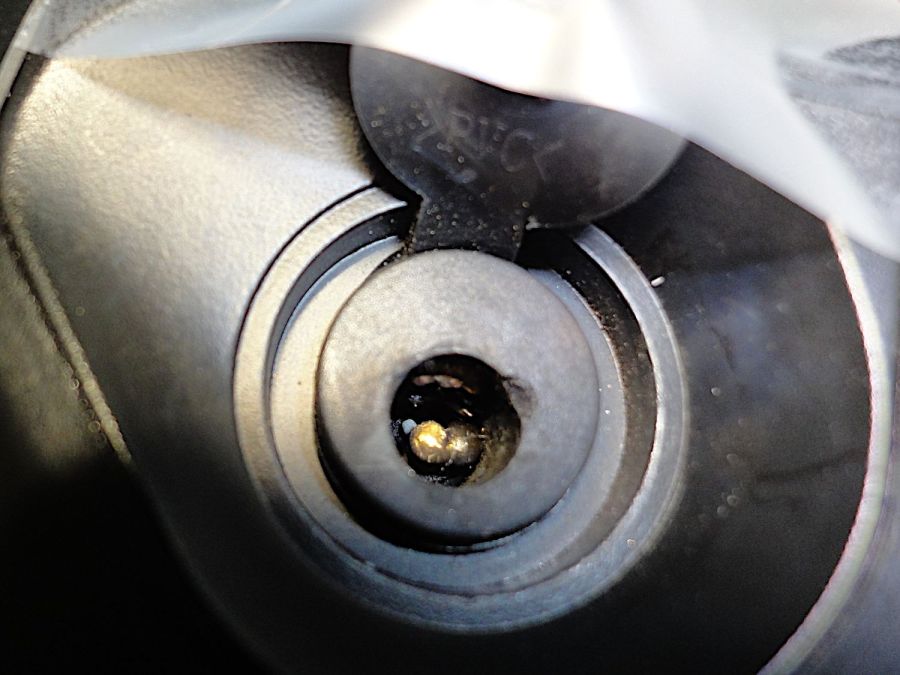
The cover protects a coaxial jack with a 5.5 mm OD and a 2.1 mm center pin:
Bafang battery – charge port
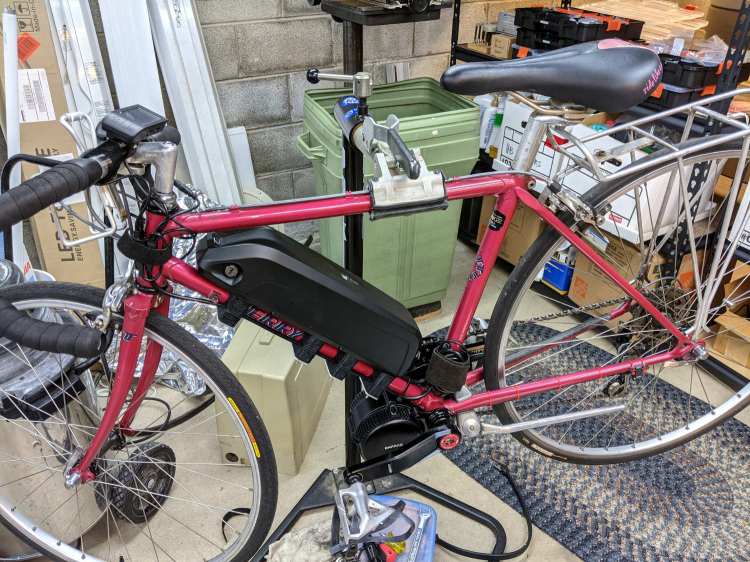
My friend in Raleigh generally removes the battery before hoisting the bike into the back of her car to haul it to a friend’s house for their companionable rides: not lifting an additional seven pounds is a Good Idea™.
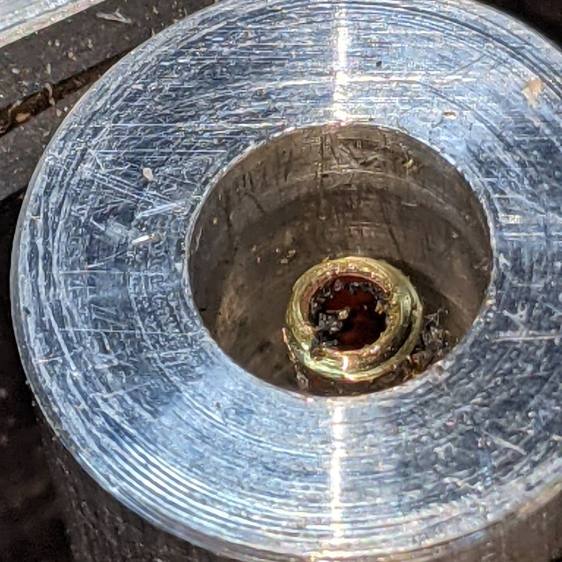
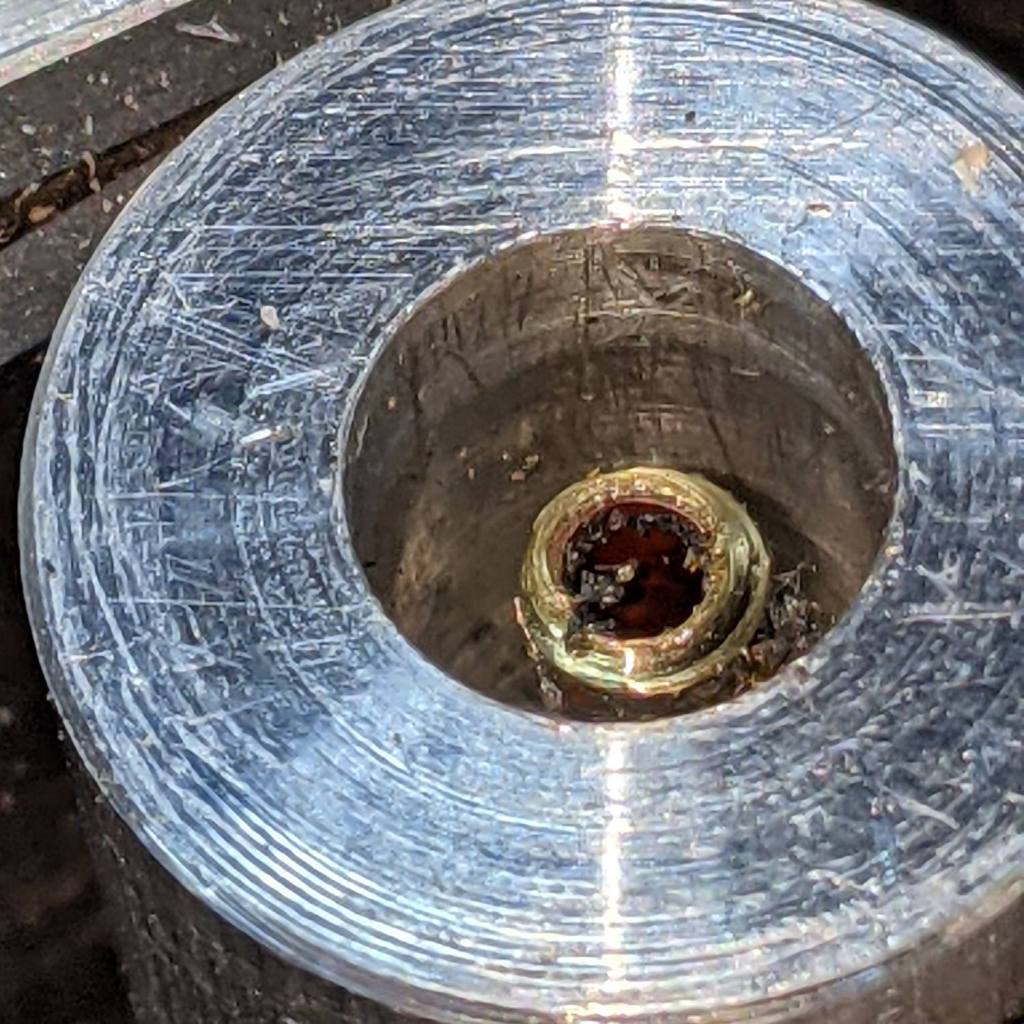
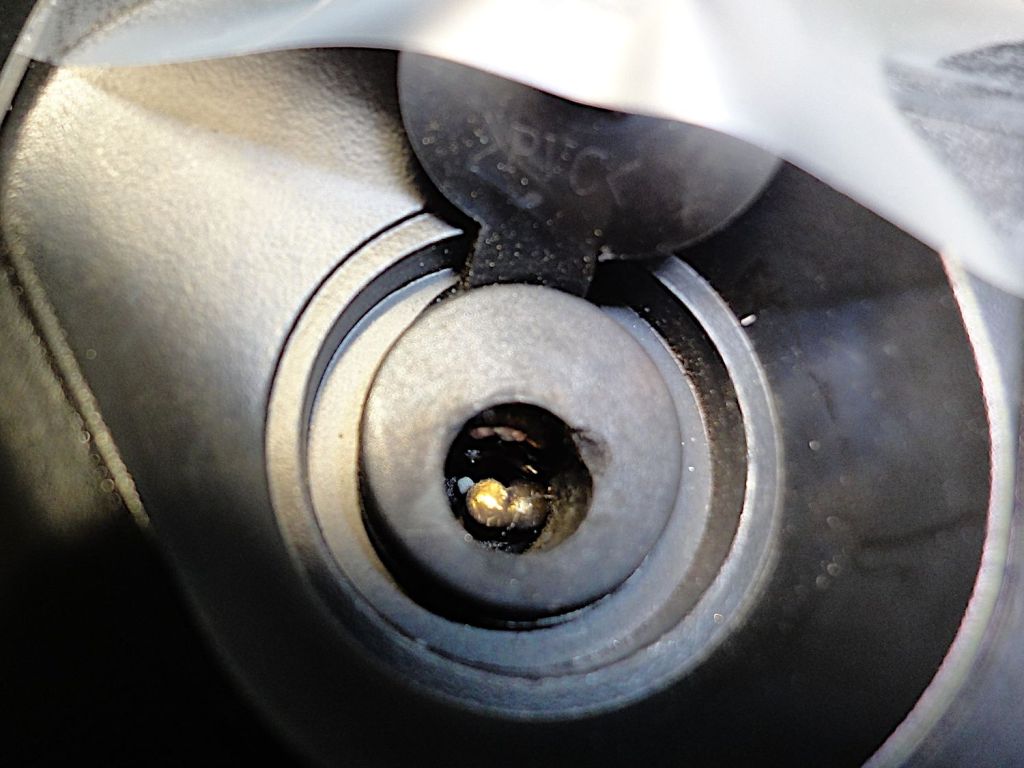
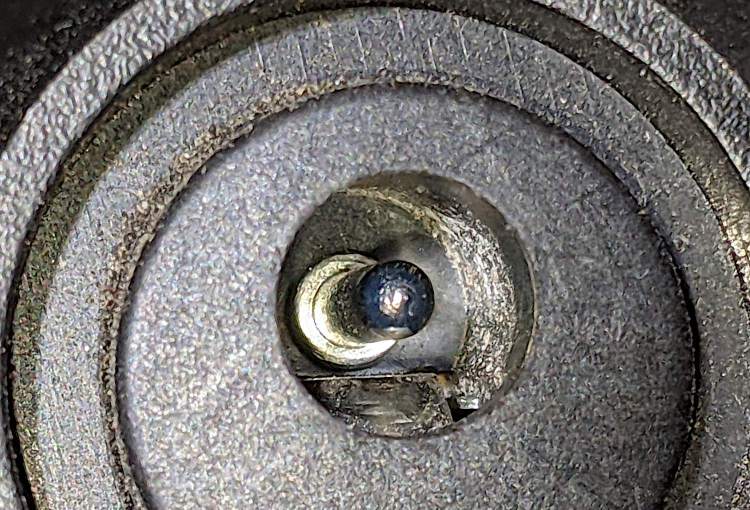
A momentary distraction in the middle of that process caused her to insert the brass key into the charging port, rather than the lock. The key put a very short circuit between the coaxial jack’s side contact and the center pin, melting the key tip and welding a brass nugget onto the side of the pin:
Bafang battery – damaged charge port
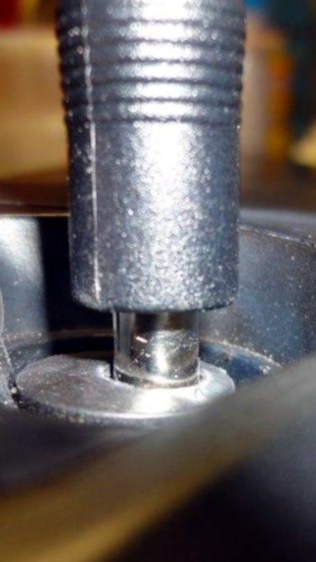
The charger plug normally sits almost flush to the port’s surface:
Bafang battery – charge plug
The nugget keeps the plug out the damaged port, preventing the plug from making electrical contact:
Bafang battery – damaged port – plug
She owned the problem and immediately bought another battery, which tells you the value she places on riding her e-bike.
Verily it is written: let someone who is without whoopsie cast the first shade.
Any takers? Yeah, the way I see it, someone who says they’ve never done anything quite like that is either not doing anything or not telling the complete truth. For sure, I’ve done plenty of inadvertent damage!
Here’s the problem:
The damaged battery is the better part of 600 miles away from my shop
Civilians cannot ship 560 W·hr lithium batteries through any parcel delivery service
Civilians cannot fly or take the train with such a battery, either
Driving 1200 miles twice is out of the question for either of us