The Smell of Molten Projects in the Morning

Ed Nisley's Blog: Shop notes, electronics, firmware, machinery, 3D printing, laser cuttery, and curiosities. Contents: 100% human thinking, 0% AI slop.

Category: Machine Shop

Mechanical widgetry

  • OXO Not-salt Grinder: Aluminum Shaft

    OXO Not-salt Grinder: Aluminum Shaft

    Having recently emptied the OXO pepper grinder we (mistakenly?) bought as a salt mill, I took it apart for a deep rinsing and cleanup:

    OXO salt-pepper mill - aluminum shaft
    OXO salt-pepper mill – aluminum shaft

    It turns out the somewhat corroded square shaft is aluminum, neither the cheap steel I expected nor the stainless steel it should be. Perhaps OXO cost-reduced the shaft, discovered aluminum is a poor choice in a saline environment, and changed the packaging to compensate?

    Removing / installing the Jesus clip requires careful whacking with a hollow-tip punch against the shaft, with the whole affair laid flat on shop towels, the handle held down to prevent rotation, and the wrap-around body capturing the escaping clip.

    Shaft corrosion as of Summer 2020:

    OXO Salt Mill - corrosion
    OXO Salt Mill – corrosion

    Soaking the body in hot water got rid of salt crusts and filled the shell with water. There being no way to completely dry the thing, I parked it in the sun for a day, refilled it, and was unsurprised when the (dried) salt turned into an assortment of moist crystals.

    We obviously need a real salt mill …

  • DIY e-Bike Conversions & Solid Modeling: Presentation

    DIY e-Bike Conversions & Solid Modeling: Presentation

    I’ll be talking about e-bikes and the solid modeling required to hang a Bafang motor and battery on your favorite bike for the Poughkeepsie Chapter of the ACM at 1930 EDT this evening:

    Bafang Battery Mount - Show view
    Bafang Battery Mount – Show view

    It’s a Zoom meeting, so (in the unlikely event you have nothing better to do) you could actually “attend”. The ACM meeting description and the Meetup announcement will get you there.

    A PDF of the presentation slides (remember slides?) includes copious linkies to sources / blog posts / distractions:

    If you’re only in it for the geometry, the OpenSCAD source code lives slumbers in a pair of GitHub Gists:

    Tour Easy

    Terry Symmetry

    Enjoy …

  • Improved Mini-lathe Disk Turning Fixture

    Improved Mini-lathe Disk Turning Fixture

    Unsurprisingly, the mini-lathe lacks enough stiffness to apply enough force to hold a disk in place while turning its rim:

    Tour Easy Rear Running Light - end cap fixture - swirled adhesive
    Tour Easy Rear Running Light – end cap fixture – swirled adhesive

    The old South Bend lathe had mojo, but those days are gone.

    So drill and tap that fixture for an M3 screw, then stick some coarse sandpaper to it:

    Improved disk turning tool
    Improved disk turning tool

    Snug the screw (a Torx T9 from the Small Drawer o’ Random M3 Screws) down on a rough-cut disk:

    Improved disk turning tool - in use
    Improved disk turning tool – in use

    Sissy cuts remain the order of the day, but the screw applies plenty of clamping force and doesn’t require the hulking live center.

  • Tube Turning Adapters

    Tube Turning Adapters

    Finishing the PVC tubes reinforcing the vacuum cleaner adapters required fixtures on each end:

    Dirt Devil adapter - pipe turning
    Dirt Devil adapter – pipe turning

    Because the tubes get epoxied into the adapters, there’s no particular need for a smooth surface finish and, in fact, some surface roughness makes for a good epoxy bond. The interior of a 3D printed adapter is nothing if not rough; the epoxy in between will be perfectly happy.

    Turning the tubes started by just grabbing the conduit in the chuck and peeling the end that stuck out down to the finished diameter, because the conduit was thick-walled enough to let that work.

    The remaining wall was so thin that the chuck would crunch it into a three-lobed shape, so the white ring in the chuck is a scrap of PVC pipe turned to fit the tube ID and provide enough reinforcement to keep the tube round.

    The conduit ID isn’t a controlled dimension and was, in point of fact, not particularly round. It was, however, smooth, which counts for more than anything inside a tube carrying airborne fuzzy debris; polishing the interior of a lathe-bored pipe simply wasn’t going to happen.

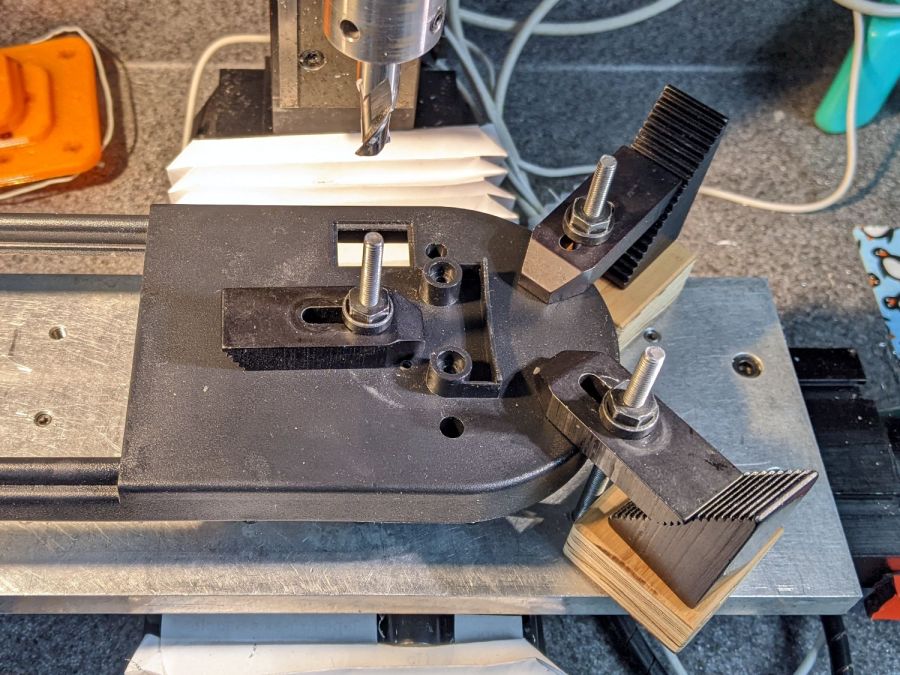
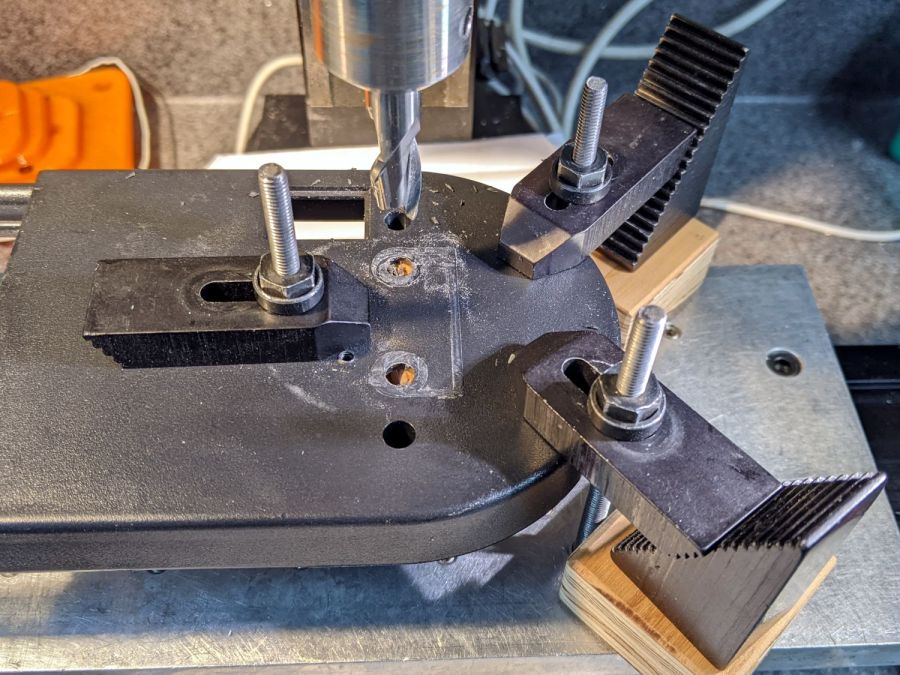
    The fixture on the other end started as a scrap of polycarbonate bandsawed into a disk with a hole center-drilled in the middle:

    Pipe end lathe fixture - center drilling
    Pipe end lathe fixture – center drilling

    Stick it onto a disk turning fixture and sissy-cut the OD down a little smaller than the eventual tube OD:

    Pipe end lathe fixture - turning OD
    Pipe end lathe fixture – turning OD

    Turn the end down to fit the tube ID, flip it around to center-drill the other side, stick it into the tube, and finally finish the job:

    Dirt Devil adapter - pipe fixture
    Dirt Devil adapter – pipe fixture

    The nice layering effect along the tube probably comes from molding the conduit from recycled PVC with no particular concern for color matching.

    A family portrait of the fixtures with a finished adapter:

    Dirt Devil adapter - fixtures
    Dirt Devil adapter – fixtures

    A fine chunk of Quality Shop Time: solid modeling, 3D printing, mini-lathe turning, and even some coordinate drilling on the Sherline.

  • Dirt Devil Vacuum Tool Adapters

    Dirt Devil Vacuum Tool Adapters

    Being the domain expert for adapters between a new vacuum cleaner and old tools, this made sense (even though it’s not our vacuum):

    Dirt Devil Nozzle Bushing - solid model
    Dirt Devil Nozzle Bushing – solid model

    The notch snaps into a Dirt Devil Power Stick vacuum cleaner and the tapered end fits a variety of old tools for other vacuum cleaners:

    Dirt Devil Nozzle Bushing top view - solid model
    Dirt Devil Nozzle Bushing top view – solid model

    Having some experience breaking thin-walled adapters, these have reinforcement from a PVC tube:

    Dirt Devil adapter - parts
    Dirt Devil adapter – parts

    A smear of epoxy around the interior holds the tube in place:

    Dirt Devil adapters - assembled
    Dirt Devil adapters – assembled

    Building the critical dimensions with a 3D printed part simplified the project, because I could (and did!) tweak the OpenSCAD code to match the tapers to the tools. Turning four of those tubes from a chunk of PVC conduit, however, makes a story for another day.

    The OpenSCAD source code as a GitHub Gist:

    // Dirt Devil nozzle adapter
    // Ed Nisley KE4ZNU 2021-10
    // Tool taper shift
    Finesse = -0.1; // [-0.5:0.1:0.5]
    // PVC pipe liner
    PipeOD = 28.5;
    /* [Hidden] */
    //- Extrusion parameters
    ThreadThick = 0.25;
    ThreadWidth = 0.40;
    HoleWindage = 0.2;
    function IntegerMultiple(Size,Unit) = Unit * ceil(Size / Unit);
    Protrusion = 0.1; // make holes end cleanly
    //———————-
    // Dimensions
    TAPER_MIN = 0;
    TAPER_MAX = 1;
    TAPER_LENGTH = 2;
    Socket = [36.0,37.0,40.0];
    LockringDia = 33.5;
    LockringWidth = 4.5;
    LockringOffset = 2.5;
    Tool = [Finesse,Finesse,0] + [30.0,31.1,30.0];
    AdapterOAL = Socket[TAPER_LENGTH] + Tool[TAPER_LENGTH];
    NumSides = 36;
    $fn = NumSides;
    //———————-
    // Useful routines
    module PolyCyl(Dia,Height,ForceSides=0) { // based on nophead's polyholes
    Sides = (ForceSides != 0) ? ForceSides : (ceil(Dia) + 2);
    FixDia = Dia / cos(180/Sides);
    cylinder(r=(FixDia + HoleWindage)/2,h=Height,$fn=Sides);
    }
    //——————-
    // Define it!
    module Adapter() {
    difference() {
    union() {
    difference() {
    cylinder(d1=Socket[TAPER_MIN],d2=Socket[TAPER_MAX],h=Socket[TAPER_LENGTH]);
    translate([0,0,LockringOffset])
    cylinder(d=2*Socket[TAPER_MAX],h=LockringWidth);
    }
    cylinder(d=LockringDia,h=Socket[TAPER_LENGTH]);
    translate([0,0,LockringOffset + 0.75*LockringWidth])
    cylinder(d1=LockringDia,d2=Socket[TAPER_MIN],h=0.25*LockringWidth);
    translate([0,0,Socket[TAPER_LENGTH]])
    cylinder(d1=Tool[TAPER_MAX],d2=Tool[TAPER_MIN],h=Tool[TAPER_LENGTH]);
    }
    translate([0,0,-Protrusion])
    PolyCyl(PipeOD,AdapterOAL + 2*Protrusion,NumSides);
    }
    }
    //———————-
    // Build it!
    Adapter();

    The taper in the code almost certainly won’t fit whatever tool you have: measure thrice, print twice, and maybe fit once …

  • Bondhus Wrench Replacement

    Bondhus Wrench Replacement

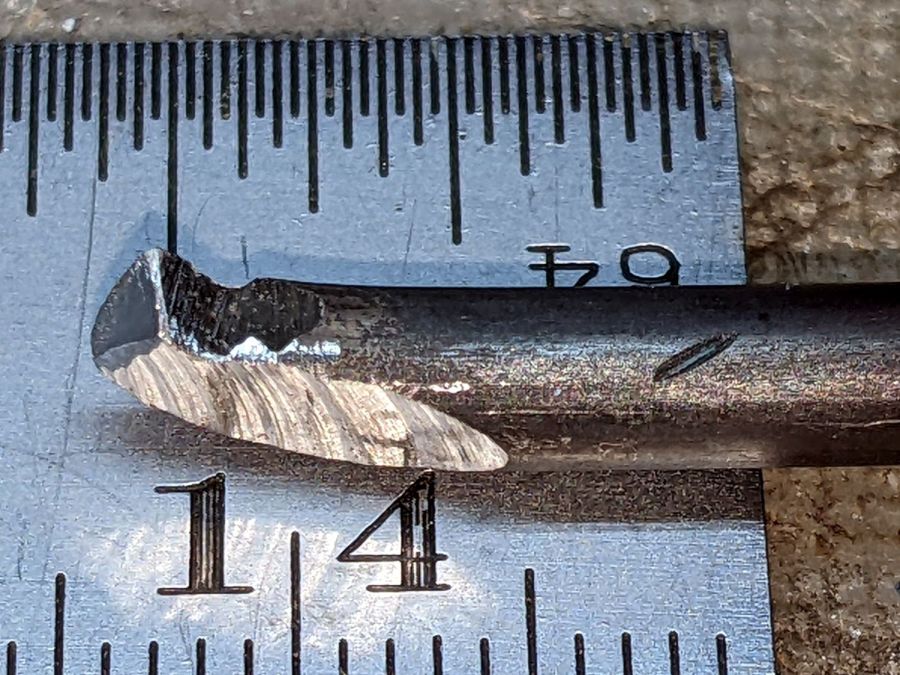
    The Bondhus Lifetime Guarantee works, as a replacement wrench just arrived:

    Bondhus hex wrenches - 7-64 ball end - replacement
    Bondhus hex wrenches – 7-64 ball end – replacement

    A close look at the aligned tips suggests the defective wrench blank was mis-chucked in the machine cutting the ball end:

    Bondhus hex wrenches - 7-64 ball end - replacement - detail
    Bondhus hex wrenches – 7-64 ball end – replacement – detail

    All’s well that ends well: thank you, Bondhus!

  • Micro-Mark Bandsaw: Acetal Upper Blade Guide

    Micro-Mark Bandsaw: Acetal Upper Blade Guide

    There being nothing like a good new problem to take one’s mind off all one’s old problems:

    Micro-Mark Bandsaw - acetal upper blade guide installed
    Micro-Mark Bandsaw – acetal upper blade guide installed

    It’s basically the same as the lower blade guide, except coming from a stick of 5/8 inch acetal. A scant 6 mm stem goes into the vertical square rod, with a flat matching the setscrew coming up from the bottom to hold it in proper alignment.

    I came within a heartbeat of cutting the slot parallel to the flat.

    It worked OK while cutting a chunk of stout aluminum tube: so far, so good!

    The impressive chunk of hardware is the OEM blade guide, with the brass tube for coolant flow all over the bearings. It’s mostly intended for use with the diamond blade, so I’ll swap it back in when I finally get around to cutting some slate for base plates.