The Smell of Molten Projects in the Morning

Ed Nisley's Blog: Shop notes, electronics, firmware, machinery, 3D printing, laser cuttery, and curiosities. Contents: 100% human thinking, 0% AI slop.

Category: Home Ec

Things around the home & hearth

  • Humidifier Float Clip Replacement

    Humidifier Float Clip Replacement

    This being the end of the humidifcation season, I tried to set the longsuffering Sears Humidifier’s water level float to dry the thing out. After a few days, it became obvious that wasn’t working and I eventually found the clip intended to hold the float at the top of its travel had broken:

    Humidifier float clips - on float
    Humidifier float clips – on float

    Building the retina-burn orange replacement started with a scan of the original:

    Humidifier float clip
    Humidifier float clip

    The black segment at the bottom is a shadow due to the scanner’s light bar being offset from the imaging sensor.

    Using GIMP, duplicate the remaining part of the latch, flip it left-to-right, then align it at the proper position:

    Humidifier float clip - repaired
    Humidifier float clip – repaired

    The latch is the only tricky part and the ID of the ring is easy to locate, so (still in GIMP):

    • Trace the edge of the whole shape
    • Using Quick Mask mode, remove all but the latch
    • Convert the selection to a path
    • Export it as an SVG file

    Then import it into OpenSCAD and eyeballometrically translate the shape to put the ring ID at the origin:

      color("Red")
        translate([-23.6,-42.6])
          import("Humidifier float clip - cabinet latch.svg");


    Which looks like this:

    Float clip - 2D latch
    Float clip – 2D latch

    Then glom a perfect ring onto it:

    Float clip - 2D model parts
    Float clip – 2D model parts

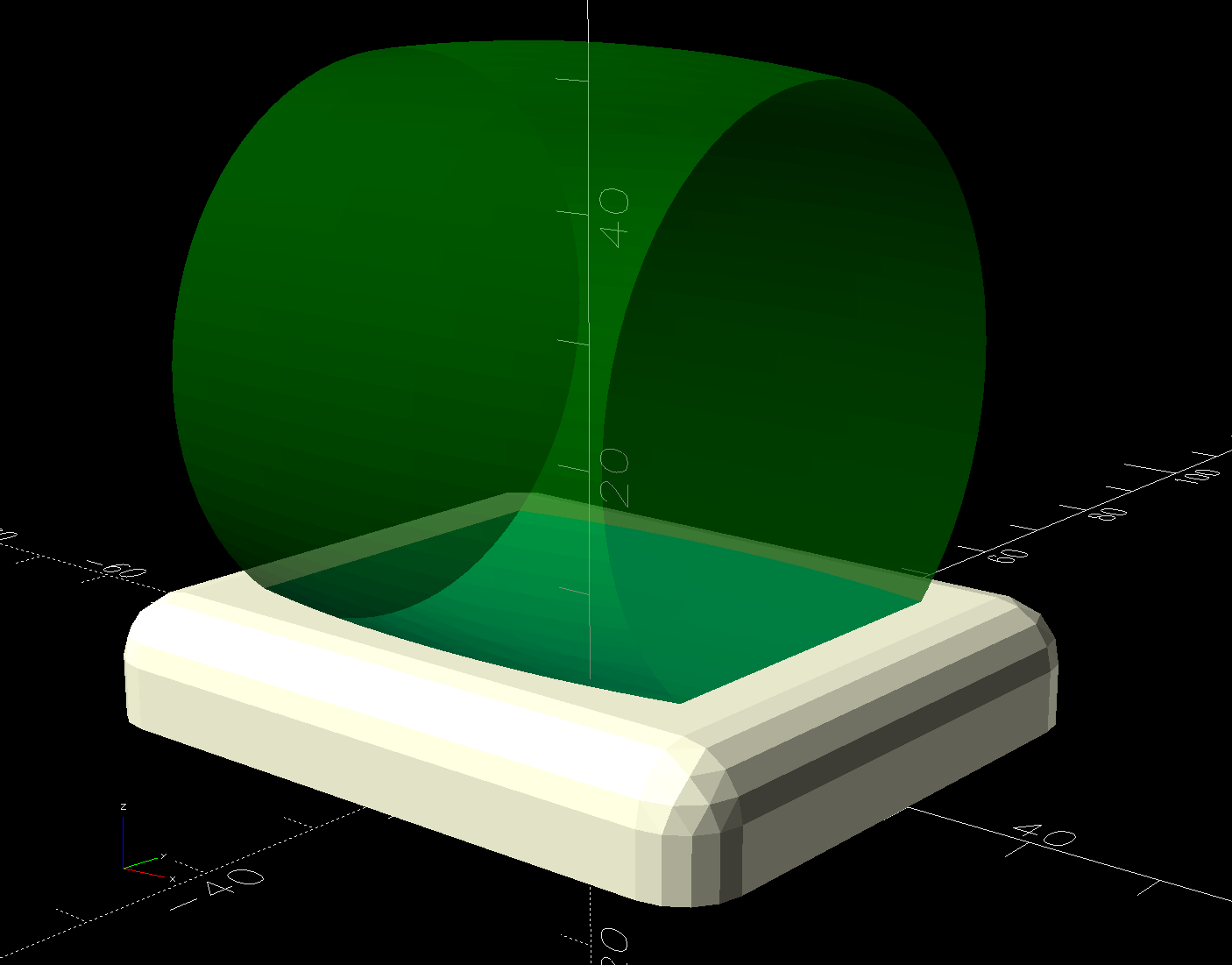
    Extrude half an inch upward:

    Float clip - extruded model
    Float clip – extruded model

    And It Just Works™:

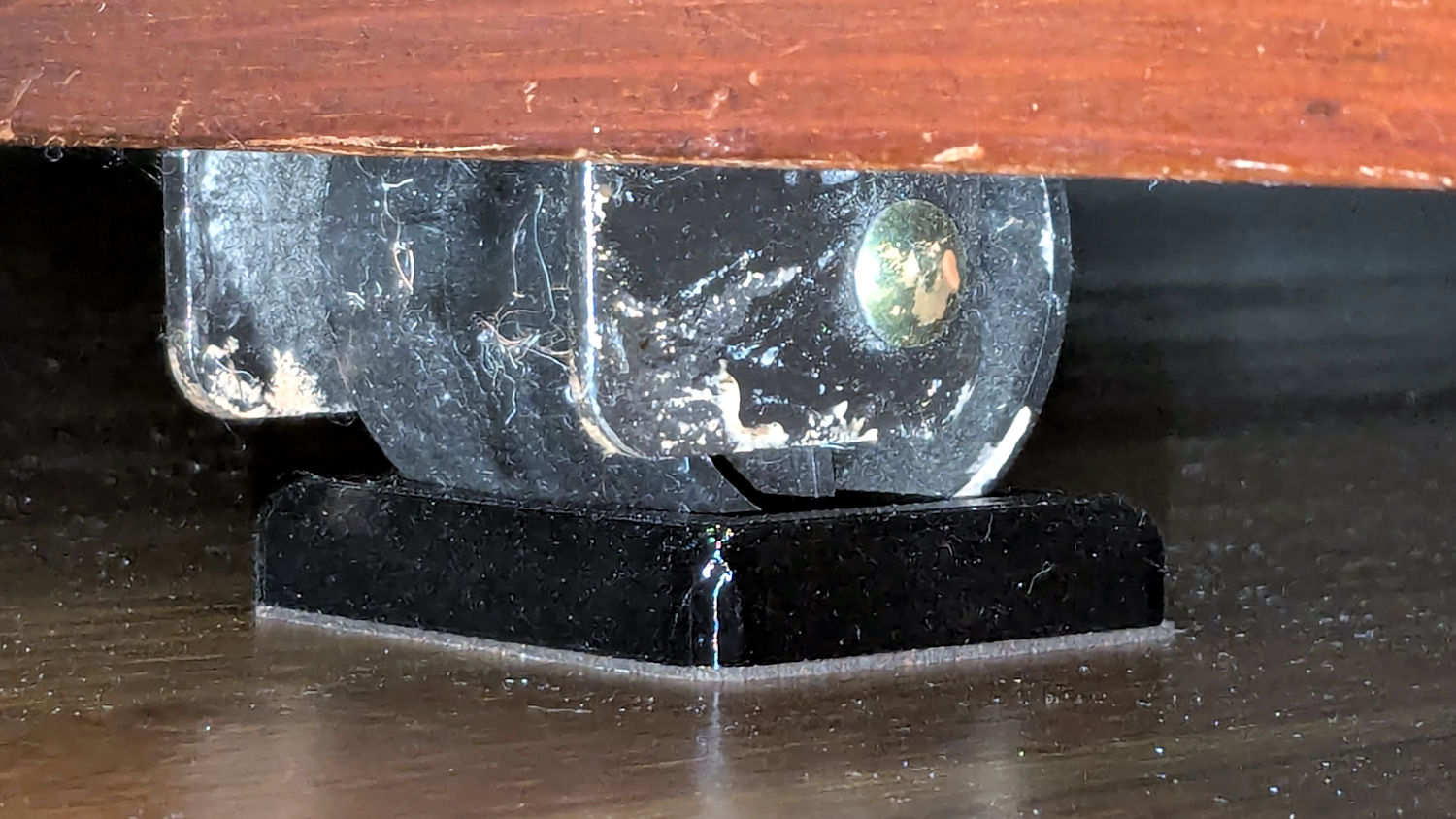
    Humidifier float clip - installed
    Humidifier float clip – installed

    There being no obvious affordance to get the ring over the two bumps in the float, I applied Channellock pliers to the float while easing the ring into place.

    Re-rebuilding the hinges sits behind a few other things going on around here …

  • Auto Side Marker Bulb: FAIL

    Auto Side Marker Bulb: FAIL

    Six years ago I replaced the W5W incandescent front side marker bulbs in our 2015 Subaru Forester with amber LED bulbs:

    Side Marker bulbs - failed adhesive
    Side Marker bulbs – failed adhesive

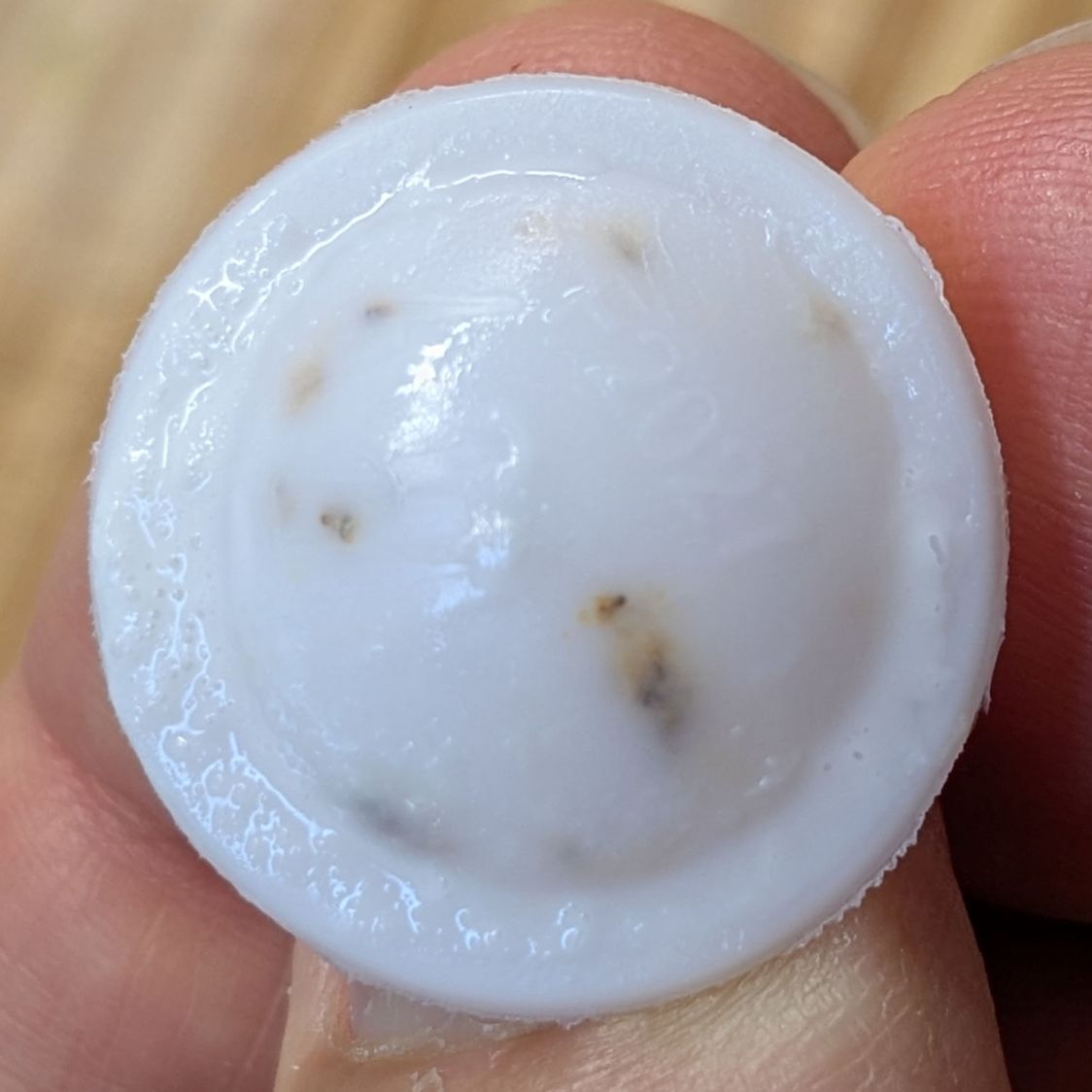
    The adhesive holding the LED PCB to the aluminum “heatsink” has fossilized and the strip on the right is peeling off (with the left one not far behind), which likely accounted for its loss of light output and flickering.

    Tearing it apart reveals the LED layout and what looks like a bridge rectifier or a big resistor (to fool the CAN bus?) on a tiny PCB jammed inside the shell:

    Side Marker bulbs - rectifier
    Side Marker bulbs – rectifier

    The other side of the PCB could be a buck converter:

    Side Marker bulbs - buck converter
    Side Marker bulbs – buck converter

    In round numbers, we’ve driven 18000 miles at an average of maybe 40 mph over those years; call it 450 hours. However, the side marker lights aren’t on unless the headlights are on; we do very little night driving, which means those LED bulbs are the usual crap.

    I replaced both front bulbs with a different design sporting two LED chips and we’ll see how long those last.

  • Medicare Advantage Mail Merge: FAIL

    Medicare Advantage Mail Merge: FAIL

    A postcard arrived last week telling me to call a special number for special deals on Medicare Advantage plans. Being that type of guy, I managed to read the microscopic Fine Print and found this amusing blooper amid the disclaimers weasel wording:

    Medicare Advantage mail spam
    Medicare Advantage mail spam

    Inserting insurance carrier names should have happened before printing the card, so [CarrierA] and [CarrierB] are either placeholders or mail-merge variables.

    Also, you’re seeing the contrast-blown and magnified version of the postcard. The original Fine Print had faint orange ink on light green cardstock: colors having different hues with the same saturation and value to minimize legibility. In general, folks eligible for Medicare Advantage plans have trouble reading Fine Print, so the choice was not accidental.

    Not a compelling value proposition, as they say.

  • Power Outage

    Power Outage

    This housing development was the second in Poughkeepsie to have underground utilities and, to put it mildly, a lot has rotted out over the last 70 years.

    Over the weekend, one phase of the AC power flickered and eventually failed completely, with the other phase supplying a steady 120 VAC. Central Hudson (Gas & Electric) crews located long-lost buried boxes in places not matching their maps:

    Power Outage - flooded box
    Power Outage – flooded box

    Then they pumped / bailed enough water to repair / lengthen the wires:

    Power Outage - corroded wiring
    Power Outage – corroded wiring

    I’ve never before seen anybody work on live wires underwater.

    They installed above-ground boxes to simplify The Next Time.

    Some improvisation was required:

    Power Outage - improvised cocoa stirring
    Power Outage – improvised cocoa stirring

    Gotta say, cold Fireball Cocoa tastes different than hot Fireball Cocoa.

  • Champion Hose Nozzle: Needs a Washer?

    Champion Hose Nozzle: Needs a Washer?

    An email discussion suggested the Champion hose nozzle might, once upon a time, have had a washer between the conical and cylindrical sections.

    So I made one:

    Champion hose nozzle - rubber washer
    Champion hose nozzle – rubber washer

    The details:

    • OD = ½ inch
    • ID = 9/32 inch
    • 2.5 mm stamp pad rubber

    It sealed perfectly, but, just before shutting off, the washer vibrated in the water flow and gave off an ear-shattering (even to my deflicted hearing) howl.

    Perhaps a stiffer and thinner washer with a slightly larger OD would work better.

    A quick check of similar nozzles in the Box o’ Hydraulics shows none of them feel like they have a compliant washer in there, but any sufficiently old rubber will have long since fossilized.

    This seems like a good job for a 3D printed washer with a conical face, made from slightly squishy TPU plastic to ease it past the nozzle’s internal threads. All I need is the ability to print TPU …

  • HQ Sixteen: Bobbin Winder Split Shaft Tweak

    HQ Sixteen: Bobbin Winder Split Shaft Tweak

    The HQ Sixteen has much larger bobbins than Mary’s Kenmore and Juki sewing machines. It also came with a dedicated bobbin winder:

    HQ Sixteen bobbin winder - overview
    HQ Sixteen bobbin winder – overview

    That thing has a distinct Industrial Revolution aspect compared to the BarbieCore bobbin winder I laid hands on a while ago.

    Out of the photo on the right:

    • The thread cone and guide tower
    • The thread tension disks

    Mary had been having trouble winding the bobbins, as the tension seemed entirely too low and the thread did not lay smoothly across the bobbin, so she asked me to take a look.

    The motor shaft has an O-ring for friction drive against the large wheel driving the shaft with the bobbin on the other end. The small silver lever over on the left flips an over-center lock pressing the wheel against the O-ring and tripping the microswitch in the aluminum housing, thus turning the motor on. The bobbin fills until a small finger monitoring the thread level flips the lock back over center, the wheel disengages, the switch turns the motor off, and a spring drives the wheel against the rubber rod in the upper left.

    Which worked well, but all the bobbins had a loose-to-sloppy fit on the shaft, to the extent that the shaft really couldn’t drive them against any thread tension.

    Loosening the screw holding the drive wheel on the shaft lets it slip off and the shaft slides out to the front:

    HQ Sixteen bobbin winder - split shaft
    HQ Sixteen bobbin winder – split shaft

    The sides of the split shaft should press firmly against the bobbin core, but that just wasn’t happening.

    Measuring a dozen bobbins showed most had an ID of 6.04 mm, with a few around 6.01 mm; unsurprisingly, the latter had the best, albeit still loose, fit. Conversely, the split shaft had two isolated points 6.01 mm apart across a diameter, with the remainder around 5.95 mm. Those are not large differences, but it was obvious why the bobbins didn’t wind correctly.

    I filed some graunch off the split edges, then gently pushed the Designated Prydriver into the end of the split to spread the sides juuuust a little bit, until all the bobbins pushed on firmly and fit snugly:

    HQ Sixteen bobbin winder - split shaft test fit
    HQ Sixteen bobbin winder – split shaft test fit

    It reassembled in reverse order and we’ll see how it behaves during the next marathon bobbin-filling session.

  • Potato Garage

    Potato Garage

    Ordinary potatoes are photosensitive and turn green & bitter when exposed to light, so Mary stores them in a paper bag in the pantry. I recently re-found the cupcake / bread box previously used for battery storage and we decided it would make a great potato storage box:

    Potato Garage - installed
    Potato Garage – installed

    It does look like a little garage with a roll-up door, doesn’t it?

    The engraving on the top came from the New Garden Encyclopedia:

    Garden Encyclopedia - Potatoes - engraving scan
    Garden Encyclopedia – Potatoes – engraving scan

    The larger spud definitely has The Stink Eye! Also: tusks!

    Threshold the scanned image, edit out a few blemishes, and engrave it atop the box:

    Potato Garage - engraved
    Potato Garage – engraved

    The result looks rather pallid, but this is not the place for fancy wood finishes.

    The alert reader will note a purple sweet potato parked in there, but it’s close to the spirit of the thing.