The Smell of Molten Projects in the Morning

Ed Nisley's Blog: Shop notes, electronics, firmware, machinery, 3D printing, laser cuttery, and curiosities. Contents: 100% human thinking, 0% AI slop.

Category: Home Ec

Things around the home & hearth

  • MTD Snowthrower: Replacement Throttle Knob

    MTD Snowthrower: Replacement Throttle Knob

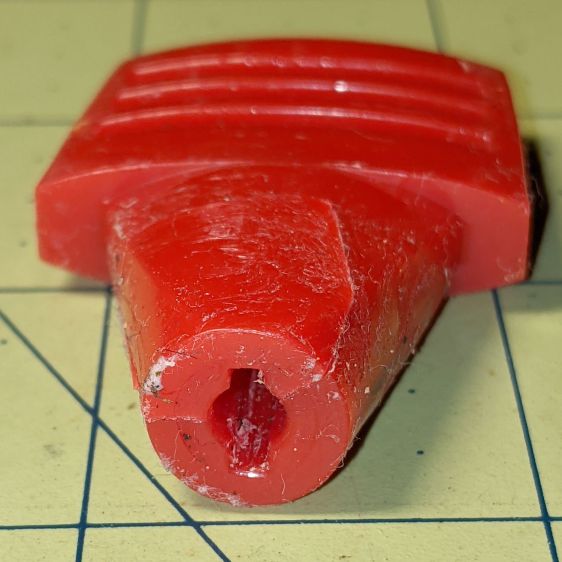
    The throttle knob on our MTD snowthrower (a.k.a. snowblower) cracked apart around its metal shaft when I pulled it upward. A temporary fix involving duct tape and cable ties sufficed to start the engine, although the usual intense vibration shook the knob loose somewhere along the driveway during the next hour.

    Update: Found it!

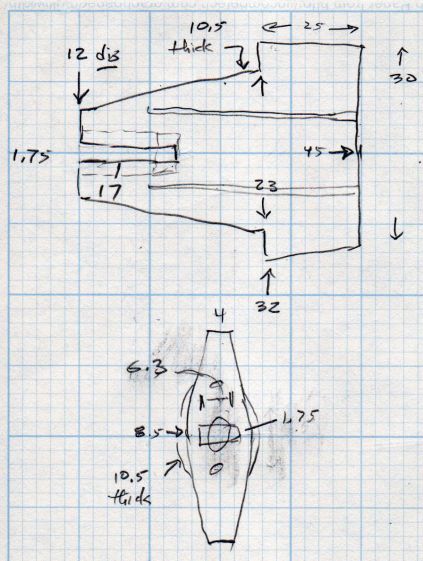
    Although I have no photographic evidence, I did make a few quick measurements:

    Throttle Knob Dimension Doodles
    Throttle Knob Dimension Doodles

    It fits an MTD model E6A4E, but I suspect nearly all their engines have identical throttle shafts:

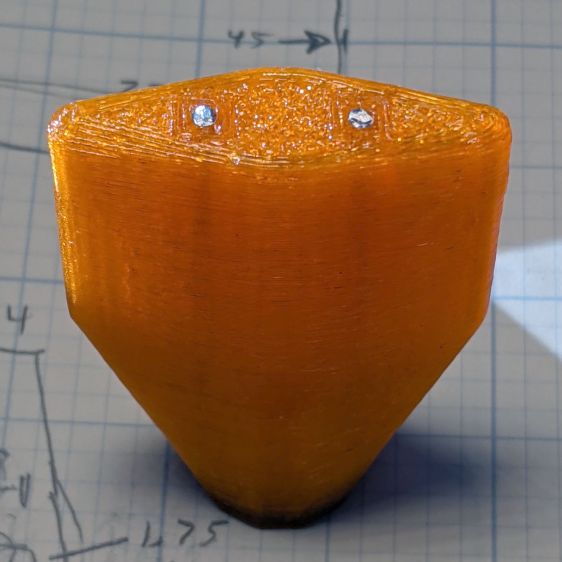
    Snowthrower Throttle Knob - stem end - solid model
    Snowthrower Throttle Knob – stem end – solid model

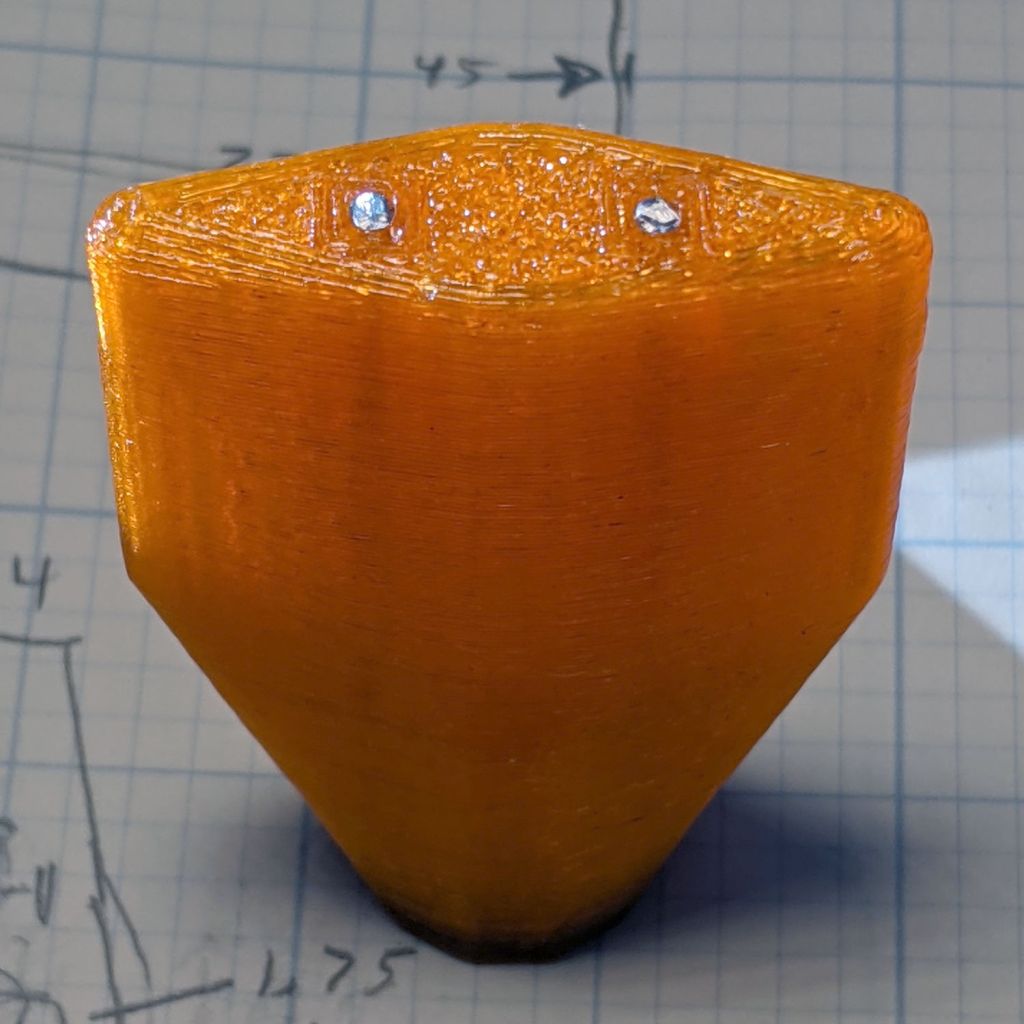
    The only practical way to build the thing has it standing on the shaft end, surrounded by a brim to improve adhesion, so I added (actually, subtracted) a pair of holes for music-wire reinforcements:

    Snowthrower throttle knob - reinforcing wires
    Snowthrower throttle knob – reinforcing wires

    It definitely has a stylin’ look, next to the original choke control knob:

    Snowthrower throttle knob - installed
    Snowthrower throttle knob – installed

    I omitted the finger grip grooves for obvious reasons.

    The slot-and-hole came out slightly smaller than the metal shaft and, rather than wait for epoxy to cure, I deployed a 230 W soldering gun (not a piddly temperature-controlled iron suitable for electronics) on the shaft and melted it into the knob.

    More snow may arrive this week and I printed another knob just in case …

    The OpenSCAD source code as a GitHub Gist:

    // MTD Snowthrower Throttle Knob
    // Ed Nisley KE4ZNU 2020-12-18
    /* [Options] */
    Layout = "Show"; // [Build, Show]
    // Extrusion parameters
    /* [Hidden] */
    ThreadThick = 0.25;
    ThreadWidth = 0.40;
    HoleWindage = 0.2;
    Protrusion = 0.1; // make holes end cleanly
    inch = 25.4;
    function IntegerMultiple(Size,Unit) = Unit * ceil(Size / Unit);
    //———————-
    // Dimensions
    Throttle = [17.0,1.85,6.5]; // blade insertion, thickness, width
    PaddleSize = [25,30,9];
    PaddleRound = 4.0;
    PaddleThick = 8.5;
    StemDia = 13.0;
    StemLength = 20.0;
    PinDia = 1.6;
    PinLength = PaddleSize.x + StemLength/2;
    echo(str("Pin: ",PinLength," x ",PinDia," mm"));
    //———————-
    // Useful routines
    module PolyCyl(Dia,Height,ForceSides=0) { // based on nophead's polyholes
    Sides = (ForceSides != 0) ? ForceSides : (ceil(Dia) + 2);
    FixDia = Dia / cos(180/Sides);
    cylinder(r=(FixDia + HoleWindage)/2,
    h=Height,
    $fn=Sides);
    }
    //———————-
    // Pieces
    module Paddle() {
    difference() {
    hull() {
    translate([PaddleSize.x/2,0,0]) {
    for (i=[-1,1], j=[-1,1])
    translate([i*(PaddleSize.x – PaddleRound)/2,j*(PaddleSize.y – PaddleRound)/2,0])
    sphere(d=PaddleRound,$fn=12);
    rotate([0,90,0]) rotate(180/12)
    cylinder(d=PaddleThick,h=PaddleSize.x,,center=true,$fn=12);
    }
    translate([-StemLength,0,0])
    rotate([0,90,0]) rotate(180/12)
    cylinder(d=StemDia,h=Throttle.x,center=false,$fn=12);
    }
    translate([-StemLength,0,0])
    cube([2*Throttle.x,Throttle.y,Throttle.z],center=true);
    translate([-(StemLength + Protrusion),0,0])
    rotate([0,90,0]) rotate(0*180/6)
    PolyCyl(2*Throttle.y,Throttle.x,6);
    for (j=[-1,1])
    translate([-StemLength/2,j*PaddleSize.y/6,0])
    rotate([0,90,0]) rotate(180/4)
    PolyCyl(PinDia,PinLength,4);
    }
    }
    //———————-
    // Build it
    if (Layout == "Show")
    Paddle();
    if (Layout == "Build") {
    translate([0,0,StemLength])
    rotate([0,-90,0])
    Paddle();
    }

  • Turkey Baster FAIL

    Turkey Baster FAIL

    We bought a generic Walmart-grade baster perhaps two years ago to replace a much older one with a failed rubber bulb. We use it intermittently throughout the year and had a turkey in the oven when we discovered this:

    Cracked Baster - overview
    Cracked Baster – overview

    A closer look at the business end:

    Cracked Baster - tip detail
    Cracked Baster – tip detail

    Yes, those cracks go all the way through, there’s a loose spear running the length of the thing, and it definitely doesn’t work as a baster.

    Contrary to what you might think from the general fogging and stress cracking, I haven’t used it for gasoline or brake fluid, nor do we put it away without washing it.

    The rubber bulb still works fine, though, so there’s that.

    We’ll up our spend for an OXO baster and see what happens.

  • Drive Wheelchair Brake Knob

    Drive Wheelchair Brake Knob

    The bent-steel brake levers on our Drive Blue Streak wheelchair present themselves edge-on to the rider:

    Drive Wheelchair Brake
    Drive Wheelchair Brake

    There are good mechanical reasons for shaping and orienting the steel like that, but the handle concentrates the considerable force required to push the brake tab into the rubberoid tire on your (well, my) palms. After a couple of weeks, I decided I didn’t need two more sore spots and conjured a palm-filling knob from the vasty digital deep:

    Wheelchair Brake Knob - installed
    Wheelchair Brake Knob – installed

    Bonus part: the little octagon near the wheel prevents the leg rest (seen in the first picture) from smashing into the end of the brake tab and chipping the lovely blue powder coat. The brown fuzzy felt foot seemed like a good idea at the time, but isn’t strictly necessary.

    A cylindrical handle on Thingiverse apparently fits on the bare steel underneath the rubberish “cushion”, but cutting a perfectly good, albeit uncomfortable, cushion off seemed like a step in the wrong direction. My knob thus descends from a doodle of the OEM dimensions:

    Drive Wheelchair Brake Handle - dimensions
    Drive Wheelchair Brake Handle – dimensions

    The knob builds in two halves adjoining the bonus octagon, which stands on edge to eliminate support inside its slot:

    Wheelchair Brake Mods - solid model - build layout
    Wheelchair Brake Mods – solid model – build layout

    You (probably) need two of all those shapes, a job your slicer is ready to perform. At three hours for each knob, I just printed the same G-Code twice.

    You can customize the knob width to fit your palm, with the other two dimensions fitting themselves around the cushion. Mary and I settled on a knob size that fits both our hands reasonably well, so it’s probably not critical.

    I tried building the knob halves without support for the first prototype, but the sloped upper surface produced awful bridging:

    Wheelchair Brake Knob - unsupported interior
    Wheelchair Brake Knob – unsupported interior

    It’s easy enough to design a customized support structure:

    Wheelchair Brake Mods - cross section
    Wheelchair Brake Mods – cross section

    I oriented the knob to put the split on the narrow sides of the brake handle in order to not have a seam facing my palm:

    Wheelchair Brake Knob - rear half installed
    Wheelchair Brake Knob – rear half installed

    The quartet of M3×20 mm socket-head cap screws thread into brass inserts epoxied into the rear half. I recessed their heads deeply into the front half and avoided thinking too hard about plugs matching the surface curvature:

    Wheelchair Brake Knob - front view
    Wheelchair Brake Knob – front view

    The low-vertex-count polygonal shape is a stylin’ thing and produces a nice feel during a firm shove, at least to my paws. Although I’d rather not need a wheelchair at all, setting the brakes now seems authoritative instead of annoying.

    The OpenSCAD source code as a GitHub gist:

    // Pride wheelchair brake lever mods
    // Ed Nisley KE4ZNU 2020-11
    /* [Layout options] */
    Layout = "Build"; // [Build, Show, Fit, TabCap, Handle, Knob, Support]
    // Hold up the knob's inside
    Support = true;
    /* [Extrusion parameters] */
    /* [Hidden] */
    ThreadThick = 0.25;
    ThreadWidth = 0.40;
    HoleWindage = 0.2;
    function IntegerMultiple(Size,Unit) = Unit * ceil(Size / Unit);
    function IntegerLessMultiple(Size,Unit) = Unit * floor(Size / Unit);
    Protrusion = 0.1; // make holes end cleanly
    inch = 25.4;
    ID = 0;
    OD = 1;
    LENGTH = 2;
    //———————-
    // Useful routines
    module PolyCyl(Dia,Height,ForceSides=0) { // based on nophead's polyholes
    Sides = (ForceSides != 0) ? ForceSides : (ceil(Dia) + 2);
    FixDia = Dia / cos(180/Sides);
    cylinder(r=(FixDia + HoleWindage)/2,h=Height,$fn=Sides);
    }
    //* [Basic dimensions] */
    WallThick = 4.0; // min wall thickness
    Screw = [3.0,5.5,20.0]; // thread, head, length under head
    Insert = [3.0,4.1,8.0]; // thread, knurl, length
    //———————-
    // Brake tab cap
    BrakeTab = [15,21,3.1]; // length to wheel, width, thickness
    BrakeTabSagitta = 8.0; // height of curved endcap
    CapOAL = [BrakeTab.y + 2*WallThick,BrakeTab.y + 2*WallThick,BrakeTab.z + 2*WallThick];
    module TabCap() {
    difference() {
    rotate(180/8)
    cylinder(d=CapOAL.y,h=CapOAL.z,center=true,$fn=8);
    translate([BrakeTab.x/2,0,0])
    cube(BrakeTab,center=true);
    rotate(180/8)
    cylinder(d=BrakeTab.y/cos(180/8),h=BrakeTab.z,center=true,$fn=8);
    }
    }
    //———————-
    // Brake lever handle
    // Soft covering with rounded sides that we square off for simplicity
    HandleRibs = [15,34,14]; // ignoring slight taper from end
    HandleCore = [50.0,24.0,12.0]; // straight section of lever to top of ribs
    HandleTipWidth = 30.0; // ignoring actual sector height
    module Handle() {
    union() {
    hull() {
    rotate(180/8)
    cylinder(d=HandleTipWidth/cos(180/8),h=HandleCore.z,center=true,$fn=8);
    translate([-HandleCore.x/2,0,0])
    cube(HandleCore,center=true);
    }
    translate([-(3*HandleCore.x/2 – Protrusion),0,0]) // extend base for ball trimming
    cube(HandleCore,center=true);
    translate([-HandleRibs.x/2,0,0])
    cube(HandleRibs,center=true);
    }
    }
    //———————-
    // Support structure for handle cavity inside knob
    // Totally ad-hoc tweakage
    // Remember it's lying on its side to match the handle
    NumRibs = 2 + 1; // must be odd
    RibSpace = floor(HandleCore.z/(NumRibs + 1));
    module KnobSupport() {
    color("Yellow") { // support overlaps in the middle
    render(convexity=3)
    intersection() {
    for (k=[-1,1])
    translate([0,k*ThreadThick,0]) // shrink inward to break adhesion
    Handle();
    translate([(HandleCore.x – HandleRibs.x)/2 – HandleCore.x – Protrusion,0,0])
    cube([HandleCore.x – HandleRibs.x,HandleRibs.y,HandleCore.z],center=true);
    union()
    for (k=[-floor(NumRibs/2):floor(NumRibs/2)])
    translate([0,0,k* RibSpace])
    cube([2*HandleCore.x,HandleRibs.y,2*ThreadWidth],center=true);
    }
    translate([(HandleCore.x – HandleRibs.x)/2 – HandleCore.x,0,0])
    cube([HandleCore.x – HandleRibs.x,4*ThreadWidth,NumRibs*RibSpace],center=true);
    }
    }
    //———————-
    // Brake handle knob
    // Largely built with magic numbers
    // Includes support because it's not really optional
    KnobOD = 55.0;
    KnobOffset = HandleRibs.x/1;
    KnobSides = 2*4*3;
    module Knob() {
    difference() {
    hull() {
    resize([0,HandleRibs.y + 4*WallThick,HandleCore.x + HandleTipWidth/2 + WallThick])
    sphere(d=KnobOD,$fn=KnobSides);
    }
    translate([0,0,KnobOffset])
    rotate([0,-90,0])
    Handle();
    for (i=[-1,1],k=[-1,1])
    translate([i*KnobOD/4,0,k*KnobOD/4]) {
    rotate([90,0,0])
    PolyCyl(Insert[OD],1.5*Insert[LENGTH],6);
    translate([0,-Screw[LENGTH]/2,0])
    rotate([-90,0,0])
    PolyCyl(Screw[ID],KnobOD,6);
    translate([0,Screw[LENGTH] – Insert[LENGTH],0])
    rotate([-90,0,0])
    PolyCyl(Screw[OD],KnobOD,6);
    }
    }
    if (Support)
    translate([0,0,KnobOffset])
    rotate([0,-90,0])
    KnobSupport();
    }
    //———————-
    // Lash it together
    if (Layout == "TabCap") {
    TabCap();
    }
    if (Layout == "Handle") {
    Handle();
    }
    if (Layout == "Support") {
    KnobSupport();
    }
    if (Layout == "Knob") {
    Knob();
    }
    if (Layout == "Show") {
    translate([60,0,0])
    TabCap();
    Knob();
    }
    if (Layout == "Fit") {
    translate([60,0,0])
    difference() {
    TabCap();
    translate([0,0,CapOAL.z/2])
    cube(CapOAL,center=true);
    }
    difference() {
    Knob();
    translate([KnobOD + KnobOD/4,0*KnobOD,0])
    cube(2*KnobOD,center=true);
    translate([-KnobOD,-KnobOD,0])
    cube(2*KnobOD,center=true);
    }
    }
    if (Layout == "Build") {
    translate([KnobOD/2,0,(CapOAL.y*cos(180/8))/2])
    rotate([0,-90,90])
    TabCap();
    for (j=[-1,1])
    translate([0,-j*0.75*HandleCore.x,0])
    difference() {
    rotate([j*90,0,0])
    Knob();
    translate([0,0,-KnobOD])
    cube(2*KnobOD,center=true);
    }
    }

    A doodle with dimensions of other parts:

    Drive Wheelchair - brake footrest tab dimensions
    Drive Wheelchair – brake footrest tab dimensions

    The angled tab on the middle left is for the leg rest release latch, but I decided not to silk-purse-ize the thing.

  • Hiatus

    Posts will appear intermittently over the next week or two.

    I’m still spending an inordinate amount of time studying the back of my eyelids while horizontally polarized in the lift chair. I can highly recommend not doing whatever it is that triggers a pinched lumbar nerve, but as nearly as I can tell, the proximate cause (shredding leaves) isn’t anything close to whatever the root cause might be.

    It does provide plenty of time to conjure solid models from the vasty digital deep:

    Wheelchair Brake Mods - solid model - build layout
    Wheelchair Brake Mods – solid model – build layout

    The wheelchair brake lever seems to have been designed by somebody who never actually had to shove it very often:

    Drive Wheelchair Brake
    Drive Wheelchair Brake

    At least I can fix that

  • Jonas Peeler: Reshaping and Origin Mystery

    Jonas Peeler: Reshaping and Origin Mystery

    This past summer we replaced a worn-out vegetable peeler with what was allegedly a high-quality Linden Jonas peeler. It worked quite well, which it should have, given that it cost nigh onto seven bucks, until I recently backed over it with my wheelchair (about which, more later) and smashed it flat.

    World+dog having recently discovered the virtues of home-cooked meals, the replacement cost nigh onto ten bucks and, through the wonders of Amazon, came from a different seller, albeit with a letter-for-letter identical description:

    Linden Jonas peeler orders
    Linden Jonas peeler orders

    With a spare in the kitchen, I applied some shop-fu to unbend the first peeler:

    Jonas peeler - reshaping tools
    Jonas peeler – reshaping tools

    Tapping the handle against the bandsawed dowel sufficed to remove the sharpest bends. The final trick involved clamping one edge of the handle to the section cut from a thread spool, resting the Vise-Grip on the bench vise, and whacking the other edge with the rubber mallet to restore the smooth curve around the main axis, repeating the process along the other side, then hand-forming the gentle curve closer to the blade. It ain’t perfect and never will be, but it’s once again comfortable in the hand.

    During that process I had plenty of time to admire the identification stamped into the handle:

    Jonas peeler - weak emboss
    Jonas peeler – weak emboss

    Which, frankly, looks rather gritty on an allegedly high-quality product from a Swedish factory.

    Compare it with the new peeler:

    Jonas peeler - good emboss
    Jonas peeler – good emboss

    Now, that’s more like it.

    The genuine Linden website doesn’t provide much detail, so I can’t be absolutely sure which peeler is a counterfeit, but it sure looks like at least one fails the sniff test. Linden’s site redirects to Amazon through a Google search link (!) that, given the way Amazon works, could result in anything appearing as a valid result:

    https://www.google.com/search?q=amazon.com+linden+sweden

    As one should expect by now, Amazon’s commingled inventory produces a fair percentage of reviews complaining about craptastic peelers stamped “Made in China” from any of the sellers unearthed by that search.

  • Aerosol Can Corrosion

    Aerosol Can Corrosion

    An odd smell in the Basement Laboratory Chemical Warehouse led to this discovery:

    Leaking aerosol can
    Leaking aerosol can

    It’s a can of spray-on topical anesthetic That Came With The House™, so it’s almost certainly four decades old and, other than being moved to that shelf, hasn’t been touched in the last quarter century.

    Surprisingly, the orange-brown goo wiped off the shelf almost completely. The similarly old box of stain remover on the left was a dead loss.

  • Suet Feeder Extension

    Suet Feeder Extension

    Shortly after this season’s suet feeder deployment, the neighborhood raccoons emptied it. A few years ago, putting a 3D printed feeder at the end of a repurposed ski pole protected it for a few weeks, so I scrounged another pole from the pile, cut off the flattened top and battered tip, and put it into service:

    Suet Feeder Extension - deployed
    Suet Feeder Extension – deployed

    The near end has a loop made from a pair of stainless steel key cables, because a single cable was just slightly too short:

    Suet Feeder Extension - anchor loop
    Suet Feeder Extension – anchor loop

    The far end has what was once a hook, beaten straight to fit through the hole, then beaten around the curve of the pole:

    Suet Feeder Extension - chain anchor
    Suet Feeder Extension – chain anchor

    Raccoons lacking opposable thumbs, this should suffice until the black bear(s) spotted around here take up residence in the yard.