The Smell of Molten Projects in the Morning

Ed Nisley's Blog: Shop notes, electronics, firmware, machinery, 3D printing, laser cuttery, and curiosities. Contents: 100% human thinking, 0% AI slop.

Category: Home Ec

Things around the home & hearth

  • X10 Appliance Module Local Control: Disablement Thereof

    After we rearranged the living room, we had a few floor lights in different locations that called for more X10 Appliance Controllers. I’m not a big fan of automated housing, because X10 communication is unreliable with a bullet, but it’s convenient to turn off all the lamps from the bedroom.

    Anyhow, the old RCA HC25 X10 Appliance Modules I pulled out of the Big Box o’ X10 Stuff suffered from the usual conflict between compact fluorescent lamps and the “local control” misfeature that’s supposed to let you turn the appliance on by simply flipping the switch. The problem is that a CFL ballast draws a nonlinear trickle of current that the module misinterprets as a switch flip, thus occasionally turning the lamp on shortly after you turn it off.

    This has been true since the first compact fluorescent bulbs appeared. The circuitry inside X10 modules hasn’t changed much, at least up until I bought the last round of switches quite some time ago. That’s either a Bad Thing (still a problem) or a Good Thing (everybody knows about it).

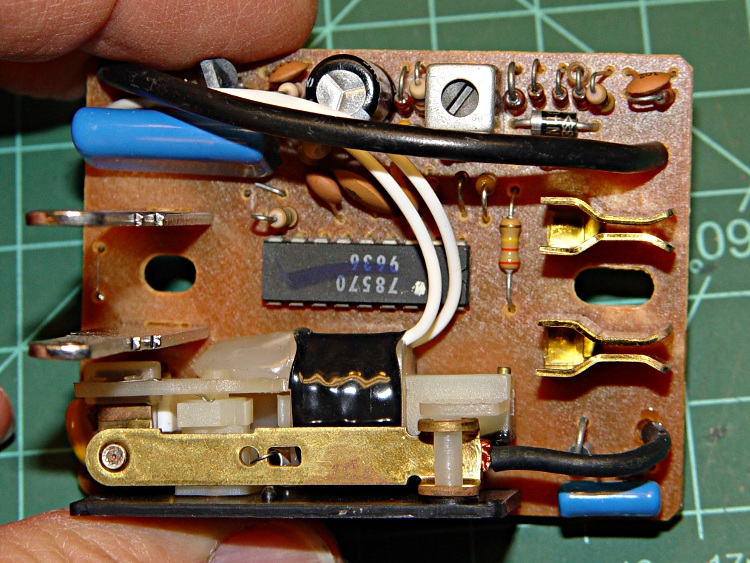
    The solution (everybody knows about it, just use the obvious keywords) is to cut a jumper on the module’s circuit board that’s obviously placed there for this very reason. In this view, it’s just below the lower-right corner of the fat blue capacitor. If you need confirmation, it’s connected to pin 7 of the only IC on the board.

    Snip the wire, move the cut end a little bit, and button the module up again.

    Local control jumper cut
    Local control jumper cut

    Oh, yeah. No user serviceable parts inside is a challenge around here…
  • Unexpected Midnight Visitor

    That post reminded me of an incident at my parents’ house, long after I’d moved out and many years ago.

    For context, the Ancestral Home is a three-story brick pile dating back to the late 1800s, with nonstandard bricks and much thicker walls than you’d expect, with plaster-on-lathe interior finishing and really nice wood trim. It’s on the southwest corner of the Hummelstown PA town square, where Main Street tapers down to two lanes.

    They were awakened around midnight by a mighty crash downstairs and found this in the front room:

    Interior View
    Interior View

    It seems a westbound van, traveling at what’s tautologically called “a high rate of speed”, swerved across Main Street, tripped on the curb, plowed down a concrete planter, and spanked the front corner of the house pretty hard:

    Front View
    Front View

    The driver wasn’t thrown clear, but a whole pile of crap fell out as they were extracting him.

    Outside View
    Outside View

    Even in the days before air bags, this one was a total loss:

    Aftermath - The Van
    Aftermath – The Van

    IIRC, the charge came down DWI but I vaguely recall he somehow wriggled out of that.

    The building was never quite the same thereafter, either: those plaster walls were never meant to take a direct hit.

    The pix are more horribly discolored satin-finish pages from the Family Album. One could do better color correction if one really had to, but …

  • Buckle Up For Safety

    Windshield head strikes
    Windshield head strikes

    Y’know how some folks say they don’t wear a seat belt because they want to be thrown free in a crash? Here’s how that works in actual practice.

    The air bag fires as the front bumper begins to deform and your body rises off the seat. Because you’re not belted in, the bag boosts your upper torso against the roof liner, bounces your head off the sunshade and bezel, then feeds you directly into the windshield glass.

    Laminated glass doesn’t disintegrate, so your skull probably won’t completely penetrate the windshield. You’ll lose some scalp, though, as you slide down the crumbling glass and wedge above the dashboard.

    Even if you survive a broken neck, the ensuing brain trauma means you won’t be the same person ever again.

    News flash: massive brain trauma does not make you a better person.

    Before laminated windshield glass became mandatory, your head would completely penetrate the windshield. Here’s what happened in 1937, from the incomparably grisly — And Sudden Death by J. C. Furnas:

    Safety Glass Windshields
    Safety Glass Windshields

    I read one of the many Reader’s Digest editions of that article during my formative years. Probably the one in October 1967, if a bit of Google-fu serves me right. You can’t get reprints of it from RD any longer, it seems.

    However, unbelievably, while I was composing this post, I checked eBay and found a typewritten copy of the article, signed by Furnas, with 38 minutes remaining in the auction. I was the only bidder: for nine bucks (delivered) it’s mine.

    Most likely it’s a publicity / fundraising copy, because the handwritten notation on the first page reads:

    With best
    regards to
    [name]
    J. C. Furnas
    Oct 20, 1947

    Those SUVs reside in the junkyard along the Dutchess Rail Trail near Creek Road, where I might get a new seat to rebuild my comfy office chair this spring.

  • New Eyeglasses

    Just got two eyeglasses from a different supplier halfway around the planet, with satisfactory results.

    The frames have the largest lenses I could find that weren’t totally dorky; I still want slightly taller lenses, but that’s not the style these days. Their 35 mm lenses are slightly larger than the 35 mm lenses from previous vendor, but IMHO still not quite tall enough for progressive bifocals. The closeup curves seem to start lower on the lens, which is fine.

    The 20 mm nose bridge is a Good Thing and made the nosepiece adjustments much easier than before.

    Metal Eyeglasses-Vincent
    Dimensions
    Width 137 mm
    Earpiece 144 mm
    Lens width 50 mm
    Lens height 35 mm
    Nose bridge 20 mm
    

    I used a 60 mm Near Pupillary Distance (for the bifocal lens area), which worked fine, although 1 mm might be better.

    The regular glasses have the usual options and work fine. The 1.6 “super thin” refractive index (vs 1.5 “regular” in the sunglasses) makes the lenses noticeably thinner than the sunglasses, but I’m not sure it’s worth the upcharge.

    - I use my Glasses for: Progressive - Bifocal without a line
    - Lens upgrades 5: Progressive Lens (no line)
    - Right Sphere(SPH): -3.50
    - Right Cylinder (CYL): +0.50
    - Right Axis: 180
    - Right Addition (near) ADD: +2.25
    - Left Sphere(SPH): -3.50
    - Left Cylinder (CYL): +0.75
    - Left Axis: 155
    - Left Addition (near) ADD: +2.25
    - Pupillary Distance (PD): 62
    - Near PD: 60
    - Lens upgrades 3: Super Thin (1.6)
    - Eye Protection and Eyeglasses 1: Anti-Scratch
    - Eye Protection and Eyeglasses 2: Anti-Reflective
    - Eye Protection and Eyeglasses 3: UV Coating
    

    For the sunglasses I tried Old School with-a-line bifocals and, frankly, don’t like them much at all. The line is very distracting in sunlight, which is where I wear sunglasses. Good news: the line falls directly across the fairing on my bike, so I can see the “dashboard” on the handlebars quite clearly. Bad news: the correction is a bit much for the automobile dashboard and, unlike the no-line bifocals, I can’t tune for best picture by nodding my head.

    Their 80% gray tint is significantly lighter than the previous vendor’s 80%; next time go for 90%. Good news: unlike the previous vendor, these folks have no trouble with AR/UV coatings over a tint.

    - I use my Glasses for: Bifocal - Both distance and reading with a line
      - Lens upgrades 4: Bifocal Lens (with line)
      - Division of lenses: 70% Distance - 30% Reading
      - Right Sphere(SPH): -3.50
      - Right Cylinder (CYL): +0.50
      - Right Axis: 180
      - Right Addition (near) ADD: +2.25
      - Left Sphere(SPH): -3.50
      - Left Cylinder (CYL): +0.75
      - Left Axis: 155
      - Left Addition (near) ADD: +2.25
      - Pupillary Distance (PD): 62
      - Near PD: 60
      - Lens upgrades 1: Standard (1.5)
      - Eye Protection and Eyeglasses 1: Anti-Scratch
      - Eye Protection and Eyeglasses 2: Anti-Reflective
      - Eye Protection and Eyeglasses 3: UV Coating
      - Tint Key: Grey 80%
      - Eye Protection and Eyeglasses 4: Color Tint
    

    A list of old frame sizes is there.

  • Oil Filter: Oops

    So I swapped in the snow tires and did the fall oil change a few days ago. Everything went smoothly, although the oil filter, as usual, blooshed oil over the front of the engine and, despite my padding the area with rags, onto the exhaust plumbing.

    Digression: I don’t understand why the Toyota engineers felt they had to tuck the oil filter below the exhaust header, behind the front downpipe, and over the flexible coupling to the forward cat converter, with the mounting tube pointed upward. It might have something to do with their rotating the entire engine rearward to get a lower hoodline. It seems to me that angling the filter so it can’t drain and must dump its contents atop the exhaust system isn’t Good Design; I’ve been muttering about it for the last decade.

    Anyway, the new filter screwed on easily, its seal ring (seemed to) seat against the block, and one final turn snugged it up just fine. The last fraction of that turn felt gritty, as though part the shell kissed the block, but I attributed that to the fact I was using a different filter style.

    I added the usual 5 quarts of oil, wiped up the spills, cleaned off the exhaust pipes, declared victory, called it a day, and put away the tools. Later that evening, I checked for leaks, found nothing, and we drove to a meeting about 12 miles away. As you might expect, the van smelled strongly of hot oil: you cannot wipe all the oil off those pipes.

    Oil trails on driveway
    Oil trails on driveway

    The next morning, Mary drove to an all-day class about 15 miles away and, about noon, I rolled out my bike to go grocery shopping… only to discover what you see in the picture (minus the sawdust patch) on the driveway.

    This is what we call in the trade A Very Bad Sign.

    There are three oil tracks:

    • Right-front track = outbound to evening trip
    • Rightmost heavy track = return
    • Leftmost track = outbound to morning trip

    Now, the fact that there’s no huge oil slick means the drain plug is in place and properly sealed. The oil evidently leaks out only under pressure, so the filter isn’t sealed against the block. This can be due to a number of causes, the most common of which is leaving the rubber ring from the old filter stuck to the block. I checked the old filter, which was still in the trash: the seal was still in place, so that wasn’t contributing to the problem.

    Regardless, the car was bleeding to death. I called Mary and she reported a dry dipstick.

    So I loaded a 5-quart jug of oil into the right pannier, dumped all the tools that might possibly come in handy into the left pannier, topped both off with many rags, stopped at an auto parts store along the way for a new filter, and rode those 15 miles at a pretty good clip. When I got to the parking lot, it was easy to find the van: simply follow its trail. The van sat atop a disturbingly large slick, evidently caused by oil draining off every local minimum inside the engine compartment and under the forward half of the chassis.

    The filter was still firmly screwed in place, but when I got it off and compared it with the new filter, they were different: the offending filter was slightly larger in diameter and the threaded hole was noticeable larger. Although it threaded on, the threads weren’t properly engaged, the larger diameter shell did hit the engine block, and it most certainly wasn’t sealed properly.

    I installed the new filter, poured in 3 quarts to the get the oil level midway into the dipstick’s OK range, wiped off some of the oil that coated essentially every part of the engine compartment, and we drove home trailing a cloud of hot oil fumes.

    As it turned out, the old filter was the same brand as the one that didn’t seal, but with different numbers and a different prefix: the correct filter is a 3614, the wrong one was 3593. Of course, the boxes and illustrations are identical, with slightly different contents. I’m sure they’re adjacent on the shelf and migrate into each other’s slot. It’s worth noting that the filter I bought while on the way to fix the problem was a different brand sporting a part number totally unrelated to 3614.

    The butt end of the van was covered with oil, as though the droplets blew out under the chassis and got sucked up against the rear surface; the window was a mess. I sprayed on stout detergent and wiped it clean, but I think we must treat the poor thing to an all-over car wash with the special undercarriage scrub option.

    No harm done, as nearly as I can tell, although it’s an exceedingly good thing we weren’t driving off to the grandparents!

  • Clearing the Shower Drain

    Clearing a clog
    Clearing a clog

    My shop assistant bears most of the hair in the household, so it seemed entirely appropriate that she clear the clog from the shower drain. She says she’s going to take a picture of the hairball and show her friends what her parents make her do…

    I pointed out that plumbers are ecstatic when they get a call for this sort of problem and will charge maybe 150 bucks to make the clog Go Away. When she’s writing the check, she can make whatever choice she wants.

    For now, this is how it gets done; the snake hangs on the garage wall.

  • Sunglasses Repair Redux

    After the hinge repair described there, those old sunglasses have been working fine and I use them regularly. The screw recently worked its Loctite loose and was held in largely by blind faith.

    It’s obvious why:

    Sunglass hinge screw - loose
    Sunglass hinge screw – loose

    A tiny dab of JB KWIK should solve that problem for the foreseeable future:

    Sunglass hinge screw - epoxy
    Sunglass hinge screw – epoxy

    In the highly unlikely event I must remove that screw, I’ll just refer to this picture and mill the epoxy out.