Ed Nisley's Blog: Shop notes, electronics, firmware, machinery, 3D printing, laser cuttery, and curiosities. Contents: 100% human thinking, 0% AI slop.
That comment prompted me to rummage around for one of my favorite photos: a much younger version of my Shop Assistant helping us shred leaves in the front yard.
Shop Assistant in Autumn leaf pile
She thinks it’s entirely right & proper to:
don safety goggles while doing anything even remotely eye-unsafe
wear a dust mask to mow the lawn
jam 30 dB foam plugs into her ears during thrash metal concerts
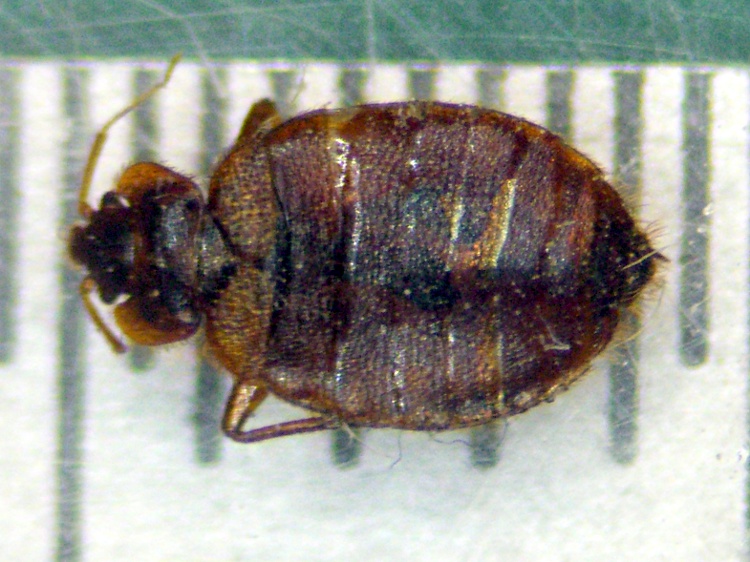
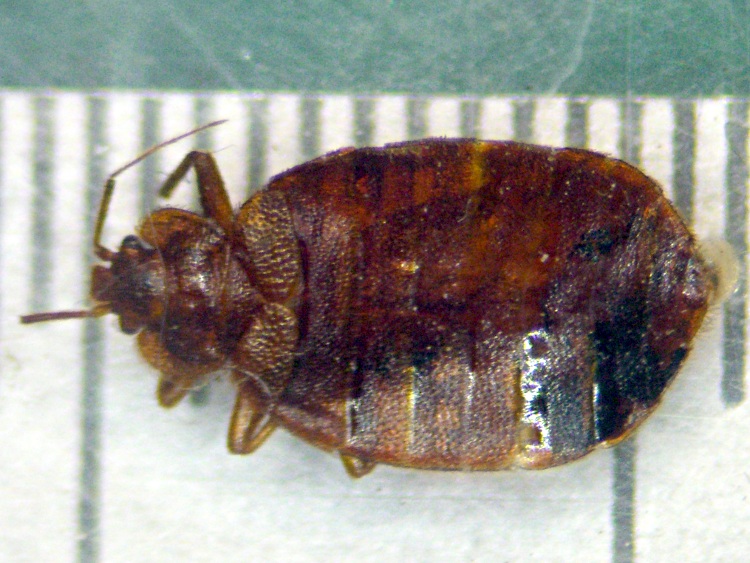
Mary quite deliberately brought home a pair of bedbugs… even knowing what we went through, you cannot imagine how dead those things had to be. She doesn’t just want them dead, she wants them extinct.
Anyhow.
Some pix, atop a scale with 0.5 mm divisions:
Bedbug – 4 mm – dorsalBedbug – 4 mm – ventralBedbug – 6 mm – dorsalBedbug – 6 mm – ventralBedbug – 6 mm – mouthparts
They were actually on load from Cornell’s Co-op lab, having recently been distinguished from bat bugs.
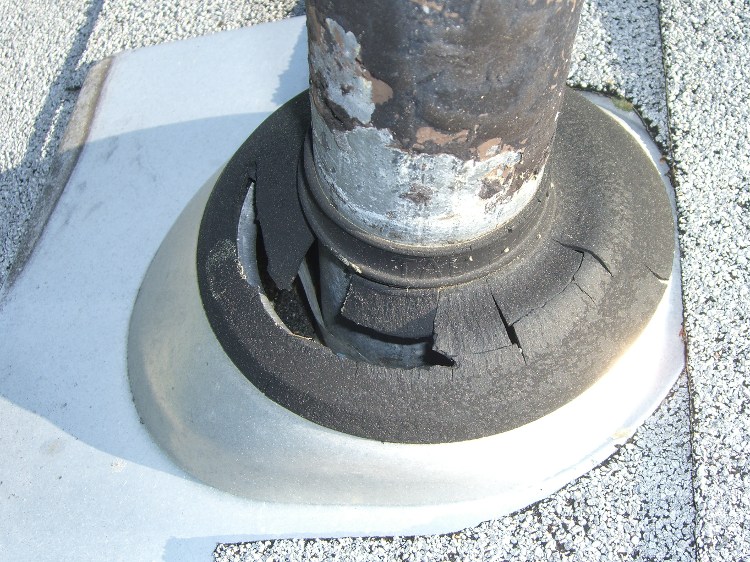
Part of the spring ritual involves cleaning the maple seeds out of the gutters, which also gives me an opportunity to inspect things up there. This year brought a revolting discovery:
Rotted vent stack gasket
It seems the rubber (?) seals around all three vent stack pipes have disintegrated. Now, the contractor installed these as part of the re-roofing project late in the last millennium, so it’s not like they came with the house. They’re an exact match for what’s currently available at Home Depot and I have no reason to believe new ones will last any longer. Sheesh.
The correct fix involves removing the shingles around the existing aluminum plates, installing new plates, and then replacing the shingles. That seems unwarranted, seeing as how the aluminum remains nicely bonded to everything, so I slipped some solid polyethylene shields around the vent stacks, tucked them under the uphill shingles, and hope that’ll suffice.
The discoloration on the roof is getting worse, except downhill from the chimney’s copper flashing. You can see one of the ugly new black plastic vent seals over on the right:
Copper effect on roof discoloration
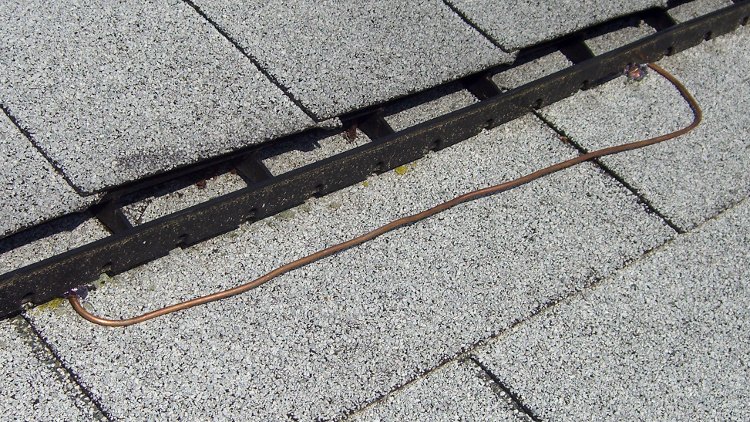
I suspect the copper ions kill off the fungus, so, invoking Science, I tucked a foot of copper wire under the ridge vent uphill from a patch of fungus:
Anti-fungal copper wire test
We’ll see if that makes any difference. I suppose the next time I’m up there I should tuck a strip of copper flashing under the shingle on the other side of the chimney to see if a bit more surface area will have more effect.
The switch on that screwdriver failed again, this time by having the internal switch mounting bosses disintegrate:
Cordless screwdriver – broken switch mounts
Not being one to worry about outside appearances, I simply drilled out the bosses to fit a pair of 4-40 screws, put the nuts inside, and it was all good:
Cordless screwdriver – switch with screws
Except that the switch now required an unseemly amount of force to operate in the forward direction. The switch is the cheapest possible collection of bent metal strips and injection molded plastic bits you can imagine, but with some bending and re-staking and general futzing around, it works fine again.
The air conditioning in our Toyota Sienna van emitted some barely cool air during the previous heat wave, which was definitely new news and not to be tolerated. The sight glass showed white foam when running and nothing when stopped, but the compressor hadn’t locked out on low pressure yet. My guess was that everything still worked and that the refrigerant had just slowly leaked away over the last 11.5 years; nothing lasts any more, eh?
I consulted with my cronies and devoted a few hours to discovering that many seemingly qualified people don’t understand the notion of vapor pressure, but that a DIY recharge wasn’t exactly rocket science. Picked up a Harbor Freight manifold gauge (on sale for 50 bucks, less one of the ubiquitous 20% coupons = $40) and two cans of R134a plus a can tapper from Autozone. Parked the car in the garage and popped the hood to let things cool off overnight.
The never-sufficiently-to-be-damned Toyota engineers put the low pressure port far back on the inside of the right-side wheel well, where I can barely reach it by standing next to the car facing forward, reaching backwards with my left arm, easing my outstretched hand through the gap between the well and the engine, then feeling around to find and unscrew and not drop the cap. No, I’m not left-handed, I just can’t contort my right hand sufficiently to do more than touch the cap.
Aligning and securing the low-pressure fitting on that port requires far more agility and strength than should reasonably be expected from one’s weak-side hand. A pox on their backsides!
Anyway.
The static pressure started out at 67 psi in the morning, which is roughly correct for R134a in the low 20 °C range: chart or table. That’s a good sign indicating that the sump still had liquid refrigerant, confirmed by the myriad bubbles in the sight glass. Eyeball the outer ring of the low-side gauge to find the R134a temperature corresponding to the pressure on the inner ring.
Harbor Freight AC Low Pressure Gauge
That gauge shows whatever pressure was left in the hose after finishing the job a few hours prior to the picture. It seems the manifold / hoses / valves hold pressure quite well, which is not a foregone conclusion given Harbor Freight’s QC.
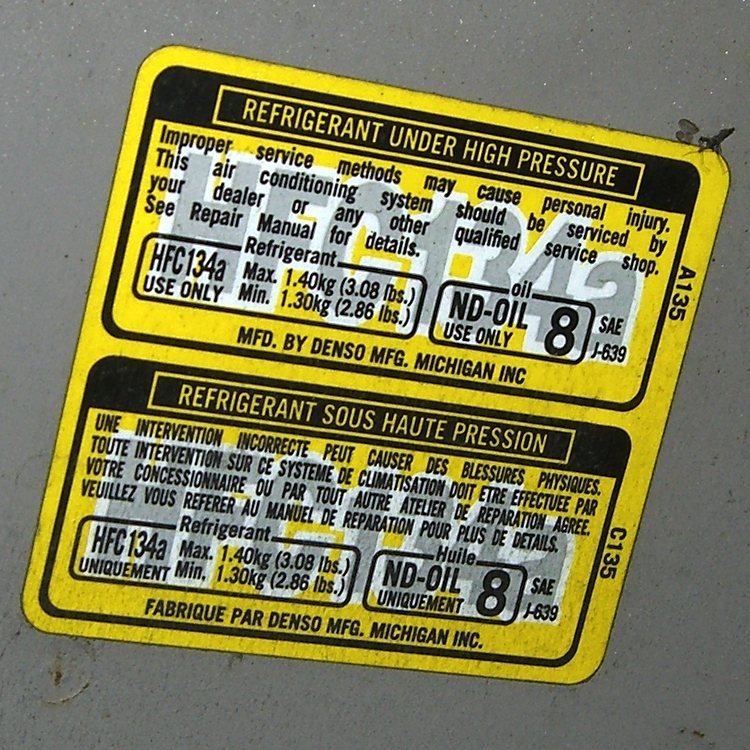
The sticker under the hood reports the AC requires about 3 pounds of refrigerant. That’s far more than most cars because the van also has a rear-cabin AC evaporator with one honkin’ big compressor for both.
2000 Toyota Sienna Refrigerant Sticker
I made the working assumption that if the AC still had some liquid refrigerant, it also had pretty nearly all the OEM oil. Most of the year the AC stays off, so I figure we’ve got a slooowww gas leak past the (usually) non-rotating seals driven by vapor pressure, all of which left the oil down in the sump. In addition, I haven’t the slightest idea if Toyota’s ND-OIL 8 gets along with the current PAG oil and adding too much oil seemed worse than having slightly too little.
The running pressures were 7 and 75 psi: grossly low.
So I fired in both cans of R134a: one with UV leak detector and another with leak sealer. That brought the pressures up to 20 / 120 psi: still too low, but at least air from the center vent now came out at 9 °C. The sight glass showed mostly foam, although with bursts of bubbly fluorescein green liquid. No leaks in evidence anywhere I could find without a nose-to-tail under-the-car inspection back to that rear evaporator.
Another trip (this time by bike) to the Autozone fetched a third can of straight R134a, which gradually cleared up the sight glass and got the pressures up to 35 / 150 psi, roughly matching the actual evaporator and condenser temperatures. I figured a few excess ounces wouldn’t do the least bit of damage; the three cans add up to 35 ounces of refrigerant, so the system was about 3/4 empty.
Early reports from the current heat wave seem encouraging.
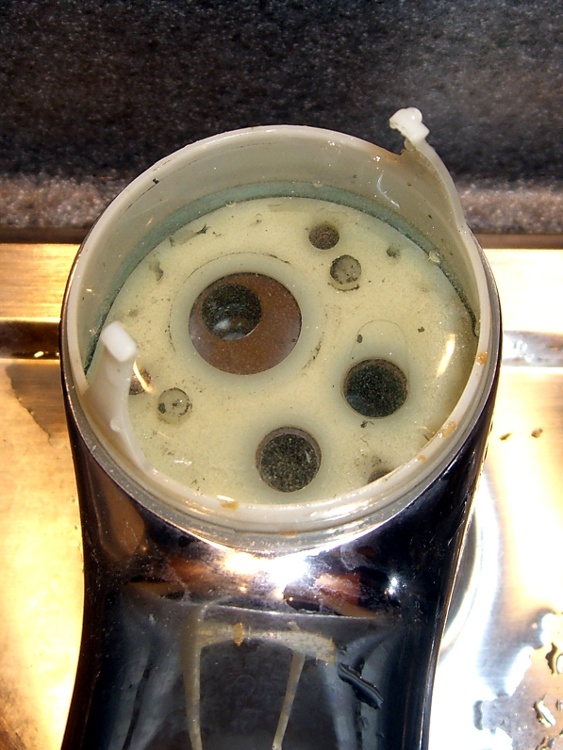
One evening I noticed that the kitchen faucet handle was skewed far off to one side and didn’t rotate to the other side as it should. I took the thing apart and found the whole pedestal was rotated:
Rotated kitchen faucet – top
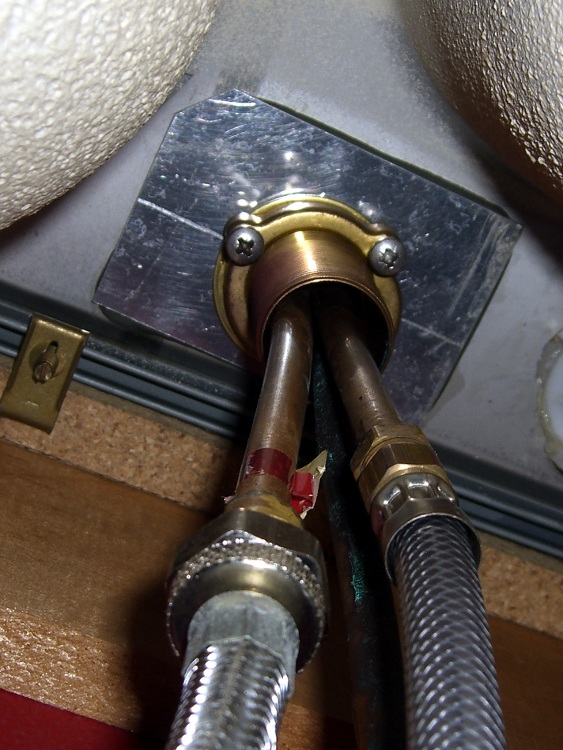
It turns out that the screws on the clamping ring below the sink had worked loose over the last decade or so, allowing the pedestal to rotate just a wee bit as we swung the spout from basin to basin.
Kitchen faucet clamping ring
Of course it only rotated a little bit in one direction and never the other way…
I epoxied that aluminum plate when I installed the faucet, because the stainless steel sink top seemed too flexy. The plate stiffened it right up and it’s been fine ever since.
Cutting those compliant washers required a really really sharp blade, which prompted me to put a new one in the cutter.
As a matter of course, I run a marker along the edge of all the new blades when I restock the utility cutter’s supply. The idea is that sometimes I can’t tell if the current blade’s been used; there’s nothing worse than sawing away at something delicate with a dull blade.
Utility cutter with marked blade
I generally use a blue marker, but the last time around the red one must have been closer to hand. I won’t make that mistake again…








 The Smell of Molten Projects in the Morning