Ed Nisley's Blog: Shop notes, electronics, firmware, machinery, 3D printing, laser cuttery, and curiosities. Contents: 100% human thinking, 0% AI slop.
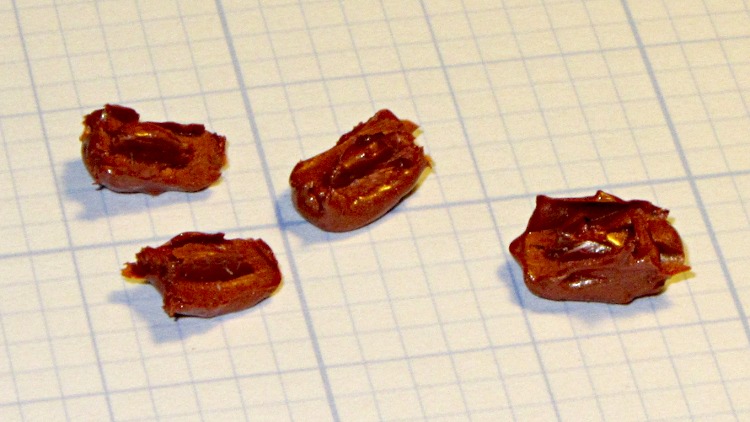
I’d waited for a few days for the silicone to cure, then put the clamps back in their home. When I went to use them, the pads were firmly affixed to the plate. Evidently, the copper-loaded silicone gasket compound takes a few days longer than forever to cure, which is not what I gathered from reading the label.
It may well be that adhesive has aged out, because when I went to try it again, the first half-inch inside the tube had turned into solid gum. Yes, it cures inside the tube and not outside.
Other than that, it seems like good stuff; I may pick up another tube and give it a second chance. Who knows? It might be useful in a plastic extruder or something like that.
As described there, the buttons on the back of my pocket camera stopped working, but the obvious laying-on-of-hands repair (i.e., wiggling the cables) didn’t improve things. I later discovered out that two other buttons on the side that didn’t go through the same flex cable were also dead, which suggested that the common failure was on the CPU board deep inside the camera. I gave it to my Shop Assistant with some handwaving about how she could maybe fix it by delving deep inside, tracing the cables, and doing some jiggling: if she could fix it, she could have it.
The first step was to take both covers off, which required a Philips 00 bit:
EX-Z850 front cover removed
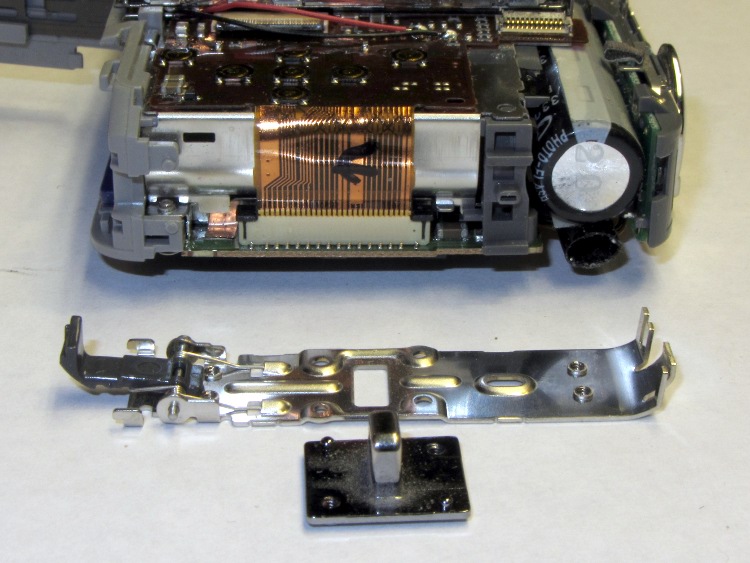
Then the side plate comes off, which requires maneuvering the spring-loaded battery latch out of its recess, at which point the lug for the carry strap will fall out:
EX-Z850 battery latch and carrying lug
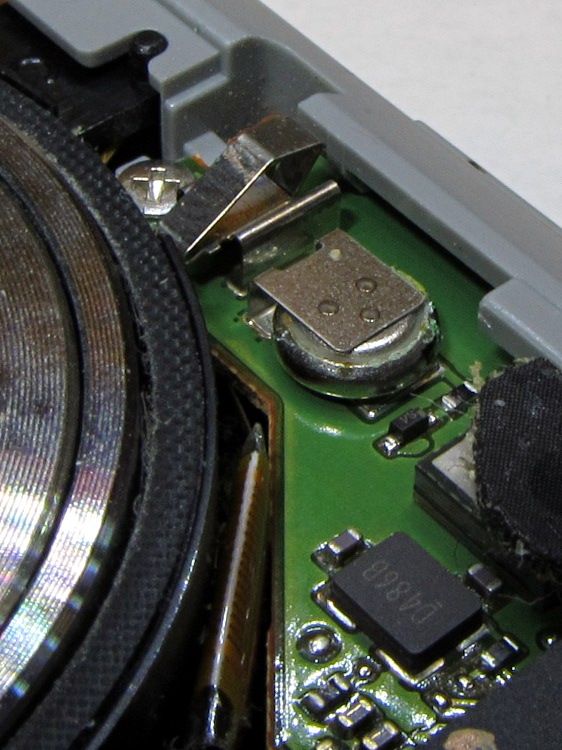
En passant, we discovered why the clock dies while changing the battery pack. It seems the miniature rechargeable lithium (?) NiMH (?) cell has rotted out:
EX-Z850 internal battery corrosion
Fortunately, it charges in a cradle, so the main battery can remain in place indefinitely. We’ll replace that thing at some point.
The CPU board has two flex cable connectors on the front surface and two on the back. My Shop Assistant released the clamps, removed the cables, wiped down the contacts with DeoxIT Red, gave it a test run with the covers off, and came bounding up the stairs as happy as I’ve ever seen her: the camera worked perfectly again!
Not being used to these things, though, she managed to crack one of the side latches on the far connector. I’ll admit to doing exactly the same thing, so I knew how to fix it: a dab of acrylic adhesive holds the fragment in place with a bit of springiness to hold the latch down.
EX-Z850 connector repair
The connector in question comes from the flash control board, to which those other two buttons (Ex and Drive mode) connect. The inside of the camera is a maze of connections, so I guess that was the simplest way to get the conductors through the body.
She reassembled the camera and it continued to work; we declared the job a complete success.
Shortly after that, I promoted her from Shop Assistant to Larval Engineer, First Instar, and we installed her in her new socket at college, where that camera should come in handy for something.
I think she’ll ace the Freshman Engineering Practicum, wherein her compadres will learn how to solder components to circuit boards, use multimeters & oscilloscopes & other instruments, and generally survive in a laboratory. Maybe she can wrangle a job as a Lab Assistant?
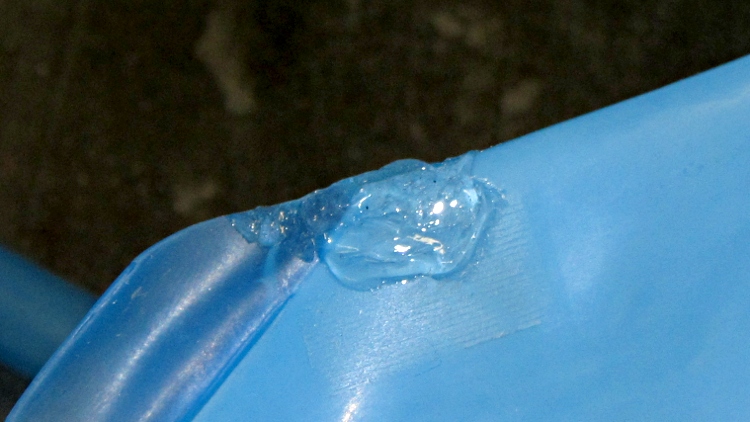
So the hydration pack I’ve been using for a few years started piddling all over the floor, whereupon some debugging revealed a pinhole leak where the large thermally sealed flange meets the bag side. Nothing, but nothing adheres to the polyethylene (or some such) bag material, but a blob of acrylic caulk (armored with a layer of electrical tape, not shown) may suffice for a while.
Hydration pack leak repair blob
I did the same thing to the other side as a prophylactic measure…
Quite some years ago, before I stapled a wad of steel wool in the hole gnawed in the corner of the garage door, the scrabble of little feet in the attic meant it was time to re-bait the mouse traps. Then, one night, we heard the scrabble of big feet in the attic…
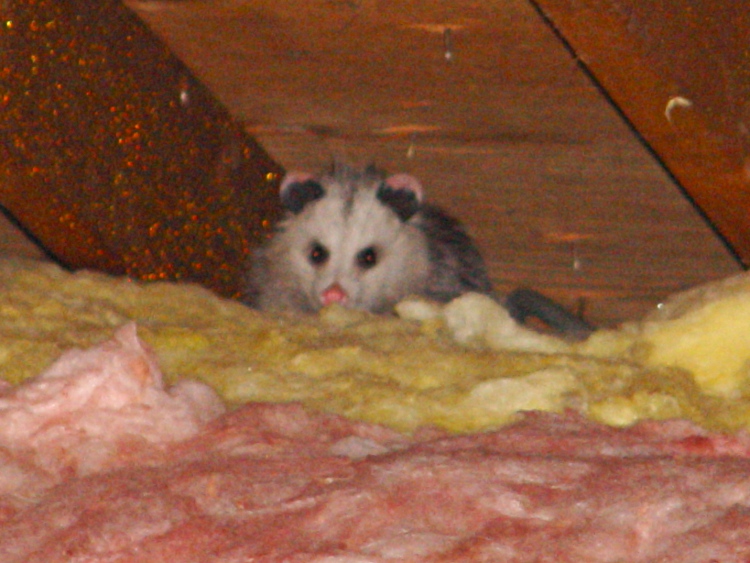
This is the point where the horror film audience starts chanting “Don’t open the door! Don’t open the door!“, but, to our credit, we did not don our skimpiest underwear before venturing into the attic. We didn’t encounter any zombies, either, but we did find this chap:
Opossum in attic
This is about as far north as opossums get; their ears suffer frostbite over the winters and get all raggedy, hence the pink teddy bear aspect. These are not, however, cute and cuddly critters.
The house has a full hip roof with a four-foot soffit over the patio, which must be the best place for a ‘possum to hang out:
Opossum in attic soffit
Some quick searches with the usual keywords suggested leaving the lights on and playing loud music, so we deployed several shoplights and a radio turned up all the way. It took two or three days, but eventually Mary spotted the critter on its way out of the garage… and now we don’t leave the garage door open any longer than needed.
FWIW, the path from the garage to the attic requires climbing those shelves, scaling three feet of vertical plasterboard wall, then crawling through a (now securely closed) vent hatch.
After rearranging the pressure washer pipes, I hauled the grill out on the driveway and opened the lid. My Shop Assistant denied putting that ball of fuzz in there:
Wool ball in propane grill
Gingerly prying it open revealed a mouse-sized pocket in the middle:
Wool ball interior
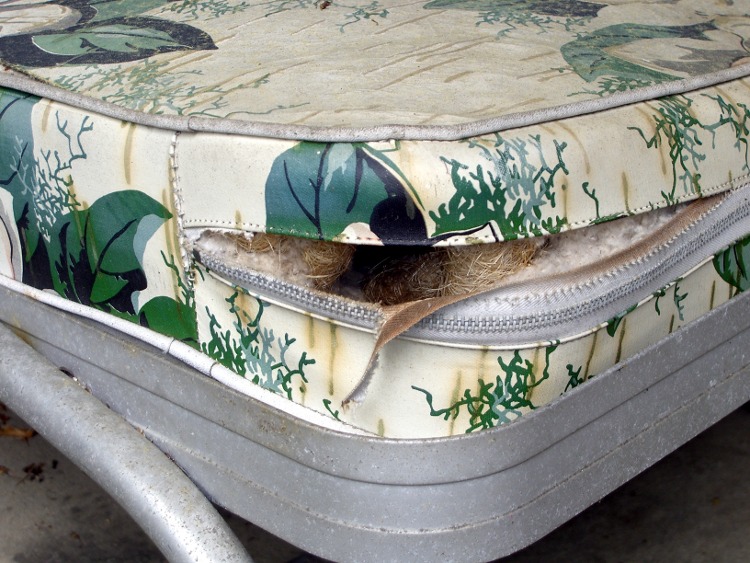
And a bit of investigation uncovered the source of the batting. Evidently, the corner seam of the ancient lawn couch thing (which came with the house and has been unused for over a decade) sitting on the patio had burst, leaving just enough room for an industrious mouse:
Source of the wool ball
They’d been camping inside the cushion at least over the winter and evidently used the far corner as their latrine. We bagged the whole cushion and added it to the van full of trash headed for the town’s bulk collection, which fortunately occurred that weekend.
Now, to haul the frame to the metal recycler and take advantage of the current commodity price bubble…
You get one chance to throw the snake over the side
The Great Greene grew up in the Midwest, with the type of summer job one might expect of a teen in an area surrounded by grain fields. One summer he found himself standing knee-deep in the wheat pouring into a cart beside a combine harvester, tasked with shoveling grain into the corners to level the load.
In addition to combines, the fields were full of rattlesnakes.
A rattlesnake adopts a characteristic pose when it senses a predator: body coiled, head and tail up, rattle vibrating vigorously. The smaller critters that dine on rattlesnakes (evidently, young rattlesnakes are tasty little pushovers) have figured out, over the course of their long shared evolutionary history, that such a display means this isn’t an immature rattlesnake and they should move along, move along. Raptors pay no attention, having invented the whole death-from-above thing long before we figured out powered flight.
Combines, having not evolved alongside rattlesnakes and being entirely unaware of the threat display, also pay no attention and simply sweep the entire snake into the threshing machinery, where the snake’s characteristic writhing-ball-of-fury reponse to an attack only serves to give the machinery a better grip. The rattlesnake emerges from the combine’s front end as a snakeskin belt surrounded by gibbage.
The combine’s sorters and sieves and transports that separate grain from straw don’t work well on rattlesnake remains, to the extent that much of the snake emerges from the conveyor belt as a damp blob dropped atop the pile of grain in the cart.
In addition to leveling the grain, the Great Greene was responsible for tossing debris over the side. He observed that the machinery downstream of the combine couldn’t do much more than sort out the larger chunks (it’s not like you can wash grain), so if he missed a snake the smaller bits were certain to wind up in your breakfast cereal bowl.
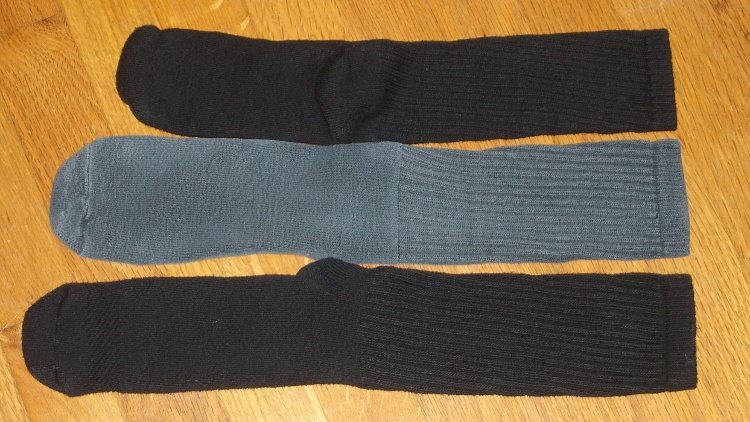
We picked up two packs of Dockers socks a while ago and after running them through the washer, I found this interesting situation:
Dockers sock size variation
The gray sock in the middle shows that I should buy socks somewhat more often, but the socks on either side came from two packs with identical labels. Well, identical except for one tiny detail (clicky for more dots):
Dockers sock labels – front
I don’t know which sock came from which pack, but I admit to a suspicion. They’re stretchy and both “sizes” fit about the same, so maybe it doesn’t matter.
[Update: It does matter. Those small socks became really snug after a few months.]
Oh, in case you were wondering, the pre-printed package reads “3 Pair $12” under that “3 Pair” sticker, with the price obliterated by hand with a marker. The current price is $14, conveyed by another sticker on the back atop the pre-printed price on the UPC barcode sticker. I don’t know if the store raised the price just in time for the sale, but I admit to a suspicion about that, too.





 The Smell of Molten Projects in the Morning