The Smell of Molten Projects in the Morning

Ed Nisley's Blog: Shop notes, electronics, firmware, machinery, 3D printing, laser cuttery, and curiosities. Contents: 100% human thinking, 0% AI slop.

Category: Home Ec

Things around the home & hearth

  • Whirlpool Refrigerator Fan Noise: Final Fix Redux

    Well, using a PC case fan as a freezer blower seemed like a good idea at the time: it worked, moved an adequate amount of air, and was pretty nearly silent. Until, that is, frost built up on the blades, water froze inside the frame, and the thing began sounding like a stick running along a picket fence:

    Frosted PC case fan in freezer
    Frosted PC case fan in freezer

    I replaced the first fan with another having slightly more clearance between the blade tips and the frame, but to no avail.

    So I dug the OEM fan (a.k.a., the Freezer Dog) from the heap, dismantled it, and discovered why it was howling. Turns out that the shaft nearest the fan blades was scored inside that bearing:

    Freezer motor - scored shaft
    Freezer motor – scored shaft

    A closer look:

    Freezer motor - scored shaft detail
    Freezer motor – scored shaft detail

    The rest of the shaft looked fine to me, so I put some green Loctite on rotor at the shaft and shoved the long end of the shaft (using the drill press as an arbor press) to put the scored section inside the rotor:

    Freezer motor - relocated rotor
    Freezer motor – relocated rotor

    Yes, that’s the same Loctite ridge you saw there

    The shaft has several small grooves that probably held lubricant or acted as alignment guides or something useful, but I’m hoping none of that matters. The rotor is turning backwards now, too, which shouldn’t make much difference: it’s pretty much symmetrical.

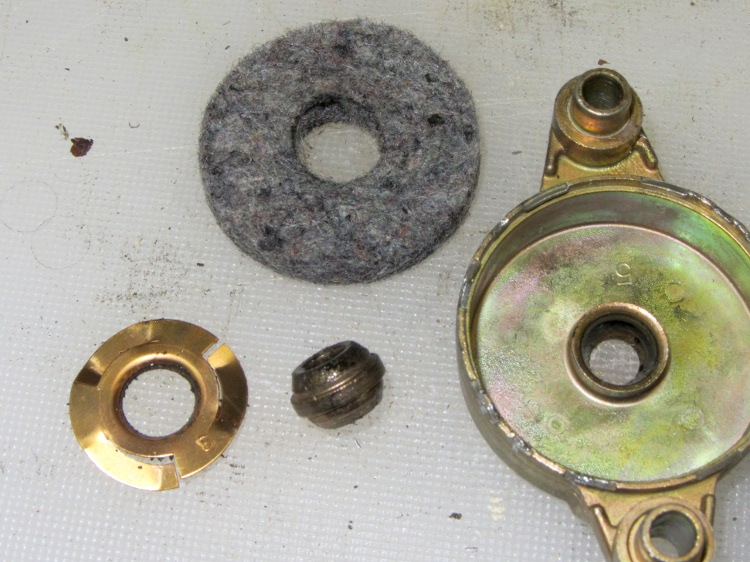
    While I had the motor apart, I whacked the bearings with a rod to shrink them a bit:

    Freezer fan bearings
    Freezer fan bearings

    Slobbered more STP on the bronze bearings, reassembled everything again, and it’s been quiet for nearly a week.

    Perhaps the combination of new shaft surfaces and tweaked bearings will run for a few more years. I still have the “new” replacement fan in a box…

  • Soaker Hose Splicing

    We deployed several granulated-rubber soaker hoses last year and, while they certainly weep enough water, they’re exceedingly brittle: they kink and break with what seems to be ordinary handling.

    The hose ID is much smaller than ordinary “half inch” hose, so I turned some grooves on a chunk of copper tube that’s a snug fit inside:

    Grooving copper tubing
    Grooving copper tubing

    Slitting a piece of scrap hose (ya gotta have stuff) and clamping it around the hose and tubing holds the splice together against the 90 psi water in the Vassar Farms irrigation system and provides a bit of strain relief beyond the ends of the tubing:

    Spliced soaker hose
    Spliced soaker hose

    While I was at it I made three more copper splices, because I know they’ll come in handy…

  • Brita Pitcher Lid: Second Hinge Pin Failure

    Although that fix continues to work, the second pin failed pretty much as expected:

    Brita pitcher lid - second broken pin
    Brita pitcher lid – second broken pin

    I glued the pin to rebuild the base, sheared the pin off, extracted the matching screw from the Tiny Vial of Teensy Screws, drilled a hole, and forced it in. This shot of the underside of the pitcher lid clearly shows that drilling the hole perpendicular to the edge doesn’t produce the proper alignment, but it works well enough:

    Brita pitcher lid - pin angle
    Brita pitcher lid – pin angle

    The “Smart Pitcher” LCD panel in the lid that counts down six weeks until filter replacement didn’t survive its most recent trip through the dishwasher, so we’re reduced to marking the calendar. How 20th century…

  • Quilting Pin Caps

    Mary has been quilting up a storm lately and is growing dissatisfied with the special safety pins she’s been using to hold the layers together. Long straight pins are ideal, except that maneuvering a large quilt through her sewing machine resembles stuffing a porcupine into a keyhole. A commercial solution costs nearly half a buck per pin, which seems unreasonably spendy for something you need by the hundreds.

    We kicked around some finger- and quilt-friendly dimensions and I cobbled up a solid model:

    Quilting Pin Cap
    Quilting Pin Cap

    Which turned into an array of small octagons that won’t roll off the table:

    Pin cap array on build platform
    Pin cap array on build platform

    We figured 25 would be enough to decide if this is workable and whether the dimensions fit fingers, pins, and quilts.

    Filling them with silicone rubber required one squirt each:

    Filling pin caps with silicone
    Filling pin caps with silicone

    The trick with the silicone rubber is to cut the snout so it fits flat on the cylinder top. Put the cylinders on a piece of non-stick paper (I used the back of the carrier for some double-sided tape, but wax paper would be better), hold one with tweezers, squirt in enough rubber to fill the cylinder solidly from bottom to top, then slide the snout sideways to smooth the surface.

    Wait for a day, pop them off, and remove any drool:

    Silicone-filled pin caps
    Silicone-filled pin caps

    It’s garden planting time right now, so it’ll take a while before I tweak the design and run off the next batch.

    I don’t know how to compute an actual cost for each of those things. I regard the entire Thing-O-Matic as fully depreciated and pretty much a sunk cost, which means the expense boils down to the incremental cost of plastic and silicone. All the Quality Shop Time is, of course, free… and maybe even therapeutic.

    The (trivially simple) OpenSCAD source code:

    // Quilting pin caps
    // Ed Nisley KE4ZNU April 2012
    
    //- Extrusion parameters must match reality!
    //  Print with +1 shells and 3 solid layers
    
    ThreadThick = 0.25;
    ThreadWidth = 2.0 * ThreadThick;
    
    HoleWindage = 0.2;
    
    function IntegerMultiple(Size,Unit) = Unit * ceil(Size / Unit);
    
    Protrusion = 0.1;			// make holes end cleanly
    
    //----------------------
    // Dimensions
    
    ID = 5.0;
    OD = ID + 2*ThreadWidth;
    Length = 5.0;
    Sides = 8;
    
    //----------------------
    // Useful routines
    
    module PolyCyl(Dia,Height,ForceSides=0) {			// based on nophead's polyholes
    
      Sides = (ForceSides != 0) ? ForceSides : (ceil(Dia) + 2);
    
      FixDia = Dia / cos(180/Sides);
    
      cylinder(r=(FixDia + HoleWindage)/2,
               h=Height,
    	   $fn=Sides);
    }
    
    module ShowPegGrid(Space = 10.0,Size = 1.0) {
    
      Range = floor(50 / Space);
    
    	for (x=[-Range:Range])
    	  for (y=[-Range:Range])
    		translate([x*Space,y*Space,Size/2])
    		  %cube(Size,center=true);
    
    }
    
    //----------------------
    // Build them!
    
    ShowPegGrid();
    
      rotate(180/Sides) {
    	difference() {
    	  PolyCyl(OD,Length,8);
    	  translate([0,0,-Protrusion])
    		PolyCyl(ID,(Length + 2*Protrusion),8);
    	}
      }
    
  • Why Friends Don’t Let Friends Run Windows: Virus Scanning

    So an email made its way through all the spam filtering:

    From:     USPS Service <us@usps.com>
    Reply-To:     USPS Service <us@usps.com>
    To:     (me)
    Subject:     Failure to deliver

    Notification,

    Your parcel can’t be delivered by courier service.
    Status:The size of parcel is exceeded.

    LOCATION OF YOUR ITEM:Riverside
    STATUS OF YOUR ITEM: not delivered
    SERVICE: One-day Shipping
    :U954571533NU
    INSURANCE: Yes

    Label is enclosed to the letter.
    Print a label and show it at your post office.

    Information in brief:
    If the parcel isn’t received within 30 working days our company will have the right to claim compensation from you for it’s keeping in the amount of $12.70 for each day of keeping of it.

    You can find the information about the procedure and conditions of parcels keeping in the nearest office.

    Thank you for your attention.
    USPS Customer.

    It had, of course, an attachment:
    Zip archive attachment (Label_Parcel_USPS_ID.45-123-14.zip)

    Not having sent a package using “one-day shipping” (which the USPS would call Express Mail), this seemed odd, as did the somewhat stilted phrasing.

    We all know how this is going to work out, but let’s do the exercise anyway.

    Save the ZIP attachment in /tmp, then …

    Apply ClamAV: run freshclam to update the virus signatures and fire clamscan at the ZIP file:

    /tmp/Label_Parcel_USPS_ID.45-123-14.zip: OK
    
    ----------- SCAN SUMMARY -----------
    Known viruses: 1201128
    Engine version: 0.97.3
    Scanned directories: 0
    Scanned files: 1
    Infected files: 0
    Data scanned: 0.04 MB
    Data read: 0.02 MB (ratio 2.00:1)
    Time: 7.549 sec (0 m 7 s)
    

    Huh. Well, then, it must be safe, right? (The alert reader will note that my version of clamav is one click back from the latest & greatest. Maybe that would make a difference. Probably not.)

    Let’s see what VirusTotal has to say:

    SHA256: febe98371e5b327118f5a703215f6f55ab47760764c68b0b9a64d1e5bdb28e25
    File name: Label_Parcel_USPS_ID.45-123-14.zip
    Detection ratio: 3 / 42
    Analysis date: 2012-04-20 11:40:44 UTC ( 0 minutes ago )
    More details
    Antivirus Result Update
    AhnLab-V3 20120420
    AntiVir 20120420
    Antiy-AVL 20120420
    Avast 20120420
    AVG 20120420
    BitDefender 20120420
    ByteHero 20120417
    CAT-QuickHeal 20120420
    ClamAV 20120419
    Commtouch W32/Trojan2.NQWF 20120420
    Comodo 20120420
    DrWeb 20120420
    Emsisoft 20120420
    eSafe 20120419
    eTrust-Vet 20120420
    F-Prot 20120420
    F-Secure 20120420
    Fortinet 20120420
    GData 20120420
    Ikarus 20120420
    Jiangmin 20120420
    K7AntiVirus 20120418
    Kaspersky 20120420
    McAfee 20120420
    McAfee-GW-Edition 20120420
    Microsoft TrojanDownloader:Win32/Kuluoz.A 20120420
    NOD32 a variant of Win32/Kryptik.AEKY 20120420
    Norman 20120420
    nProtect 20120420
    Panda 20120420
    PCTools 20120420
    Rising 20120420
    Sophos 20120420
    SUPERAntiSpyware 20120402
    Symantec 20120420
    TheHacker 20120420
    TrendMicro 20120420
    TrendMicro-HouseCall 20120420
    VBA32 20120419
    VIPRE 20120420
    ViRobot 20120420
    VirusBuster 20120420

    Obviously, this blob of slime arrived still warm from the oven: even though the Big Name AV checkers have up-to-date signatures, they detect nothing wrong and would happily let me run a Trojan installer. That’s what malware protection buys you these days.

    To a good first approximation, whatever virus scanner you’re using won’t save your bacon, either; the advice to keep the signatures up-to-date is necessary, but not sufficient. Of course, you know enough to not autorun random files on your Windows box, but this attack works often enough to justify sending messages to everybody in the world. Repeatedly.

    I recently had a discussion with someone who wanted a system secured against email and web malware. She also insisted that it had to run Windows and share files with other Windows machines. I declined to bid on the job…

  • Replacement Oven Drawer Supports

    One of the oven drawer supports in our Sears Kenmore gas range cracked and I finally got around to replacing it:

    Cracked oven drawer slide and replacement
    Cracked oven drawer slide and replacement

    I originally thought the drawer slid on the large, blocky, well-supported lump. Nope, that delicate little tab must support half the weight of the drawer; the lump might support the drawer in another oven. Perhaps we shouldn’t store the Lesser and Least Cast Iron Pans in that drawer, but that’s where they fit best. The Greater Cast Iron Pan lives atop the stove, because it get used so often there’s no point in putting it away.

    One could, of course, Fire the Thing-O-Matic! to print brightly colored plastic bits (after the usual tedious 3D modeling & trial fitting), but replacement parts cost a buck each from RepairPartsDirect. I bought three, so as to have a complete backup set, and most of the $9 total went to postage & handling.

    Done!

  • Sears Kenmore HE3 Washer Repair: End of the Story

    Our story so far:

    So here’s the Rest of the Story, reconstructed from my notes…

    Having already torn the thing apart and discovered that the repair would include both the drum+spider assembly (not available separately, which may actually make sense given high-speed spin balancing) and the front half of the plastic tub, I priced them at RepairClinic and Sears Parts Direct. In round numbers, this adventure would cost $300-400 just for the parts, a bit less than half the cost of the washer.

    As I recall, the Sears price for the drum was roughly twice that for RepairClinic, while the tub was about the same. I suspect Sears deliberately inflates the drum price to make sure nobody actually buys the thing and to pad out the tech’s time to replace it.

    The warranty in the front of the Owner’s Manual seemed promising:

    Sears Kenmore HE3 Washer Warranty
    Sears Kenmore HE3 Washer Warranty

    So I called the Sears Parts & Warranty line, walked the menu tree, explained the situation, asked for a new drum, and was told that they must dispatch a tech to diagnose the problem. Despite the warranty, there would be a labor fee and an additional fee to process the parts order. There was no way to determine those fees before dispatching the tech.

    I pointed out that I’d already dismantled the washer, knew exactly what the problem was, and just needed the replacement drum as described in the warranty. I was put on hold to “process my request”, eventually being transferred to a “tech specialist department for further assistance”.

    The “tech specialist” was willing to spend as much time as required to convince me that the Lifetime Warranty had expired, based on a deliberate misreading of the terms. As far as they were concerned, the sentence “After the first year, you will be charged for labor” meant that the warranty had expired on a five-year-old washer and that the drum was no longer covered. They would not, under any circumstances, send me the drum. Yes, I asked for a supervisor and, no, I doubt that she really was one; handing the call to the next cubicle is standard call-center subterfuge to placate irate customers.

    I eventually decided that this was not a language-barrier issue, but a carefully planned & executed part of their standard script: letting their Indian-subcontinent call center take the heat works wonderfully well for the purpose of getting rid of warranty claims.

    So I looked up the phone number of the “interim CEO/President” (I assume he’s long gone by now) at Sears Holding Corporation and gave him a call. Of course, I didn’t expect to actually reach the CEO, but I figured I’d shake the dice a bit to see if a better combination came up.

    It turns out that they expect this sort of behavior and immediately connected me to their “Executive Customer Service” department, which was described as “the highest they can go”. So I told my tale, asked her to ship me a drum, and was told that wasn’t possible. What she could do, as a “one time offer”, was to “waive the labor fee” when they dispatched the tech.

    I asked if there were any other fees. She refused to answer that question. I asked if there was a charge to order the parts. She refused to answer that question. It being a Friday, I asked when the tech could arrive; she said that they would attempt to schedule it for Monday, but Tuesday was more likely. I asked if he’d arrive with the drum. She said the tech would assess the problem and order the necessary parts, requiring a second appointment later in the week.

    I told her that it was obvious Sears had no intention of honoring their warranty. She repeated that this was a one-time offer. We did not part on good terms.

    So I ordered the drum & tub from RepairClinic, two huge boxes arrived on Tuesday, I installed everything, buttoned up the machinery, and the washer has worked fine ever since.

    Every time I looked at that big drum, I got mad all over again. I never mustered the enthusiasm to take the spider off the back for a post-mortem, which is why there’s no Part 2 after that post. Eventually I hauled the carcasses to the town’s disposal site and bid them good riddance.

    Obviously, Sears won: they got rid of me without spending a dime on the warranty. It cost them maybe two hours of phone time, but I doubt the pleasant voice in the “Executive Customer Service” department makes much more than minimum wage and Indian-subcontinent personnel are basically free compared to that.

    I’m doing a bunch of appliance repair right now and wonder just how much we’d be spending if we had to go through the Official Channels for repairs. I’m definitely earning my keep… and having much more fun than being jerked around by that corporate structure.

    And that’s the end of that story…