The Smell of Molten Projects in the Morning

Ed Nisley's Blog: Shop notes, electronics, firmware, machinery, 3D printing, laser cuttery, and curiosities. Contents: 100% human thinking, 0% AI slop.

Category: Electronics Workbench

Electrical & Electronic gadgets

  • Earbud Cushion Replacement

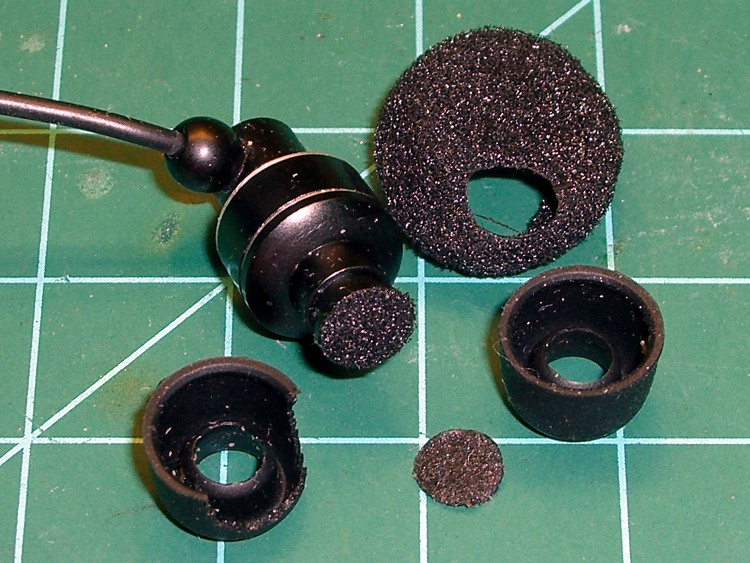
    Somehow I managed to shred the silicone cushion of the earbud on my bike radio. As nearly as I can tell, it got caught between the seat and the back; the missing part certainly isn’t inside my ear.

    Anyhow, I have a bag of spare cushions from all the other earbuds, so this isn’t a showstopper.

    The adhesive snot holding the earwax filter in place also failed, so I figured I should fix that while I had the hood up. The old filter was all ooky with earwax & oil & dried sweat, which meant that any new adhesive wouldn’t stick. I chopped a disk from a random foam earbud cover with a 7/32-inch hollow punch and glued it in place with some acrylic sealant.

    Earbud cushion and wax filter replacement
    Earbud cushion and wax filter replacement

    While I had the sealant out, I replaced the tape sealing the vent hole (on the other end of the earbud) with a dot of glop, much as I should have done originally.

  • External Li-Ion Pack Intermittent Connection: Solved!

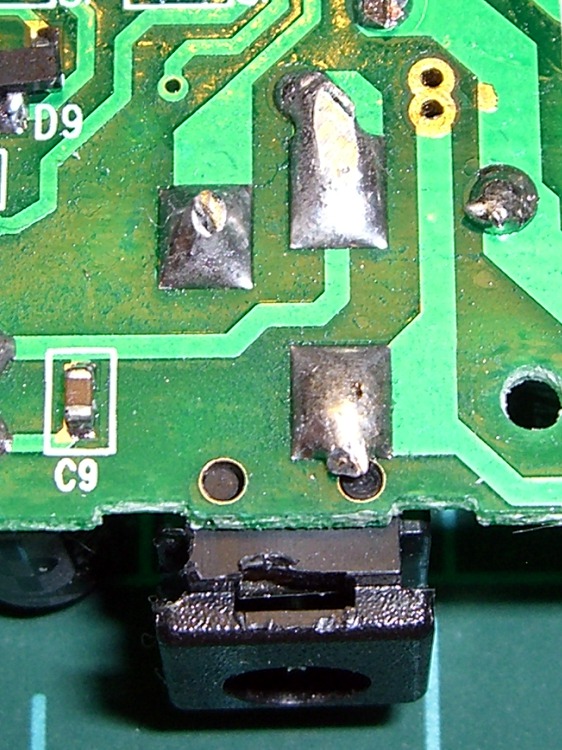
    After all the hassle of dismantling the battery pack, removing the jack from the board required nothing more complex than a solder sucker.

    Coaxial power jack - solder side
    Coaxial power jack – solder side

    With the jack in hand, I idly poked a coaxial plug into it and realized that the amount the plug stuck out was just about exactly equal to the thickness of the black plastic cap on its tip. Some rummaging turned up one of the six plugs with a missing tip, at which point both the problem and its solution were obvious.

    Broken vs original coaxial power tips
    Broken vs original coaxial power tips

    A bit of tedious work with a tiny screwdriver and a needle convinced the socket to disgorge the plastic ring from its bowels …

    Broken tip extracted from jack
    Broken tip extracted from jack

    Now, I suppose I could have figured this out without taking the case apart, but actually fixing the problem would still require surgery, soooo there’s no wasted effort. That’s my story and I’m sticking with it.

    If you think you could extract that ring from the outside, there’s a joke about that.

    I put the case back together with a few dabs of silicone snot adhesive (despite what I know about letting acetic acid loose near electronics) to anchor the circuit board, applied a belly band of tastefully color-coordinated (i.e. silver) duct tape, and it’s all good.

    Actually, the pack was stone cold dead until I plugged it into the charger to reset its battery protection circuitry. Evidently, disconnecting and reconnecting the battery tripped the protection logic. I’ve seen that in other Li-Ion packs, so it wasn’t quite so scary as it was the first time around.

    As for the coaxial power tip: a dab of solvent glue, an overnight clamping session, and I think it’ll work fine forever more.

    I should machine up some stabilizing collars around the sockets to match that obvious shoulder on the plug, shouldn’t I?

  • External Li-Ion Pack Intermittent Connection: Dismantling the Pack

    The power lead into the Li-Ion pack I’m using for the bike radio became badly intermittent on a recent ride. When I got back I swapped in a different pack and the problem Went Away, but I noticed that the coaxial power plug didn’t seem to seat all the way into the jack on the failed pack. I’d noticed that before, although I attributed it to getting two different sets of the packs; it didn’t seem to make any difference.

    Given that I was going to have to either repair or replace the jack, dismantling the offending pack was next on the list. Some preliminary poking showed that there were no screws concealed under the label, so the two halves of the pack were either snapped or bonded together.

    The case didn’t respond to the usual wedging and prying by revealing an opening, which suggested that it was bonded. That meant I must saw the thing apart.

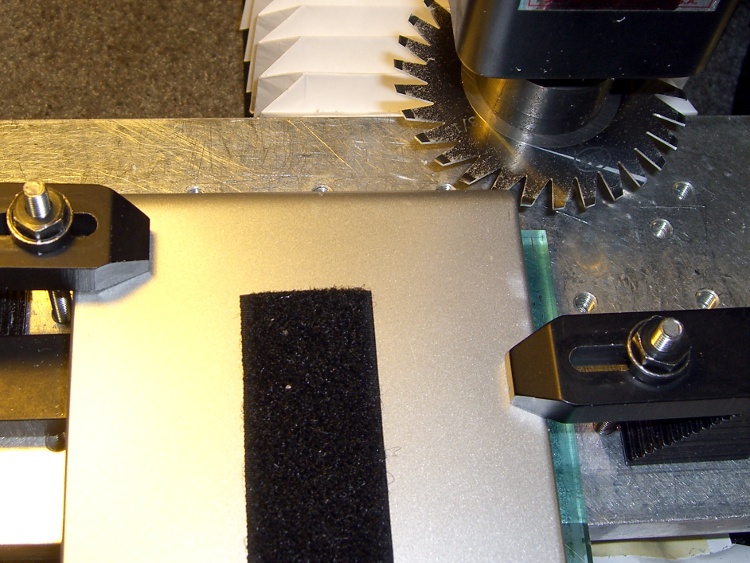
    I set up a 31-mil slitting saw on the Sherline and clamped the pack atop a random plastic slab atop the tooling plate. The Sherline’s limited throat depth meant I had to cut the far side of the pack. I aligned the saw to the Z-axis level of the joint along the middle of the pack by eyeballometric guesstimation.

    Slitting saw setup
    Slitting saw setup

    Key point:

    • You absolutely do not want to saw into a lithium-ion cell, not even a little bit.

    Therefore:

    • The pack must be aligned parallel to the cutter’s travel
    • The cuts must proceed in tiny increments, and
    • You must verify that each cut doesn’t reveal any surprises.

    In this setup, the pack aligns against a clamp on the left side and to a parallel block (removed while cutting) along the rear edge of the tooling plate. I could then unclamp the pack, rotate it to put the next edge in place, and use the same XYZ origin with the edge parallel to X.

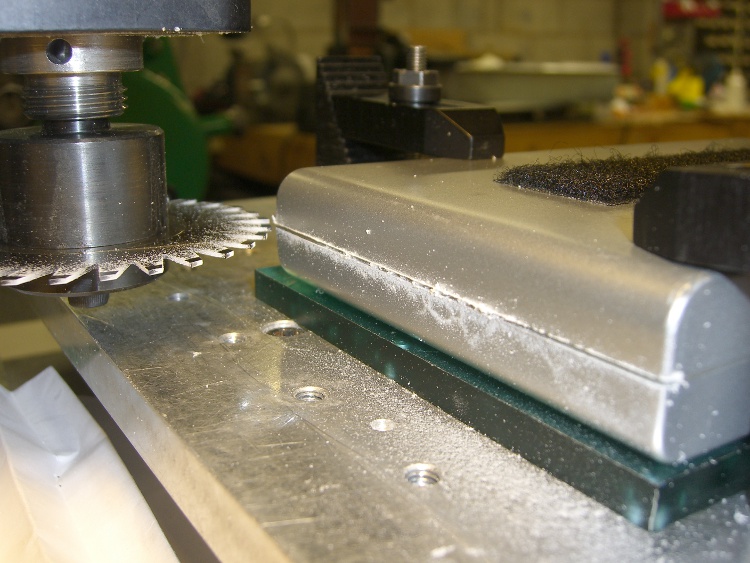
    Here’s the view from the back of the table.

    Sawing the case
    Sawing the case

    I ran the spindle at 5 k RPM and cut about 15 inch/secminute. I’m sure the pros do it faster, but that was enough to warm up the blade and that’s fast enough for me. [Update: typo on the units. Thanks!]

    Cuts were 0.020 inch per pass, which is about 0.5 mm. I expected the case to be some hard-metric dimension and wasn’t disappointed.

    After the cuts reached 0.060 inch, I manage to pry the remaining plastic in the joint apart and split the halves apart along the connectors and LEDs at the front where I couldn’t do any sawing.

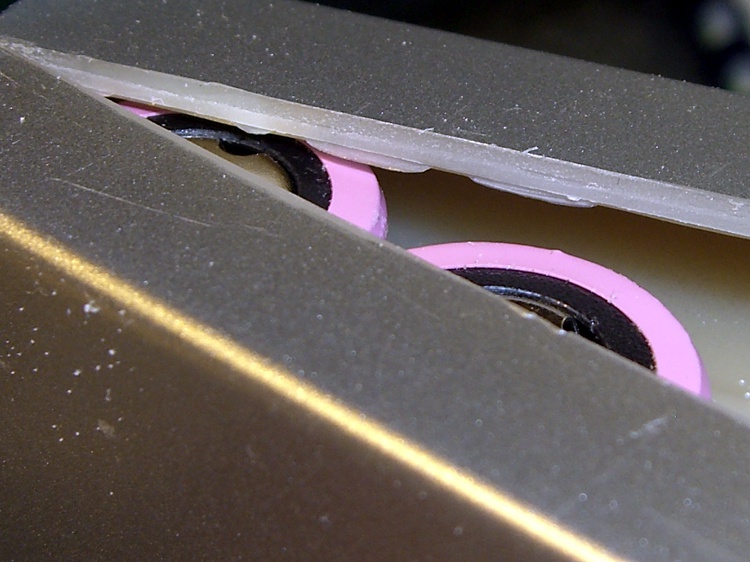
    Here’s a close look at the cut, just above the battery terminals. The case turned out to be 2 mm thick, about 0.080 inch, so I was just about all the way through. The cut was perfectly aligned with the case and cracked open neatly along the entire length.

    Tight tolerance on the cut depth
    Tight tolerance on the cut depth

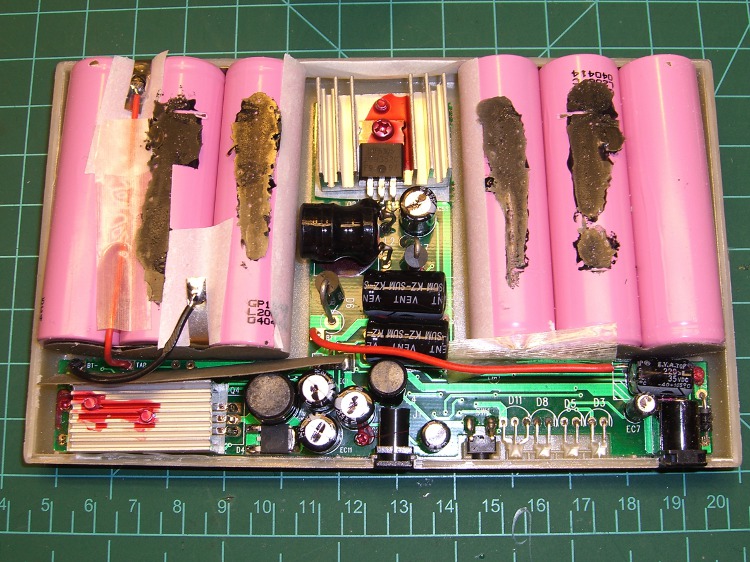
    An interior view, showing that the cells adhered to the left half of the case and the electronics to the right: of course. I pried the cells loose from the left side, which provided enough access to unsolder the things, as the terminals were against the case. Notice that there’s absolutely nothing between the inside of the case and the outside of the cell, so cutting just slightly too deep would be a Bad Thing™.

    First look inside the case
    First look inside the case

    After a bit of work, here’s the entire layout…

    Battery pack internal layout
    Battery pack internal layout

    Much to my surprise, the battery consists of two series-connected sets of three cells: 2 x 3.7 V = 7.4 V. I expected three series sets for about 3 x 3.7 = 11.1 V, with a linear regulator down to the 9.0 V output.

    As it turns out, they used two switching regulators: the one between the two triplets controls the charging voltage and the one to the lower-left boosts the battery to the pack’s 9.0 V output. I had hoped for a resistor divider that I could tweak to get 9.6 V out, but it certainly wasn’t obvious.

    I unsoldered the cells, dismounted the circuit board, and puzzled over it for a bit, after which the problem was obvious.

    The story continues tomorrow, with a dramatic denouement…

  • Pin Spanner for 3.5 mm Audio Jack Nut

    The external antenna jack on the Totally Featureless Clock is, by necessity, recessed way down in a hole (because I can’t get to the inside of the now-finished half-inch-thick case to gnaw it out from there). Perforce, that puts the locking nut out of reach.

    Solution: a pin spanner wrench. I’m sure they’re available commercially, but what’s the fun in that?

    The male threaded part of the jack is 0.230 inch OD, the nut is 0.313 OD, and the notches are 0.030 wide and 0.020 deep. Raw material is about two inches of 5/16-inch air-hardening drill rod, not that I’m actually going to heat treat it for this application.

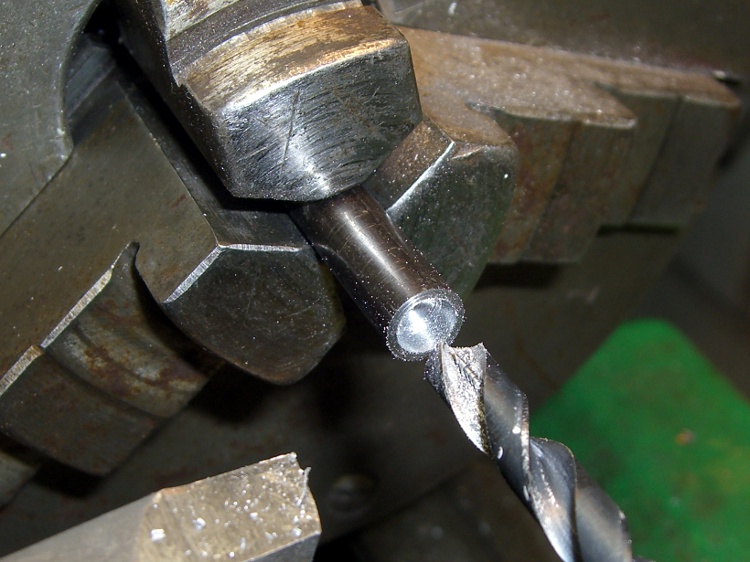
    Face off the end and drill the guts out with a 15/64-inch drill.

    Drilling central recess
    Drilling central recess

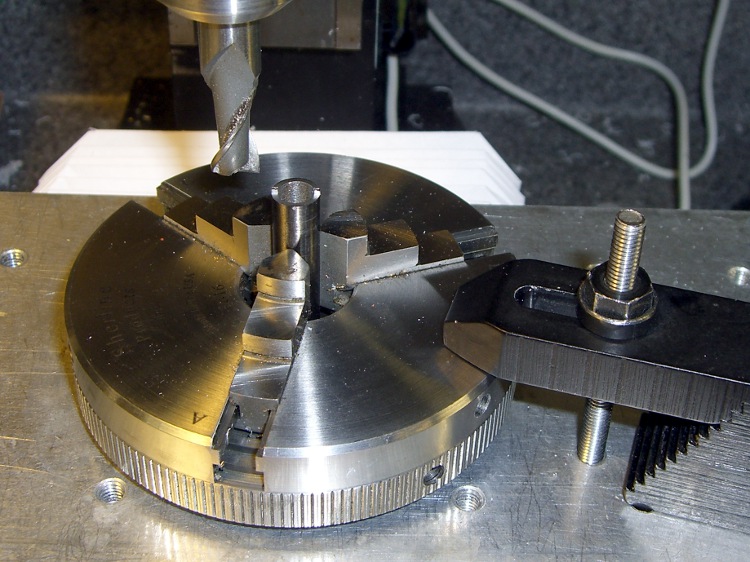
    Grab it in the 3-jaw chuck bolted firmly to the table, then mill off anything that isn’t a pin. Don’t grab it in the milling vise, which doesn’t have enough oomph to hold a slick steel cylinder in place; don’t ask how I know this.

    Milling pins in 3-jaw chuck
    Milling pins in 3-jaw chuck

    Set Z=0 at the top surface of the spanner-to-be and XY = 0 on the axis of the cylinder, of course.

    Manual CNC, feeding the commands into EMC2’s MDI slot and then mouse-clicking the stored commands to avoid reduce typing errors. For my setup, Y=±0.171 to produce the 30-mil pin and  X=±0.4 to clear on both sides.

    After cutting the first side at 3 k RPM, feed 2 inches/min, and 10 mils per pass, I whacked the other side off in one giant 20-mil bite. I’m such a sissy…

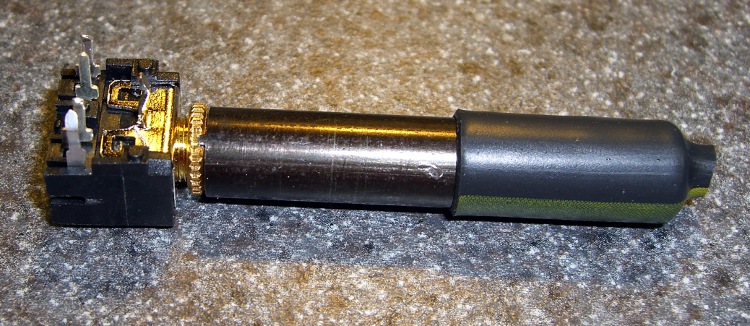
    A bit of heatshrink tubing improves the griptivity and it’s all good.

    Finished spanner engaged in nut
    Finished spanner engaged in nut

    This is the sort of thing you do once, drop in the baggie with the rest of the connector nuts, and use for years thereafter. I should’a done it years ago, but I’ve been able to not quite butcher the nuts with a needle-nose pliers…

    [Update: It turns out a commercial nut driver was available, at least in one special shop in one special place, but no longer. For my delicate uses, that shaft into the jack isn’t really needed.]

  • Cutting Thin Rings: Homebrew Punches

    The Totally Featureless Clock is back for a refit: its preferred location turned out to have essentially no RF at all, so I must move the antenna out of the clock case on the end of a cable.

    Drat!

    I put the ferrite bar inside a length of PVC pipe, turned down to make it less ugly, with white plastic end plugs. Rather than fiddle around with complex mountings, I cushioned the fragile bar in closed-cell foam, which meant I needed some way to cut a bunch of foam rings.

    Some rummaging produced a thinwall brass tube with about the same ID as the PVC pipe. A brief trip to the lathe put a reasonably sharp edge on one end.

    Sharpening the brass tube
    Sharpening the brass tube

    That edge is more keen than it looks; while it’s not razor-sharp, it’s plenty good enough. I didn’t use it as a punch, just grabbed it in a rag to cushion my palm and rotated it through the foam against a plywood scrap.

    That produced a bunch of foam cookies.

    Foam cutouts
    Foam cutouts

    The bar diameter was close enough to a standard hole punch that I didn’t have to make one. Centering by eye and rotating by hand turned the cookies into donuts.

    Punched holes
    Punched holes

    And then they fit just fine…

    Cushioned ferrite bar antenna
    Cushioned ferrite bar antenna

    I made more donuts to swaddle the bar from end to end inside the PVC tube. I slipped the antenna in from the left, then pushed the donuts over the bar with Yet Another Brass Tube. The end result is an antenna compression-packed in foam, which ought to keep it in good condition through at least a minor oops.

    Finished antenna housing
    Finished antenna housing

    The screws pass through the end plugs to hold them against the pressure from the foam cookies at the bar ends. The holes are slightly counterbored on the top to blend the screw heads into the curve of the tube. There’s a 3/8-inch flat along the bottom that will eventually settle against the underside of a shelf.

  • Capsaspitators

    I had our daughter solder up some circuit boards for me (as part of a clever scheme to get her trained up on circuitry) and we were discussing the projects. I used the term capsaspitator and she gave me a blank look … as well she might, because even Google doesn’t know what they are.

    A long time ago, back on the IBM Video Disc project, Mad Phil and HH were chasing the gremlins out of a particularly tricky bit of RF-oid analog / digital circuitry. This task required a prodigious quantity of bypass caps and, at some point, Mad Phil announced that he’d had it up to there with those [obscene gerund] capsaspitators!

    The term immediately caught on and I use it to this day in reference to any particularly obscure capacitor, particularly  bypass caps that seem useless and are actually vital.

    It’s pronounced caps-ASS-pi-tator, of course, and now everybody can find it on The Web…

  • PTT Switch Contact Corrosion

    Corroded Pushbutton Switch Contacts
    Corroded Pushbutton Switch Contacts

    The PTT switch for the amateur radio on my bike got erratic: pushing the button didn’t seem to be producing reliable RF. I’d have sworn when I bought the switches that they were washable-during-PCB-assembly: at least moderately sealed.

    Wrong.

    Turns out there’s only the seal you get from snug-fitting mechanical parts. I carved off the square aluminum bezel and found an ordinary dome switch underneath, with contacts that actually looked better than you’d expect after half a decade on a bike. But, yes, I could see why it was erratic.

    Lacking anything smarter, I installed another one, just like the other one, with a square of Kapton tape over the button. Not a great seal, but maybe it’ll be Good Enough.

    Here’s what the button looked like in happier times…

    PTT Button
    PTT Button

    Memo to Self: Tape up the other PTT buttons?