The Smell of Molten Projects in the Morning

Ed Nisley's Blog: Shop notes, electronics, firmware, machinery, 3D printing, laser cuttery, and curiosities. Contents: 100% human thinking, 0% AI slop.

Category: Electronics Workbench

Electrical & Electronic gadgets

  • Thing-O-Matic / MK5 Extruder: Thermal Switch Block

    Thermal Switch Block on Thermal Riser
    Thermal Switch Block on Thermal Riser

    The best place to mount a thermal switch (or a thermal sensor, depending on how much you trust your circuitry) is on the MK5 Thermal Core, but that’s far too hot for the switches I have in hand. As a compromise, I decided to mount the switch on the Thermal Riser tube leading vertically upward to the Filament Drive gear: good thermal contact, a solid mount, and out of harm’s way.

    All the alternative locations seem worse. Tucking it inside the insulation wrap doesn’t provide a solid mechanical mount, so you don’t get a repeatable position and the leads get bent every time you move something. Bolting it to the plate over the Core looks solid, but that’s just a flat sheet of metal with four screws connecting it to the Core: no real thermal contact surrounded by lots of cooling air.

    One good omen: with an operating temperature well under 100 °C, JB Industro Weld epoxy will work fine and eliminate any need for fussy clamps and fittings.

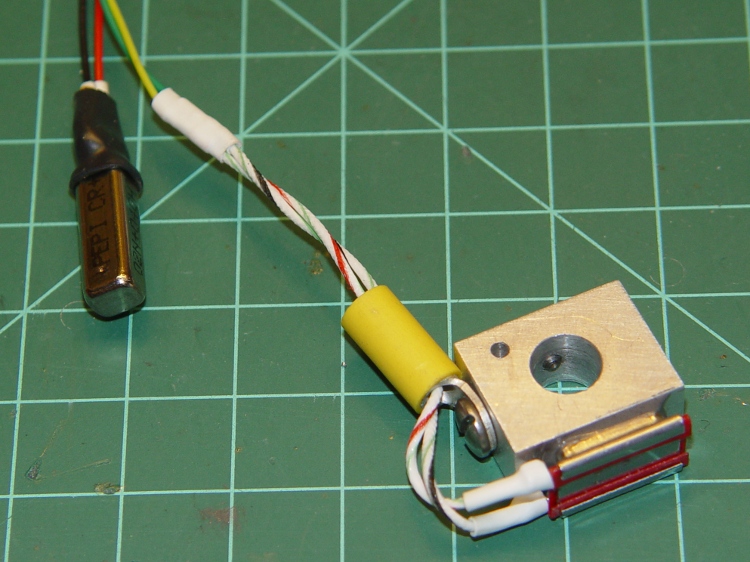
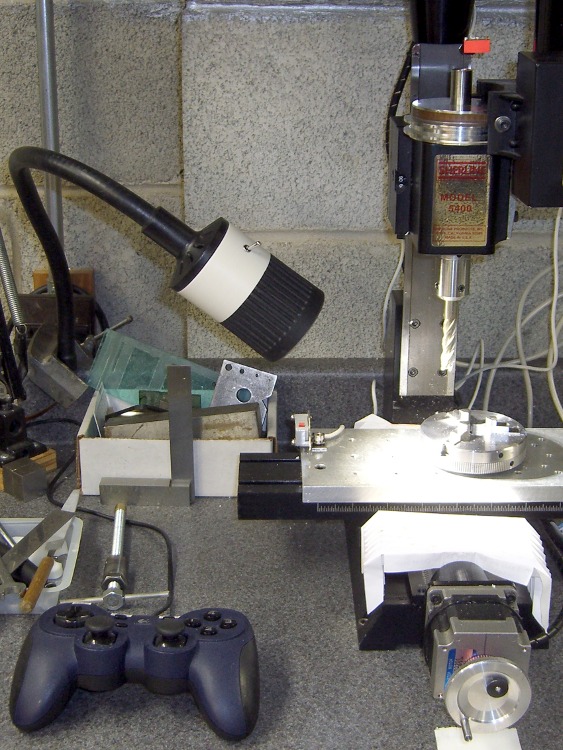
    So I sawed off a random chunk of aluminum plate, squared it up in the Sherline mill, and poked a few holes in it. This doodle has dimensions roughly equivalent to the final object, but absolutely nothing is critical other than the 5/16 inch central hole:

    Switch block sketch
    Switch block sketch

    The 4-40 setscrew secures the block to the Thermal Riser. Aluminum expands considerably more than stainless steel, so I dropped a snippet of PTFE wire insulation into the hole as a rubberdraulic plunger.

    The lug on the top provides strain relief for the wires; it’s not an electrical connection. The modular phone cable trailing off to the Thermal Cutout box has wires insulated with low-temperature plastic, so a few inches of Teflon hookup wire keep them out of the Danger Zone.

    The small hole is just big enough for a thermocouple bead.

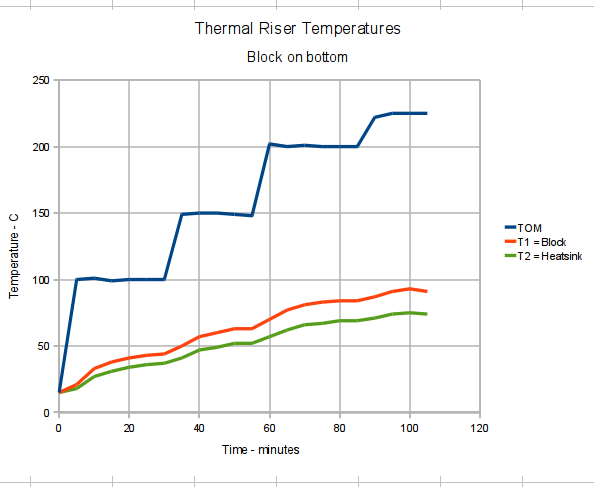
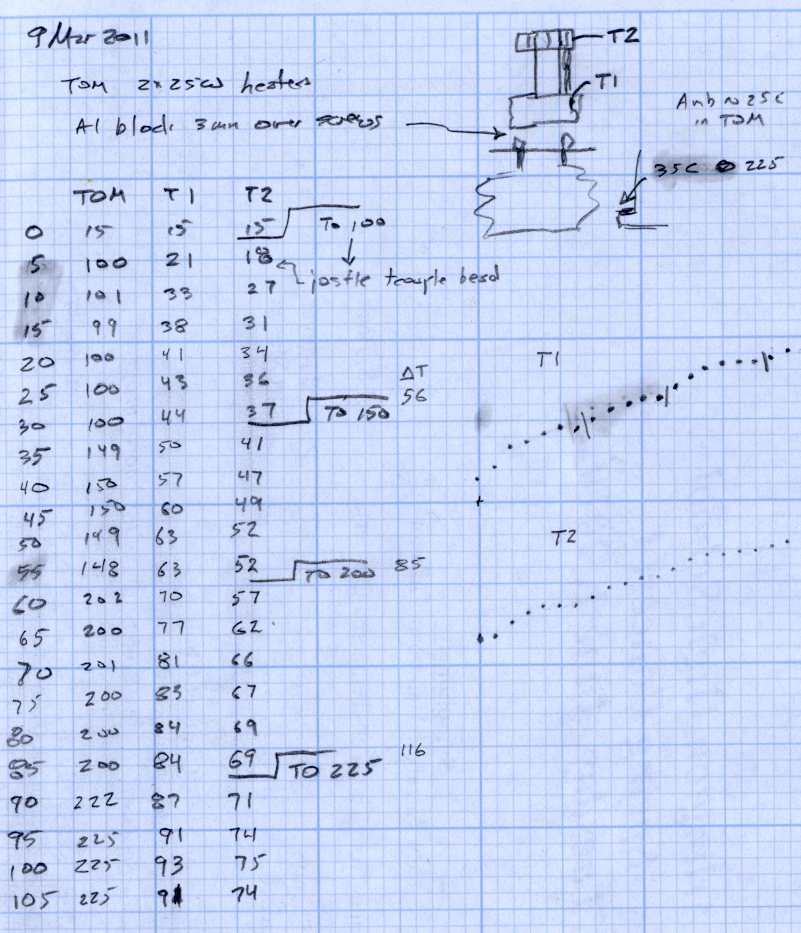
    This is what the thing eventually looked like, but I made some measurements before sticking that switch in place:

    Themal Switches - prepped and mounted
    Themal Switches – prepped and mounted

    Up next: measurements!

  • Building an LED Floodlight Into a Task Lamp

    Building an LED Floodlight Into a Task Lamp

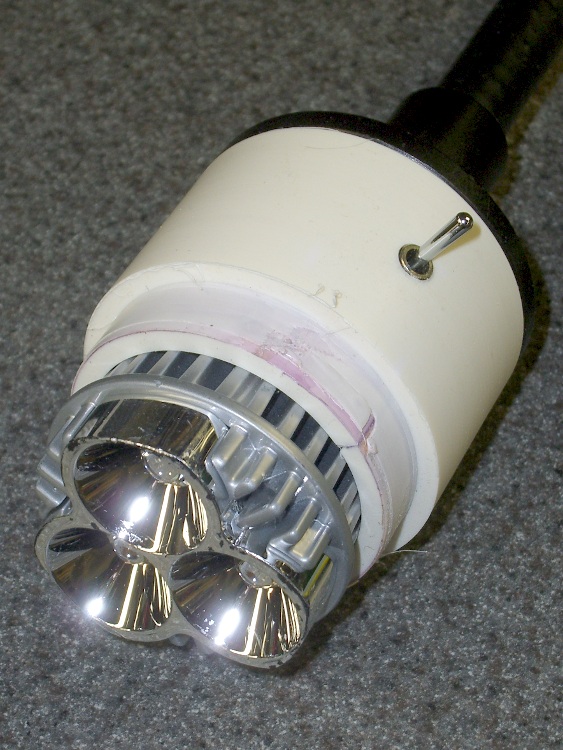
    LED Gooseneck Floodlight
    LED Gooseneck Floodlight

    Eks forced me to take a pile of crap useful make-froms, including a gooseneck task lamp that was probably bolted onto a machine tool in its former life. It sported a 20 W halogen bulb, but looked to be just about exactly the right size for those LED floodlights, which is why I didn’t put up much of a fuss about taking it off his hands.

    The LED lamps are much bigger than the halogen bulb, but they fit neatly into the housing diameter. All they needed was a bit more front-to-back room, which looked a lot like a chunk of PVC pipe. The housing screws together with a 1.5 mm thread that I can’t produce on my inch lathe; I’m still not set up for thread milling. This being a low-stress application with a lamp that ought to outlast me, I figured I’d just make the belly band slip-fit the two threads, glue it in place, and move on.

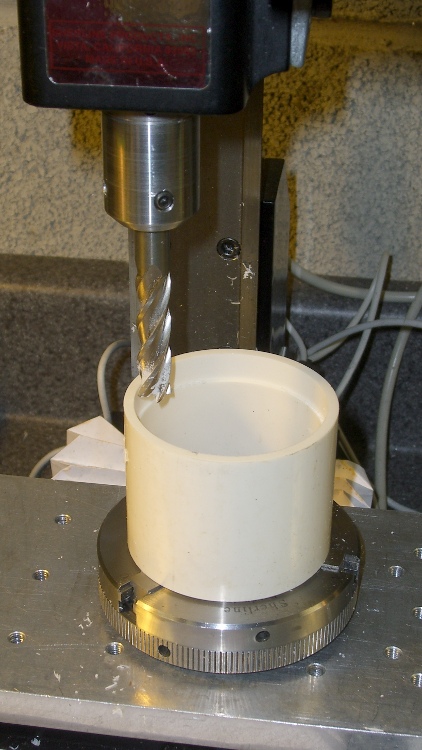
    I sawed off a length of PVC pipe, faced off the ends in the lathe, then CNC milled a recess to clear the male threads on the gooseneck part (I hate precision boring in the lathe). Given the rather tenuous grasp of that 3-jaw chuck, I made two passes around the perimeter: pipe ID 52.1, thread OD 54.5, remove 1.2 mm all around, about 9 mm down.

    Milling top recess
    Milling top recess

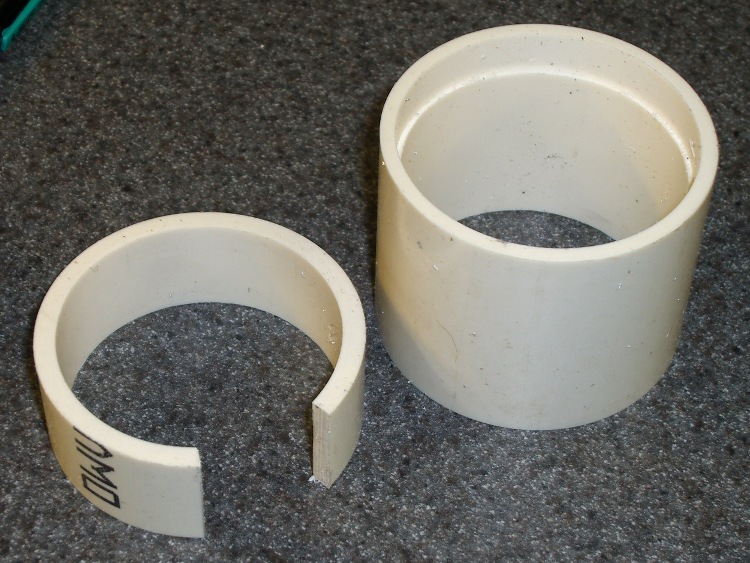
    On the other end, the female thread ID = 52.2 and the pipe ID = 52.1, so I glued another ring of PVC pipe inside to provide enough meat to turn it down. Once again, saw off a ring, face the ends, then cut out a segment so that the OD circumference of the inner ring is just slightly smaller than the ID circumference of the outer pipe. The result looked like this:

    PVC insert sizing
    PVC insert sizing

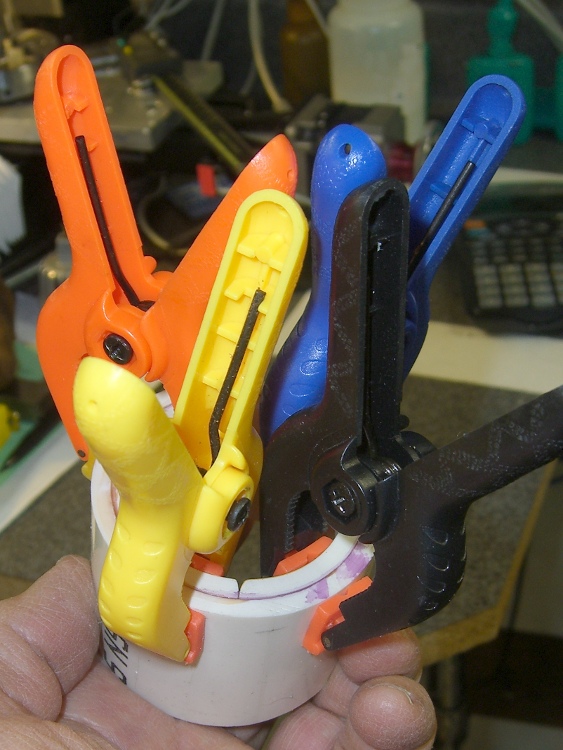
    Apply a heat gun to the inner ring until it’s soft enough to stuff into the pipe, clamp it until it hardens, apply PVC cement, and clamp overnight. Contrary to appearances, the ends of the two pipes are flush at the surface. Once again, you cannot have too many clamps:

    Clamped PVC insert
    Clamped PVC insert

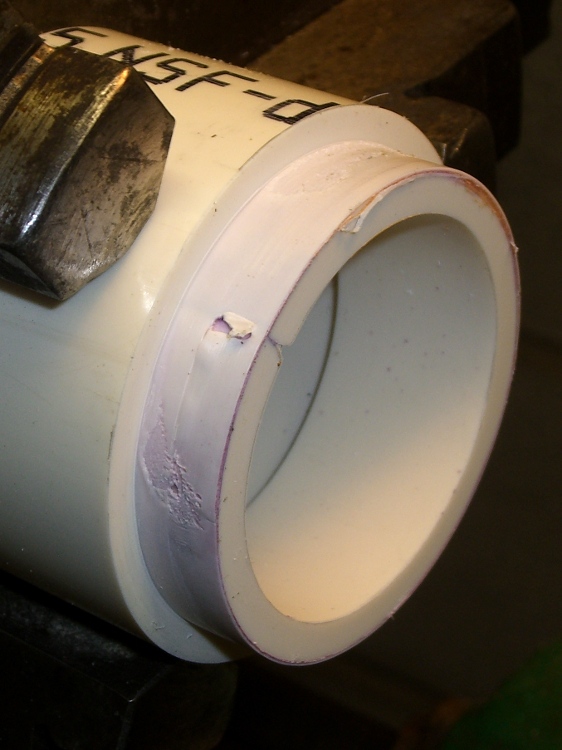
    Turning down the outside to fit the threads shows just how little meat was left on that pipe:

    Skinning down to the insert
    Skinning down to the insert

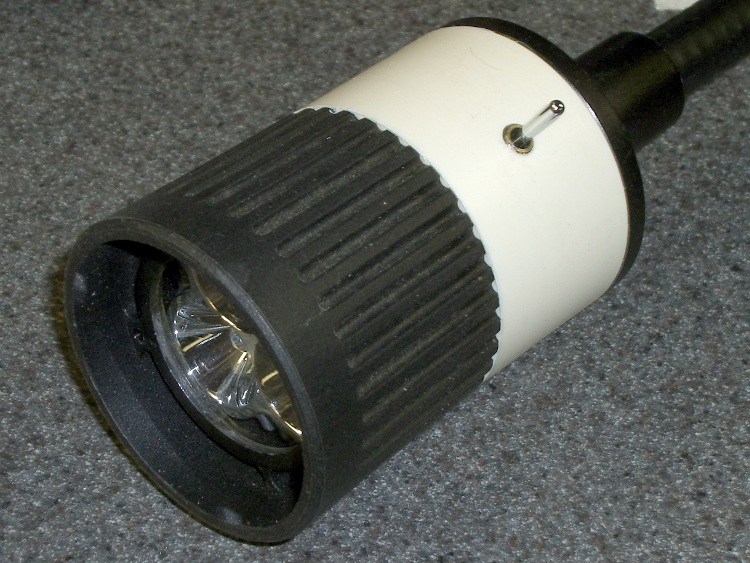
    While it was chucked up (and despite my dislike of boring) I bored a bevel to accept the LED lamp and adjusted the OD so the lamp fit snugly between the end of the belly band and the lens holder on the front of the housing:

    Floodlight in holder
    Floodlight in holder

    The switch comes from the Parts Heap. A D drill puts a slightly undersized hole that’s just right for the threaded switch; I simply turned it in by hand. A length of zip cord carries the power up the gooseneck, where various ends get soldered to the switch and lamp.

    I applied some hot-melt glue to the threads and pushed everything together:

    Finished LED Floodlight
    Finished LED Floodlight

    The glass lens on the front fits in a molded holder with an annular air gap. The LED lamp housing has all those fancy cooling fins against the inner pipe, so there’s a bit of cooling air flow around the lamp and out through the rear black section. A thermocouple reports the lamp temperature gets up around 75 °C in a 14 °C shop; a 50 °C rise might be a tad warm in the summer, but we’ll see what happens.

    The power supply came from the Parts Heap: a 12 V 1 A wall switching power supply in the shape of a wall wart. For now, the zip cord from the lamp terminates in a coaxial power jack that (amazingly enough) fits the wart’s connector, but I’ll eventually put a box in there somewhere.

    Clamped the butt end of the gooseneck to the backsplash on the countertop under the mill and It Just Works!

  • LED Floodlight Rehabilitation

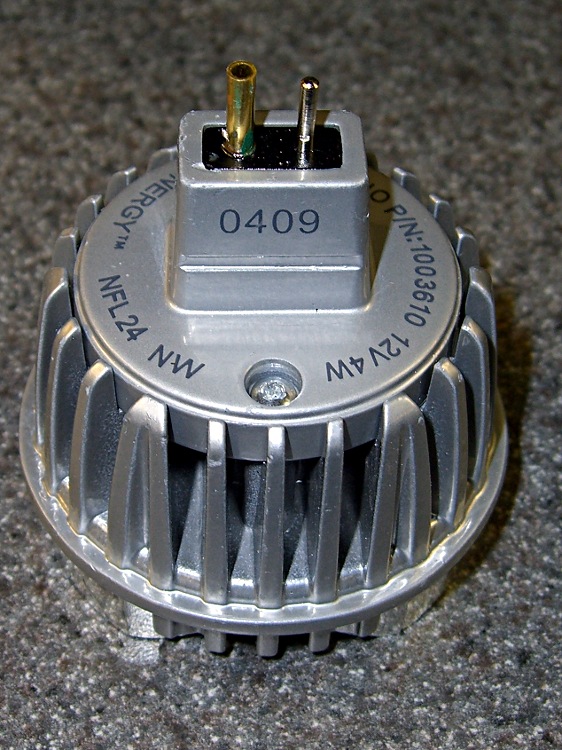
    I picked up a pair of 12 V 4 W 3-LED floodlights (datasheet, newer datasheet, and catalog) with 34 degree and 24 degree beams from All Electronics, with the intent of making some task lighting fixtures for the shop. Somebody decommissioned the lamps by snipping off a pin, so they’re not immediately useful.

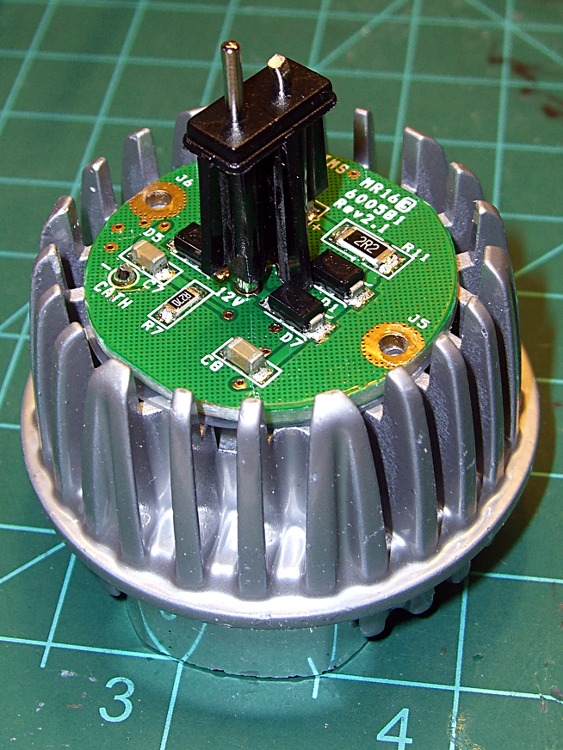
    The back pulls off with a bit of difficulty, after removing the two obvious screws and holding the connector body in place while pulling. I didn’t try to remove the circuit board, which would require unsoldering the clearly marked Anode and Cathode LED wires that enter from the bottom of the board.

    LED Floodlight - interior
    LED Floodlight – interior

    I plan to build these lamps right into the fixtures, so soldering a wire directly onto the pin makes sense; I expect they’ll outlast my usage and a socket won’t add any value. As an intermediate step, I soldered a short brass tube onto the pin stump:

    LED Floodlight - repaired pin
    LED Floodlight – repaired pin

    In new condition, these retail somewhere beyond $60, so cutting 6 mm from one pin shaved about fifty bucks off the price. I suspect they were extracted from somebody’s shiny new, recently abandoned, and probably foreclosed, office complex and were ruined to prevent resale-as-new. The fact that the reflectors got a bit scuffed up along the way wouldn’t help their value any, either.

    They draw 330-odd mA from a 12 V supply, run from AC or DC (either polarity), and seem to have a constant-current driver inside. I wouldn’t buy ’em new, but for eight bucks a pop they’re a pretty good deal.

  • Thing-O-Matic: Thermal Lockout Circuit

    Thermal lockout control box
    Thermal lockout control box

    This is a proof-of-concept lashup of a circuit to shut off the Thing-O-Matic’s power should the Thermal Core overheat. It vaguely resembles those doodles, but with the thermal switch cases grounded and an indicator for the main thermal switch.

    [Update: You should read the rant at the bottom of that post to understand why this isn’t a firmware mod and doesn’t contain a microcontroller.]

    Operation is straightforward:

    • The black NO (Normally Open) momentary switch energizes the DPDT relay, one NO pole of which then holds the relay power on.
    • The red NC (Normally Closed) momentary switch interrupts that circuit and releases the relay.
    • An NC thermal switch detects an overheated Thermal Core, opens that circuit, and releases the relay.

    The other NO relay pole connects / disconnects the ATX power supply’s -Power On line from the Thing-O-Matic Motherboard. That connection requires a circuit-board cut to splice the relay into the Motherboard.

    The LEDs:

    • Lower Green = ATX AC power on (from +5VSB power)
    • Upper Green = +Power On signal active
    • Red = Test / Fault (on = relay inactive)
    • Yellow = low over-temperature alarm
    • Orange atop box = high over-temp switch active

    I included a second NO thermal switch that activates at a lower temperature, mostly because I had one, but that’s certainly not required. The multitude of LEDs makes for a happy-looking box; labels would be a nice touch, I agree.

    When you turn on the ATX power supply, the Lower Green and Red LEDs turn on: the “Test” part of the “Test / Fault” indicator. Push the black button, the Red LED goes off, the Upper Green LED goes on, and the Thing-O-Matic is up & running. Push the red button, the TOM shuts down, and you’re back to the starting condition.

    The Yellow LED goes on when the lower temperature switch goes on.

    Shortly thereafter, presumably, the higher temperature switch opens, the Orange LED goes on, the TOM shuts down, and you’re left with the Lower Green, Yellow, and Orange LEDs: zowie! When the  high temp switch cools off a bit, the Orange LED goes off and the Red LED goes on. After a while, the Yellow LED will go off, and you’re back to Square One again.

    What’s not yet done: mounting the thermal switches to the Thermal Core in a way that’s mechanically solid, electrically isolated, and thermally dependable. I just got a bag of 100 °C NC switches, which make more sense than the 65 °C NC switches I’d been fooling with.

    The wiring uses 4P4C and 6P6C modular phone connectors and cables, which are cheap & readily available, if not exactly proof against high temperatures. In normal use, failures tend to be open-circuit that will shut off the heater power. Take care not to position the cables so they melt first; they’re not intended as thermal switches.

    Achtung: modular cable color codes are not standardized, particularly on the jack side, so pay more attention to the pin numbers than the colors. If I ever meet the guys who rearranged the jack colors, There. Will. Be. Gibbage.

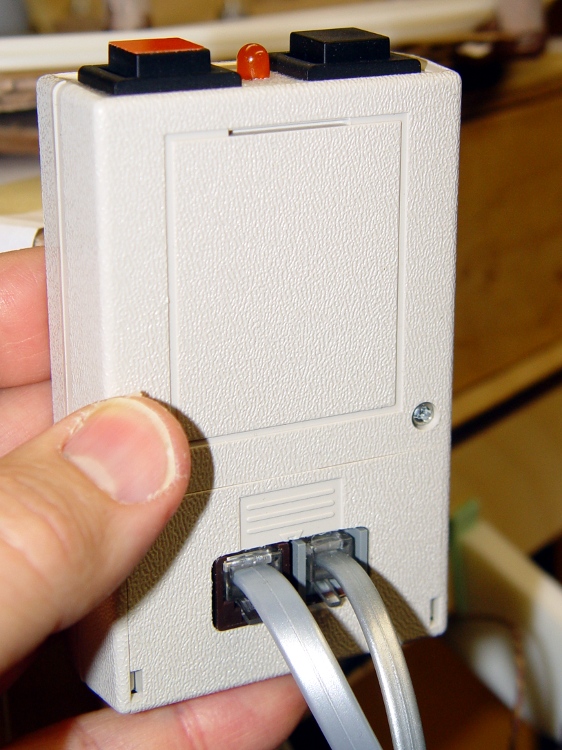
    A back view of the box shows a nice rectangular hole that’s obviously a manual CNC job on the Sherline, with no corner filing whatsoever. Hot melt glue holds the connectors in place, so I’m not showing off the inside:

    Thermal lockout box - rear
    Thermal lockout box – rear

    The -Power On connection to the Motherboard requires the single cut shown in yellow:

    Motherboard PCB Modification
    Motherboard PCB Modification

    It looks like this in real life, with the wire soldered to the Arduino header pin. Another dab of my Shop Assistant’s orange nail polish seals the PCB wound:

    Motherboard -Power On modification
    Motherboard -Power On modification

    The remaining wires attach to the ATX power connector pins on the bottom of the board. The yellow wire passes through an unused mounting hole on its way to the top side, as above. Use a cable tie to tie the cable to the board, through a pair of otherwise unused RS-485 connector mounting holes.

    Motherboard Connections - Bottom
    Motherboard Connections – Bottom

    While you’re chopping away at the Motherboard, add that isolating diode to keep +5 V USB power from turning the ATX fan with the power off.

    The overall schematic (clicky for more dots):

    Thermal Lockout Schematic
    Thermal Lockout Schematic

    There is no corresponding PCB layout, because the circuitry forms a point-to-point hairball inside the box. If you were doing this for real, you’d want a PCB with a bazillion connections, but …

    For example, here’s the FET driver for the Orange (it just looks Red) high temperature LED before a liberal application of heat stink shrink tubing:

    Overtemperature LED driver hairball
    Overtemperature LED driver hairball

    You can test the thermal switches using a butane lighter.

  • 3D Printed Pactec Box Panel

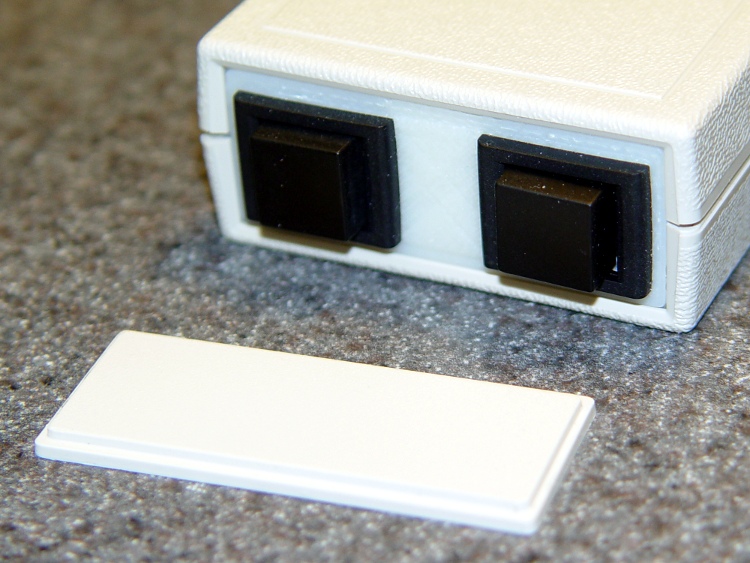
    As part of the Thermal Lockout project, I planned to put a pair of big pushbutton switches on the end of a little Pactec box, thusly:

    Pactec box - printed panel
    Pactec box – printed panel

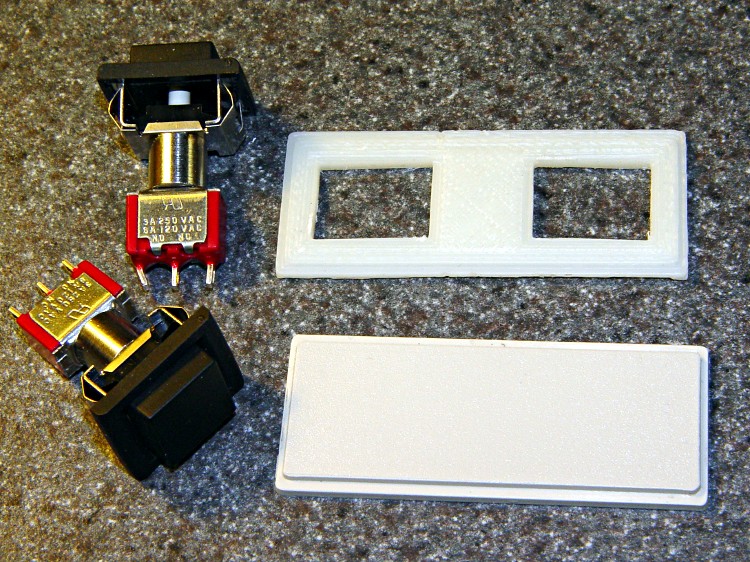
    I was in the midst of figuring out how to clamp that tiny panel to the Sherline milling machine’s table and gnaw out those big holes, when I realized I could just print out a new panel with the holes already in place:

    Pactec panels with switches
    Pactec panels with switches

    No muss, no fuss, no exciting chips… and no tedious corner filing, either.

    The 3D model has the hole for an LED that I added later; the panel shown above acquired that hole during a brief conference with Mr Drill Press.

    Thermal Cutout Box - switch plate model
    Thermal Cutout Box – switch plate model

    In actual point of fact, I had to do a bit of edge filing for the switches, as the holes came out slightly undersized. The HoleWindage setting should take care of that for the next time around. The panel was a drop-in replacement for the original: all the outside dimensions & thicknesses were spot on.

    The OpenSCAD source code:

    // End panel for PacTec 61191-01 box
    //    Panel 61580-01
    // Ed Nisley - KE4ZNU - Feb 2011
    
    Layer1Z = 1.50;
    Layer2Z = 1.00;
    
    HoleWindage = 0.55;                // approximately equal to extrusion width
    Protrusion = 0.1;                // stick out over top and bottom
    
    SwitchOffsetX = 15.0;
    
    SwitchX = 16.0 + HoleWindage;
    SwitchY = 12.0 + HoleWindage;
    SwitchZ = Layer1Z + Layer2Z;
    
    LedR = (5.0 + HoleWindage)/2;
    LedZ = SwitchZ;
    
    difference() {
     union() {
     translate([0,0,Layer1Z/2]) cube([55,22.5,Layer1Z],center=true);
     translate([0,0,(Layer1Z + Layer2Z)/2]) cube([52.6,19.5,Layer1Z + Layer2Z],center=true);
     }
    
     translate([SwitchOffsetX,0,SwitchZ/2])
     cube([SwitchX,SwitchY,SwitchZ + 2*Protrusion],center=true);
    
     translate([-SwitchOffsetX,0,SwitchZ/2])
     cube([SwitchX,SwitchY,SwitchZ + 2*Protrusion],center=true);
    
     translate([0,0,LedZ/2])
     cylinder(r=LedR,h=LedZ + 2*Protrusion,center=true,$fn=10);
    
    }
    
  • Thing-O-Matic: USB Power Backfeed Prevention

    The Arduino Mega 2650 board used in the Thing-O-Matic gets its power from the +12 V ATX supply plugged into the TOM Motherboard. It will also automagically switch to +5 V from the USB connection when the +12 V external power Goes Away.

    Come to find out that the Foxconn Atom I’m using doesn’t shut off the power to the USB ports when it’s “turned off”. That keeps the Arduino alive and, by a quirk of the circuitry, backfeeds +5 V into the +12 V supply, which makes its way back to the ATX power supply and keeps the fan running. Slowly, but it’s ticking over in there.

    Rather than keep unplugging the USB cable, I added a diode in series with the Motherboard +12 V trace going to the Arduino connector:

    USB backfeed prevention diode
    USB backfeed prevention diode

    The orange stuff is nail polish rejected by my Shop Assistant, which covers a slit gouged in the +12 V trace. The diode bridges the gouge and passes current only into the Arduino.

    Any diode will do, as the next step in the +12 V supply chain is that poor overworked Arduino regulator responsible for shaving it down to +5 V. I used a good old 1N4001 and it’s perfectly happy.

    [Update: the Arduino will remain powered up overnight, even with everything else turned off. When you turn the Thing-O-Matic on the next morning, pop the Reset button to get the Arduino’s attention.]

  • Recommended Scissors

    These Fiskars scissors [Update: they’ve moved to the Gardening section. Try there or there. ] seem to be intended for sewing & quilting, but they work just fine for snipping plastic filament, cutting tape, and severing hangnails…

    Fiskars Softouch Scissors
    Fiskars Softouch Scissors

    The titanium nitride coating probably doesn’t add much value to the mix, but that’s what they had at JoAnne Fabric when I bought ’em.

    Fiskars scissors tip detail
    Fiskars scissors tip detail

    This detail of the tip shows why they’re so great for detail work: each blade ends in a two-way taper to a genuine cutting point. Of course, that means they’ll survive exactly zero falls to the shop’s concrete floor, but they’re fine while they last.

    The trick is to sign up for JoAnne sale flyers, which regularly deliver “40% off any one item” discount coupons, then make a targeted shopping expedition. Those coupons account for the green self-healing cutting mat that’s in the background of so many pictures around here, too…