The Smell of Molten Projects in the Morning

Ed Nisley's Blog: Shop notes, electronics, firmware, machinery, 3D printing, laser cuttery, and curiosities. Contents: 100% human thinking, 0% AI slop.

Category: Amateur Radio

Using and building radio gadgetry

  • APRS Packet Routing

    This might be another personal best in a different category:

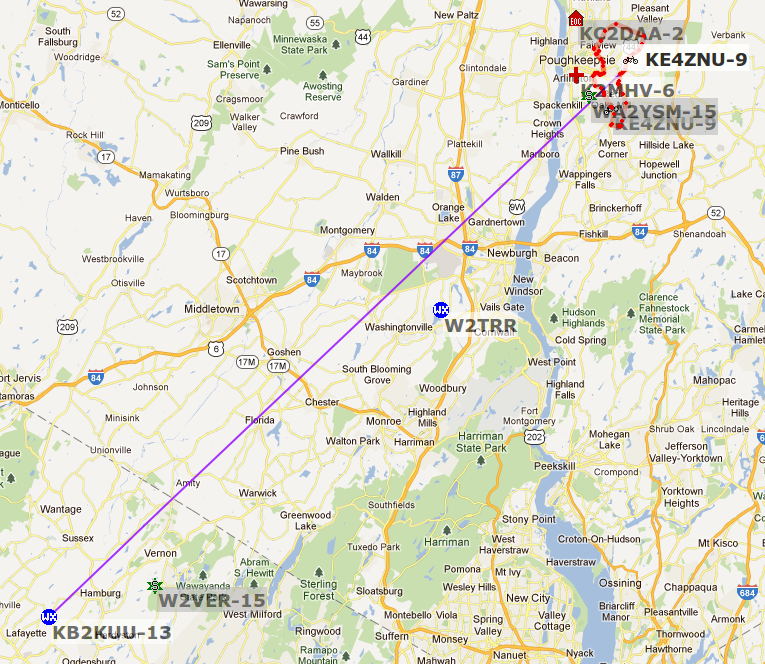
    KE4ZNU-9 APRS to KB2KUU-13 - Lafayette NJ
    KE4ZNU-9 APRS to KB2KUU-13 – Lafayette NJ

    The path from KE4ZNU-9 (on my bike in Pleasant Valley) to KB2KUU-13 near Lafayette, NJ, spans a bit over 90 km / 55 miles, which isn’t bad for a 5 W (that’s optimistic) hand-held radio through a dual-band mobile antenna bolted to the seat frame with my head much too close to the base. The topography lay in my favor, though: Pleasant Valley sits near the top of the Wappingers Creek watershed (admittedly, barely 200 feet above sea level) and the valleys run southwest-to-northeast all along this part of the East Coast. The KB2KUU-13 antenna may be only 20 feet above average terrain, but that puts it 600 feet above sea level with a commanding view to the northeast.

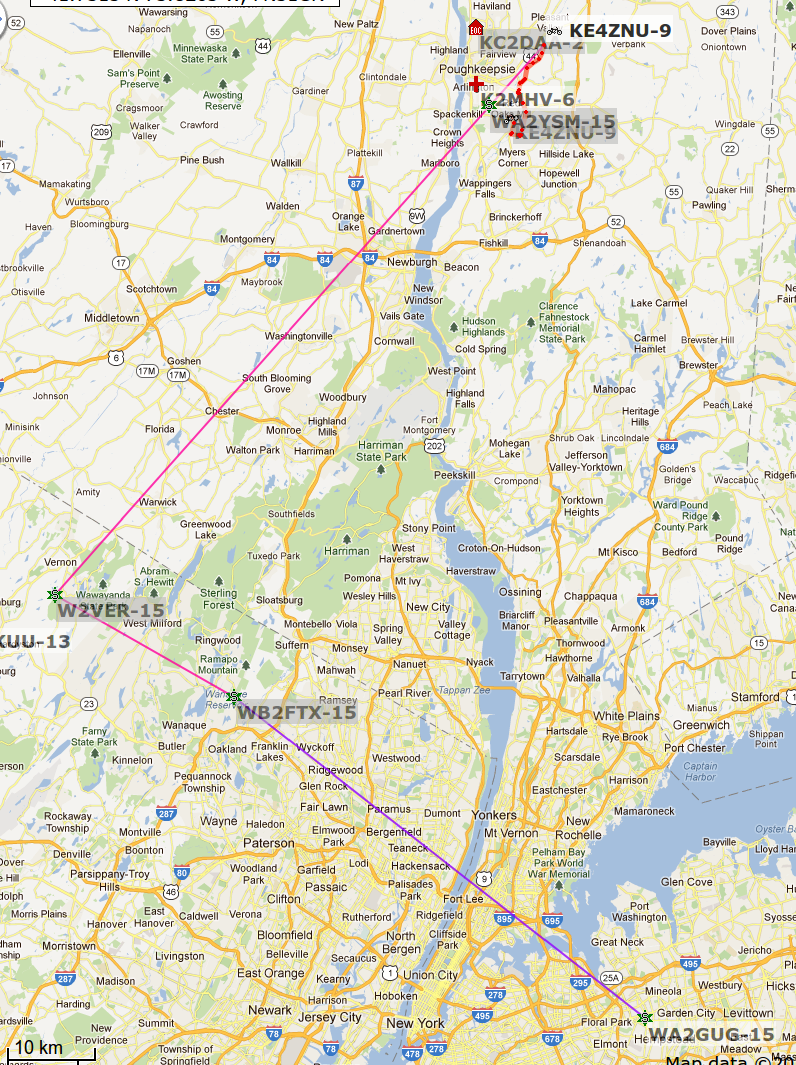
    Another packet sent a few minutes later took a much longer path to an APRS iGate:

    KE4ZNU-9 APRS to WA2GUG-15 - Long Island - 2012-02-01
    KE4ZNU-9 APRS to WA2GUG-15 – Long Island – 2012-02-01

    The first hop covered about 80 km / 50 miles to W2VER-15. That antenna is 320 feet above average terrain, but that’s with a 1400 foot base: a ridge near Hamburg Mountain. The next hop is about 20 miles to WB2FTZ-15, then 60 km / 40 miles across the plains and out to WA2GUG-15 near Hempstead on Long Island.

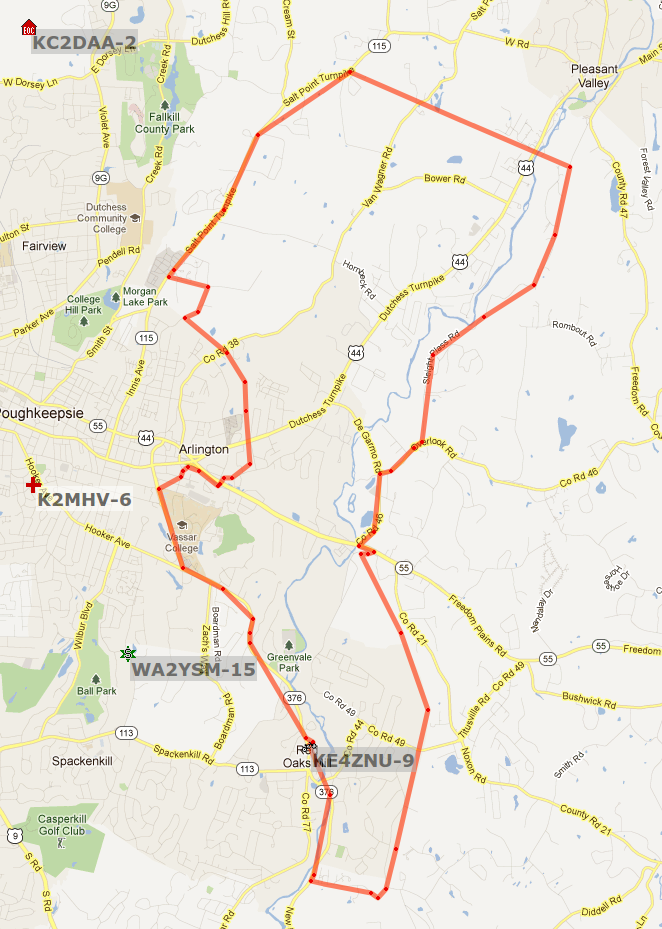
    Normally, of course, a closer digipeater snags packets from my bike; most go through WA2YSM-15 or KC2DAA-2 to K2MHV-6 and probably don’t clog up the entire eastern seaboard. It’s hard to tell, though, because the APRS database records only the first successful capture of a given packet.

    The whole bike ride looked like this:

    KE4ZNU-9 trip - 2012-02-01
    KE4ZNU-9 trip – 2012-02-01

    The APRS spots missed the sprint along West Road into Pleasant Valley, but you get the general idea: 22 miles, 15 mph average speed, temperature around 58 °F, a fine day for a ride!

  • Capacitor Self-resonance: The Madness

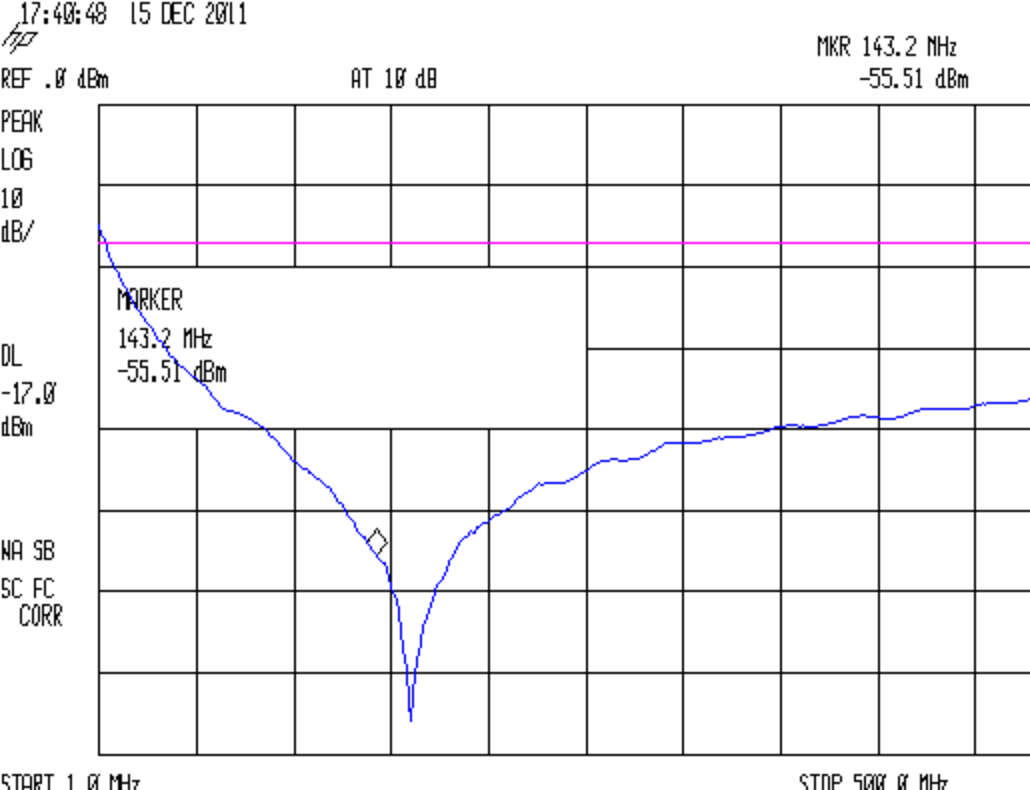
    I’d wondered whether suppressing RFI by picking capacitors by their self-resonant frequency, so that each cap would suppress a known input signal. Turns out that’s entirely possible, even for the amateur VHF and UHF bands:

    Wouxun PCB - 100 nF 680 80 pF AVX - PTT
    Wouxun PCB – 100 nF 680 80 pF AVX – PTT

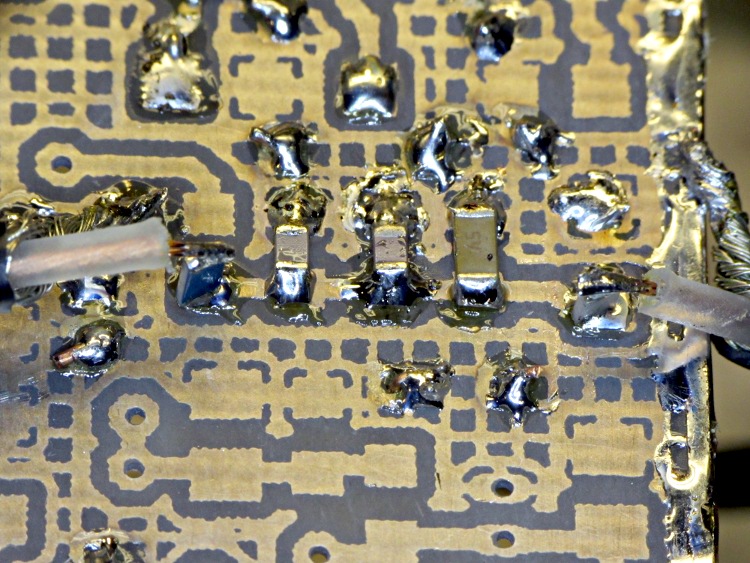
    The three caps producing that trace look like this on the brassboard PCB for the Wouxun GPS+voice interface,  with spectrum analyzer input & output through RG-174 coax with 22 Ω and 470 Ω SMD resistors tombstoned on the pads at the end of the string:

    GPS voice PCB - SMD caps on PTT input
    GPS voice PCB – SMD caps on PTT input

    The scattered solder blobs cover Z-wires connecting the top ground plane to the continuous ground pour on the bottom surface. The solder strip along the edge joins the copper tape bonding the surfaces together around the perimeter. Basically, this is as well-controlled a layout as one can rationally get, without full RF matched-impedance zaniness.

    However, the whack-a-mole RFI suppression concept makes absolutely no sense whatsoever for anything other than a mass-production board with rigidly controlled component parameters, which isn’t what you see here. Basically, ceramic caps have poor tolerances, bad thermal stability, and standard values too far apart to make fine tuning practical: lining up the self-resonance with a desired frequency requires trial-and-error selection for every capacitor.

    Those peaks between the self-resonances can be much higher than you’d expect, too, because they represent parallel resonances where the total impedance can approach an open circuit. Remember that caps above resonance look like inductors and caps below resonance look like caps, so two parallel caps form a nice RL tank circuit for signals between their self-resonant frequencies. The caps have very low ESR, making the Q unreasonably high.

    If you were hoping for / requiring broad-spectrum RFI suppression, paralleling caps will definitely make things worse, which is probably not what you expected, either.

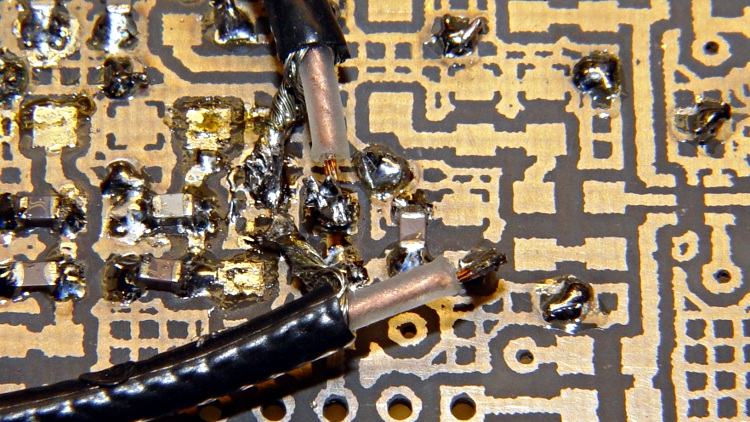
    The whole scheme also suffers from measurement error due to parasitic inductance from the position of the SA and TG “probes”. Compare this trace:

    Wouxun PCB - 330 pF - HTPTT near
    Wouxun PCB – 330 pF – HTPTT near

    Made with the SA and TG connected to the same pad:

    SA and TG - same pad
    SA and TG – same pad

    With this trace:

    Wouxun PCB - 330 pF - HTPTT far
    Wouxun PCB – 330 pF – HTPTT far

    Which involves moving the SA input to a pad on the other end of the trace, the better part of 8 mm away:

    SA and TG - different pads
    SA and TG – different pads

    Yes, those layouts are identical when you’re talking about signals near DC.

    The pigtail leads certainly contribute some inductance, as does the the PCB trace itself. I suspect you could model that effect, but I’m not sure you could generate a predictive model without a 3D field solver and a whole bunch of calibration measurements. If you really care about the location of that self-resonant peak, I’m not sure which trace / layout you’d trust.

    Of course, if you use a cap with a very broad self-resonant peak, then it’s all good. Except, equally of course, that I have no idea how you’d specify one of these to your purchasing agent:

    Wouxun PCB - 992 pF - HTMIC
    Wouxun PCB – 992 pF – HTMIC

    That’s a 1 nF cap from the same assortment (made by AVX, a nominally reputable manufacturer, if the eBay vendor is to be believed) that produced the other peaks. Obviously there’s something different about those caps (and the 1.5 nF caps in the next compartment of the assortment, too): it’s not a measurement error! Notice that it has the expected high impedance at low frequencies, so you’d probably want a larger cap in parallel, which would give you at least a moderate parallel-resonant peak in between.

    So if there’s a single frequency that needs squelching you can probably find a suitable cap by rummaging around in your assortment. More than that, though, just isn’t practical.

    Just about the only other discussion I’ve seen about this comes from the folks at Ultracad Designs, who have run the numbers much further than may seem be reasonable, even by my standards.

  • SMD Measurement Tweezers

    While fiddling around with those SMD capacitors, it occurred to me that I really needed some SMD tweezers: small forceps with isolated jaws, connected to the capacitance meter’s terminals. In the nature of a proof-of-concept, I sacrificed a (surplus) Tektronix banana plug cable and an old plain-steel tweezer (stamped Made in Japan back in the day when that had the same quality connotations as does Made in Pakistan right about now) and lashed them together:

    SMD tweezers - overview
    SMD tweezers – overview

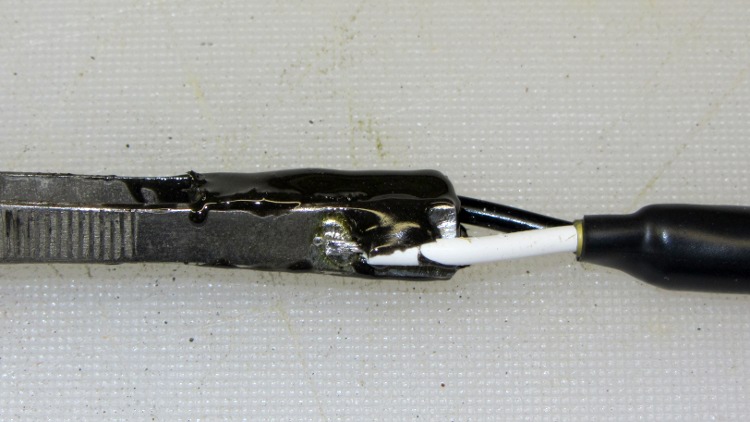
    I chopped off the tweezer joint with a bolt cutter, scuffed up the steel with a file, soldered the cable wires, cut a small wood block to fit, and epoxied the whole mess together:

    SMD tweezers - epoxy joint
    SMD tweezers – epoxy joint

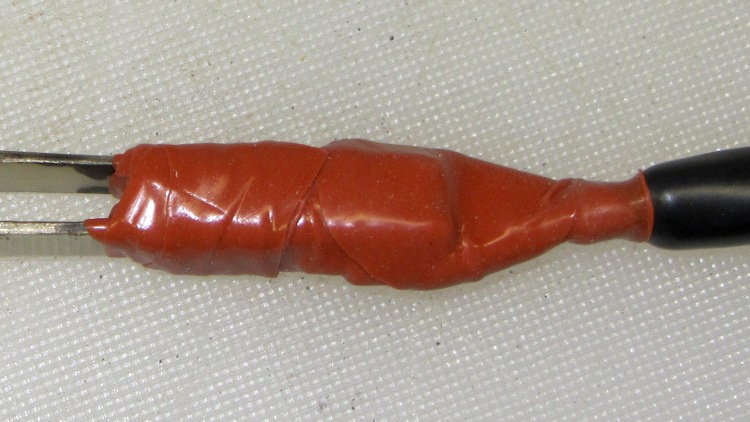
    When the epoxy cured, a generous wrap of silicone tape hid most of the hackage. Two lengths of clear heatstink tubing insulate the handles from my sweaty fingers:

    SMD tweezers - joint detail
    SMD tweezers – joint detail

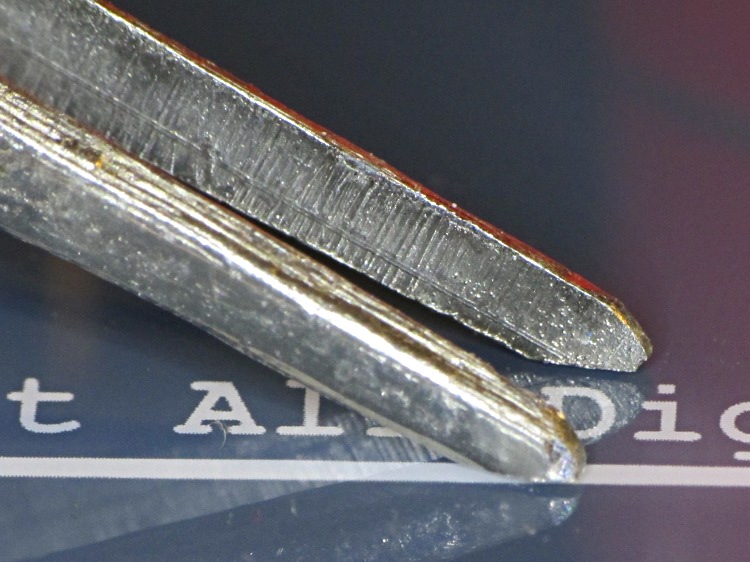
    Part of the reason for picking this victim was its cheap-and-bendy steel: more easily soldered than stainless, no regrets about filing the jaws to suit. They’re flattened on the bottom and filed to grip SMD chips along their length:

    SMD tweezers - tip shape
    SMD tweezers – tip shape

    That’s on the top panel of my indispensable AADE LC meter. The stray capacitance of that cable is around 50 pF, but the meter can null it to a fraction of a pF. At least as long as I don’t change my grip, that is, which isn’t too severe a restriction. [Update: got the link right this time.]

    That gorgeous Tek cable turned out to be entirely too stiff and the natural curve doesn’t lie in the correct direction. The next version will probably use a length of RG-174 mini coax and a dual banana plug. I think I’d like angled jaws, too, so as to attack the chips from the top down.

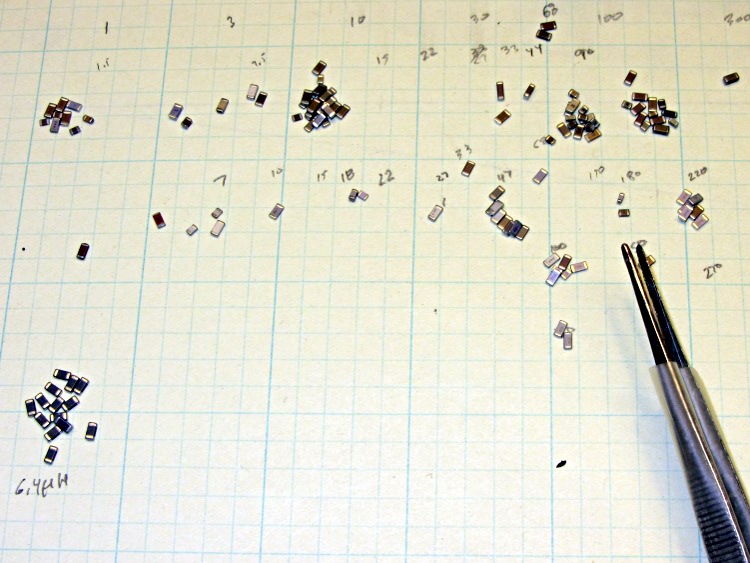
    But even this version works wonderfully well, as I sorted out a few hundred random SMD caps in two half-hour sessions that I’d been putting off for far too long. This is the last batch; I’ve learned the hard way that it pays to transfer batches of chips to their storage bins long before I think I should:

    Sorting SMD caps
    Sorting SMD caps

    Yeah, it’s false economy, but it keeps me off the streets at night. OK?

  • Self-resonant Frequencies of Some Ceramic Capacitors

    In that version of the GPS+voice interface, I sprinkled 100 nF and 100 pF SMD caps across the input lines in the hope that they’d reduce EMI on the audio board. The board worked fine for years, but now that it’s time to build another board & box, I figured it’d be good to know a bit more about their actual response.

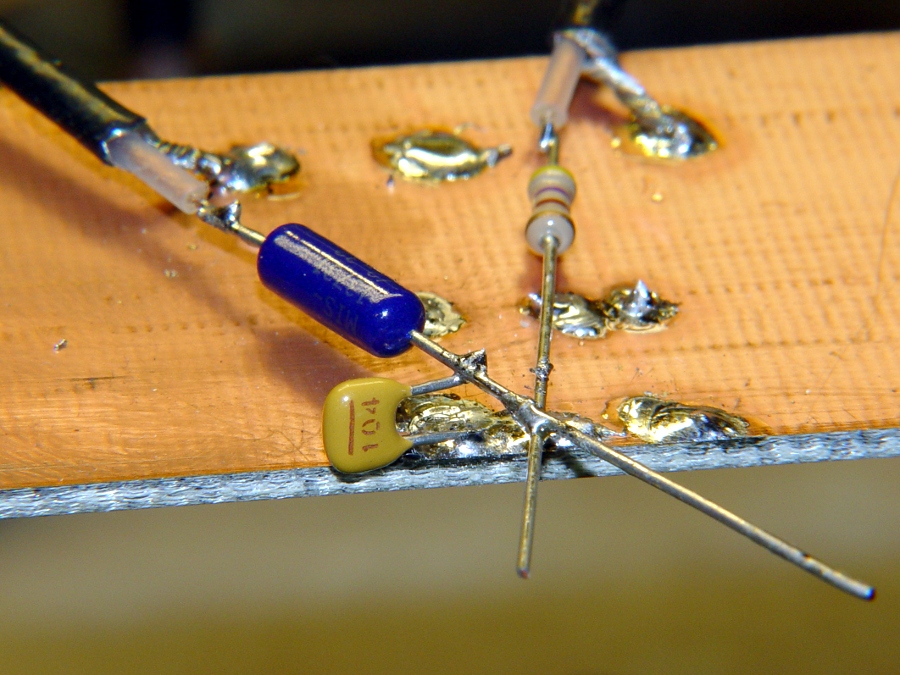
    So I cobbled up a test fixture with a 3 dB pad from the tracking generator output and a 20 dB pad to the spectrum analyzer input (both of those are bogus, because the cap impedance varies wildly, but work with me on this):

    Ceramic 100 nF cap on copper
    Ceramic 100 nF cap on copper

    Pulled an assortment of 100 nF ceramic caps from the stockpile:

    100 nF ceramic capacitor assortment
    100 nF ceramic capacitor assortment

    And rubbed them against the HP8591 spectrum analyzer & tracking generator:

    Cap Comparison - Detail
    Cap Comparison – Detail

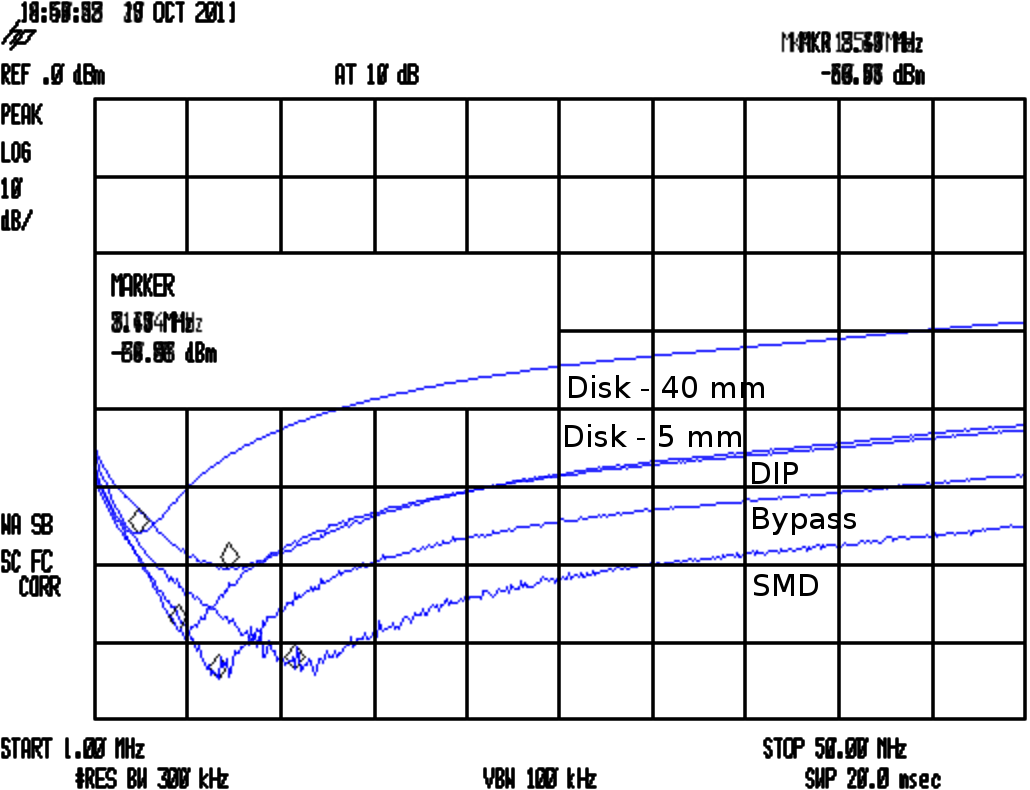
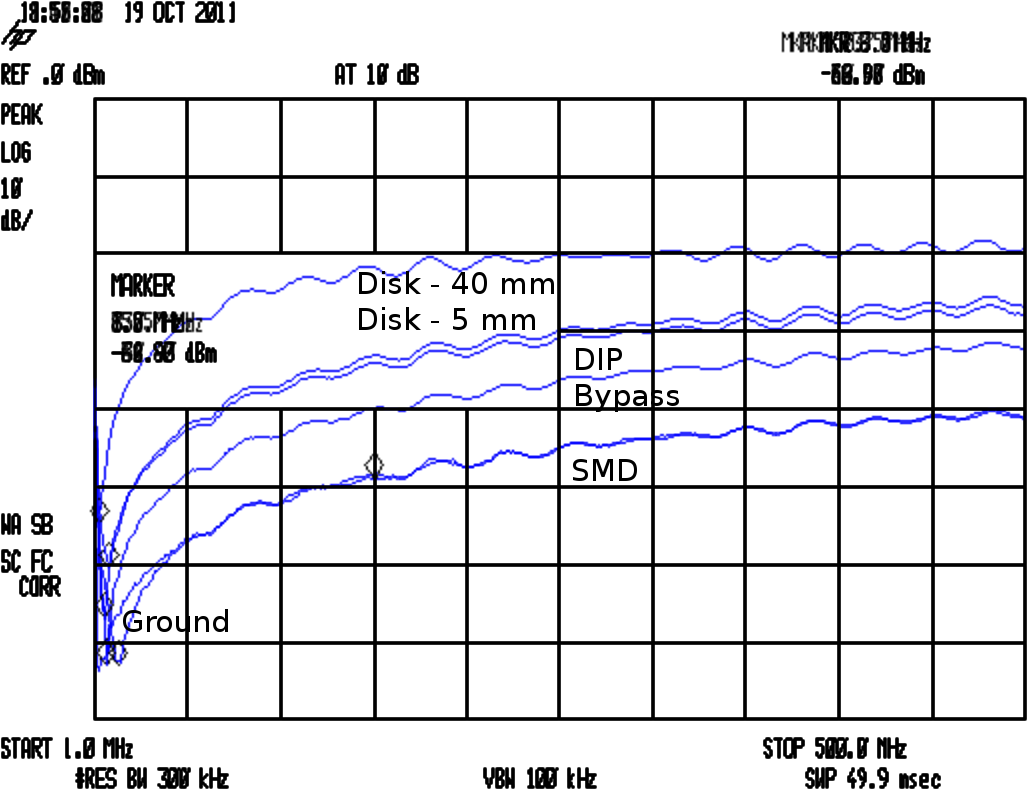
    Their self-resonant frequencies are much lower than I expected:

    Cap Comparison
    Cap Comparison

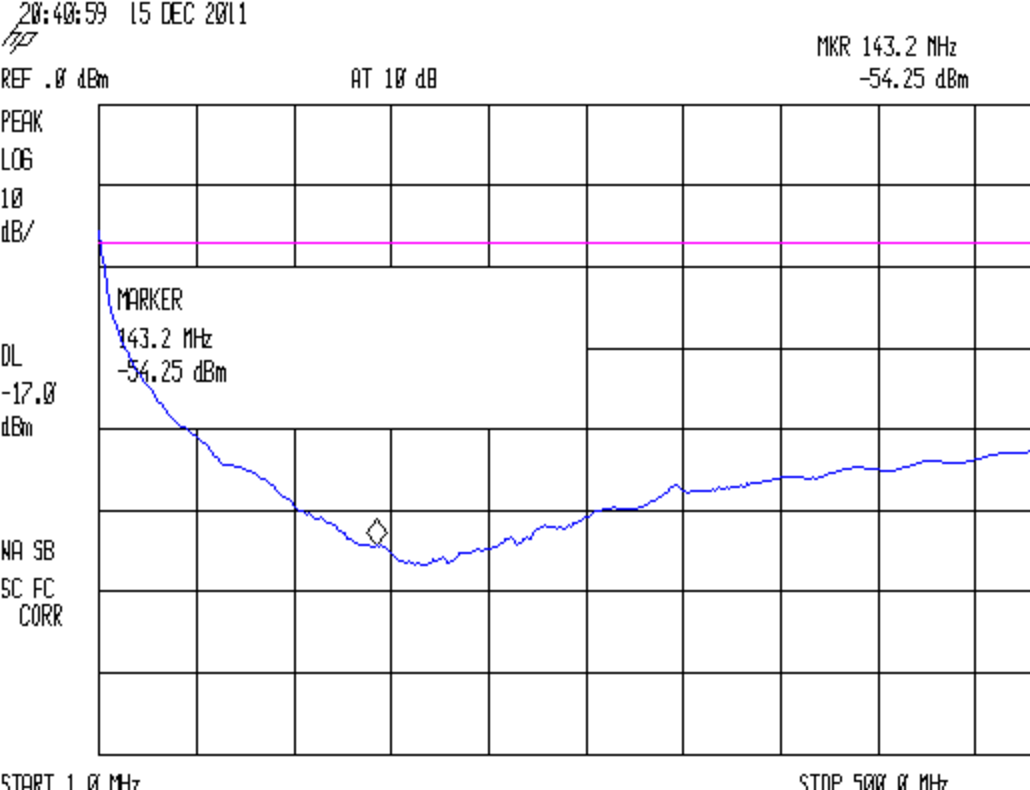
    The attenuators produce about 17 dB of loss with no cap in the circuit, so the disk caps are pretty much asleep at the switch from VHF on up. The small bypass cap in the top photo is OK and the SMD cap is pretty good, but they’re all well past their self-resonant frequency and acting like inductors.

    The relevant equations:

    • FR = 1/(2π √(LC))
    • XC = 1/(2π f C)
    • Q = FR / BW
    • ESR = XC / Q

    The drill goes a little something like this:

    • Find resonant frequency FR and 3 db bandwidth BW
    • Knowing FR and C, find parasitic L
    • Knowing FR and BW, find Q
    • Knowing XC and Q, find ESR

    In round numbers, the 100 nF SMD cap has L=2 nH and ESR=60 mΩ.

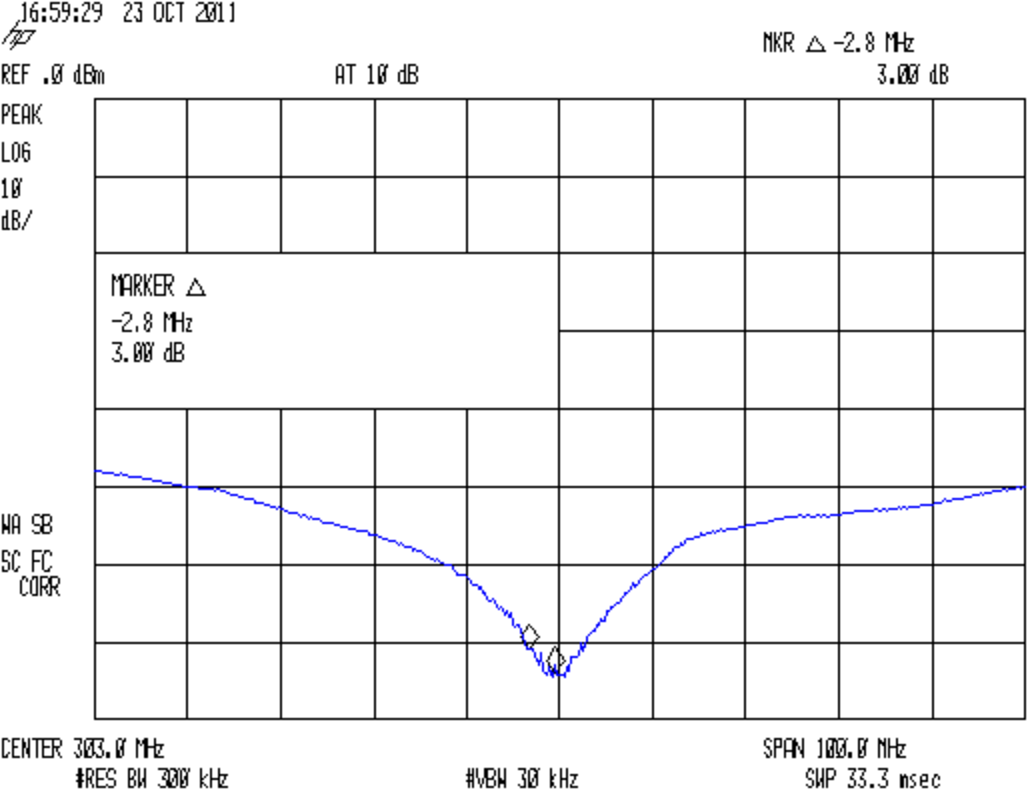
    Now, it turns out a 100 pF SMD cap resonates up at 300 MHz, between the VHF and UHF amateur bands:

    SMD - 100 pF Bandwidth
    SMD – 100 pF Bandwidth

    So I think the way to do this is to pick the capacitance to put the self-resonant frequency in the VHF band, parallel another cap to put a second dip in the UHF band, and run with it. A back of the envelope calculation suggests 470 pF and 47 pF, but that obviously depends on a bunch of other imponderables and I’ll just interrogate the heap until the right ones step forward.

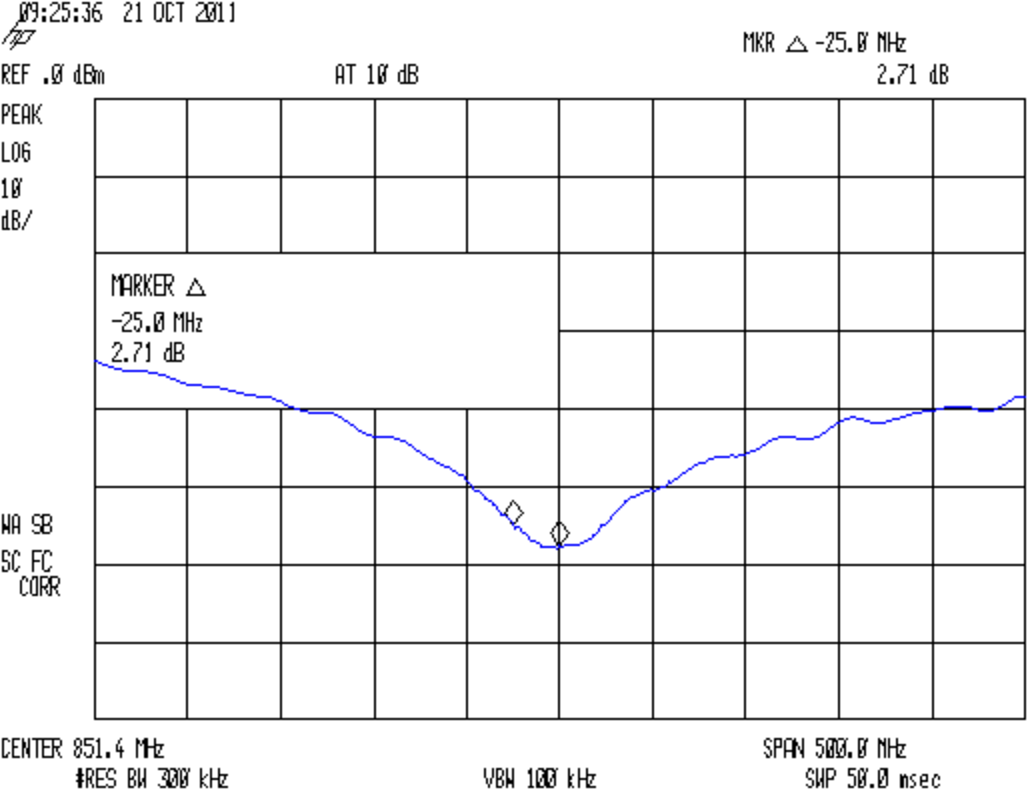
    Just to show the test fixture isn’t a complete piece of crap, here’s a 12 pF cap resonating up around 850 MHz:

    SMD - 12 pF Bandwidth
    SMD – 12 pF Bandwidth

    For the combination of components, sweep speeds, bandwidths, and suchlike in effect, the spectrum analyzer’s noise floor is down around -75 dBm. I think the 12 pF cap is actually better than it looks, but I didn’t fiddle around with a narrower resolution bandwidth.

  • Flex-fatigued Helmet Cable

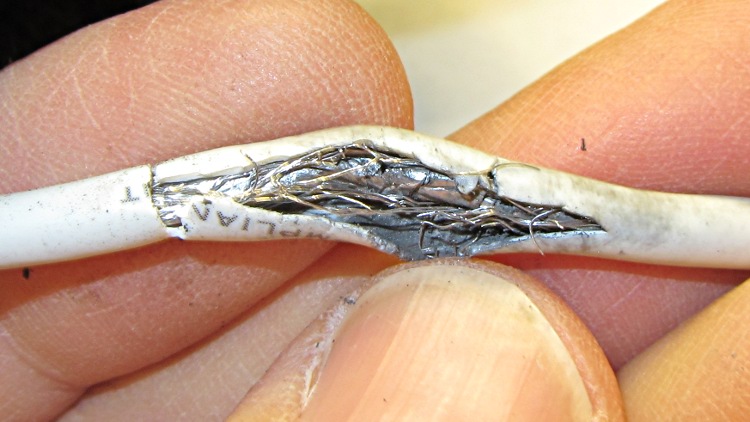
    I cable-tied the mic/earphone cable on Mary’s bike helmet to a rib on the fancy air vents near the back end, hoping that would reduce the inevitable flexing. Alas, it didn’t work out that way and the cable lasted only two seasons. This cut-away view shows the pulverized shield braid inside the jacket:

    Fatigue-failed helmet cable
    Fatigue-failed helmet cable

    The symptoms were totally baffling: the mic worked perfectly, but the earphones cut out for at most a few syllables. Of course, I can’t wear her helmet and it only failed occasionally while riding. I barked up several wrong trees, until it got so bad that I could make it fail in the garage while listening to the local NWS weather radio station.

    I spliced in a new USB male-A connector and (re-)discovered that the braid seems to be aluminum, rather than tinned copper. In any event, the wire is completely unsolderable; I crimped the braid from the new connector to a clean section of the old braid. The braid serves only as an electrostatic shield, as it’s not connected to anything on the helmet end. That should suffice until I rebuild the headsets this winter.

  • KG-UV3D GPS+Voice: Plug Mounting Plate

    Unlike my old ICOM IC-Z1A, the Wouxun KG-UV3D radio has mic and speaker jacks recessed into the case, so that a custom plug plate can absorb all the stress from forces applied to the cables without wiggling the plugs. Even better, there’s a removable cover with a mounting screw that can hold the new plate in place!

    Wouxun plug mounting plate - overview
    Wouxun plug mounting plate – overview

    The first pass at the mount required a bit of filing, as the deepest part of the recess turns out to be not exactly rectangular. That’s (probably) fixed in the source code:

    Wouxun plug plate - detail
    Wouxun plug plate – detail

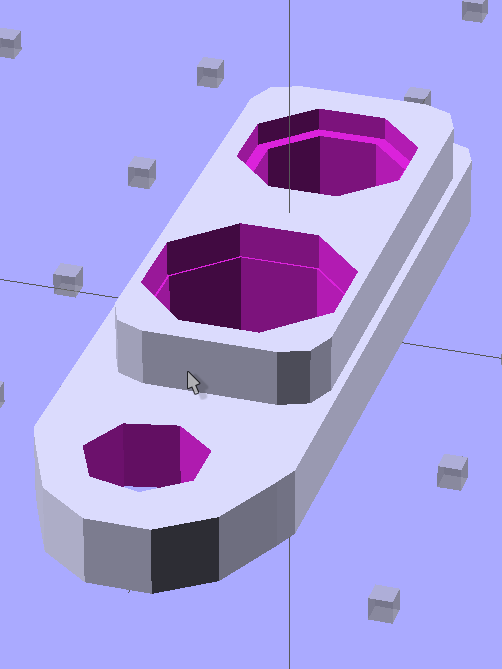
    The solid model looks about like you’d expect, with terribly thin side walls between the plugs and the not-quite-rectangular section. The whole affair is asymmetrical around the long axis; the not-quite-rectangular block and hole really are offset:

    Plug Mount Plate - Solid Model
    Plug Mount Plate – Solid Model

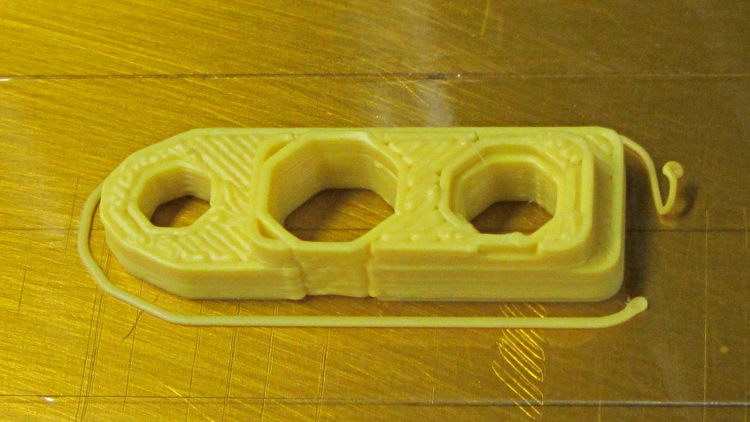
    When printed, the thin sections come out one 0.66 mm plastic thread wide:

    Wouxun plug mounting plate - build
    Wouxun plug mounting plate – build

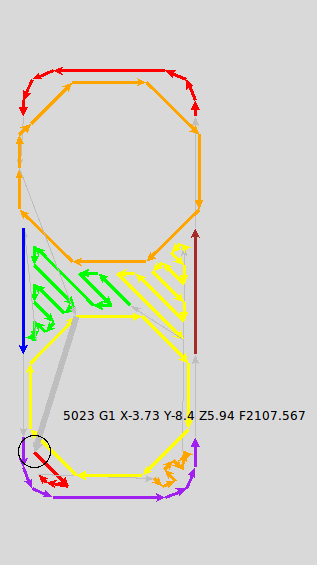
    I spent quite some time iterating through OpenSCAD, RepG, and SkeinLayer to make sure that came out right. This is from a later version with larger recesses around the plugs:

    Plug Mount Plate - skeinlayer
    Plug Mount Plate – skeinlayer

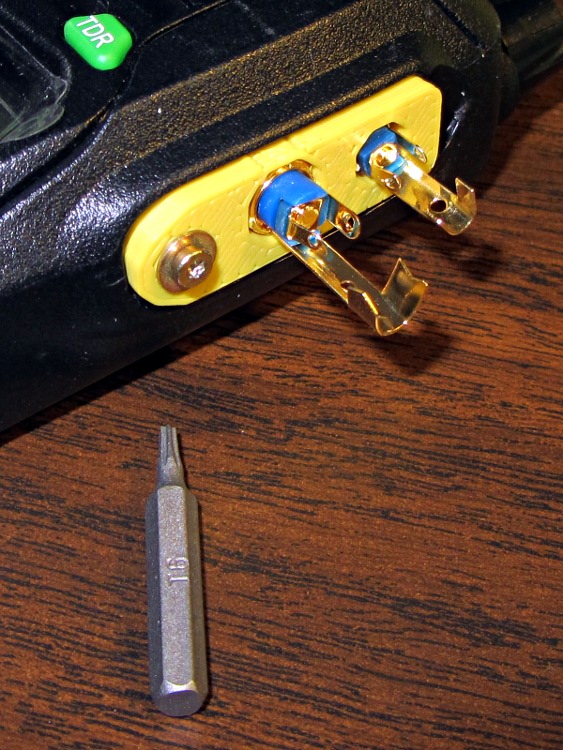
    Some epoxy eased down along the plugs will lock them into the plastic, with an epoxy putty turd over the top to stabilize the cables and terminal connections. That’s a T6 Torx bit to mate with the 2 mm screw (with a captive washer!) pulled from the Small Drawer o’ Salvaged Metric Screws:

    Wouxun plug plate - trial fit
    Wouxun plug plate – trial fit

    The OpenSCAD source code is part of the huge block of code at the bottom of that post, but here’s the relevant section:

    module PlugPlate() {
    
      BaseX = PlugBaseWidth/2 - PlugBaseRadius;
      BaseY = PlugBaseLength/2 - PlugBaseRadius;
    
      difference() {
    	union() {
    	  linear_extrude(height=PlugBaseThick,center=false,convexity=3)
    		hull() {
    		  translate([-BaseX,-BaseY,0])
    			circle(r=PlugBaseRadius,$fn=8);
    		  translate([-BaseX, BaseY,0])
    			circle(r=PlugBaseRadius,$fn=8);
    		  translate([ BaseX, BaseY,0])
    			circle(r=PlugBaseRadius,$fn=8);
    		  translate([ BaseX,-BaseY,0])
    			circle(r=PlugBaseRadius,$fn=8);
    		}
    
    	  translate([PlugFillOffsetX,
    				(PlugFillLength/2 - PlugBaseLength/2 + PlugFillOffsetY),
    				PlugBaseThick])
    		linear_extrude(height=PlugFillThick,center=false,convexity=5)
    		  hull() {
    			translate([0,-(PlugFillLength/2 - PlugFillRadius2),0])
    			  circle(r=PlugFillRadius2,$fn=10);
    			translate([-(PlugFillWidth/2 - PlugFillRadius1),-PlugBaseLength/2,0])
    			  circle(r=PlugFillRadius1,$fn=8);
    			translate([-(PlugFillWidth/2 - PlugFillRadius1),
    					  (PlugFillLength/2 - PlugFillRadius1),0])
    			  circle(r=PlugFillRadius1,$fn=8);
    			translate([(PlugFillWidth/2 - PlugFillRadius1),
    					  (PlugFillLength/2 - PlugFillRadius1),0])
    			  circle(r=PlugFillRadius1,$fn=8);
    			translate([(PlugFillWidth/2 - PlugFillRadius1),-PlugBaseLength/2,0])
    			  circle(r=PlugFillRadius1,$fn=8);
    		  }
    	}
    
    	translate([0,-JackOC/2,-Protrusion])
    	  rotate(360/16) {
    		PolyCyl(Plug3BezelDia,(Plug3BezelThick + Protrusion),8);
    		PolyCyl(Plug3ScrewDia,(PlugBaseThick + PlugFillThick + 2*Protrusion),8);
    	  }
    
    	translate([0,+JackOC/2,-Protrusion])
    	  rotate(360/16) {
    		PolyCyl(Plug2BezelDia,(Plug2BezelThick + Protrusion),8);
    		PolyCyl(Plug2ScrewDia,(PlugBaseThick + PlugFillThick + 2*Protrusion),8);
    	  }
    
    	translate([JackScrewOffsetX,-(PlugBaseLength/2 + JackScrewOffsetY),0])
    	  PolyCyl(JackScrewDia,(PlugBaseThick + PlugFillThick + Protrusion));
      }
    
    }
    
  • KG-UV3D GPS+Voice: Box Model

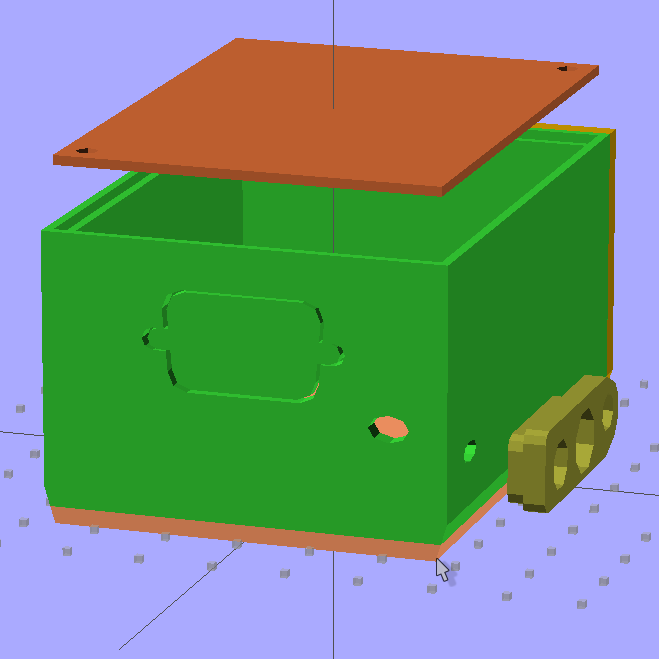
    The first pass at the box that will eventually hold the GPS+voice interface for the KG-UV3D radio looks like this, from the end that engages the alignment tabs on the bottom of the radio:

    Case Solid Model - Tab End View - Fit
    Case Solid Model – Tab End View – Fit

    The other end has the opening for the TT3’s serial connector to the GPS receiver, a probably too-small hole for the external battery pack cable / helmet cable / PTT cable, and a hole on the side for the radio mic/speaker cables.

    Case Solid Model - Connector End View - Fit
    Case Solid Model – Connector End View – Fit

    The serial connector opening has a built-in support plate that’s the shape shrunken by 5% so it’s easy to punch out. That worked surprisingly well; the line just above the right edge isn’t a break, it’s a stack of Reversal Zits. This version is rectangular; the solid model shows the proper D shape.

    KG-UV3D box - connector hole support removal
    KG-UV3D box – connector hole support removal

    The bottom has battery contact recesses and counterbores (if that’s the right term for a molded feature) for the PCB mounting  screws. In retrospect, those holes should be tapping diameter and the screws inserted from the top, through the PCB.

    Case Solid Model - Battery Contact View - Fit
    Case Solid Model – Battery Contact View – Fit

    The colors mark individual pieces that get glued together. I can probably reduce the wall thickness on the top & bottom by three threads, which is in the nature of fine tuning. The latch mechanism that holds this affair to the radio is conspicuous by its absence…
    The OpenSCAD source code:

    // Wouxun KB-UV3D Battery Pack Case
    // Ed Nisley KE4ZNU September 2011
    
    include </home/ed/Thing-O-Matic/lib/MCAD/units.scad>
    include </home/ed/Thing-O-Matic/Useful Sizes.scad>
    include </home/ed/Thing-O-Matic/lib/visibone_colors.scad>
    
    // Layout options
    
    Layout = "Fit";		// Envelope Plate Base Lid Shell Fit Buildx ScrewSupport
    								// PlugPlate
    
    //- Extrusion parameters must match reality!
    //  Print with +1 shells and 3 solid layers
    //  Use 210 C extrusion temperature to improve layer bonding
    
    ThreadThick = 0.33;
    ThreadWidth = 2.0 * ThreadThick;
    
    HoleWindage = 0.2;
    
    function IntegerMultiple(Size,Unit) = Unit * ceil(Size / Unit);
    
    Protrusion = 0.1;			// make holes end cleanly
    
    BuildOffset = 2.0;			// clearance for build layout
    
    //----------------------
    //- Case dimensions
    
    CaseOverallHeight = 40;
    CaseOverallWidth = 56;
    CaseOverallLength = 80.0;
    
    PlateWidthMin = 53.0;			// plate interfacing with radio contacts
    PlateWidthMax = 54.5;
    PlateLength = 75.0;
    PlateThick = IntegerMultiple(2.0,ThreadThick);
    
    ContactWidth = 7.0 + HoleWindage;
    ContactLength = 7.0 + HoleWindage;
    ContactRecess = 2*ThreadThick;	// recess for contact metal plate
    ContactGapX = 10.5;				// X space between contacts
    Contact1Y = 53.0;				// offset from base
    Contact2Y = 56.5;
    
    BaseWidthInner = PlateWidthMin;
    BaseWidthOuter = CaseOverallWidth;
    BaseLength = CaseOverallHeight;
    BaseThick = 1.0;
    BaseWidthTaper = 5.0;
    
    BaseOpeningMax = 42.0;
    BaseOpeningMin = 33.0;
    BaseOpeningY = 5.25;
    BaseOpeningDepth = 2.0;
    
    BaseTabWidth = 6.0;
    BaseTabThick = 2.0;
    BaseTabGap = 7.0;
    BaseTabOC = BaseTabWidth + BaseTabGap;
    
    BaseToothBase = 6.0;
    BaseToothTip = 3.0;
    BaseToothThick = 2.0;
    BaseToothOC = BaseTabOC;
    
    WedgeAngle = atan(BaseWidthTaper/((BaseWidthOuter - BaseWidthInner)/2));
    echo(str("Plate & Shell Wedge Angle: ",WedgeAngle));
    
    BaseEndLip = ThreadThick;			// should be 0.25 mm or so
    BaseEndWidth = (PlateWidthMin - 3*BaseToothBase - 2*BaseToothTip)/2;
    BaseEndAngle = atan((BaseOpeningDepth - BaseEndLip)/BaseOpeningY);
    
    echo(str("Plate End Angle: ",BaseEndAngle));
    
    PCBWidth = 2.00 * inch;
    PCBLength = 2.75 * inch;
    PCBMargin = Head2_56;
    PCBClearBottom = IntegerMultiple(2*Nut2_56Thick,ThreadThick);
    PCBHoleDia = Tap2_56;
    PCBHoleY = 2.50 * inch;
    PCBHoleX = 1.75 * inch;
    
    echo(str("PCB Mounting Holes OC X: ",PCBHoleX," Y: ",PCBHoleY));
    echo(str("       bottom clearance: ",PCBClearBottom));
    
    ShellHeight = CaseOverallHeight - PlateThick;
    ShellWidth = CaseOverallWidth;
    ShellLength = PlateLength;
    ShellWallX = IntegerMultiple((ShellWidth - PCBWidth)/2,ThreadWidth);
    ShellWallY = IntegerMultiple((ShellLength - PCBLength)/2,ThreadWidth);
    ShellWallMax = max(ShellWallX,ShellWallY);
    
    echo(str("Wall thick X: ",ShellWallX," Y: ",ShellWallY));
    
    LidThick = IntegerMultiple(1.0,ThreadThick);
    LidMargin = IntegerMultiple(1.0,ThreadWidth);
    LidWidth = ShellWidth - 2*LidMargin;
    LidLength = ShellLength - 2*LidMargin;
    
    LidScrewHead = Head3_48;
    LidScrewTap = Tap3_48;
    LidScrewClear = Clear3_48;
    LidScrewLength = 5.0;
    LidScrewOffsetX = ShellWidth/2 - LidMargin - 0.75*LidScrewHead;
    LidScrewOffsetY = ShellLength/2 - LidMargin - 0.75*LidScrewHead;
    
    HTCableDia = 5.0;
    HTCableAspect = 2.0;			// width of hole
    HTCableY = 65;
    HTCableZ = 10;
    
    SerialZ = ShellHeight - LidThick - 12.0;
    
    BikeCableDia = 5.0;
    BikeCableAspect = 1.5;
    BikeCableX = -20;
    BikeCableZ = 15;
    
    JackOC = 11.20;						// 14.25 OD - (3.58 + 2.58)/2
    
    JackScrewDia = 4.6;
    JackScrewOffsetX = 1.00;
    JackScrewOffsetY = 5.25;				//  mounting screw to edge of lower recess
    
    PlugBaseWidth = 9.25;				// lower section of plate
    PlugBaseLength = 22.0;
    PlugBaseThick = 2.5;
    PlugBaseRadius = 1.75;
    
    Plug3Offset = 5.25;					// edge of base recess to 3.5 mm jack
    
    Plug2BezelDia = 7.1;				// 2.5 mm plug
    Plug2BezelThick = 1.04;
    Plug2ScrewDia = 6.0;
    Plug3ScrewLength = 3.0;
    
    Plug3BezelDia = 8.13;				// 3.5 mm plug
    Plug3BezelThick = 1.6;
    Plug3ScrewDia = 7.95;
    Plug3ScrewLength = 4.0;
    
    PlugFillOffsetX = JackScrewOffsetX - 0.5;		// base recess CL to fill CL
    PlugFillOffsetY = -10.5;				//  ... to edge of fill plate
    PlugFillWidth = 11.0;
    PlugFillLength = 34.00;
    PlugFillThick = 3.0;
    PlugFillRadius1 = 1.5;
    PlugFillRadius2 = 4.5;
    
    PlugFillOffsetYTotal = 0;
    
    //----------------------
    // Useful routines
    
    module PolyCyl(Dia,Height,ForceSides=0) {			// based on nophead's polyholes
    
      Sides = (ForceSides != 0) ? ForceSides : (ceil(Dia) + 2);
    
      FixDia = Dia / cos(180/Sides);
    
      cylinder(r=(FixDia + HoleWindage)/2,
               h=Height,
    	   $fn=Sides);
    }
    
    module ShowPegGrid(Space = 10.0,Size = 1.0) {
    
      Range = floor(50 / Space);
    
    	for (x=[-Range:Range])
    	  for (y=[-Range:Range])
    		translate([x*Space,y*Space,Size/2])
    		  %cube(Size,center=true);
    
    }
    
    //- Hack job for DB-9 (DE-9) panel opening
    //  Snug fit around the shell surrounding the male pins
    //  DB-9 should mount on outside, but if it's already soldered to the board,
    //   that doesn't work and you must mount it inside the box
    
    module DSubMin9(Height=1.0) {
    
      union() {
    
    	linear_extrude(height=Height,center=false) {
    	  hull() {
    /*
    		translate([-(19.28+0.13)/2,(10.72+0.13)/2,0])			// rectangular outline
    		  circle(r=3.05/2,$fn=8);
    		translate([-(19.28+0.13)/2,-(10.72+0.13)/2,0])
    		  circle(r=3.05/2,$fn=8);
    		translate([ (19.28+0.13)/2,(10.72+0.13)/2,0])
    		  circle(r=3.05/2,$fn=8);
    		translate([ (19.28+0.13)/2,-(10.72+0.13)/2,0])
    		  circle(r=3.05/2,$fn=8);
    */
    		translate([-(17.0+0.05)/2,-(8.48+0.05)/2,0])
    		  circle(r=0.105*inch,$fn=8);
    		translate([ (17.0+0.05)/2,-(8.48+0.05)/2,0])
    		  circle(r=0.105*inch,$fn=8);
    		translate([ (15.5+0.05)/2, (8.48+0.05)/2,0])
    		  circle(r=0.105*inch,$fn=8);
    		translate([-(15.5+0.05)/2, (8.48+0.05)/2,0])
    		  circle(r=0.105*inch,$fn=8);
    	  }
    	  hull() {
    		translate([-24.99/2,0,0])
    		  circle(r=3.05/2,$fn=8);
    		translate([ 24.99/2,0,0])
    		  circle(r=3.05/2,$fn=8);
    	  }
    	}
      }
    
    }
    
    //-------------------
    
    //- Overall case outline
    //  This defines the mating taper into the radio shell
    
    module CaseEnvelope(Length=1) {
    
    	rotate([90,0,0])
    	  linear_extrude(height=Length,center=true,convexity=5)
    		polygon(points=[
    				  [-BaseWidthOuter/2,BaseLength],
    				  [-BaseWidthOuter/2,BaseWidthTaper],
    				  [-BaseWidthInner/2,0],
    				  [-BaseOpeningMax/2,0],
    
    				  [ BaseOpeningMax/2,0],
    				  [ BaseWidthInner/2,0],
    
    				  [ BaseWidthOuter/2,BaseWidthTaper],
    
    				  [ BaseWidthOuter/2,BaseLength]
    				],
    				convexity=1
    		);
    
    }
    
    //- Battery contact plate recess
    //  This gets subtracted from the bottom plate in two places
    
    module Contact() {
    
      union() {
    	translate([0,0,-(ContactRecess - Protrusion)/2])
    	  cube([ContactWidth,ContactLength,(ContactRecess + Protrusion)],center=true);
    	translate([0,0,-(PlateThick + Protrusion)])
    	PolyCyl(Clear3_48,(PlateThick + 2*Protrusion));
    	translate([0,0,-(ContactRecess + Head3_48Thick/3)])
    	  PolyCyl(Head3_48,Head3_48Thick);				// allow for solder blob
      }
    }
    
    //- Back interface plate with battery contacts
    
    module Plate() {
    
      difference() {
    
    	translate([0,PlateLength/2,0])
    	  intersection() {
    		translate([0,0,PlateThick])
    		  rotate([180,0,0])
    			CaseEnvelope(PlateLength);
    	  translate([-PlateWidthMax/2,-PlateLength/2,0])
    		cube([PlateWidthMax,PlateLength,PlateThick],center=false);
    	  }
    
    	translate([-(ContactGapX/2 + ContactWidth/2),(Contact1Y + ContactLength/2),PlateThick])
    	  Contact();
    	translate([+(ContactGapX/2 + ContactWidth/2),(Contact2Y + ContactLength/2),PlateThick])
    	  Contact();
    
    	translate([0,PlateLength/2,0])
    	  PCBHoles(PCBHoleDia,PlateThick);
    
    	translate([0,PlateLength/2,(PlateThick - 2*Head2_56Thick/3)])
    	  PCBHoles(IntegerMultiple(Head2_56,ThreadWidth),IntegerMultiple(Head2_56Thick,ThreadThick));
      }
    
    }
    
    //- Radio bottom locating feature
    //  This polygon gets subtracted from the battery pack base
    
    module RadioBase() {
    
    linear_extrude(height=(BaseOpeningDepth + Protrusion),center=false,convexity=5)
      polygon(points=[
    			[-BaseOpeningMax/2,-Protrusion],
    
    			[-BaseOpeningMin/2,BaseOpeningY],
    			[-(BaseToothOC/2 + BaseToothBase/2),BaseOpeningY],
    
    			[-(BaseToothOC/2 + BaseToothTip/2),(BaseOpeningY - BaseToothThick)],
    			[-(BaseToothOC/2 - BaseToothTip/2),(BaseOpeningY - BaseToothThick)],
    			[-(BaseToothOC/2 - BaseToothBase/2),BaseOpeningY],
    
    			[ (BaseToothOC/2 - BaseToothBase/2),BaseOpeningY],
    			[ (BaseToothOC/2 - BaseToothTip/2),(BaseOpeningY - BaseToothThick)],
    			[ (BaseToothOC/2 + BaseToothTip/2),(BaseOpeningY - BaseToothThick)],
    			[ (BaseToothOC/2 + BaseToothBase/2),BaseOpeningY],
    			[ BaseOpeningMin/2,BaseOpeningY],
    
    			[ BaseOpeningMax/2,-Protrusion],
    
    			[ (BaseTabOC + BaseTabWidth/2),-Protrusion],
    			[ (BaseTabOC + BaseTabWidth/2),BaseTabThick],
    			[ (BaseTabOC - BaseTabWidth/2),BaseTabThick],
    			[ (BaseTabOC - BaseTabWidth/2),-Protrusion],
    
    			[ BaseTabWidth/2,-Protrusion],
    			[ BaseTabWidth/2,BaseTabThick],
    			[-BaseTabWidth/2,BaseTabThick],
    			[-BaseTabWidth/2,-Protrusion],
    
    			[-(BaseTabOC + BaseTabWidth/2),-Protrusion],
    			[-(BaseTabOC + BaseTabWidth/2),BaseTabThick],
    			[-(BaseTabOC - BaseTabWidth/2),BaseTabThick],
    			[-(BaseTabOC - BaseTabWidth/2),-Protrusion],
    		  ],
    		  convexity=5
      );
    }
    
    //- PCB Mounting Holes
    
    module PCBHoles(HoleDia=PCBHoleDia,Height=1.0) {
    
      for (x=[-1,1])
    	for (y=[-1,1])
    	  translate([(x*PCBHoleX/2),
    				(y*PCBHoleY/2),
    				-Protrusion])
    		PolyCyl(HoleDia,(Height + 2*Protrusion));
    
    }
    
    //-- Battery pack base
    
    module Base() {
    
      difference() {
    
    	translate([0,0,(BaseThick + BaseOpeningDepth)/2])
    	  rotate([-90,0,0])
    		CaseEnvelope(BaseThick + BaseOpeningDepth);
    
    	translate([0,0,BaseThick])
    	  RadioBase();
    
    	translate([(BaseToothOC + BaseTabWidth/2),
    			  -(BaseThick + BaseEndLip)/tan(BaseEndAngle),
    			  0])
    	  rotate([BaseEndAngle,0,0])
    		cube([BaseEndWidth,3*BaseOpeningY,BaseOpeningDepth],center=false);
    
    	translate([-(BaseToothOC + BaseTabWidth/2 + BaseEndWidth),
    			  -(BaseThick + BaseEndLip)/tan(BaseEndAngle),
    			  0])
    	  rotate([BaseEndAngle,0,0])
    		cube([BaseEndWidth,3*BaseOpeningY,BaseOpeningDepth],center=false);
      }
    }
    
    //- Lid
    
    module Lid(WithHoles = false) {
    
      translate([0,LidLength/2,LidThick/2])
    	difference() {
    	  cube([LidWidth,LidLength,LidThick],center=true);
    	  if (WithHoles) {
    		translate([LidScrewOffsetX,LidScrewOffsetY,-(LidThick/2 + Protrusion)])
    		  PolyCyl(LidScrewClear,(LidThick + 2*Protrusion));
    		translate([-LidScrewOffsetX,-LidScrewOffsetY,-(LidThick/2 + Protrusion)])
    		  PolyCyl(LidScrewClear,(LidThick + 2*Protrusion));
    	  }
    	}
    }
    
    //- Lid screw support shape
    
    module LidScrewSupport(WithHole = false) {
    
      SupportSize = IntegerMultiple(LidScrewHead,ThreadWidth);
    
      difference() {
    	translate([0,0,LidScrewLength/2])
    	cube([SupportSize,SupportSize,LidScrewLength],center=true);
    	if (WithHole)
    	  translate([0,0,-Protrusion])
    		PolyCyl(LidScrewTap,(LidScrewLength + 2*Protrusion));
      }
    
      translate([-SupportSize/2,SupportSize/2,-2*SupportSize])
    	rotate([90,0,0])
    	  linear_extrude(height=SupportSize,center=false)
    		polygon(points=[
    				  [0,0],[0,2*SupportSize],[SupportSize,2*SupportSize]]);
    
    }
    
    //- Battery pack shell
    
    module Shell() {
    
      union() {
    	difference() {
    
    	  translate([0,0,-PlateThick])
    		intersection() {
    		  CaseEnvelope(ShellLength);
    		  translate([0,0,(ShellHeight/2 + PlateThick)])
    			cube([ShellWidth,ShellLength,ShellHeight],center=true);
    		}
    
    	  translate([0,-LidLength/2,(ShellHeight - LidThick)])
    		scale([1,1,2])				// ensure clean cut across top
    		  Lid(false);
    
    	  translate([0,0,
    				((ShellHeight - PCBClearBottom - LidThick + Protrusion)/2 + PCBClearBottom)])
    		cube([PCBWidth,PCBLength,
    			 (ShellHeight - PCBClearBottom - LidThick + Protrusion)],
    			 center=true);
    
    	  render()
    		difference() {
    		  translate([0,0,ShellHeight/2])
    			cube([(PCBWidth - 2*PCBMargin),
    				(PCBLength - 2*PCBMargin),
    				(ShellHeight + 2*Protrusion)],
    				center=true);
    		  for (x=[-1,1])
    			for (y=[-1,1])
    			  translate([(x*PCBHoleX/2),(y*PCBHoleY/2),-Protrusion])
    				cylinder(r=PCBMargin,(ShellHeight + 2*Protrusion),$fn=4);
    		}
    
    	  PCBHoles(PCBMargin);
    
    	  translate([-(PCBWidth/2 - Protrusion),(HTCableY - PlateLength/2),HTCableZ])
    		rotate([0,-90,0])
    		  scale([1/HTCableAspect,1,1])
    			PolyCyl(HTCableDia,(ShellWallMax + 2*Protrusion),8);
    
    	  translate([BikeCableX,(PCBLength/2 - Protrusion),BikeCableZ])
    		rotate([0,90,90])
    		  scale([1/BikeCableAspect,1,1])
    			PolyCyl(BikeCableDia,(ShellWallMax + 2*Protrusion),8);
    
    	  translate([0,(PCBLength/2 - Protrusion),SerialZ])
    		rotate([-90,0,0])
    		  DSubMin9(ShellWallMax + 2*Protrusion);
    
    	}
    
      	translate([0,(PCBLength/2 + ThreadWidth/2),SerialZ])
    	  rotate([-90,0,0])
    		scale([0.95,0.95,1])
    		  DSubMin9(ShellWallY - ThreadWidth);		// thin support plug in hole
    
      }
    
    }
    
    //- Speaker-Mic plug mounting plate
    
    module PlugPlate() {
    
      BaseX = PlugBaseWidth/2 - PlugBaseRadius;
      BaseY = PlugBaseLength/2 - PlugBaseRadius;
    
      difference() {
    	union() {
    	  linear_extrude(height=PlugBaseThick,center=false,convexity=3)
    		hull() {
    		  translate([-BaseX,-BaseY,0])
    			circle(r=PlugBaseRadius,$fn=8);
    		  translate([-BaseX, BaseY,0])
    			circle(r=PlugBaseRadius,$fn=8);
    		  translate([ BaseX, BaseY,0])
    			circle(r=PlugBaseRadius,$fn=8);
    		  translate([ BaseX,-BaseY,0])
    			circle(r=PlugBaseRadius,$fn=8);
    		}
    
    	  translate([PlugFillOffsetX,
    				(PlugFillLength/2 - PlugBaseLength/2 + PlugFillOffsetY),
    				PlugBaseThick])
    		linear_extrude(height=PlugFillThick,center=false,convexity=5)
    		  hull() {
    			translate([0,-(PlugFillLength/2 - PlugFillRadius2),0])
    			  circle(r=PlugFillRadius2,$fn=10);
    			translate([-(PlugFillWidth/2 - PlugFillRadius1),-PlugBaseLength/2,0])
    			  circle(r=PlugFillRadius1,$fn=8);
    			translate([-(PlugFillWidth/2 - PlugFillRadius1),
    					  (PlugFillLength/2 - PlugFillRadius1),0])
    			  circle(r=PlugFillRadius1,$fn=8);
    			translate([(PlugFillWidth/2 - PlugFillRadius1),
    					  (PlugFillLength/2 - PlugFillRadius1),0])
    			  circle(r=PlugFillRadius1,$fn=8);
    			translate([(PlugFillWidth/2 - PlugFillRadius1),-PlugBaseLength/2,0])
    			  circle(r=PlugFillRadius1,$fn=8);
    		  }
    	}
    
    	translate([0,-JackOC/2,-Protrusion])
    	  rotate(360/16) {
    		PolyCyl(Plug3BezelDia,(Plug3BezelThick + Protrusion),8);
    		PolyCyl(Plug3ScrewDia,(PlugBaseThick + PlugFillThick + 2*Protrusion),8);
    	  }
    
    	translate([0,+JackOC/2,-Protrusion])
    	  rotate(360/16) {
    		PolyCyl(Plug2BezelDia,(Plug2BezelThick + Protrusion),8);
    		PolyCyl(Plug2ScrewDia,(PlugBaseThick + PlugFillThick + 2*Protrusion),8);
    	  }
    
    	translate([JackScrewOffsetX,-(PlugBaseLength/2 + JackScrewOffsetY),0])
    	  PolyCyl(JackScrewDia,(PlugBaseThick + PlugFillThick + Protrusion));
      }
    
    }
    
    //-------------------
    // Build it!
    
    ShowPegGrid();
    
    if (Layout == "Envelope")
      CaseEnvelope(CaseOverallLength);
    
    if (Layout == "Plate")
      Plate();
    
    if (Layout == "Base")
      Base();
    
    if (Layout == "Lid")
      Lid(true);
    
    if (Layout == "ScrewSupport")
      LidScrewSupport(true);
    
    if (Layout == "Shell")
      Shell();
    
    if (Layout == "PlugPlate")
      PlugPlate();
    
    if (Layout == "DSub")
      DSubMin9();
    
    if (Layout == "Fit") {
    
      translate([0,-PlateLength/2,0]) {
    
    	translate([0,0,PlateThick])
    	  rotate([0,180,0])
    		color(LOR) Plate();
    
    	rotate([90,0,0])
    	  color(DYO) Base();
    
    	translate([0,LidMargin,10 + (CaseOverallHeight - LidThick)])
    	  color(MOR) Lid(true);
    
    	translate([0,PlateLength/2,PlateThick])
    	    color(MFG) render() Shell();
    
    	translate([-(ShellWidth/2 +10),70,15])
    	  rotate([0,-90,0])
    		color(DDY) PlugPlate();
      }
    }
    
    if (Layout == "Build1") {
    
      translate([-20,-PlateLength/2,0])
    	Plate();
    
        translate([10,0,0])
    	rotate([0,0,-90])
    	  Base();
    
    }
    
    if (Layout == "Build2") {
    
      translate([0,-LidLength/2,0])
    	Lid(true);
    
    }
    
    if (Layout == "Build3") {
    
      translate([-20,0,0])
    	Shell();
    
    }
    
    if (Layout == "Build4") {
    
      translate([0,0,(PlugBaseThick + PlugFillThick)])
    	rotate([180,0,0])
    	  PlugPlate();
    
    }