Ed Nisley's Blog: Shop notes, electronics, firmware, machinery, 3D printing, laser cuttery, and curiosities. Contents: 100% human thinking, 0% AI slop.
Adding those grounding wires from my desk lamp and the aluminum plate under the keyboard / trackballs to the PC case reduced the problem, but didn’t eliminate it.
Grounding Wire on Desk Lamp
Logging all that data, though, pointed to what (I think) is the cause: static discharge. I’ve been touching the screws on the wall switch before sitting down, which pretty much made the problem Go Away. Touching the (now-grounded) desk lamp or the keyboard plate still kills the hub, so the hub inside the PC must be way sensitive.
The disconnect follows the external hub’s cable, which means (I think) the jolt’s entering through that wire. I’ve already tried different cables, but perhaps different routing will help; there’s a huge tangle of wires behind the desk.
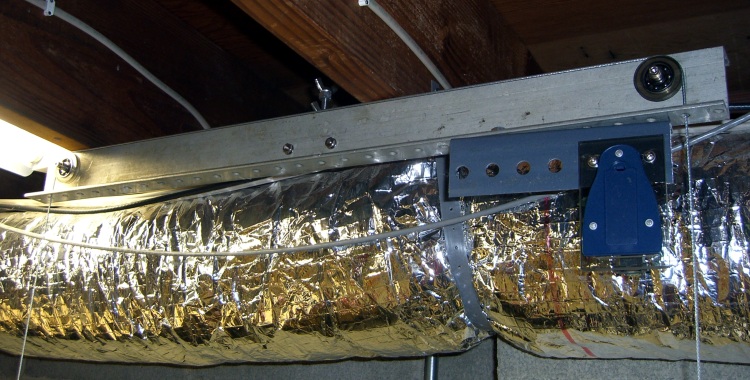
I’d planned to whack the ends off the counterweight gantry I made for Cabin Fever Expo and mount them to a plywood plate, but I hate cutting stuff up. Turns out that the entire beam fit very nicely on the floor joists over the mill and the counterweight even hangs in a reasonable location.
Sherline counterweight gantry on ceiling
I used a plumb bob to get the pulley pretty close to the right location, then simply moved the beam around until the cable hung down through the middle of the hole. Securing it to two joists means it’s pretty nearly perfectly level along both axes, so the cable’s close enough to being vertical.
Of course, holding it overhead, aligning it, and then drilling the holes in the joists required three or four hands.
The blue doodad on the right end is the laser aligner on its new bracket. The crinkly silver tube is an exhaust duct for the never-sufficiently-to-be-damned radon mitigation air exchanger, a topic I refuse to discuss.
The observant reader will note that I still haven’t made dust shields for those open ball bearings.
I mentioned my cheap laser alignment gizmo for my Sherline milling machine at Cabin Fever and several folks wondered how I aligned the aligner. Having just mounted the counterweight gantry and bashed out a bracket for the pointer, here’s how it went down.
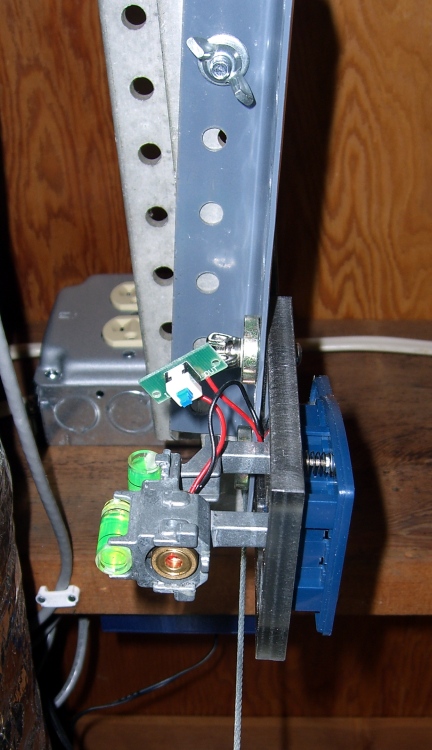
Laser pointer on bracket on counterweight gantry
The blue-gray bracket started life as a shelving support strut. I machined the web from between two holes so I could slide the pointer along the strut, filed off some sharp edges, and mounted the laser pointer with an assortment of machine screws & wing nuts.
I used a plumb bob to figure out roughly where the laser beam must start in order to go straight down the milling machine’s bore, then wiggled & jiggled the strut and pointer to get it more-or-less there. None of this is very precise, but it provides a starting point.
Here’s the trick: put a mirror flat on the mill table. When the reflected spot hits the bezel around the laser’s outbound lens, you know the beam is (pretty nearly) perpendicular to the table. Tweak the pointer’s mounting screws to make that come out right.
Use the plumb bob to figure out where the pointer is in relation to where it should be, wiggle & jiggle & slide everything until it’s there, then tighten & re-jigger everything to tweak the spot location.
Takes about 15 minutes, doesn’t involve any cussing, and works like a champ!
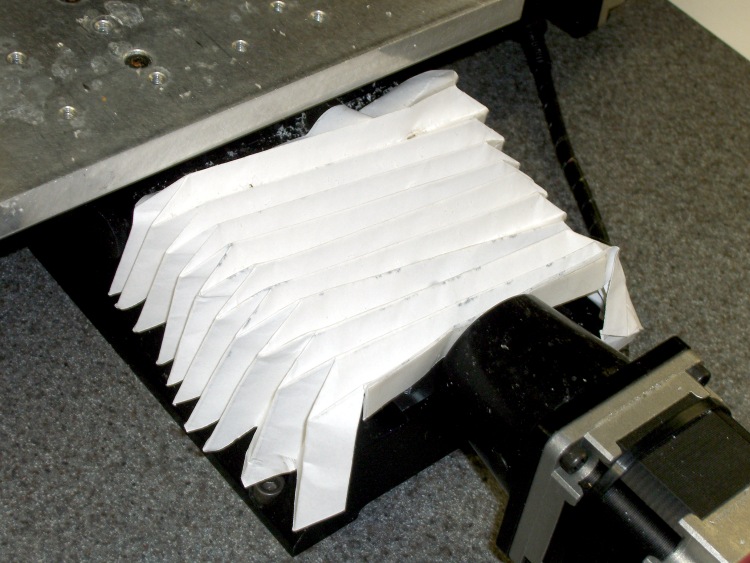
The Y-axis leadscrew on a Sherline milling machine sits exposed to all the crap blowing off the cutter; maybe it doesn’t matter, but it seems nasty.
Throw them out when they're this dirty!
So I made a set of way covers from the template available here or here, except I used plain old printer paper, stuck in place with double-sided tape. The picture shows what one looks like after surviving the rigors of a trip to Cabin Fever Expo.
The key feature is that, when they get too schmutzig, you just throw them away and fold up a new set. It’s easier than dismounting and cleaning something more substantial that you can’t just discard because you’ve developed a serious, deep, long-term emotional attachment.
Everybody at Cabin Fever Expo liked them and wanted the template. If those links have rotted out, I have a copy of the file in the Useful Stuff section: here.
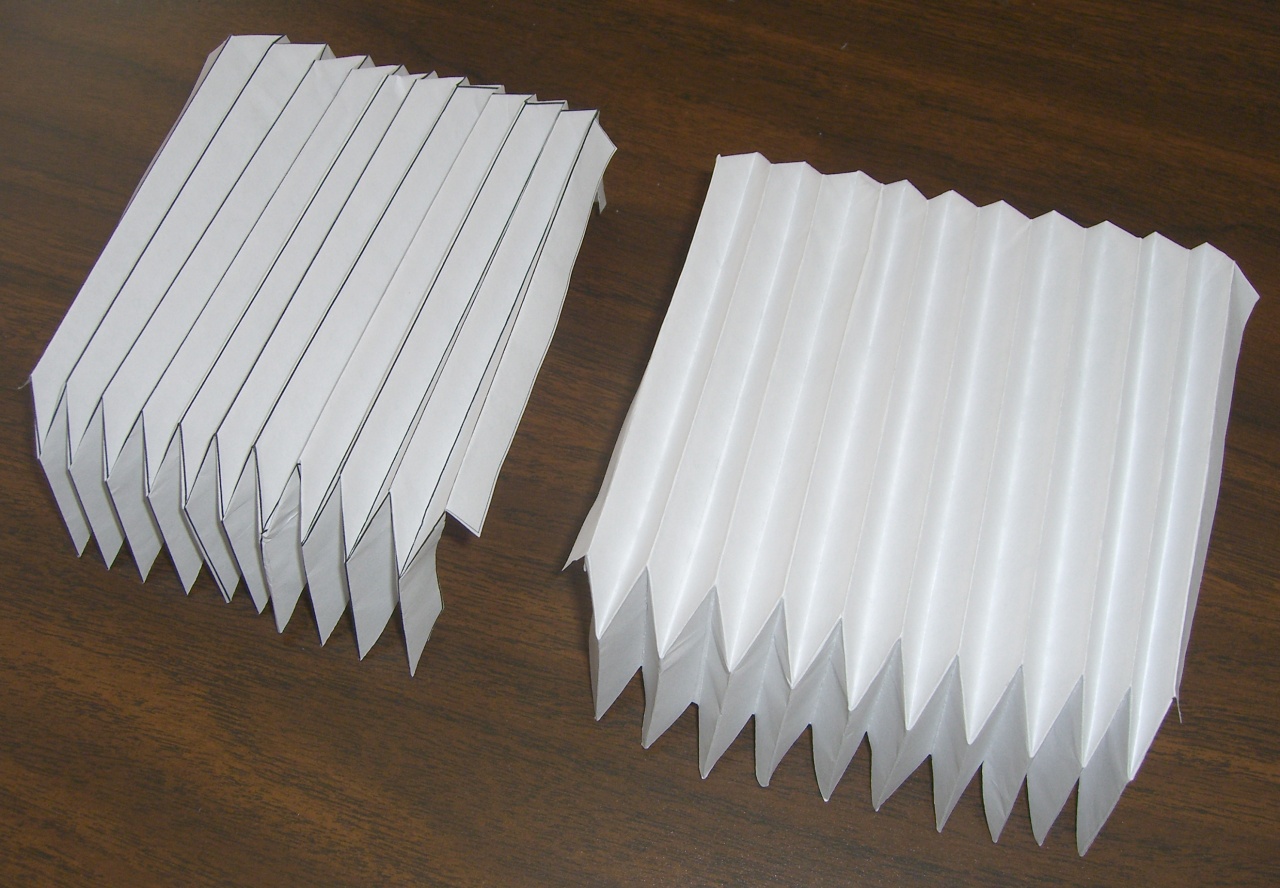
Bellows Folding
Update: Here’s a closeup of a new set. Start with the printed lines up, then fold the end tabs up: the printed side will be down (as in the bellows on the right) and nobody will know how poorly you followed the lines. Click to get a big pic with decent resolution if you need more detail.
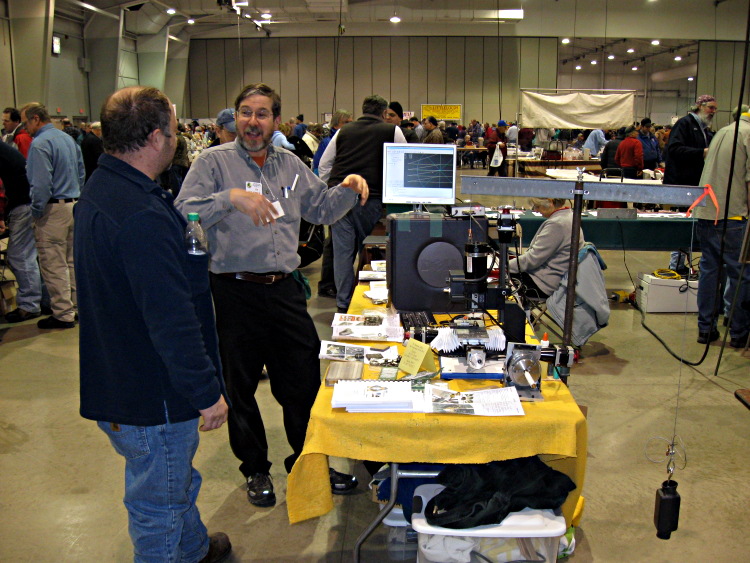
So I hauled my Sherline CNC milling machine gadgetry, an assortment of trivial projects, a stack of handouts with pix & G-code, and a pile o’ EMC2 doc to Cabin Fever Expo for two days of Performance Art…
Ed Nisley Demo-ing CNC at Cabin Fever. Picture courtesy of Brian Glackin.
The key is to have the knobs turning: an inactive machine is just background clutter that everyone walks right past. It’s not nearly as interesting as miniature tools or a chuffing steam engine.
There’s something to be said for being on the crowd side of the table, as that lets both of you see the monitor. A bigger display might be more helpful; I duct-taped a 14-inch 1024×768 LCD panel to the top of the desktop PC box.
Although I brought some blank stock along, it quickly became obvious that live-fire milling under show conditions is a Bad Idea: far too many distractions and far too many things can go wrong. So I contented myself with cutting air; nobody really minded and I could switch programs in mid-stride to show folks the G-code program they really wanted to see.
Plenty of folks stopped by, many of whom either have CNC running or are in the throes of getting started. A surprising number of conversations started with “I have this old Bridgeport …” and went on from there.
There’s a crying need for a comprehensive machine design tutorial that explains how all the pieces fit together, with sort of a flowchart outlining the choices (I know it’s more complex than that, but a diagram would be a starting point for discussion). I don’t know enough of the servo end of the biz, but someone should show how the machine’s size determines the motor size and, thus, the motor driver size, with plenty of examples. There’s a misconception that you can run a big machine on little steppers or puny servos, with the controller making up the difference.
Many people do not understand the difference between CAD, CAM, and what EMC2 provides. I described the process as three layers: CAD makes the pretty pictures, CAM digests those pictures and emits G-code, EMC2 converts G-code into motion. That seemed to help.
The single most attention-getting part of the exhibit was, to my astonishment, my Orc Engineering counterweight (described here and here) supporting the Sherline’s milling head. I had to explain just exactly why you need a counterweight in the first place (heavy offset motor, short Z-axis ways) and how much it weighs (13 pounds, a bit too much). Some folks commented that they put similar counterweights on their much larger machines and after a while I stopped feeling inadequate.
EMC Penguin Mascot
At least a dozen people picked up my EMC doc and asked if I was selling it; took me a while to realize they wanted to buy the booklets. I don’t know if you could make any money at it, but there’s a definite market for ink-on-paper books with no plot and weak character development. Now, if Chips were was way more shapely, we could have a real bodice-ripper cover. Somebody get on that, OK?
I make booklets using Adobe Reader’s print-as-booklet feature, a printer with continuous-flow inking, and an Ibico comb binding machine, but there’s enough fiddling that doing much of it for anybody else just doesn’t make sense. Something like Lulu might work, but there’s a stiff (to me, anyway) up-front charge and the EMC doc changes often enough that you’d have to run plenty fast to stay in the same place.
Other people picked up the books and asked if I was selling the software. They seemed puzzled when I said it was free for the download and that not only was the software free, but the GPL meant that they were, too. I need to work on that part of the schtick… should’a had a few CDs to pass out, too.
I remembered to bring a bag of cough drops, ate ’em like candy, talked almost continuously, and wound up hoarse anyway. Probably convinced a few folks to try EMC, didn’t terrify many children, and a good time was had by all.
Although live-fire milling is scary, it’d be fun to make something like a finger ring (as in Dan Statman’s gorgeous designs, but plastic) as a hand-out freebie. The whole process should take no more than five minutes, tops, which might be tough. Running a rotary table and the mill would be a real crowd-pleaser; my 4th axis attracted some questions. Perhaps an EMC tag-team would suffice: one to mind the mill while the other works the crowd?
As always, Cabin Fever is stuffed with gorgeous examples of machine-shop work. Those guys actually know what they’re doing; I can write G-code, but it’ll take many more years of experience before that code actually makes passably pretty parts.
I just finished re-typing my (admittedly limited) list of contacts, merging the lists from my ancient Virgin Mobile Nokia Shorty and my new-but-defunct Kyocera Marbl into the replacement Marbl.
These things should be able to bag up their internal representation of my Contacts into some standard interchange format, place that file somewhere, download such a file, and poof be up and running.
If Virgin wants me to keep buying phones, why do they make it such a pain to start up a new one? Come to think of it, I know why: they don’t make any money on the phones, so they must maximize the phone’s lifetime, while simultaneously touting new features to entice new customers.
I’m still grumpy from driving too much, even after a mid-morning nap.


 The Smell of Molten Projects in the Morning