Ed Nisley's Blog: Shop notes, electronics, firmware, machinery, 3D printing, laser cuttery, and curiosities. Contents: 100% human thinking, 0% AI slop.
Just got a letter from Canada, allegedly from the Readers Digest Sweepstakes, but with a letterhead address of 1125 Cornell Ave, Atlanta GA 33412. The phone/fax number is 912-480-0353, oddly not a toll-free business number. The letter has medium production values, pixellated Readers Digest logos, surprisingly few typos, and a painfully ersatz signature.
I’m to believe I’ve won $255,069.00 in a contest I’ve never entered (the way I see constests, while you’ve got to play to win, entering doesn’t improve your chances of winning). The “69” is a nice touch, I’d say.
Enclosed is an exceedingly valid-looking check for $3892.91 “to help you cover any charges that may be required before you receive your funds.” Check number 1100912681, if you can believe that. It has excellent production values, a genuine artificial watermark on the back, and is nominally drawn on an actual Canadian bank.
Bogus check
Obviously, a fraud. International and postal, no less.
I’m impressed at the level of effort they went to, but it seems that with an actual telephone number (the address is surely faked), some branch of law enforcement should be able to fly right into their ears. No, I am not going to call that number…
I gave the FBI a tip, but I’m reasonably sure nothing will come of it.
[Update: Well, maybe the FBI didn’t do anything, but there’s an absolutely wonderful riff based on this letter. I’ll only quibble about the 57 Chevy… it was really a Studebaker.]
I managed to jam the 3-jaw chuck on my lathe by turning the lathe on without the formality of snugging the chuck against the spindle first; IIRC, there was maybe 1/8″ clearance. The resounding thunk when the irresistible force hit the immovable object was the prelude to about a year of increasingly desperate attempts to remove the chuck, punctuated by long periods of despair.
The absurd derring-do with clamping the 4-jaw Sherline chuck in the 3-jaw lathe chuck described there finally prompted me to ask my buddy Eks for advice, which is what I should have done in the first place. He suggested removing the chuck body from its backplate, building a lever that bolted to the backplate with the same six bolts as the chuck, blocking the spindle with wedges under the belt pulley, and wailing on the lever with a lead hammer.
We wondered if a hard hammer would be better than the lead hammer, perhaps because the impact would be less squishy, but that was in the nature of fine tuning.
The key idea is that removing the chuck body also removes a tremendous amount of rotational inertia, so that wailing on the lever arm actually transfers force / impact directly to the backplate, rather than trying to spin the body. The somewhat risky part is that there’s a pin connecting the spindle with the drive pulley (it’s disengaged when using the back gears), so that it’s entirely possible to break the pin rather than unstick the chuck. But it was still a better idea than any I’d had so far.
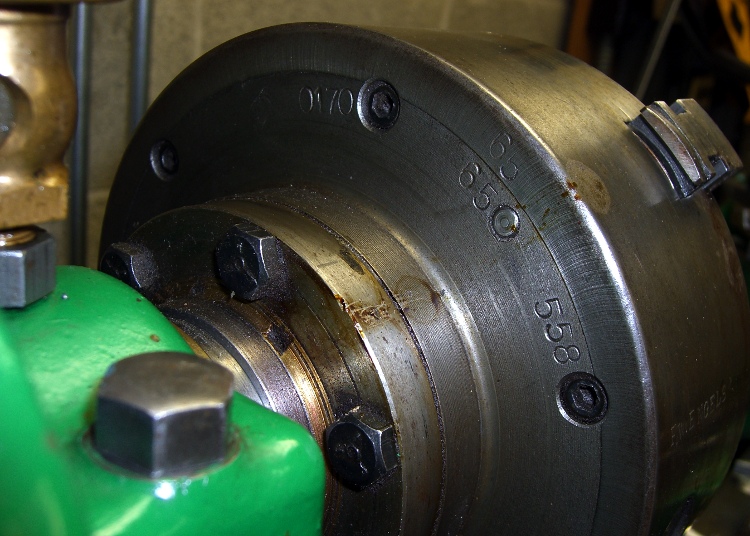
Stuck backplate
Making note of the witness marks on the backplate and chuck body, I removed the body. Fortunately, there was just enough clearance between the front bearing journal and the backplate that I could get the bolts out without dismantling anything else.
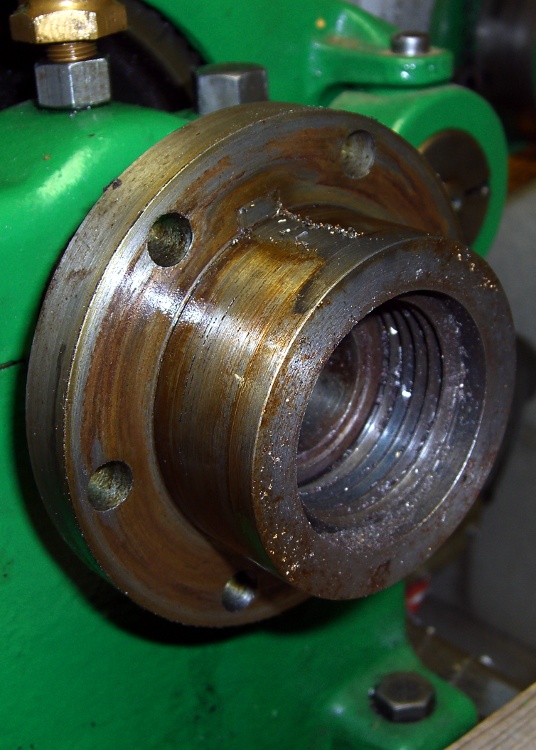
That left me with the rather grody and still firmly stuck backplate. The bolt disk was brazed onto the threaded cylinder with a keyway. Although the chuck body had a key slot, it looks like the matching key had been machined off of the cylinder, so the bolts were taking all the cutting torque. Worked OK for both the previous owner and for me, so I suspect it’ll continue to work just fine for the next owner, too.
Bicycle handlebar stem in spindle
Peering through the spindle reminded me of some recent bike repairs and it occurred to me that maybe, just maybe, a old-skool split-wedge handlebar stem would get enough traction inside the spindle to hold it in place. Some rummaging in the Bike Junk box produced just such a stem and it fit exactly into the spindle bore. Now the spindle is fixed in place by its ID and there’s no risk of breaking the locking pin or (shudder) the back gear.
Even better, the lumber pile emitted a chunk of 1×4 (actual dimensions!) wood that was precisely the correct length to reach from the floor to the stem. I like it when projects work like that; finding exactly the right stuff in the pile is sort of an omen that things are going well.
Fundamental rule: always start with a hunk of something that looks a lot like what you want to end up with.
Corollary: ya gotta have stuff!
Coordinate-drilling the lever arm
Some rummaging in the parts heap turned up several feet of nice “angle iron”, so I bandsawed off a hunk. I should have realized something was wrong when a foot of teeth stripped right off the saw blade, but I ascribed that to, oh, maybe weakening a few teeth when I soldered up the blade.
I had our daughter run the trig to generate coordinates for the six holes, then lay out the center bore and bolt holes on the plate for practice. Drilling the first hole prompted me to resharpen the drill, but poking the remaining five holes into that plate produced vast clouds of wood smoke from the sacrificial plate underneath, despite boiling copious quantities of cutting fluid off the top.
I finally admitted defeat when the “angle iron” rubbed the teeth right off a 2-inch hole saw.
As nearly as I can tell, that plate is un-machinable stainless steel, hand-forged by the Devil himself specifically to taunt me, and is good for nothing. Obviously, I hadn’t used it for anything in the years it had been in my pile and, perhaps as an omen, it didn’t have any other holes in it from anybody else’s efforts. I’ll keep the pieces around just to sneer at them; won’t get fooled again.
So, at this point, I am out a bandsaw blade, a drill bit, and a hole saw. We won’t discuss the circle cutter or my abortive attempt to lash the damn thing down to the Sherline and perform helix-milling upon it.
Unstuck backplate with beating bolt
While licking my wounds, I wondered if the bolt circle on the backplate would provide enough lever arm to make any difference. I tightened a sacrificial bolt & nut with one face of the bolt aligned along a radius from the spindle center, then deployed a big drift punch and the two-pound ball-peen hammer (a.k.a., The BFH).
A half-dozen good shots later, the backplate spun free. Notice the very small gap between spindle and backplate… that’s all it takes!
I added a closed-cell foam washer to fill the gap between the backplate nose and the butt end of the chuck; there was a remarkable amount of crud built up in there.
I am so happy that it even makes up for the death toll among the tools…
It’s worth noting that the headstock has two honkin’ big bronze spindle bearings, no delicate balls, and a few mighty thwacks didn’t do them a bit of harm.
They’re doing well in their new home, building out comb on the foundation. The queen is in good shape, laying eggs as soon as the workers finish the cells. The workers seem to be feeding pollen directly to the larvae rather than storing it, which makes perfect sense. They’re taking two quarts of 1:1 sugar water every day!
Either you already know what this is all about or you really don’t want to know.
While replacing the rear derailleur on Mary’s Tour Easy, I rediscovered that I have two different cable sizes in my stash: large brake cables and small derailleur cables.
The large ferrules are 0.235 inches in diameter, the smaller 0.187 inches. The brazed-on cable-stop sockets are obviously sized for the larger ferrules, which makes perfect sense.
If you put a small ferrule in a large stop, it tends to cant whichever way the cable pulls it. That results in the cable sawing into the edge of the ferrule… and that results in excess friction and sometimes a broken cable.
In the past I’ve snipped out little brass shimstock rectangles, wrapped them around mandrels, and generally spent a lot of time fiddling around. This time I remembered to rummage in my collection of brass tubing cutoffs, which yielded a pair of very-nearly-perfect slip fit pieces that neatly adapted the small ferrules to the large stops.
Rear shift cable with modified ferrules
Life is good…
I have no idea what the cables look like on weight-weenie exotic-frame bikes. For sure, this isn’t a trick for hydraulic disk brakes.
Incidentally, the cable housing length worked out to 130 mm. Neither of the charts in the SRAM X.7 instructions matched the TE’s butt end; the seat stay angle is halfway between what’s normal for diamond-frame bikes. So we picked a reasonable length and it seems to be OK.
Scenario: You install the latest Firefox update, restart as requested, and then get stuck in a loop where the popup window at the top of the browser keeps telling you to restart.
That bug (270303 “your browser has been updated and needs to be restarted”) and its ilk have been repeatedly fixed, on every version since about 3.0.2, and (it seems) to no avail.
What worked for me after updating to Firefox 3.0.11 was to close the browser and then:
As I mentioned there, I originally connected my bicycle-mobile amateur radio gadget to the ICOM IC-Z1A radio using separate mic and speaker plugs. That seemed like a good idea, but bicycles vibrate a lot and the plugs apply enough leverage to the jacks inside the radio to pry them right off the PCB. That requires a protracted repair session that I never wanted to do again.
The solution is to mount both plugs rigidly on the radio so that they simply can’t move. I dithered for a while and finally decided that function trumps good looks on this project, particularly given that our radios spend their entire lives inside a bag behind the bike seats.
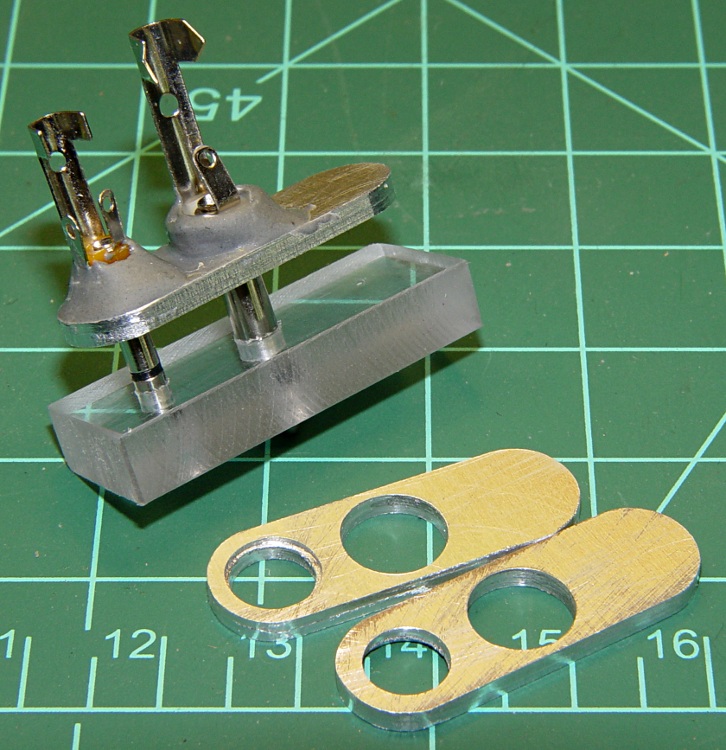
The top picture shows the small aluminum plates I made to align the plugs to the HT jacks, along with a plastic gluing fixture to hold the plugs parallel while the epoxy cures. If you just jam the plugs into the radio without an alignment fixture, you will glue the plugs together in such a way that they cannot be removed: the radio does not hold the shafts exactly parallel!
Plug stabilization – What Not To Do
How do I know? Well, I tried doing exactly that by simply epoxying the existing plugs into place, applying enough epoxy putty to stabilize the plugs against the radio. Looks reasonable, but when it came time to take them out (and you will want to take them out, trust me) they are firmly and permanently embedded. I had to carve them apart to get them out.
The mic, speaker, and coaxial power jacks are 10 mm on center. The 2.5 mm mic plug has a small shoulder that required a matching recess in the plate, while the 3.5 mm speaker plug is basically a cylinder. I don’t use the coaxial power jack, having hacked an alkaline battery pack with Anderson Powerpoles. The plate’s external contour matches the flat area atop the radio around the jacks.
You could lay out and drill close-enough holes by hand, use a step drill to make the shoulder recess, and then let the epoxy do the final alignment. However, you want the center-to-center distance exactly spot-on correct, as the plugs won’t mate properly otherwise. I turned it into a CNC project for my Sherline mill, of course, but that’s just because I have one.
HT Plugs in gluing fixture
This picture shows two plugs epoxied into the plate. While the epoxy cures, the plate rests atop the fixture with the two plugs vertical and their shell flanges flush against it. I applied the epoxy with a toothpick and worked it into the gap between the threads and the plate.
The end result will be a pair of plugs that exactly match the radio’s jacks in a plate that sits firmly atop the radio’s case. You should find that the plugs snap firmly into place and the entire assembly is absolutely rigid.
Caveat: don’t use an aluminum plate if your radio depends on separate electrical connections for the mic and speaker plug shells. The IC-Z1A has isolated shells, but remains happy when they’re connected. My Kenwood TH-F6A HT uses the shells for entirely different functions and will not work with them shorted together.
With the epoxy cured, wire the connections as usual. I had a small cable with enough tiny wires to put the mic conductors in their own shielded pair, but that’s likely overkill.
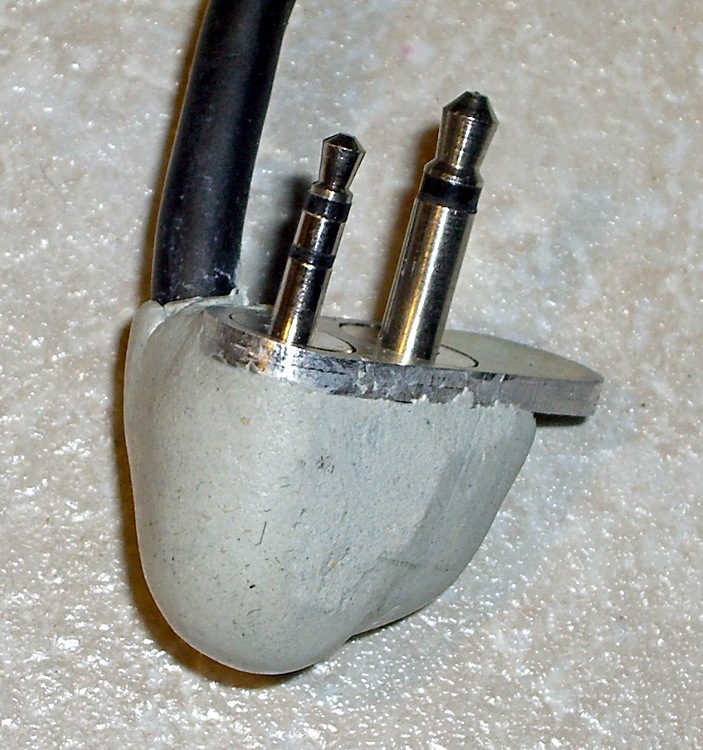
Finished plugs with epoxy blob
You could machine a nice enclosure, but I simply molded an epoxy putty turd around the connections, shells, and cable. The trick is to wait until it’s nearly cured, plug it into the radio, then shave off whatever gets in the way of the knobs, antenna plug, and other appurtenances.
The radio on Mary’s bike has been misbehaving over the last few months: the PTT button on the handlebars occasionally had no effect. Debugging this sort of intermittent problem is quite difficult, as it would sometimes fail and repair itself before we could get stopped in a safe place where I could poke around in the wiring.
After months of this nonsense, I narrowed the failure down to the short cable from the HT’s mic jack to the interface board: by positioning the cable just so, the radio would work fine for days or weeks at a time. I taped the thing in position and all was well, at least for a few days or weeks at a time.
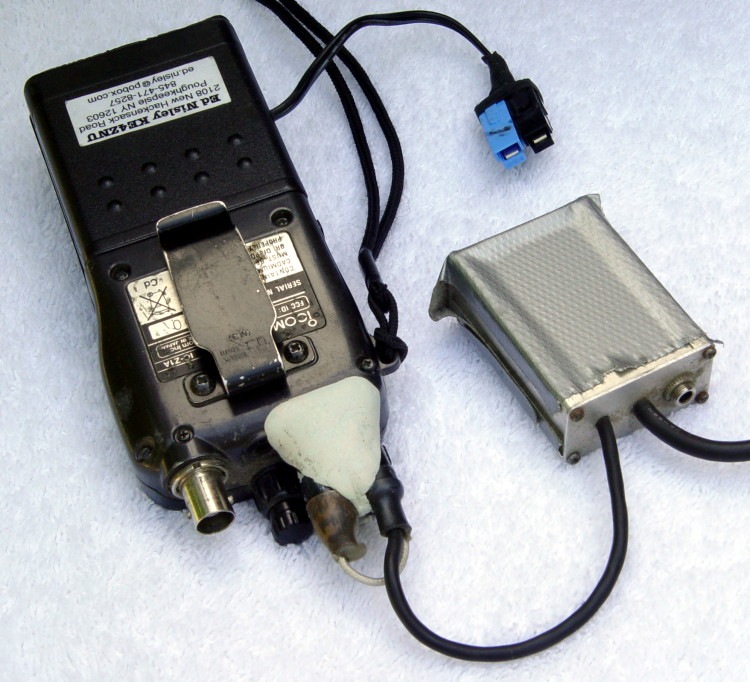
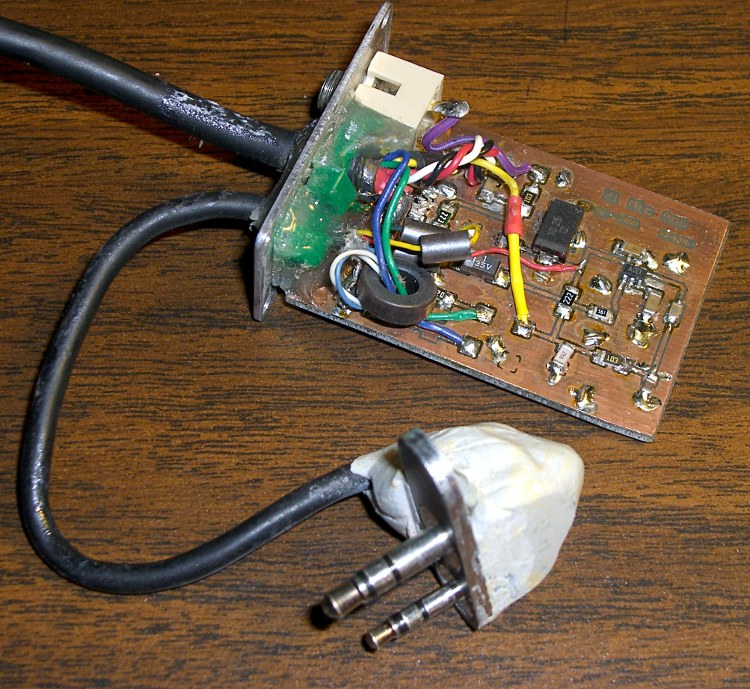
These two pictures show what the interface looked like back in 2001 when I put it together (modified from another version I did in 1997!) and what it looks like today. The most significant change is in the plugs connecting the whole affair to the HT: a CNC-machined plate holds them perfectly parallel at the proper spacing and an epoxy-putty turd fuses them into a rigid mass. More on that sub-project tomorrow…
Loose plugs, it turns out, vibrate the HT’s jacks right off the circuit board in short order and those jacks are a major pain to replace. Ask me how I know…
The wire break seemed to be precisely where the mic cable exits the epoxy turd. You’d expect a fatigue fracture to occur at that spot, so I wasn’t particularly surprised, although I was amazed that the thing hadn’t failed completely over the months I spend fiddling with it. I finally resolved to fix this once and for all, which meant either flaying the cable and patching the wire in situ or rebuilding the whole connector assembly. Either choice requires enough fiddly work to discourage even me.
Sooo, disconnect everything & haul it to the Basement Laboratory, Electronics Workbench Division…
Before cutting into the cable, I measured the mic voltage on the PCB and tried to make the thing fail on the bench. The HT (an ancient ICOM IC-Z1A) normally presents 3.5 V DC on the mic wire and the external PTT switch pulls it to ground through a 22 kΩ (or 33 kΩ or thereabouts) resistor. The mic audio is a small AC signal riding a volt or so of DC bias with the PTT active.
The wire measured maybe 0.25 volts and the PTT dragged it flat dead to ground. Yup, through that honkin’ big resistor. Well, maybe the last conductor in that mic wire had finally broken, right there on the bench?
Measured from the 2.5 mm plug tip conductor (tip = mic, ring = 3.5 V DC, sleeve = mic common) to the PCB pad on the PC, the mic wire stubbornly read 0.0 Ω, regardless of any wiggling & jiggling I applied to the cable. But no voltage got through from the radio to the board…
Sticking a bare 2.5 mm plug into the HT mic jack produced a steady 3.5 V on the tip lug. Reinstalling my epoxy-turd plug assembly produced either 0.25 or 3.5 V, depending on whether I twisted the thing this way or that way.
Ah-ha! Gotcha!
Pulled out my lifetime supply of Caig DeoxIT Red, applied a minute drop to the end of the mic plug, rammed it home & yanked it out several times, wiped off the residue, and the PTT now works perfectly. Did the same thing to the adjacent speaker plug, just on general principles, and I suspect that’ll be all good, too.
Diagnosis: oxidation or accumulated crud on the mic jack inside the radio.
Now, to try it out on the bike and see how long this fix lasts. Anything will work fine on the bench, but very few things survive for long on a bicycle.
Memo to Self: It’s always the connectors. Unless it’s the wires.
Here’s the schematic, just in case you’re wondering. I wouldn’t do it this way today, but that’s because I’ve learned a bit over the last decade or so…









 The Smell of Molten Projects in the Morning