Ed Nisley's Blog: Shop notes, electronics, firmware, machinery, 3D printing, laser cuttery, and curiosities. Contents: 100% human thinking, 0% AI slop.
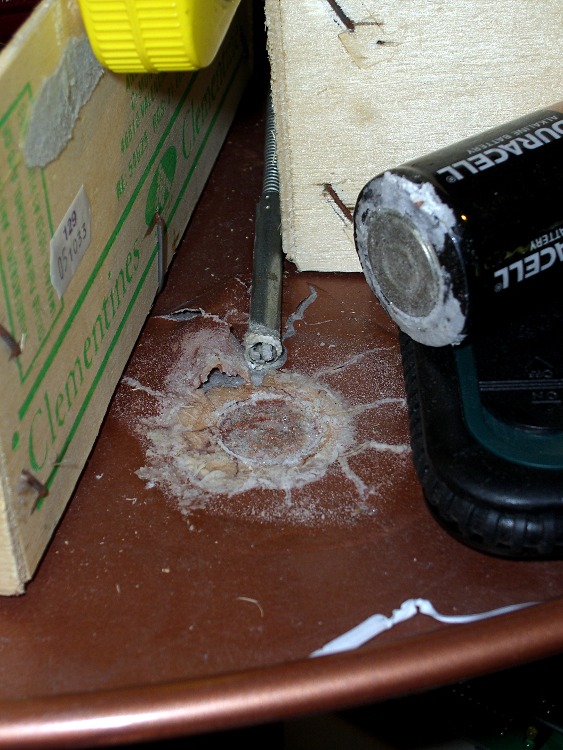
Found this toxic spill while I was looking for a gadget on another shelf: it seems I left an alkaline D cell standing on my electronics parts & tools carousel for much too long.
Amazingly, although the cell’s leakage blistered the paint pretty badly, it didn’t affect the steel carousel!
I wiped most of the crud and dead paint off, then applied white vinegar (which is essentially dilute acetic acid) to neutralize the cell’s potassium hydroxide. The grabber tool sticking out from between the boxes had a pretty good dose of corrosion up the side, but soaking it in vinegar (wow, the bubbles!) removed that and a shot of penetrating oil expelled the rinse water.
It’s definitely not Duracell’s fault: the cell had a best-used-by date in 1997.
I need an LED taillight (and maybe headlight) with a metal case and far more LEDs than seems reasonable. This is a doodle to sort out some ideas… not all of which will work out properly.
The general notion is that one can put today’s crop of ultrasuperbright 5 mm LEDs to good use. While the Luxeon & Cree multi-watt LEDs are good for lighting up the roadway, they’re really too bright and power-hungry for rear-facing lights. Mostly, you want bright lights facing aft, but the beam pattern & optical niceness really aren’t too critical as long as you’re not wasting too many photons by lighting up the bushes.
I think, anyway. Must build one and see how it works. I know that a narrow beam is not a Good Thing, as cars do not approach from directly behind and it make aiming the light rather too finicky.
The problem with commercial bike taillights is that they use piddly little LEDs and not enough of them. If you’ve ever actually overtaken a bicyclist at night with a blinky LED taillight, you’ve seen the problem: they’re too damn small. Automobile taillights must have a very large surface area for well and good reason.
So the diagram in the pic explores the notion of arranging a bunch of red & amber LEDs in a fairly compact array. The shaded ones are red, the open ones are amber (with two more side-facing ambers to meet legal requirements), and there are eight of each. The OD is about 40 mm. Figure 5 mm LEDs with 2.5 mm of aluminum shell between them. If the center four LEDs were spaced right, an axial (socket-head cap?) screw could hold the entire affair together.
Turns out both the red & amber LEDs in the bags of 100 I just got from Hong Kong run at 2 V forward drop @ 30-ish mA, so that’s 16 V total for eight in series.
Four AA NiMH cells fit neatly behind the array, so the supply will be 4 – 5 V, more or less. The outer casing could be plastic pipe.
What to do for a battery charging port? Must be mostly weatherproof. Ugh.
Rather than a regulated supply and a current sink / resistor, use an inductor: build up the desired forward current by shorting the inductor to ground, then snap the juice into the LEDs. The voltage ratio is about 4:1, so the discharge will happen 4x faster than the charge for a duty cycle around 20%. At that ratio, you can kick maybe 50 mA into the poor things.
Governing equation: V = L (ΔI/ΔT)
If they’re running continuously, 2 V x 50 mA x 0.2 = 20 mW. The full array of red or amber is 160 mW, 320 mW for both. If you’re powering them at 10% duty cycle, then the average power dissipation is pretty low. Not much need for an external heatsink in any event.
A 1 kHz overall cycle means a 200 µs inductor charging period. With low batteries at 4 V and 50 mA peak current, the inductor is 16 mH. That’s a lot of inductor. I have a Coilcraft SMD design kit that goes up to 1 mH: 12 µs charge and 16 kHz overall. Well, I wouldn’t be able to hear that.
No need for current sensing if the microcontroller can monitor battery voltage and adjust the charge duration to suit; three or four durations would suffice. Needs an ADC input or an analog window comparator.
Automotive LED taillights seem to run at about 10% duty cycle just above my flicker fusion frequency; say between 50 – 100 Hz. If that’s true, red & amber could be “on” simultaneously, but actually occupy different time slots within a 100 Hz repeat and keep the overall duty cycle very low.
I’d like red on continuously (10% of every 10 ms) with amber blinking at 4 Hz with a 50% duty cycle. When they’re both on the total would be 60% duty.
The legal status of blinking taillights is ambiguous, as is their color; more there. Motorcycles may have headlight modulators. Bikes, not so much.
Battery life: assume crappy 1500 mAh cells to 1 V/cell. Red = 50 mA x 0.2 x 0.1 = 1 mA. Amber = 50 mA x 0.2 x 0.5 = 5 mA. Thus 1500 / 6 = 250 hours. Figure half of that due to crappy efficiency, it’s still a week or two of riding.
Rather than a power switch, use a vibration sensor: if the bike’s parked, shut off the light after maybe 5 minutes. It wouldn’t go off when you’re on the bike, even stopped at a light, because you’re always wobbling around a little.
Memo to Self: put the side LEDs on the case split line?
For obscure reasons, I have a pair of headsets attached to the PC: one USB that’s used for phone calls and one plugged into a sound card for everything else.
They’ve been cluttering up the corner of the desk for far too long, so I bent up a rack from a surplus coat hanger. Nothing critical, as long as it’s tall enough to hold the mics off the desk and wide enough they don’t clunk together.
The trick is to just drill a hole in the top of the desk and poke the end of the rod into it. That works because my desk has a notch along the edge just exactly the right width to hide the hole!
Hanger Mounted Under Desk
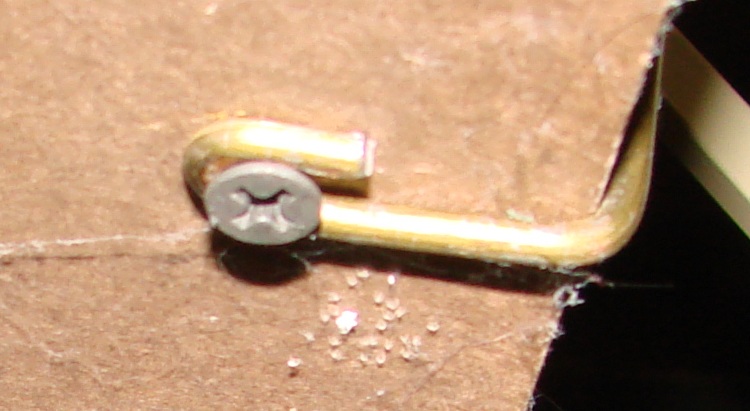
Maybe you don’t want to do this to the top of your desk, in which case maybe you can bend the hanger around the edge and put a screw in the bottom or the desktop. If you don’t look under there very often, the spiders will take over; this one is from the basement desk that I haven’t used for far too long.
Details of the hanger, not that you can’t figure it out on your own:
Every now and then I notice the pedals are getting further away on my Tour Easy recumbent, which means it’s time to snug up the seat lace again. The lace cord has a Kevlar core, so it’s not very stretchy, but over the course of a few thousand miles either it stretches or the seat mesh relaxes.
Here’s the only tool I’ve found that works for this purpose:
Stanley 82-113 Hook Tool: "The Hemorrhoid Picker"
That’s what a friend calls his, anyway.
It’s from Stanley and not in their current website listing, but they do offer the 78-393 – 4 Piece Hook and Pick Set, which looks to have a tool sporting the same hook end with a different (and much smaller) handle. IIRC, I got this one several-many years ago at Wal-Mart; maybe it’s a special-issue part number just for their shelves?
What you do is work your way from the bottom of the seat lacing on one side all the way to the top, pulling out the slack as you go. At the top of that side, pull the accumulated cord into the knot, then start at the bottom of the other side. When you’ve got both sides pulled taut, knot up the slack again and you’re done.
Needless to say, you can give yourself a King Hell puncture wound with that thing…
Just got a new credit card, which arrived with the usual “Privacy Policy” flyer describing how they’ll keep our sensitive bits safe & secure. Except, of course, that by default they’ll share those bits with nearly any organization that asks, if there’s even the least bit of money to be made in the process.
The flyer explains how we can tell them of our privacy choices. Oddly, in this Internet Age, none of the banks have figured out how to put our privacy policy choices on their websites. Maybe that would be entirely too efficient.
Anyhow, we’re supposed to either:
Pick up the phone to deal with their customer service apparat or
Pick up a pen, fill out a form, cut it out, and mail it to them
For our joint accounts, if I forget to say “And this also applies to my wife”, well, then they’re free to share her sensitive bits.
I’m sure they know that when they make “choosing” difficult enough, nobody will bother.
Ya think?
For the record:
Chase: press 0 to short-circuit the account info blather and get to a rep
Citi: press 6 for that purpose. Why not 0? Huh…
The Chase folks tell me this may require up to 90 days to take effect. Wow, do they fill out forms and hand-carry the paperwork to Galactic HQ for further transcription?
Memo to Self: Remember to tell the nice voice…
This applies to both account holders
Turn off all information sharing options
Turn off “convenience checks” (is anybody stupid enough to use those things?)
Turn off automatic credit line increases
This takes about four minutes for each account on a Sunday morning.
Just in case I spill a sticky liquid on the caliper and must disassemble it again…
This was a relatively inexpenive, but not dirt cheap, caliper that has worked fine all along, apart from the issue with the thumb roller frame.
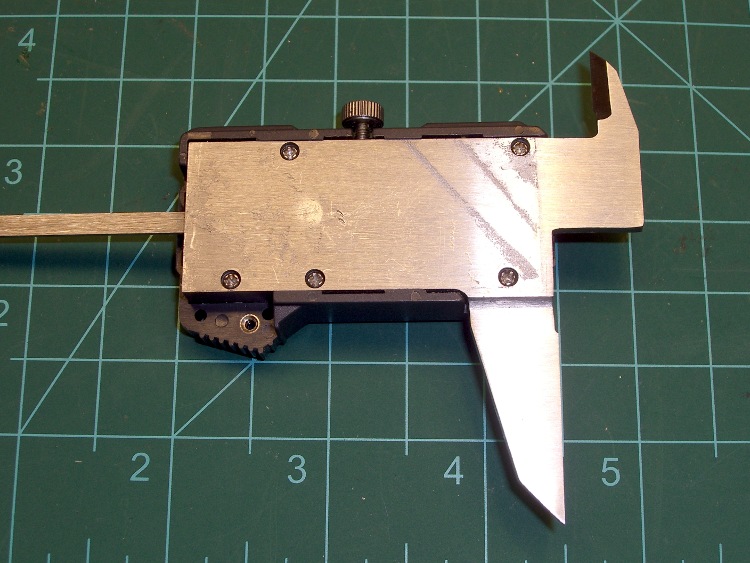
After removing all the obvious screws, taking off all the various doodads, and extracting the sliding jaw, it still doesn’t come apart. The trick, as always, is to peel the label off the back side to reveal the five crucial screws that secure the electronics package to the metal scale.
These screws don’t have the best heads in the world, but a #2 Phillips driver, solid pressure, and steady torque gets them out. All but one of the screws are pointed; the one in the lower-left corner (as above) is a machine screw that, I think, ensures a good electrical connection between the metal frame and the electronics package.
Caliper Disassembled
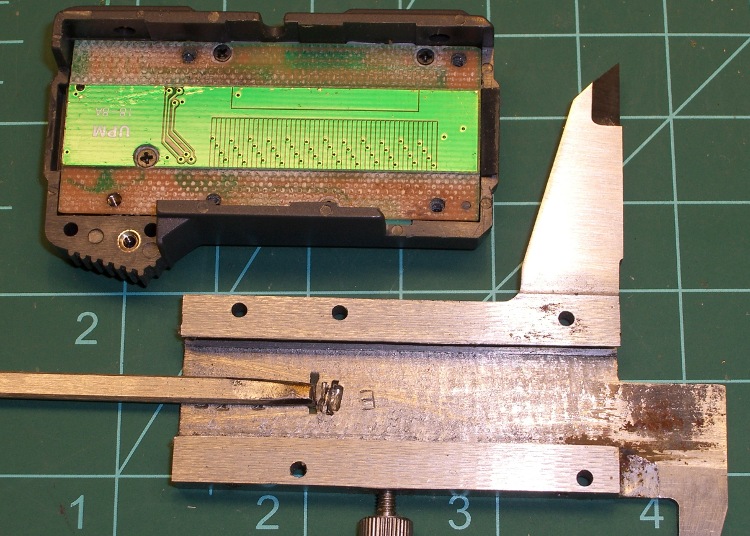
With those screws removed, the electronics package pulls off to expose the innards. Note the cough delicate hand-forging that secures the tang to the back plate.
The schmutz on the far right matched up with a similar patch of rust on the sliding scale. Some TopSaver rust treatment applied with a scrubbing pad reduced the problem to mere discoloration; the rust wasn’t all that deep.
Reassemble in reverse order, with dabs of lubricant on the obvious wear points along the way. The thumb roller must go on after securing the electronics package, not before.
My buddy Mark One dropped off a pair of Maxwell PC10 10 farad Ultracapacitors. We both recall our respective professors saying that a farad is an impractical unit, there’d never be such a thing as a 1 F capacitor, and it would be the size of a barn anyway…
These are 25x30x3 mm.
The downside, of course, is that they’re rated at 2.5 V DC with an absolute maximum of 2.7 V.
On the other paw, they have a maximum current of 2.5 A and a whopping 19 A short-circuit current. Serious risk of fire & personal injury there…
Charged one up from an AA NiMH cell I had lying around on the desk, which took a while, then let it discharge all by itself while taking notes. The results look like this:
Now, maybe that’s not exactly the extreme top left end of an exponential drop, but it looks close enough:
V(t) = V0 * exp (-t/τ)
Pick any two points on the curve to find τ, the time constant:
V(t1) / V(t2) = exp (-t1/τ) / exp (-t2/τ)
Take the log of both sides and remember that the log of a ratio is the difference of the logs:
log V(t1) – log V(t2) = (-t1 + t2) / τ
Plug in the first and last data points to get:
0.02341 = 21.6 ks / τ
Reshuffle and τ = 923 ks. Close enough to a megasecond for my purposes.
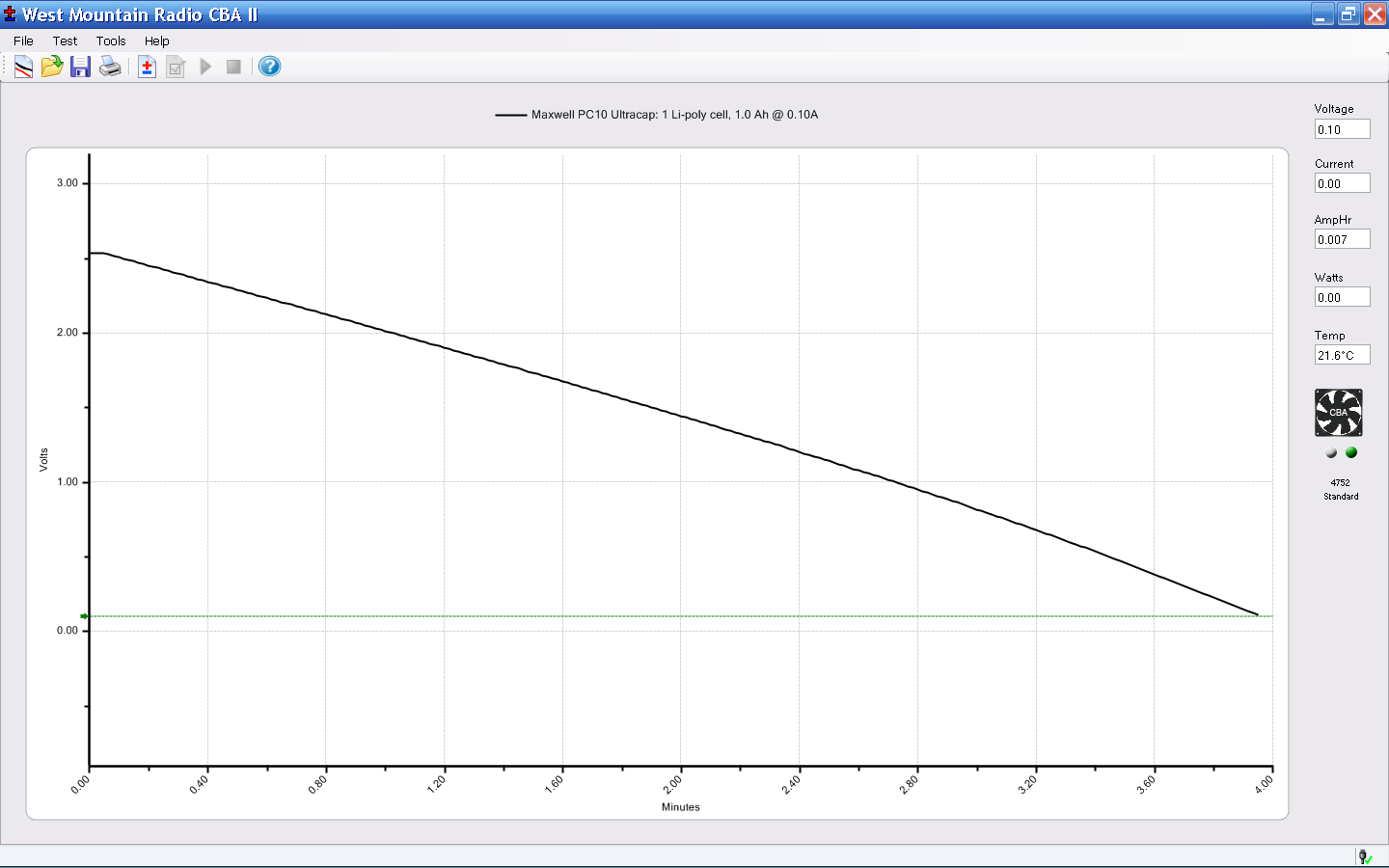
How to find the capacitance? Charge the cap up fram a pair of NiMH cells, discharge it at a constant current using a battery tester, thusly:
10 uF Ultracap – 100 mA Load
That curve isn’t exactly linear, but it’s close enough that we can use the familiar capacitor equation:
ΔV/ΔT = I/C
Reshuffle to get capacitance over there on the left side:
C = I * ΔT / ΔV
The lower axis is minutes, not seconds, with truly poor grid values. Eyeballometrically, call it 4 min * 60 = 240 seconds.
Plug in the appropriate numbers and find that
C = 0.1 A * 240 s / 2.5 V = 9.6 F.
Close enough.
Knowing τ and C, find the self-discharge resistance R = τ/C = 96 kΩ. That seems pretty low, but at 2 V it amounts to 25 µA. The cap’s self-discharge current is rated at 40 µA, so that’s well within spec.
Now, admittedly, the cap doesn’t hold much energy:
NiMH 2 x AA = 1 Ah @ 2.4 V = 2.4 Wh = 8600 Ws = 8600 J
Ultracap 10 F @ 2.4 V = 1/2 * C * V^2 = 29 J
But, heck, it’s pretty slick anyway… it’ll make a dandy backup power source for a clock I’m thinking of making.
Memo to Self: Datasheet says to add balancing resistors that carry 10x the self-discharge current when stacking in series. That’d be 10 kΩ, more or less, which seems scary-low.






 The Smell of Molten Projects in the Morning