The Smell of Molten Projects in the Morning

Ed Nisley's Blog: Shop notes, electronics, firmware, machinery, 3D printing, laser cuttery, and curiosities. Contents: 100% human thinking, 0% AI slop.

Author: Ed

  • ICOM IC-Z1A Tone Squelch: Fixed?

    ICOM IC-Z1A HT with UT-93 Tone Board
    ICOM IC-Z1A HT with UT-93 Tone Board

    A few days ago I rode off to an eye doctor appointment and my ladies rode off later to meet me at the grocery store after they stopped in the garden to harvest root crops. This sort of thing is easy enough to synchronize with amateur radio, but this morning I didn’t hear a thing until they rolled up beside me in the store parking lot.

    It seemed they could hear each other and me, but I couldn’t hear either of them. We’re all on 144.39 MHz, the APRS data frequency, with 100 Hz tone squelch to keep the robots out of our ears. Our daughter has the GPS APRS tracker feeding data into the mic input, which is why we’re using a data channel for tactical comm.

    This has happened once or twice before, but it’s very intermittent. I now had sufficient motivation to disconnect the radio, an ancient ICOM IC-Z1A, from the bike and pith it on the Electronics Workbench for examination. The UT-93 Tone Squelch board is unplugged & flipped over, resting on the front half of the radio body at the lower-left of the photo.

    Turns out that there’s nothing visibly wrong in there. I suspect it’s a molecule or two of oxidation on the (gold-plated!) connector between the UT-93 and the main board, because the UT-93’s held firmly in position by the black foam square you can see in the lower-left of the photo. The small white plug near the top of the UT-93 mates with the equally small socket on the main board, just to the left of the lithium secondary cell in the middle.

    It’s all CMOS logic, of course, and there’s no actual load current involved. That’s the worst condition for contacts, as a dry connection simply doesn’t produce enough energy to burn through the least hint of oxidation. That’s why they use gold plating on connectors, but it’s been a long time since that board has moved at all; the foam square is deeply indented.

    So I wiggled & jiggled all the ribbon-cable connectors while I was in there, buttoned everything back up, and the tone decoding works again. I hope this will continue…

    Memo to Self: remove only the four black corner screws on the upper case, plus the two silver screws near the very bottom inside the battery compartment, and the two halves pop apart. No need to remove the mic and earphone plugs, whew!
  • Cheese Garrotte

    Cheese Garrotte
    Cheese Garrotte

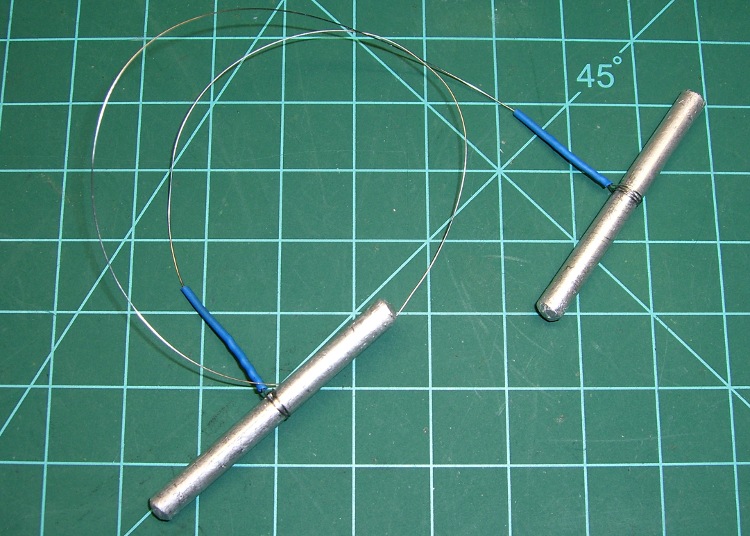
    Just chopped up a 5-lb lump of Provolone into 2-oz chunks for pizza, which brings this simple shop project to mind: a cheese garrotte.

    It’s about a foot of 0.011-inch (call it 0.25 mm) stainless steel wire with the ends wrapped around some aluminum rod, neatly tied off with heatshrink tubing.

    Usage is about what you’d expect: it cuts cheese like nothing else on earth. The only trick is maintaining a straight line, which is easier (for me, at least) when I cut vertically downward.

    It’s difficult to cut all the way to the bottom and that wire is rough on the fingertips, so I tend to flip the cheese over and pull sideways for the last inch or two. Maybe not a perfect cut, but good enough.

    Cheese Garrotte Handle Detail
    Cheese Garrotte Handle Detail

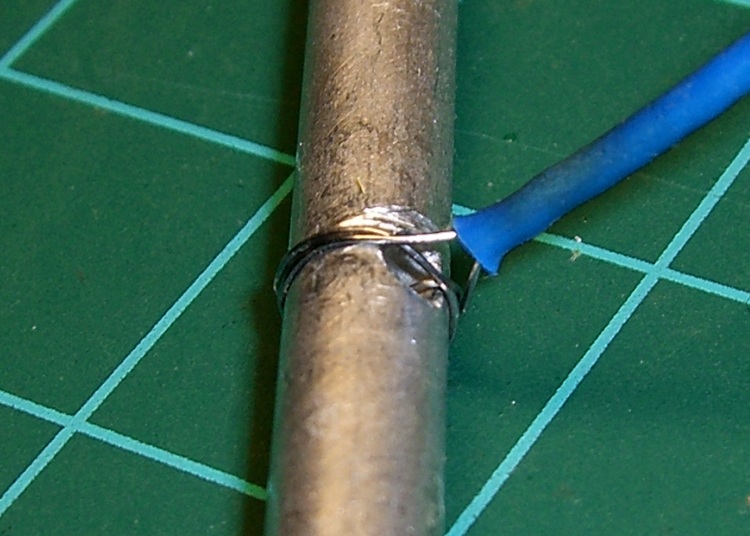
    Construction nuance: loop the wire around the handle once or twice, pass it through the hole, then do another loop before twisting the end. If you run the wire directly through the hole, it’ll break on the far-side sharp edge after a while, even when you countersink the hole.

    I put a shallow groove around the handle, but that’s likely not needed. You can certainly get fancier with the handles if you like. This one is dishwasher safe, which makes up for a lot.

    You really, really need heatshrink tubing over the bare wire ends, as the tip of a 11-mil stainless wire is indistinguishable from a needle.

  • Mysterious Noise in Toyota Sienna Minivan: Fixed!

    For about the last week I’ve noticed a soft clicking-buzzing sound somewhere near the dashboard / center console of our 2000 Toyota Sienna. I tried some on-the-fly isolation, but it wasn’t related to motion, engine on/off, CD or tape player, fan, or anything else. Finally Mary noticed it, too, and we spent half an hour in the garage yanking fuses and wiggling things until we tracked it down to below the passenger seat.

    Now, in the good old days, that was empty space, but in the Sienna it’s where the rear-area heater lives. Shoving the seat forward to the stop exposed the heater and, sure enough, it’s buzzing and clicking. Intermittently, somewhat randomly, but very steadily.

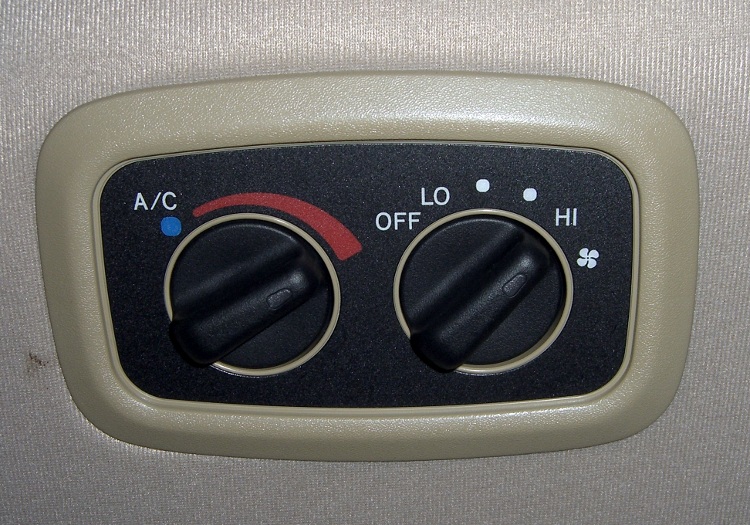
    Rear Temperature Control
    Rear Temperature Control

    With that as a hint, I twisted the rear-area temperature control (on the headliner behind the driver seat) and shazam the noise stopped. The control has detents and when moving the control to each detent the heater makes a faint buzzing. I suspect the control adjusts a valve that regulates engine coolant flow inside the heater.

    It’s not obvious whether the control is a pure-digital rotary encoder or a potentiometer, so I decided to investigate: it’s already sorta busted, what’s to lose? The bezel comes off by prying its door-side edge outward. The white plastic frame has two screws into the metal structure under the roof. The two electrical connectors are, of course, the positive-latching kind that you pull the little tab until you break your fingernail and then realize that you should push it instead.

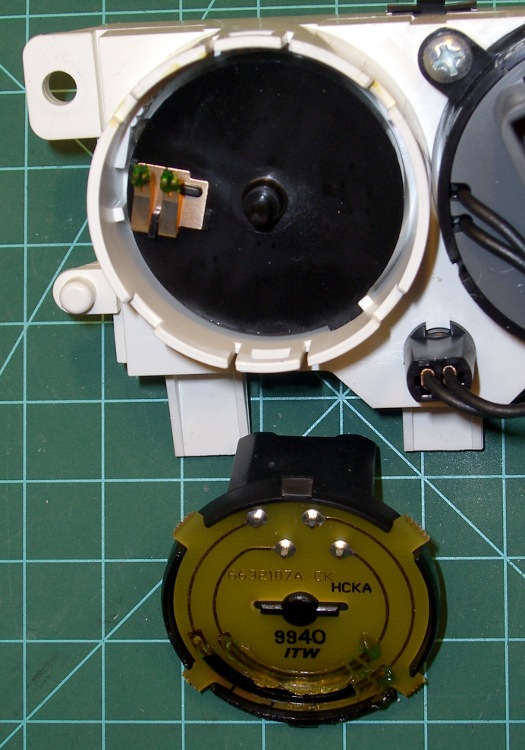
    Temperature Control - Interior View
    Temperature Control – Interior View

    Taking the control apart reveals that it’s a potentiometer with some switching contacts. The two bifurcated spring-finger contacts on the black plastic disk short the resistive element to the inner metallic track.

    Resistive Element
    Resistive Element

    The metal contacts appeared slightly grody, but with no major corrosion. The resistive track looked just fine.

    The offending control position would be to the left side of the element as shown in the pictures here: there’s nothing obviously wrong at that spot. I think the maximum-heat position is off the resistive element entirely, resting on the far left end of the metal traces, but the control wasn’t quite set to that spot. Perhaps the problem was that the contacts became intermittent at the exact edge of the element.

    I smoothed the collection of anti-oxidation grease over the tracks, covered the contacts with their own blobs, put everything back together, and it works fine.

    We tend to put the control at A/C during the summer and at maximum heat during the winter. I suppose the poor thing got frustrated after we moved it a month or so ago…

    The money saved with this repair might just pay to have the Toyota dealer replace the spark plugs. The shop manual says that task starts by removing the windshield bezel and all the stuff above the engine intake manifold; the job costs upwards of 300 bucks. I can barely see the rear plugs with a looong inspection mirror angled just so while lying on the floor under the van, so it’s truly a nontrivial operation.

    I [delete] all over their [censored]…

  • VGA-grade Video Cable Connector

    VGA-class Video Cable Connector
    VGA-class Video Cable Connector

    Setting up a new (well, new to me, it’s that old GX270) PC gave me reason to rummage in the Video Cable box and come up with this VGA-class cable. Half the connector shell had worked its way off, giving a nice view of the handiwork. Easily snapped back on with no permanent damage.

    The cable works OK at 1280×1024, although the image seems a bit soft, and higher screen resolutions are out of its reach. There are no obvious signal reflections visible on the screen, so the impedance bumps are not as bad as you might think.

    The VGA connector includes common returns for the Red, Green, and Blue signals, and the two wires for each color should be twisted together. That obviously hasn’t happened here, but crosstalk doesn’t seem to be much of a problem.

    To their credit, they did solder the cable shield to the connector shell, which is a really nice touch. Alas, the impedance of a one-inch pigtail pretty much chokes off the high-frequency stuff you really want to drain to the shell.

    Memo to Self: One of these days, run a bandwidth check with the spectrum analyzer. Use 6-dB pads to get nice 75-Ω terminations.

  • Source Code Reformatting

    I just figured out how to use the WordPress “sourcecode” formatting and applied it to my software-related posts. It produces much nicer results than the manual formatting I was using, mostly by preventing long lines from jamming into the right column.

    The catch: WordPress imposes a round trip from my original text to the screen encoding and back, which sometimes randomly mangles special symbols. Angle brackets and double-quotes, in particular, take serious damage.

    If you happen to remember a favorite chunk of code in a previous post, please take a look at it and see if I missed any of the obvious text-replacement errors. Trawling through the Software category should turn up most of the posts.

    As is always the case with program listings, the errors will be really obvious to everyone except me.

    Thanks…

  • Stick Insect Laying an Egg

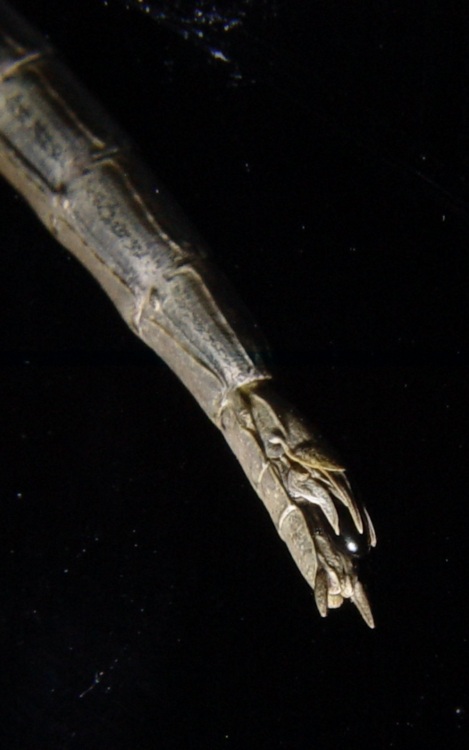
    Stick Insect Egg Laying
    Stick Insect Egg Laying an Egg

    Another one of my top-ten favorite pix: a landing module docked with an alien interstellar probe.

    Actually, it’s a stick insect laying an egg.

    Stick insects just drop their eggs onto the forest floor with a stereotyped abdominal shake. This critter was in an aquarium standing on end, so every egg made a little tick when it hit the bottom pane. They do this mostly at night, hence the black background of our living room.

    I caught this egg just before release, aiming through the glass wall with an LED flashlight for illumination, through close-up adapters on a DSC-F717 on a tripod. A bit of fiddly image editing got rid of most of the “stars” caused by dirt on the glass, but the insect and egg aren’t edited.

    Although stick insects can live for up to three years, we cannot find food for them during the winter months. They’re rather fussy eaters, specializing in oak leaves in these parts, and simply don’t accept substitute meals.

    A high-res version serves as the background on my right-hand portrait monitor.

    A different view of the eggs is there.

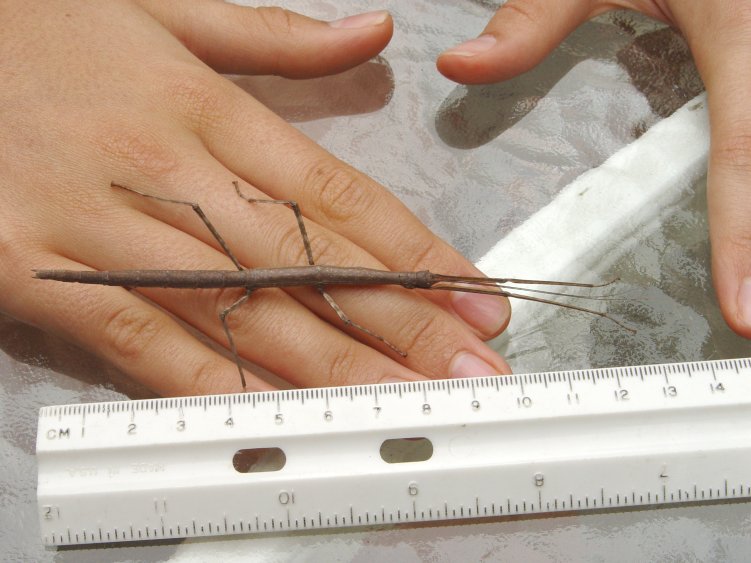
    An overall view of the critter, with the two front legs extending frontward along the antennae in a characteristic pose.

    Stick Insect - 125 mm overall
    Stick Insect – 125 mm overall
  • Color Guard Night Practice: Flags

    Another picture from the Arlington Marching Band competition at The Dome in Syracuse.

    Silhouetted Flags
    Silhouetted Flags

    These are flag twirls against portable mercury-vapor floodlights. The glare off that bare tree make the scene look just about as cold as it really was, even if it wasn’t icy.

    The camera picked 1/5 second for this exposure, although the translucent flags don’t show the same strobing as the bright-white rifles. I think the lower floodlight is the same one in the single-rifle picture.