The Smell of Molten Projects in the Morning

Ed Nisley's Blog: Shop notes, electronics, firmware, machinery, 3D printing, laser cuttery, and curiosities. Contents: 100% human thinking, 0% AI slop.

Author: Ed

  • The Decline of Literacy: Part Two

    Saw this in a somewhat downscale grocery store while chaperoning a Marching Band event.

    Hand Dryer Graffiti
    Hand Dryer Graffiti

    I’d give him (it’s a mens’ restroom) some bonus points, as I think he caught and corrected the error, but then there’s that “to”. Ouch.

    I ask you, though, what grade were you in when you learned how to spell “much”? I doubt you’ve had any trouble spelling it since then.

  • The Decline of Literacy: Part One

    Enunciator Panel Placard
    Enunciator Panel Placard

    Saw this one on the outside of an old-style school building while working as an Election Inspector in the recent primary.

    I’m guessing: the person who typed this up heard the word, but never encountered it in actual use.

    The correct word, of course, is annunciator, as defined there. Not exactly a homonym, but a pretty close match.

    Wrong word, used properly, and spelled correctly. It’s not like I’ve never made that sort of mistake, fer shure!

  • TCFFHRC Rules Document: LyX / LaTeX Settings

    I’m editing the Trinity College Home Firefighting Robot Contest rules document using the LyX GUI front end to LaTeX to handle the formatting.

    Yes, yes, I know OpenOffice and its ilk have all the features you think you need. When you actually try to put together a book-length document, you find that the features don’t actually work / work together / behave reliably. Been there, done that. Enough times to be wary, indeed.

    So LyX / LaTeX is the least-worst alternative and actually does a pretty good job after you get the various configurations beaten into shape. After that, you just type, add tags, and it’s all good.

    Here’s a list of the settings I’m using… for future reference, natch, because figuring this stuff out from first principles takes a while.

    Document settings

    Document Class: report
    Text Layout: MedSkip vertical, Single line, Two-column
    Page Layout: US Letter, fancy headings
    Page Margins: 0.75 inch all around, 0.3 inch separations</pre>
    <strong>LaTeX Preamble</strong>
    <pre>\usepackage{ragged2e}
    \usepackage{lastpage}
    \usepackage{url}
    \usepackage{dvipost}
    \usepackage{breakurl}
    \usepackage[labelfont={bf,sf}]{caption}
    \renewcommand{\bottomfraction}{0.7}
    \pagestyle{fancyplain}
    \fancyhf{}
    \lhead{\fancyplain{}{Trinity College Home Robot Contests}}
    \rhead{\fancyplain{}{2010 Rules}}
    \lfoot{\fancyplain{Modified \today}{Modified \today}}
    \cfoot{Copyright 2009 by Trinity College}
    \rfoot{\fancyplain{\thepage\ of \pageref{LastPage}}{\thepage\ of \pageref{LastPage}}}
    \RaggedRight
    \dvipostlayout
    \dvipost{cbstart color push Blue}
    \dvipost{cbend color pop}
    

    Trickery


    Some of those packages aren’t part of the default LyX / LaTeX installation on Ubuntu. Searching for LaTeX in Synaptic is tedious, but works.

    The three ways to export to PDF are not identical.

    • dvipdfm doesn’t produce clickable TOC links.
    • pdflatex, the default, doesn’t produce change bars, which is a crippling defect for a rules document under heavy revision. It’s OK for the final draft, though.
    • ps2pdf doesn’t produce searchable text; it’s all graphics. Ptooie!

    So use dvipdfm during development (to get change bars) and use pdflatex for the final product (to get clickable links). There has got to be a way around that, but I haven’t a clue as to what’s going on under the hood.

    In order to track changes:

    Document -> Change Tracking -> Track Changes.

    In order to print change bars and suchlike:

    Document -> Change Tracking -> Show Changes in Output

    Figures appear on-screen in dot-for-dot mode by default, so tweak the on-screen ratio to maybe 50%. Force the printed width of all figures to 3 inches for two-column layout. Insist that picture resolution bear some resemblance to reality: 3 inches at 300 dpi -> 1000 pixels across.

    There seems to be no way to export LyX directly to ODT. Exporting to RTF strips off most of the formatting, as you’d expect, and change tracking Goes Away.

    Exporting to HTML produces one honkin’ big lump of HTML with a bazillion image files in a separate directory. That’s probably OK for most purposes.

    Memo to Self: Turn off change tracking for minor editorial tweakage, because nobody really cares.

  • Adding a Device to LTSpiceIV

    Searching around for an LM386 SPICE model turned up this useful thread.

    The model has some limitations, discussed there, but seems practical. So far, the main gotcha is that the output voltage doesn’t center neatly at Vcc/2, but that’s in the nature of fine tuning.

    The trick is getting the model & symbol into Linear Technology’s LTSpiceIV

    Running under WINE in Xubuntu, the emulated C drive is in your home directory at

    .wine/drive_c/

    with the Linear Tech LTSpiceIV files tucked inside that at

    .wine/drive_c/Program\ Files/LTC/LTspiceIV/

    Incidentally, WINE puts the program icon in

    .local/share/icons/05f1_scad3.0.xpm

    It’s not clear what the prefix means, but the actual executable is scad3.exe (I think that’s historical cruft, as the new overall name is LTSpiceIV).

    Copy the LM386.sub file to lib/sub and the LM386.asy file to lib/sym, then restart LTSpiceIV.

    After putting the symbol in the schematic, I had to edit its attributes (other-click the symbol), make both InstName & Value visible to see them on the schematic, then move them to somewhere other than dead-center in the symbol. I can’t figure out how to make that happen automagically, as it does with other symbols. Comparing the two files to ordinary components doesn’t show anything obviously missing.

    Link rot being what it is, here’s the LM386.sub file:

    * lm386 subcircuit model follows:
    
    ************************************original* IC pins:     2   3   7   1   8   5   6   4
    * IC pins:     1   2   3   4   5   6   7   8
    *              |   |   |   |   |   |   |   |
    .subckt lm386 g1  inn inp gnd out  vs byp g8
    ************************************original*.subckt lm386 inn inp byp  g1  g8 out  vs gnd
    
    * input emitter-follower buffers:
    
    q1 gnd inn 10011 ddpnp
    r1 inn gnd 50k
    q2 gnd inp 10012 ddpnp
    r2 inp gnd 50k
    
    * differential input stage, gain-setting
    * resistors, and internal feedback resistor:
    
    q3 10013 10011 10008 ddpnp
    q4 10014 10012 g1 ddpnp
    r3 vs byp 15k
    r4 byp 10008 15k
    r5 10008 g8 150
    r6 g8 g1 1.35k
    r7 g1 out 15k
    
    * input stage current mirror:
    
    q5 10013 10013 gnd ddnpn
    q6 10014 10013 gnd ddnpn
    
    * voltage gain stage & rolloff cap:
    
    q7 10017 10014 gnd ddnpn
    c1 10014 10017 15pf
    
    * current mirror source for gain stage:
    
    i1 10002 vs dc 5m
    q8 10004 10002 vs ddpnp
    q9 10002 10002 vs ddpnp
    
    * Sziklai-connected push-pull output stage:
    
    q10 10018 10017 out ddpnp
    q11 10004 10004 10009 ddnpn 100
    q12 10009 10009 10017 ddnpn 100
    q13 vs 10004 out ddnpn 100
    q14 out 10018 gnd ddnpn 100
    
    * generic transistor models generated
    * with MicroSim's PARTs utility, using
    * default parameters except Bf:
    
    .model ddnpn NPN(Is=10f Xti=3 Eg=1.11 Vaf=100
    + Bf=400 Ise=0 Ne=1.5 Ikf=0 Nk=.5 Xtb=1.5 Var=100
    + Br=1 Isc=0 Nc=2 Ikr=0 Rc=0 Cjc=2p Mjc=.3333
    + Vjc=.75 Fc=.5 Cje=5p Mje=.3333 Vje=.75 Tr=10n
    + Tf=1n Itf=1 Xtf=0 Vtf=10)
    
    .model ddpnp PNP(Is=10f Xti=3 Eg=1.11 Vaf=100
    + Bf=200 Ise=0 Ne=1.5 Ikf=0 Nk=.5 Xtb=1.5 Var=100
    + Br=1 Isc=0 Nc=2 Ikr=0 Rc=0 Cjc=2p Mjc=.3333
    + Vjc=.75 Fc=.5 Cje=5p Mje=.3333 Vje=.75 Tr=10n
    + Tf=1n Itf=1 Xtf=0 Vtf=10)
    
    .ends
    *----------end of subcircuit model-----------

    And the corresponding LM386.asy file:

    Version 4
    SymbolType CELL
    LINE Normal -64 -63 64 0
    LINE Normal -64 65 64 0
    LINE Normal -64 -63 -64 65
    LINE Normal -60 -48 -52 -48
    LINE Normal -60 48 -52 48
    LINE Normal -56 52 -56 44
    LINE Normal -48 -80 -48 -55
    LINE Normal -48 80 -48 57
    LINE Normal -44 -68 -36 -68
    LINE Normal -40 -72 -40 -64
    LINE Normal -44 68 -36 68
    LINE Normal -16 -39 -16 -64
    LINE Normal 0 32 0 48
    LINE Normal 48 -8 48 -32
    SYMATTR Value LM386
    SYMATTR Prefix X
    SYMATTR ModelFile LM386.sub
    SYMATTR Value2 LM386
    SYMATTR Description Low power audio amplifier
    PIN -16 -64 LEFT 8
    PINATTR PinName g1
    PINATTR SpiceOrder 1
    PIN -64 -48 NONE 0
    PINATTR PinName In-
    PINATTR SpiceOrder 2
    PIN -64 48 NONE 0
    PINATTR PinName In+
    PINATTR SpiceOrder 3
    PIN -48 80 NONE 0
    PINATTR PinName V-
    PINATTR SpiceOrder 4
    PIN 64 0 NONE 0
    PINATTR PinName OUT
    PINATTR SpiceOrder 5
    PIN -48 -80 NONE 0
    PINATTR PinName V+
    PINATTR SpiceOrder 6
    PIN 0 48 LEFT 8
    PINATTR PinName bp
    PINATTR SpiceOrder 7
    PIN 48 -32 LEFT 8
    PINATTR PinName g8
    PINATTR SpiceOrder 8

    Props to Roff, who actually created those files…

  • Anderson Powerpoles: Stress Relief

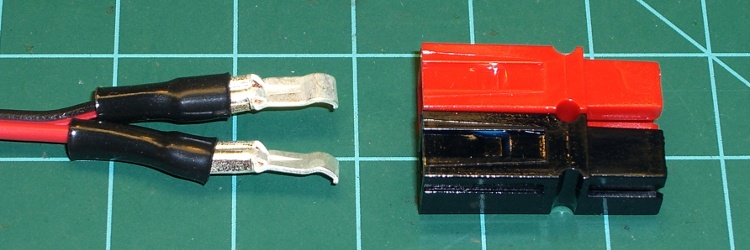
    This is quick & easy. When you’re making a Powerpole connector, shrink a length of small heatshrink tubing over the end of the terminal after crimping.

    Heatshrink tubing stress relief for Anderson Powerpole terminals
    Heatshrink tubing stress relief for Anderson Powerpole terminals

    You can’t cover the entire crimped region, lest the terminal not snap into the housing, but halfway seems to work fine.

    The goal is to keep the wires from flexing right at the end of the terminal, which is exactly where they’ll break.

    I’ve also wrapped a length of self-vulcanizing rubber tape around the entire connector housing and the wire, which is appropriate for high-stress applications. Looks hideous, though, not that that matters much.

  • Bike Lighting: Automotive Specs

    Having recently taken a thorough drubbing on the ‘Bentrider forums for having a rear-facing white light on my bike, I should accelerate my plans for a red / amber taillight.

    This Philips LumiLED app note gives some specs on automotive lighting. The one we bikies all tend to ignore is the surface area: greater than 37.5 square centimeters for rear combination stop-turn fixtures. Call it a scant 4 inches in diameter. You’ve never seen a bike light that large, have you?

    LED combo tail stop light
    LED combo tail stop light

    Maybe the right thing to do is start with a street-legal truck light and build some electronics around it. This is a 4 inch diameter, 44 LED rear light with both taillight and brake light terminals. At 12 V, the taillight draws 10 mA and the brake light is 250 mA. Got it from Gemplers with a recent order, but they’re certainly not the optimum supplier if that’s all you’re buying.

    Obviously, it’s unreasonable to run a 3 watt taillight on a bike, as the most recent crop of single-LED killer headlights are merely a watt or three. Battery life remains a problem.

    At 10% duty cycle the brake LEDs would average 300 mW. That might be roughly comparable to the running lights on some cars these days.

    With the taillight constantly energized and the brake flashing at 4 Hz, it’d be 120 + 0.5 * 300 = 270 mW.

    That’s more reasonable. With a 50% efficient upconverter to 12 V, that’s half a watt. Start with 4 AA cells, triple the voltage, draw 100 mA, runtime is 1500 / 100 = 15 hours. Good enough.

    And it ought to be attention-getting enough for anybody! The only trouble will be fitting the damn thing on the back of the bike; fortunately, ‘bents have plenty of room behind the seat, so maybe attaching it below the top seat rail will work.

    Memo to Self: The rear reflector must be something like 3 inches in diameter, too. We ignore that spec, too.

  • Best. Recumbent. Bicycle. Advertisement. EVER.

    Best Recumbent Bicycle Ad EVER
    Bicycling Magazine, August 2009, page 35

    Let’s quote that text so you can read it (or click the picture for a bigger one):

    Yeah… we’re talking down there. With lots of supporting data that says prolonged riding while your boys are numb is a no-no, we decided to build a saddle you can fine-tune to fit… you.

    Speaking of prolonged riding, the current hour records:

    • Upright bike: 30.882 miles
    • Recumbent: 56.2948 miles

    Sam Whittingham (who also holds that recumbent hour record) recently set the new human-powered land speed record at Battle Mountain: 82.43 miles per hour. Yup, pedaling a bicycle, on level ground, in minimal wind.

    Admittedly, he was riding a recumbent that bears as much relation to the Tour Easy I ride as a Formula One car bears to yours. On the other paw, those Tour de France bikes aren’t exactly factory stock, either.

    If you want to go as fast as you can on a bike, you want a recumbent. Unless, of course, you’re doing UCI races, in which case you may go as fast as they’ll allow you and wreck your body in the process.

    When you get back from a ride on a recumbent bike, no matter how long you rode the bike, not only do all your parts still work, but nothing hurts. What’s not to like?

    My earlier musing on bike performance is there. Clicking on the “Recumbent Bicycling” category summons forth more posts…