The Smell of Molten Projects in the Morning

Ed Nisley's Blog: Shop notes, electronics, firmware, machinery, 3D printing, laser cuttery, and curiosities. Contents: 100% human thinking, 0% AI slop.

Author: Ed

  • Why Friends Don’t Let Friends Run Windows: Mystery Banking DLL

    So I signed into the credit union’s online banking site, did the multi-factor authentication dance, and was confronted with this dialog box…

    HVFCU Mystery DLL Download
    HVFCU Mystery DLL Download

    No, as a matter of fact, I did not choose to open ibank.dll, thank you very much for asking.

    Well, what would you do?

    Got this response from the credit union’s email help desk:

    Upon speaking to out Information Technology department, I have been advised that this is a known problem for FireFox, Mac, and Linux users.

    Hmmm, well now, Internet Explorer is conspicuous by its absence on that list, isn’t it?

    A bit more prodding produced this response:

    HVFCU uses a third party vendor to provide the Internet Banking software used on our servers.  On November 22 we installed the equivalent of their year end release (which is mandatory due to regulatory changes contained in the release).  Subsequent to that upgrade we discovered that errors had been introduced for Mac and/or Linux users of Safari and FireFox (and also for a small subset of Windows Internet Explorer users).  These same errors do not occur on Safari nor FireFox running on Windows.  We reported these problems to our vendor within 24 hours of the installation.

    My guess is that the “small subset of Windows Internet Explorer users” corresponds to the few who actually armored-up their IE security settings enough that it doesn’t automatically download and execute anything offered to it from any website.

    The rest, well, those PCs are most likely part of a zombie botnet.

    He assured me:

    The “ibank.dll” program cannot run on a Mac nor a PC.  It is solely a server side application which generates HTML pages.

    Just guessing here, but if the “misconfiguration” had extended to actually serving the file, well, it probably would have run just fine (or, at least, attempted to run) on any Windows PC. They are, after all, using DLLs on the server, so it’s not like they’re a Unix-based shop.

    And it’s pretty obvious that their vendor’s testing extended only far enough to verify that the code worked with security settings dialed to “Root me!” Maybe they didn’t actually do any testing at all; this was, after all, just an end-of-year update. What could possibly go wrong?

    If you’re wondering why your Windows-based PC has been behaving oddly, maybe you’ve gotten a drive-by download from a trustworthy site with all the appropriate icons on their home page.

    Makes you really trust the banking system, doesn’t it?

    Or maybe it’s just another reason to stop using Windows…
  • Ambient Room Light Intensity

    The Totally Featureless Clock has been running continuously for the last few months, with a laptop dutifully recording its trace output. Occasionally the USB link will disconnect, but on the whole it works pretty well; the clock continues to run even when the USB link fails.

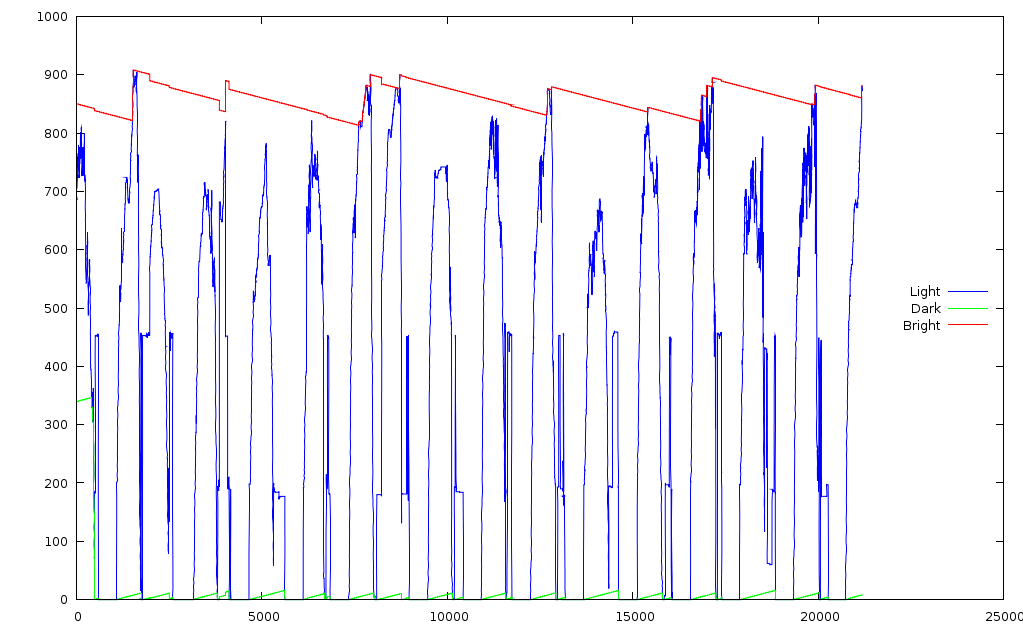
    Here’s about three weeks of light intensity record. The red trace is the max value, green is minimum, and blue the current intensity. The min and max tend toward the middle, one count per hour, so they don’t stick at the extremes.

    Light Intensity
    Light Intensity

    The peaks represent daylight hours, zeros are overnight, and the overall scale is roughly logarithmic, more or less, kinda-sorta.

    The general idea is that the LED brightness matches the room illumination, with the min & max values tracking the actual ambient light range to get the most benefit out of the TLC5916’s limited dynamic range.

    You can spot the data dropouts where the red trace steps abruptly; it should decline smoothly from each peak and the peaks should be evenly spaced about 24 hours (1440 minutes) apart. Each minute generates three lines with the exact time, so it would be possible to futz around and timestamp each record, but …

    The clock dumps the ADC values in hexadecimal, which gnuplot can’t handle, so a bit of preprocessing is in order.

    cat *log > 0.txt
    grep Light 0.txt > 1.txt
    sed 's/Light: /0x/g;s/Min=/0x/g;s/Max=/0x/g' 1.txt > 2.txt
    gnuplot
    set key on right center
    plot "2.txt" using 1 with lines lt 3 title "Light", (and so forth)
    

    All in all, it seems to be working as intended. When I put it inside the case, I’ll probably have to increase the resistor to account for the dark-gray faceplate.

  • Little Brown Bat

    Brown Bat in Skinner Hall - Vassar
    Brown Bat in Skinner Hall – Vassar

    We attended a concert at Vassar College and found this fellow flitting about an upstairs hallway in Skinner Hall. He eventually settled down atop a door frame and I took this picture from across the hall; it’s a tiny crop from a much larger image because I didn’t want to spook him.

    He’s most likely a Little Brown Bat and perfectly harmless. Anybody who can eat that many insects gets a free pass from me!

    He was at least as scared of us as some of the students were of him. Flying in a hallway full of running people must be bewildering…

    Somebody called Campus Security and I suppose they wiped the little guy out during the second part of the concert.

  • Acrylic Sheet Thickness Variations

    Milling plate thickness
    Milling plate thickness

    So I measured the thickness of the black acrylic sheet I’m using for the Totally Featureless clock and machined the rabbets to match. Went to assemble everything and the rabbets are too shallow!

    Come to find out that the sheet varies in thickness from about 0.437 to 0.475 across the four pieces I’d cut and, of course, I’d measured the thinnest end of the thinnest piece. Makes no sense to me, as I’d expect the thickness to be pretty well controlled over a few feet of sheet, but that’s not how things went down.

    The simplest solution was to mill a flat on the inside of the case to match the rabbet, so all four panel ends were the same thickness. The sketch below has the straight dope.

    Acrylic sheet thickness fix
    Acrylic sheet thickness fix

    Milling with a 3/8-inch end mill at 2500 rpm, 10 ipm, in one pass with no cooling was OK.

    I’ll insert some brass shimstock into the rabbets to make the outside edges wind up flush.

  • Sherline: Milling a Too-long Rabbet

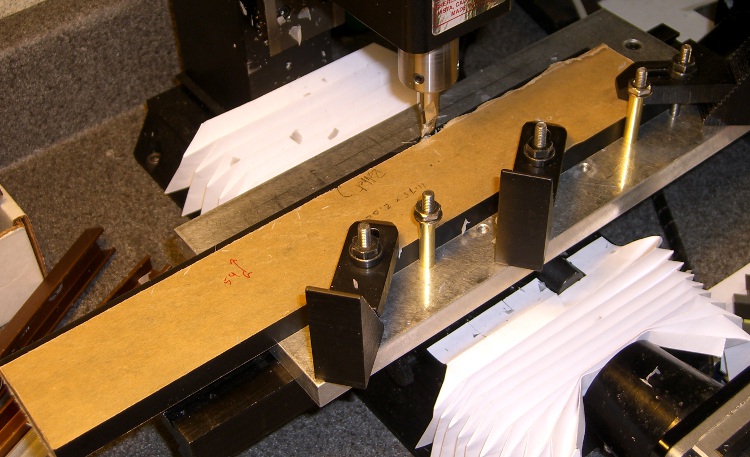
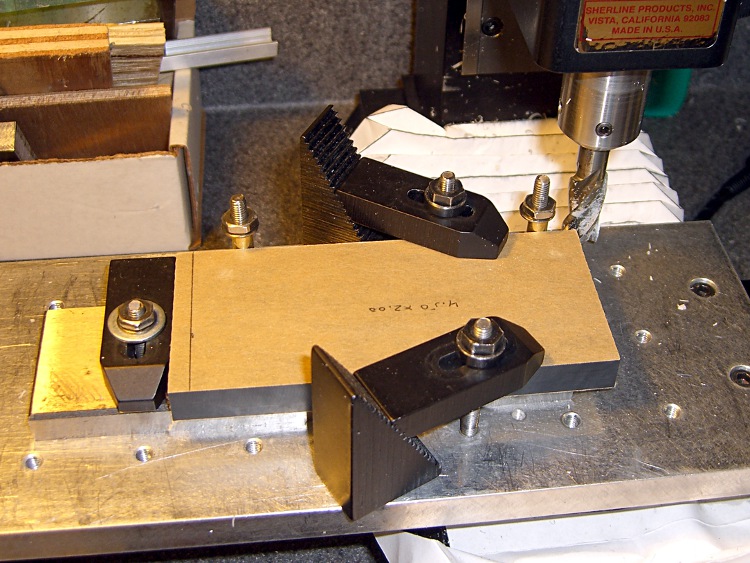
    This is pretty much the same general idea and setup as the one I described there, but with the panel flat against the tooling plate.

    Milling rabbet on top panel
    Milling rabbet on top panel

    The cutter sits at the far right end of its maximum travel. I made the rabbet in three manual CNC passes.

    To set up for the rest of the cut:

    • G0 X-4.25 to clear the left end of the panel
    • Loosen the three clamps, slide the panel leftward
    • Push the panel against the brass tubes
    • Tighten the clamps

    And away we go…

    Complete rabbet
    Complete rabbet

    One disadvantage: you can’t do a final finishing pass along the entire length of the cut. There are tool marks at the stopping point, but nothing really objectionable on the back of a clock where a panel will cover the rather ugly guts.

    The brass tube “locating pins” work surprisingly well.

    About 2000 rpm with 3/8 inch end mill. Cut 1/8 inch wide and 0.25 inch deep @ 10 ipm in three passes. Finish pass 15 ipm at 0.257 deep to make it pretty.

  • Red-Tailed Hawk On Watch

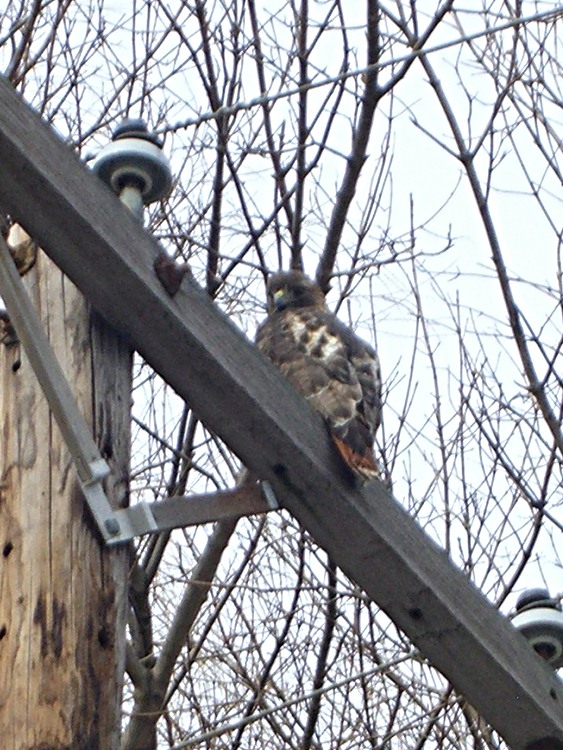
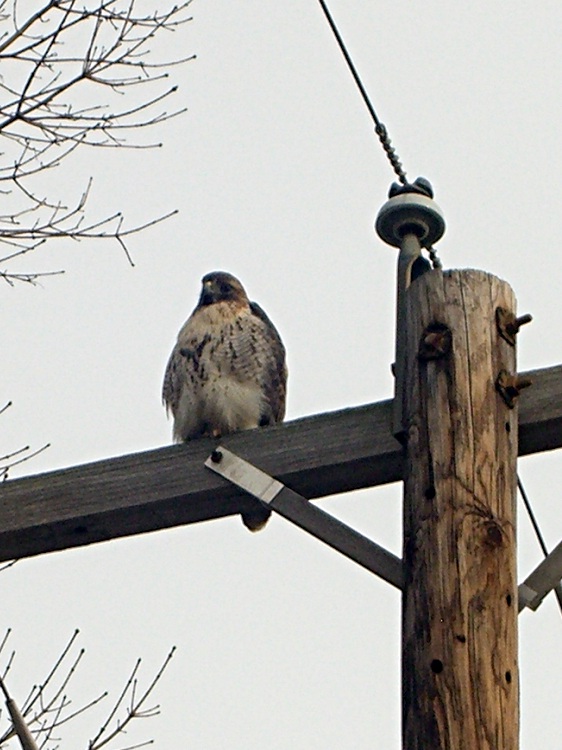
    Saw this chap on a walk around the neighborhood.

    It was quite cold (notice his fluffy down coat) and he was content to watch us go by. In fact, it was so cold the crows were just flying by without doing their usual hawk harassment.

    Taken with a Casio ZX-850 pocket camera: no fancy optics. Looks it, too… these are tight crops from much larger images. Click for bigger, but not wonderfully detailed, images.

  • Sherline: Milling the Ends of Too-long Acrylic Panels

    Having flycut the acrylic panels to the proper width, I had to cut them to the proper length, too. This picture shows the lashup I used to hold them down during the operation…

    Clock top panel fixture
    Clock top panel fixture

    The brown bar sticking out to the left is one of the bookshelf struts that held the toolmaker’s vises down during the flycutting; it’s now secured to the Sherline table with a T-nut. A vise clamped to the bar serves as an end stop for the panels.

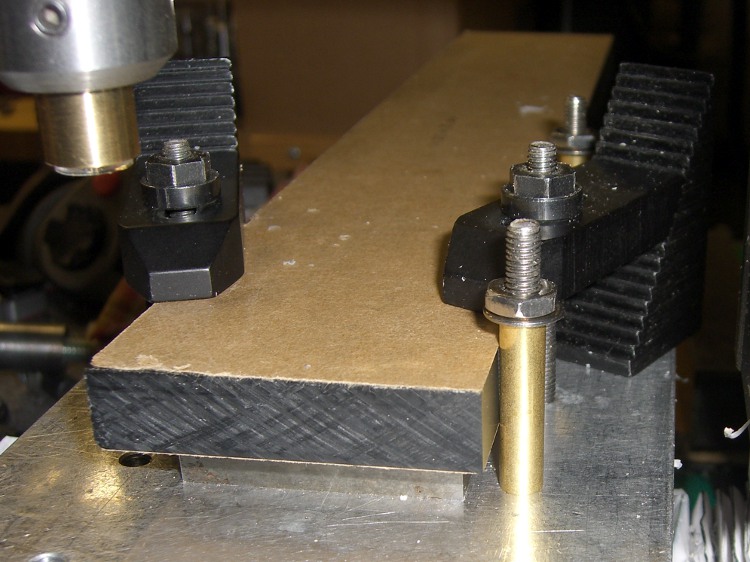
    Brass tubing locating posts
    Brass tubing locating posts

    A pair of brass tubes around studs serve as locating pins. To get the things lined up:

    • Loosely clamp a panel down atop a spacing plate
    • Push it back against the loose tubes: crudely parallel to X axis
    • Snug the clamps
    • Align the panel to the X axis using the laser
    • Push the tubes against the panel
    • Tighten their nuts
    Top panel end trimming detail
    Top panel end trimming detail

    Crude, but good enough for this purpose.

    Then a bit of manual CNC to shave off the end. Half-inch mill, 1500 rpm, 150 mm/min, more-or-less 0.5 mm cuts. The panels don’t have to be any exact length, as long as the clock circuit boards fit inside, but the ends must be perpendicular and smooth for good gluing.

    The exact part will come when I rabbet the side panels…

    The side panel setup was much simpler: same brass posts, same spacer, no need for the long bar hanging off to the left.

    Side panel fixturing
    Side panel fixturing