Ed Nisley's Blog: Shop notes, electronics, firmware, machinery, 3D printing, laser cuttery, and curiosities. Contents: 100% human thinking, 0% AI slop.
I ran into an amusing situation on a recent family bike ride with our GPS-to-APRS trackers running: my ladies were transmitting a few seconds apart. As a result, I had to listen to a pair of very short data bursts in quick succession throughout the whole ride.
Under normal circumstances that doesn’t happen, because I set the TinyTrak3+ trackers to delay during and wait a second after a voice PTT that collides with an automatic beacon. Somehow they never managed to delay an APRS beacon to knock the synchronization off kilter.
So I tweaked the automatic transmission intervals to make us relatively prime: 179, 181, and 191 seconds. That’s close enough to the original 180 seconds as to make no difference, while now ensuring that we won’t collide with each other for very long even if we should get aligned.
An alternative is SmartBeaconing, which I’ll turn on in a while after I collect a bit more data.
If you have some spare CPU and power, you can join the Great Internet Mersenne Prime Search and help find new primes, albeit ones much larger than I need…
The remote cable for the Yaesu FT-857 I have in the car terminates in an 8-pin modular plug. The connector body has a cutout for the round rubber (?) insulation around the cable; it’s not set up for a standard flat 8-wire network cable. However, the cable makes a right-angle bend immediately outside the Front Panel to fit inside the confines of the remote mounting case, which pulled the insulation out of the connector.
Connector with displaced insulation
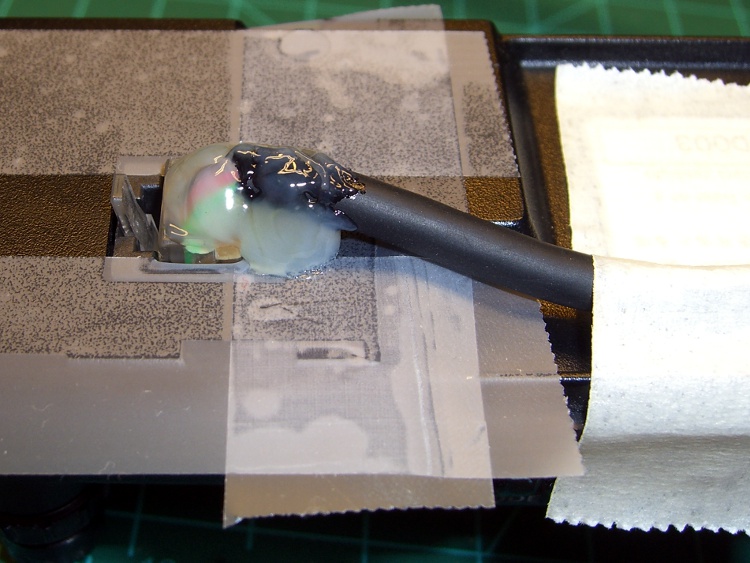
The electrical connections are fine, but that can’t last. I finally got around to armoring that bend to (I hope!) prevent any problems. Contrary to what you might expect from my proclivity to blob epoxy on everything, I blobbed on hot-melt glue to hold the wires in place, as well as turn a bit of the cable into a rigid body. Even in a hot car, this ought to work fine…
Connector with hot-melt glue
I put some ordinary adhesive tape on the back of the Panel, butted up against the connector body, to keep the glue out of the socket and off the (back of the) Front Panel. That prevents the connector from becoming one with the Panel.
Pause while the glue solidifies, release the latch and pry the connector+glue off the tape with a small screwdriver, trim the excess glue, then peel the tape off the Panel. The connector snaps into place just like it should and the wires no longer have any freedom of motion.
Here’s what the modified connector looks like in all its glory. The cable really does bend downward slightly beyond a right angle in order to fit into a recess in the Front Panel.
Finished connector kludge
This isn’t suitable for a connector getting a lot of the old in-out in-out, but the Front Panel remains in place for months at a time and this should delay the inevitable failure.
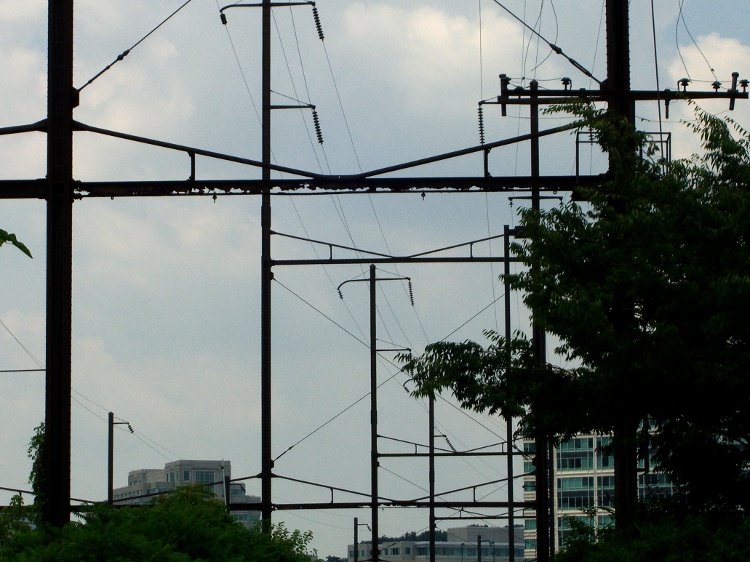
Saw this while riding along a rail-trail route west of Philadelphia. Evidently they left the catenary support structures standing over the trail to carry the (still energized!) power lines, but the I-beams webs across the trail have rusted completely through.
Rusted railway catenary support
Verily, rust never sleeps… I wonder if they ran diesel locomotives along this part of the line?
The beams across the active railway seem to be in fine shape.
The rear wheel of my bike popped a spoke while I was riding along a section of unimproved trail trail. Actually, it’d be more accurate to say “as-abandoned” railway line; they ripped out the ties and graded the baby-head ballast more-or-less level. It wasn’t really suitable for a long-wheelbase recumbent bike, but I really hate white-water rafting, which was the other choice.
Anyhow.
Of course, the broken spoke was on the sprocket side of the rear wheel. I discovered this when we were out of the most rugged section, so I have no idea how long I’d actually been abusing the wheel.
I released the rear brake, gingerly rode to the campsite, then installed the FiberFix emergency spoke I’ve been carrying around for a few years. After snugging the cord and tightening the nipple, I added a turn to each of the two adjacent spokes, making the wheel true enough to continue the mission.
FiberFix spoke in action
The other end simply passes through the spoke hole in the hub. It doesn’t mind the deformation pressed into the hub.
Hub end of FIberFix spoke
Much easier than removing the sprocket cassette under field conditions, that’s for sure!
Back home in the shop, I installed a new spoke, tightened it up to match the others, backed out the extra turn in the adjacent spokes, and the wheel trued right up.
I originally built the wheel using a Park Spoke Tension Meter, which is a wonderful tool. If you build wheels, even occasionally, you really, really need one. Lace ’em up, tighten uniformly, then tweak just a little bit for a perfectly true wheel.
And, yeah, Phil hubs on all three bikes. I hate adjusting bearings. The man is gone; may his legacy live forever.
Mary’s feet are exquisitely sensitive to irregularities in the insoles of her shoes, which poses a real problem with her bike shoes: those SPD cleat recesses are no good at all.
This is a view down into one shoe, with the SPD cleats adjusted all the way to the rear. That leaves a large recess in the front, which was painfully obvious to her sole. The white shape is the gap filler…
I pressed a sheet of paper across the gap to get the general shape, traced it twice onto a slab of 0.060-inch aluminum with a nice pebbly paint job, and cut the two pieces out. A few conversations with Mr Belt Sander, a few licks with a rat-tail file, and they dropped right onto place. The recess is slightly curved, but I didn’t have to bend the pieces to fit.
I laid duct tape across the whole affair, put the insoles back in place, and it was all good.
The backing plate is 0.072 inch thick and she was content with the difference.
In previous shoes, with the cleat near the middle of the adjustment range, I’ve stuffed epoxy putty into the gaps. That works, but it doesn’t bond to the (miracle engineering plastic) soles and tends to crumble. This is Not A Good Thing…
The discussion following that post prompted me to take a closer look at the corroded spider. I planned to pull the spider off the back of the drum and examine the pieces, but a week of dribbling thread lube around the bolts left two of them firmly affixed.
While I don’t have it completely apart yet, some observations are in order…
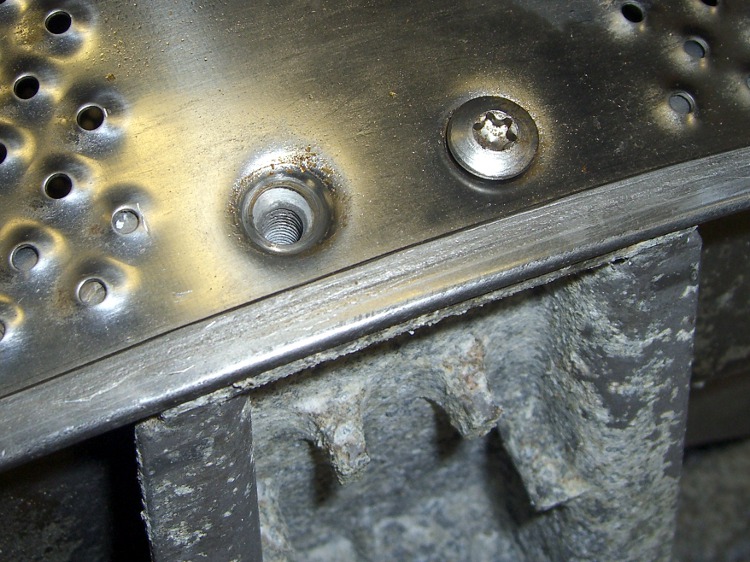
Spider mounting bolts through drum
The bolts are stainless steel and utterly immovable with the usual screwdriver-handle-mounted Torx bit. I got the first two bolts out by putting a T30 bit in a 1/4-inch socket in a ratchet wrench and applying brute force.
A few days of thread lube (the incomparable PB B’Laster) persuaded two more out of their lairs. The remaining bolts may require even more brute force, but I’ll give the lube a few more days to work its magic.
Despite that, the bolts and holes are not corroded. They may have some thread locker down in there, but I see little evidence of that. I think it’s just a case of being torqued down hard, then set adrift in ionic water for half a decade.
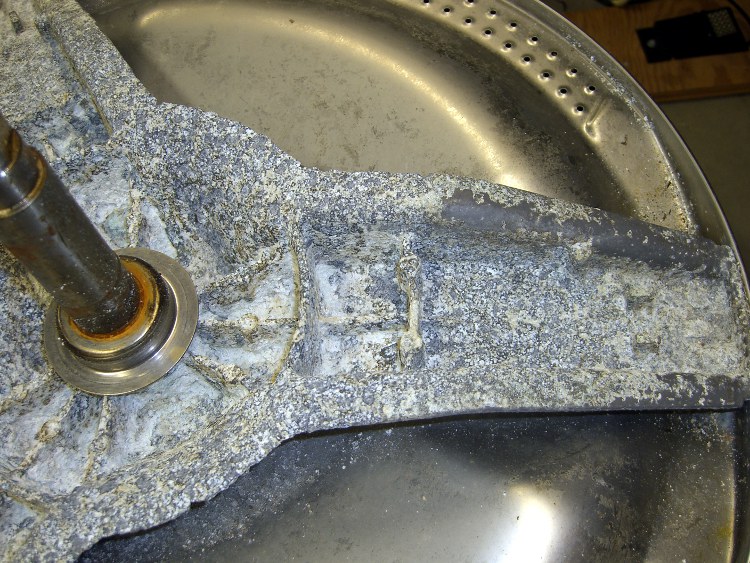
The outer third of each arm has a covering of corrosion products, but the metal below that (now dried and flaking) gunk seems undamaged. The arms have severe corrosion and cracking throughout the inner two-thirds of their length.
Spider corrosion
If this were chemical corrosion, I’d expect it to apply evenly throughout the length of the arm, because the presence of corrosion products over the entire arm indicates pretty good distribution.
However, galvanic corrosion should follow the same pattern, so I’m not sure what to make of this.
The fact that an oxidation layer on the stainless steel tends to passivate it may not really matter. Compare the surface areas of the drum and the spider: there’s a whole lot more drum than spider, so even a passivated drum could provide enough current to rot the spider.
The ends of the spider spend their lives whipping through the water inside the tub at a pretty good clip. That could dislodge most of the crud and leave them reasonably clean, at least compared to the hub that moves more slowly (same rotational speed, smaller radius). It’s also true that the water level never reaches the hub, remaining below the level of the door seal.
Thus, the hub probably gets splashed, but never immersed, and thus has no way to remove any contaminants. The corrosion products simply build up there, keeping it wet throughout its life.
I maintain there’s little drying going on, even with the door open, in the relatively short intervals between washings. The hub region would be least likely to dry, however, because there’s absolutely no ventilation back there.
All that notwithstanding, this corrosion should not happen.
I’d very much like to see some measurements: we’re all obviously guessing at the conditions. The plastic tub surrounding the drum has a port for the rear vent near the perimeter, so it’s possible to get a (cramped, inconvenient) look in there without tearing the washer apart.
We spent the night aboard BB62 in Camden NJ, with our bikes lashed to a post on the dock. Follow the light-color brick track from the upper-left GPS point across the dock to the black dot marking a memorial stone: we tied up just to the left of that spot.
Position Jitter – ZNU at NJ2BB-15
NJ2BB-15 is the APRS digipeater aboard BB62 with an antenna high in the superstructure. While I didn’t have any trouble with RF reception, packet collisions pose a problem in a dense urban environment. For what it’s worth, essentially everything in the superstructure is an antenna; the NJ2BB ham shack is a wonder to behold.
BB62 starboard side
The point-to-point jitter is about 20 meters (18.52, says the GPS info dump), so you’re looking at the un-augmented GPS accuracy of a long-term stationary object. I’m sure there’s a slight registration mismatch between the satellite imagery coordinates and the GPS coordinates, enough to put the upper-left point across the dock.
If you get the chance, take the tour. The guides are retired Navy, some served aboard BB62, and they take their storytelling duties very seriously. The bunk space, even with air conditioning, is claustrophobic at best; a tip of the bike helmet to you folks who live in these machines!
[Update: Our daughter discovered three itchy bites in a line across her tummy the morning after spending a night in the bunks. That means BB62 has bedbugs, which you do not want to bring home in your luggage. As a result, I cannot recommend an overnight on BB62, alas. We wish she’d mentioned that before we got home…]
[Further update: when I reported this to the folks at BB62, they had an exterminator check out the berthing spaces and conclude they have no bedbugs on board. That’s encouraging, but I still heartily recommend that you follow the same decontamination procedures that you should use after all trips.]
It turned out one rider in our group was an active-duty Rear Admiral who, evidently, could (or should) have supervised the signal gun firing after Colors and Taps. She was traveling incognito, though, and didn’t stand on ceremony.






 The Smell of Molten Projects in the Morning