The Smell of Molten Projects in the Morning

Ed Nisley's Blog: Shop notes, electronics, firmware, machinery, 3D printing, laser cuttery, and curiosities. Contents: 100% human thinking, 0% AI slop.

Author: Ed

  • Biting Through the Bite Valve

    I carry a water pack behind the seat on my Tour Easy, with the hose over my left shoulder and the valve captured by a magnetic thingie pinned to my shirt. On a recent ride I hit a substantial pothole while drinking from the tube and managed to bite completely through the miracle plastic “Bite Me” valve, mostly due to clenching my teeth in concentration rather than from the impact.
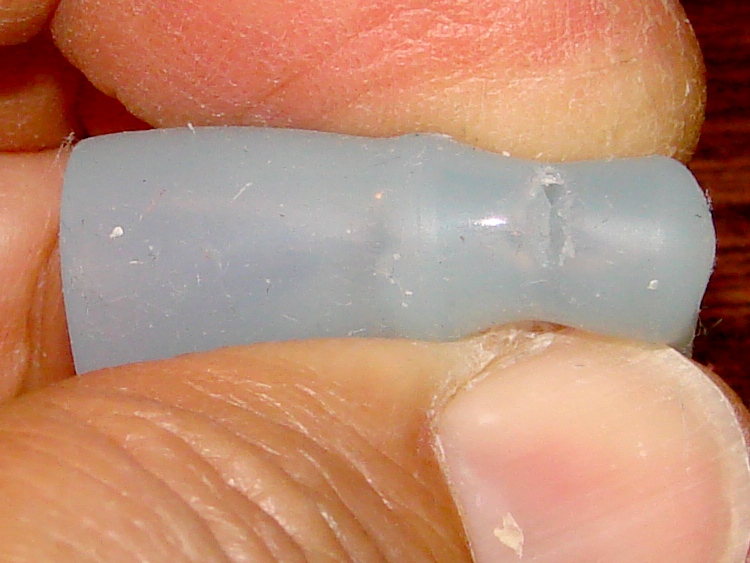
    Bitten bite valve
    Bitten bite valve

    A few days later my dim consciousness finally took note that the water kept draining down into the pack between sips: every sip came with a mouthful of air.

    A year or so ago, the original valve developed a nasty case of embedded gunk and I picked up a quartet of Genuine Nalgen valves (or a credible imitation thereof) from the usual eBay supplier. I wonder if the reservoir and tubing will outlast the remaining two valves?

  • Plastic Screw-top Flashlight Fix

    As part of my clear-off-the-workbench effort, this flashlight emerged from the dark depths. It’s a few decades old and wasn’t a good design: the “switch” is a simple contact between the end of the cell casing and the reflector rim, activated by screwing the reflector tighter on the case.

    Broken flashlight case
    Broken flashlight case

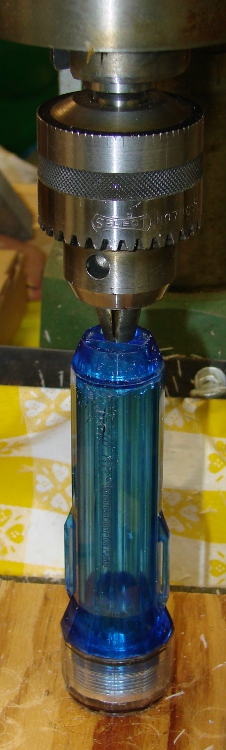
    The failure is simple: the case cracks through at the stress raiser formed where the “switch” contacts rest on a sharp inside corner. That stiff little spring maintains pressure on the cells, so the case is always under tension and eventually fractures.

    Flashlight clamped in mill
    Flashlight clamped in mill

    I grabbed the broken pieces in the lathe, turned off the fractured plastic, and wound up with a pair of nicely mating surfaces (and a somewhat shorter flashlight, but it’s still long enough). Apply enough Plastruct solvent glue to soften the new faces, then clamp them together. The big manual mill knows how to apply a strong, steady vertical force to a project like this.

    It’s once again hanging by the basement door, where it gets used roughly once every other blue moon (yeah, it’s color-coordinated). This isn’t the first time this flashlight has failed that way, but it’ll be the last: next time, it’s in the trash.

    Honest, I swear it!

  • Screwdriver Bit Ball Repair: Rubberdraulics!

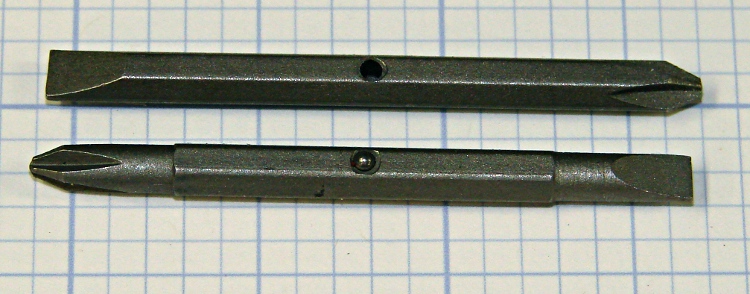
    Went to use a small multi-bit screwdriver and the bit fell right out: evidently, the ball wasn’t swaged tightly enough; it and the spring went walkabout. Given that I don’t know when or where that might have happened, there’s no chance I’ll ever see those parts again.

    Screwdriver bit with missing ball
    Screwdriver bit with missing ball

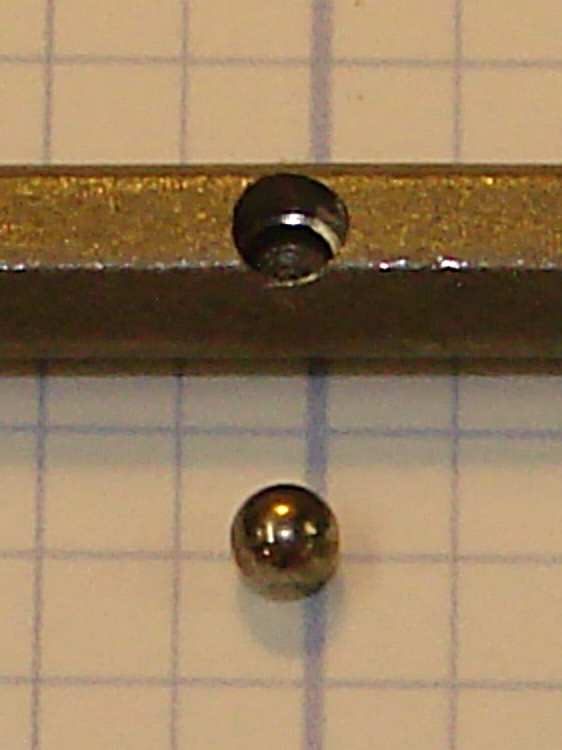
    But I do have some 2 mm steel bearings that aren’t grossly oversized, so all hope is not lost. Alas, I have no idea what sort of spring to put in there, other than that I don’t have one of those.

    Drilled hole with ball
    Drilled hole with ball

    This looks like an application for rubberdraulics: use compliant silicone snot rubber as a spring. Lautard described a use with a lock ring and an external screw to apply pressure, but here it’ll work fine to allow a small motion for a tiny ball.

    Drill out the recess barely larger than the ball: the slight clearance allows the cured rubber to squish out around the ball. I clamped it in the Sherline vise and jogged into position by eyeball, then poked a hole with G83 down 1.5 mm. The original recess was a bit over 2 mm deep, so there’s plenty of room for the silicone in the bottom.

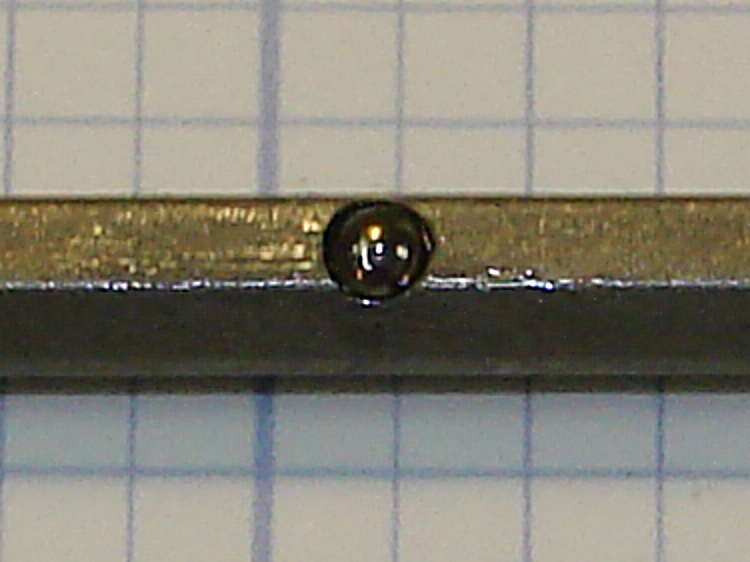
    Then mush some silicone into the hole, install the ball, push it down until it stands barely proud of the surface, scrape off the excess rubber, and let it cure overnight.

    New ball in place
    New ball in place

    There, now, that wasn’t so bad, was it?

  • Homebrew Mini-ITX LPT Bracket

    I’m putting together an Atom 510 box to replace the ancient Dell currently acting as the Sherline CNC controller, with the intent of seeing whether a rather anemic low-power CPU with two cores will work as well. The system board has room for one PCI card and I figured I’d install a second parallel printer while I had the hood up.

    But then I realized that the only LPT cards in my stash had tall brackets that wouldn’t fit in the new mini-ITX case.

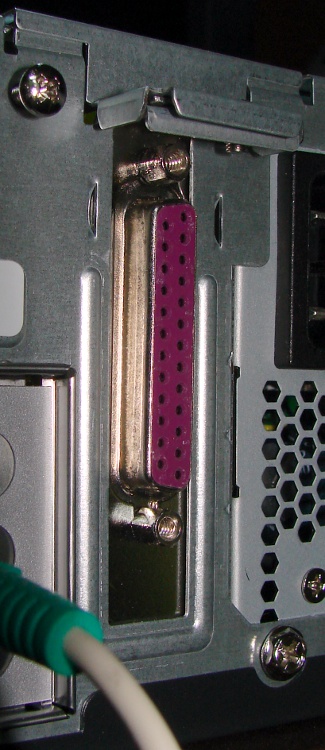
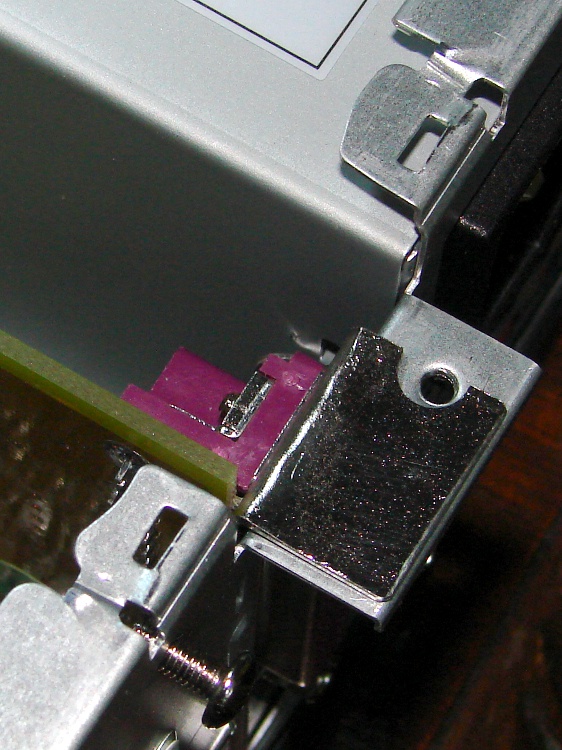
    Well, it turns out that the LPT card itself would fit in the box, so all I had to do was reshape the bracket:

    • A bit of filing on the bottom knocked off a millimeter and put a tidy taper on the tab
    • A brief session with Mr Hammer bent the top flange over, so as to meet the case mounting flange
    • A somewhat surprised tin snips removed the excess length
    • A cylindrical file chewed out a somewhat generous screw clearance notch
    Finished LPT bracket
    Finished LPT bracket

    And then it’s just a matter of screwing things together.

    LPT Bracket - outside
    LPT Bracket – outside
    LPT Bracket - top
    LPT Bracket – top

    I’ll admit the clearance from the top mounting screw to the flange is terrifyingly cozy, but I’m not averse to applying force majeure to either an unsuspecting LPT connector or the case itself…

    The top view omits the screwdown clamp that secures the card to the case so you can see where the screw notch goes.

  • AA Cell Holder: Fragile Contacts

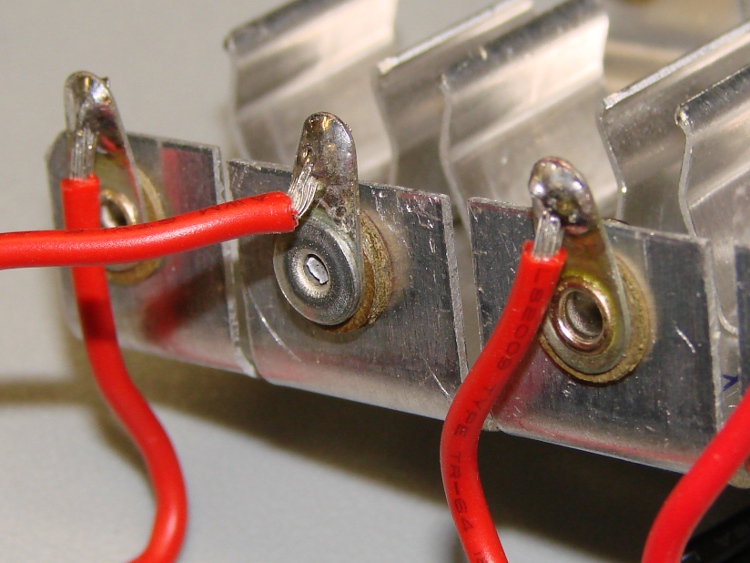
    Broken cell holder contact
    Broken cell holder contact

    It seems I applied a bit too much pressure to one of the contacts on a metal AA cell holder: the outer rim of the rivet holding the solder tab in place departed for the distant reaches of the Basement Laboratory.

    No big deal, I thought: pop another rivet in place and get back in operation…

    You really want the rivet to go in with the flat head inside the cell holder where the original flat head was. Unfortunately, the rivet yanker’s head won’t fit into the holder; I’m pretty sure the manufacturer has a Special Machine to make that happen.

    So I put the reinforcing washer and lumpy end inside. That meant switching the insulating washers to keep the overall distance from the negative cell contact about the same.

    Cell holder rivet - inside
    Cell holder rivet – inside

    The outside looks much better…

    Cell holder rivet - outside
    Cell holder rivet – outside

    For what it’s worth, these pix came from the Sony DSC-H5 with the flash turned down 1 EV. Much better results than the Casio EX-Z850, even with its flash set to Soft (whatever that is). The H5 has much better macro capability… and with the new Eneloop cells, it lasts long enough to make it usable in the shop.

  • Erosion at Work

    Exposed cable anchor
    Exposed cable anchor

    Many years ago, I suppose Central Hudson (the local power utility) drilled a hole into this shale bank, poured in some concrete, and planted an anchor for a pole guy rope.

    Time passes…

    Perhaps this is the result of putting a parking lot behind what’s now the Adriance Library’s Arlington Branch; the asphalt level is two feet below the base of that exposed concrete slug and extends rather close to it. I wonder if the excavators took away too much shale and erosion has continued the process.

    The anchor looks bent, doesn’t it? The pole certainly carries more wires and cables than it did earlier in its career; that lower wire may be exerting more force than is strictly desirable.

    It’ll take a lot more time before this becomes a real problem…

  • LED Worklight: Innards Thereof

    So I added a cheap 72-LED worklight as a box-filler to a recent order. Popped in four AA alkaline cells, clicked the switch, and … huh, that thing looks dim.

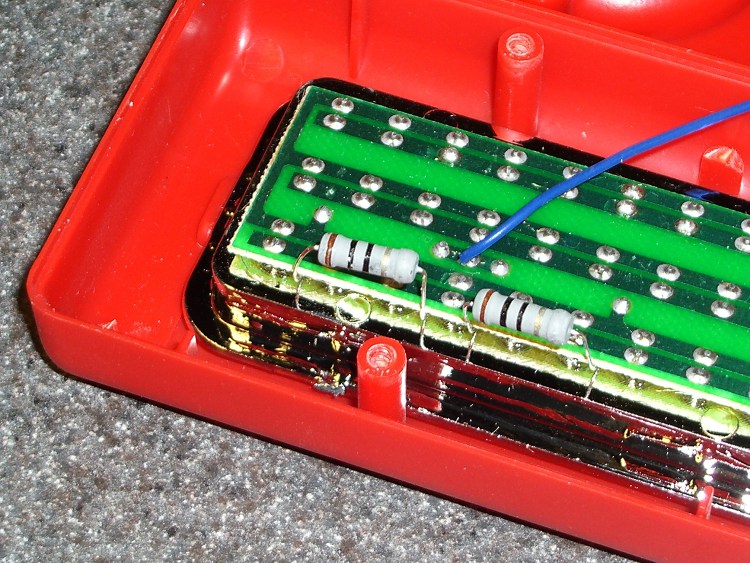
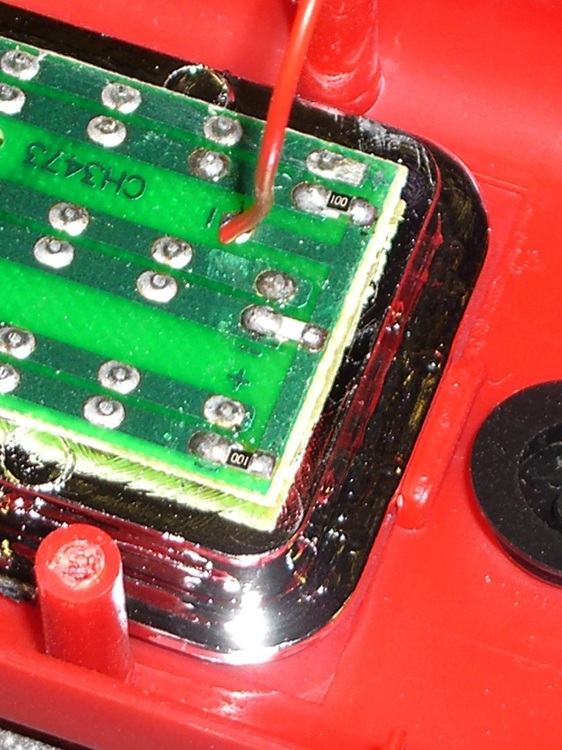
    Took it apart and what do we find inside? Resistors!

    Over on the left lives a pair of 10-Ω resistors that limit the overall LED current. They’re in parallel, so it’s running with a 5-Ω ballast.

    LED ballast resistors
    LED ballast resistors

    Over on the right, each string of 24 parallel LEDs has a separate 10-Ω equalizing resistor.

    LED equalizing resistors
    LED equalizing resistors

    A quick ammeter check gives the dismal news: total current is 220 mA = 73 mA per string of 24 LEDs = 3 mA per LED.

    Well, no wonder why it’s dim!

    The ballast resistors drop 0.22 x 5 = 1.1 V, each equalizing resistor is good for 0.073 x 10 = 0.73 V, and (as you’d expect) the LEDs run at about 4 V.

    Run it on rechargeables and it’s much worse.

    Given the low price, I’d expect these LEDs to fall over dead if I goosed them all to 20 mA… not to mention, 0.02 x 72 = 1.44 A is a pretty stiff load for alkalines and the housing wouldn’t stand up to nearly 9 W of power dissipation.

    Ah, well, it’ll come in useful here & there…