Ed Nisley's Blog: Shop notes, electronics, firmware, machinery, 3D printing, laser cuttery, and curiosities. Contents: 100% human thinking, 0% AI slop.
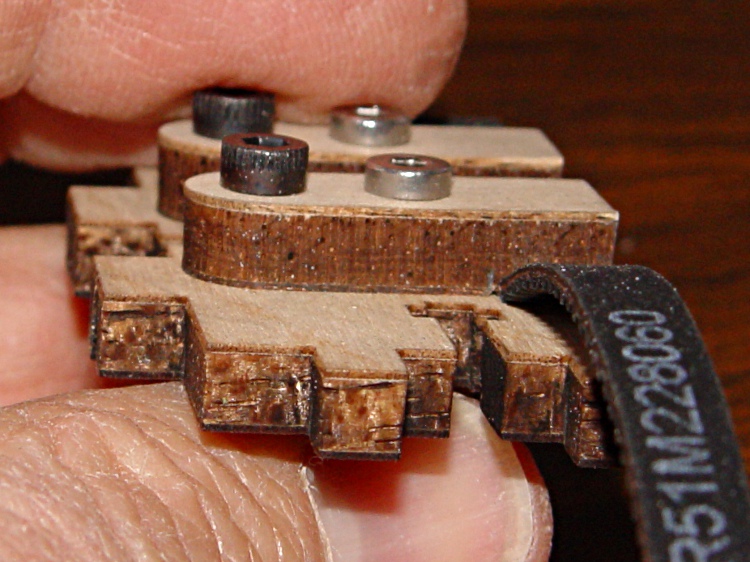
The laser-cut plywood clamps holding the timing belts to the drive ribs slant diagonally across the rib + belt and secure one edge of the belt.
Belt clamp before modification
While this certainly works, it offended my sensibilities and is probably why the instructions call for that low-profile bolt.
Introducing the belt clamp to Mr Disk Sander provided just enough relief to clear the belt’s backing, while not making for a sloppy fit. In round numbers, if you barely trim off the plywood veneer it’ll be about right. Use an ordinary file if one of Mr Sander’s relatives doesn’t live in your shop.
Modified belt clamp
And then it works just like it should. If you were even fussier, you might chamfer the outer edges to allow the belt to lie flatter against the rib, but that’s in the nature of fine tuning. At least on my Thing-O-Matic, there’s plenty of air between a standard bolt head and the adjoining carrier rod.
Modified belt clamp in place
This is obviously not something you should dismantle your Thing-O-Matic for, but if you’re in the delightful position of facing that mountain of parts, this is perfect timing.
The MK5 Extruder’s DC motor seems prone to a shorted-winding failure that reduces the DC resistance of (at least) one pole to (at best) a few ohms. The A3949 H-bridge driver has an upper limit of 2.8 A, but the failed winding jams too much current through the chip and eventually (instantly?) kills it stone cold dead.
Discussions on the Makerbot Wiki tended to favor fuses. My buddy Eks suggested putting an incandescent lamp in series with the motor leads, as described there, and that’s what I’ve done. That discussion is also informative.
It’s worth noting that the A3949 datasheet has this to say about overloads:
Output current rating may be limited by duty cycle,
ambient temperature, and heat sinking. Under any
set of conditions, DO NOT exceed the specified
IOUT or TJ.
So all this may be irrelevant: any transient overload could kill the driver chip stone cold dead, regardless of how clever you (think you) are.
Anyhow.
Yesterday I came across my Big Box of Fuses and said the obvious thing:
Note: that’s not the same as the Famous Last Words “Hold my beer. Watch this!”
I clipped the oscilloscope across a 1 Ω power resistor, set a 3 A bench power supply to 12.0 V, and connected a Device Under Test between the +12 V lead and the resistor:
The #89 bulb from my TOM
A Littelfuse 3AG 1 A fast-blow fuse (actually, two of ’em)
A dead short
I used a 1 A fuse because that’s what I have. I strongly suspect a 1/2 A fuse would behave about the same way.
The oscilloscope trace starts at 0 V, jumps when the DUT contacts the resistor, and then settles at the final current. The 1 Ω resistor makes the vertical scale read directly in amps. Pay attention to the horizontal scale.
First, the lamp:
Type 89 Lamp
The peak current hits 4.5 A before the bulb lights up and limits the current to about 600 mA in the steady state. The supply’s current limiter doesn’t seem to come into play: the bulb wrestles the current under 3 A before the supply notices what’s going on. Indeed, it’s under 3 A in 2 ms and below 1 A in 20 ms.
Next, the fuse:
Littelfuse 3AG 1A Fast – 50 ms
The peak current starts off-scale high, well in excess of 7A, drops to the power supply’s 3 A limit, then falls to zero when the fuse blows 76 ms later.
Finally, the dead short:
Bare 1 ohm resistor
I changed the vertical scale to capture the initial peak, which tops out just under 10 A, obviously not limited by the power supply. The supply eventually clamps the current to 3 A and, because there’s no fuse, the current just sits there.
So…
The lamp does a much better job of protecting the H-bridge chip than the fuse:
The peak current is lower
It cuts off sooner
And the sustained current falls well within the chip’s limit
The TOM does not have a current-limited +12 V supply, which means a nominally “protective” fuse will conduct whatever current the failing motor’s winding will permit until it eventually blows. The time-to-blow depends on the fault current: if the winding fails at, say, 6 Ω the fuse will last much longer while it passes 2 A than with the 3 A you see here.
Here’s an example of how that works. The first time I tapped the fuse to the resistor, I flinched and it fell off:
Littelfuse 3AG 1A Fast – 20 ms
That’s indistinguishable from a blown fuse, but the same fuse subsequently produced this result (another fuse died to produce the first fuse picture):
Littelfuse 3AG 1A Fast – 100 ms
Moral of the story: a 1 A fuse can pass 3 A for 80 ms and live to tell the tale!
Of course, I knew how this would work out: Eks didn’t accumulate 100+ patents during his career by not knowing what he was doing…
The snarl of wires, cables, and filaments inside a Thing-O-Matic is a wonder to behold. A few cable clamps can tidy it up and reduce the chance that a loose wire will snag on a moving stage.
It’s probably a Good Idea to keep the thermocouple cable out of the bundle with the stepper cable, but, other than that, a few clamps inside the body work fine:
Cable clamp inside body
There’s another clamp inside the right-front corner that corrals the ABP cabling.
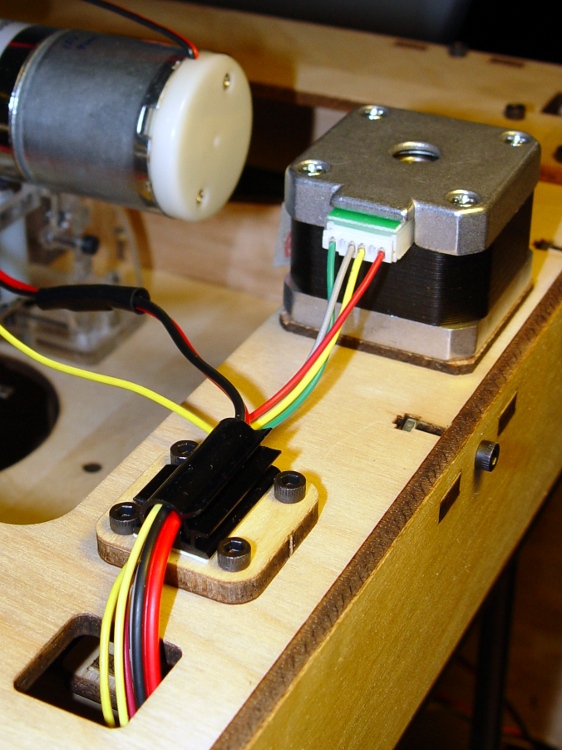
Atop the body, a clamp keeps the Z axis cable and Extruder motor wires under control. This was before I added Powerpoles and the Safety Lamp into the DC motor cable.
Cable clamp atop body
A little clamp immobilizes the thermocouple cable near the Thermal Core. The fat red wire across the top is the Thermal Core static drain and ground connection.
Thermocouple cable clamp
These clamps have an adhesive backing, which means you don’t have to drill holes and lose screws under the bench, and it’s not the end of the world should you stick one in the wrong spot.
The Y axis rods seem to be a bit too long for the overall case size; they stuck out the better part of 2 mm.
Y axis rod protrusion
I applied a 3/8-inch Forstner bit to the inside of the rod end caps to make a slightly-too-deep recess, then shimmed the hole with some cardboard to make the answer come out right.
Recessed Y-axis rod caps
The Z axis rods were just barely too long, but I did the same thing to those caps.
The next time you take your Thing-O-Matic apart, epoxy the damn nuts in place so you’re not going crazy trying to manipulate them.
Inside the ends of the Y axis stage, which makes removing the X axis rod covers trivially easy:
X axis rod cover nuts
Inside the front and back body panels, which makes removing the Y axis rod covers trivially easy:
Y axis rod cover nuts
That’s in addition to applying tape inside the panels at all the most-likely-to-be-removed T-nut locations, of course. I’m loathe to epoxy those nuts in place, but I could overcome that reluctance after bringing a few more of the things to heel under the bench…
The stock MK5 Extruder head assembly instructions suggest wrapping the thermocouple with Kapton tape before capturing it under the washer against the Thermal Core. Alas, as I’ve found, that doesn’t work well: the tape isn’t proof against mechanical forces applied to small objects and the thermocouple bead can punch through the tape to contact the Core.
This isn’t a problem until one of the heating resistors blows out and shorts the +12 V supply to the Thermal Core. The only ground path is through the thermocouple, which leads to the MAX6675 thermocouple interface chip, which generally results in a dead Extruder Controller. The third picture in that thread is chilling, isn’t it?
I cast my thermocouple into a brick of JB Industro Weld epoxy for both mechanical and electrical protection. The epoxy is rated for 500 °F (call it 260 °C), which is barely adequate for the job, but JB Weld is cheap & readily available. Note that this isn’t your really cheap garden-variety clear epoxy, which falls apart at much lower temperatures. That discussion suggests a higher-temperature epoxy from Omega, but I haven’t gone that route yet.
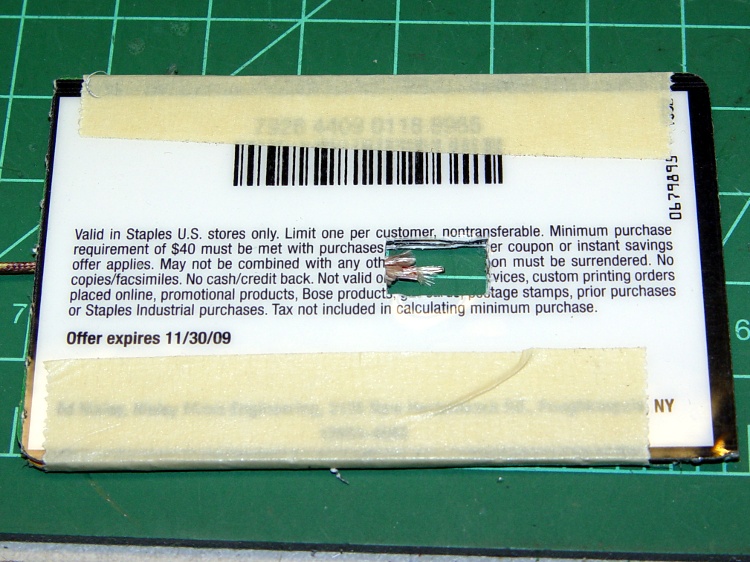
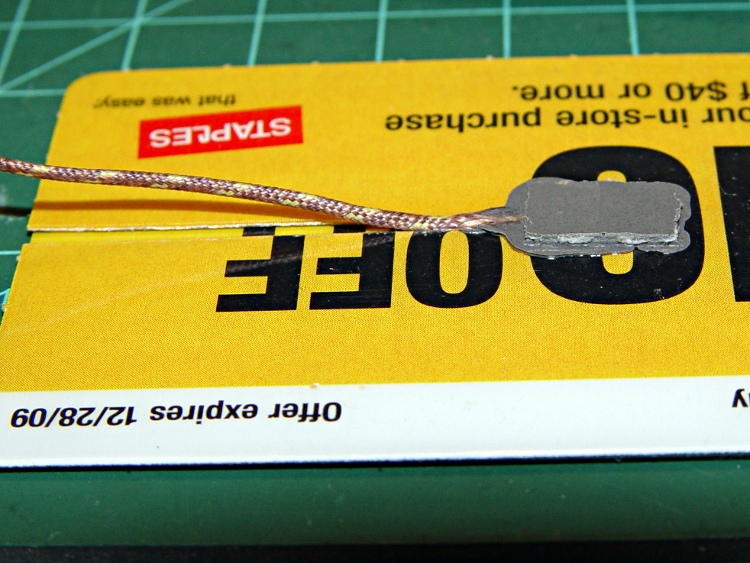
Anyhow, I converted three credit-card-thickness sale coupons from Staples into a brick-shaped mold around the thermocouple. The middle card has a slot for the thermocouple wire, which means the bead is positioned in free space in the middle of the opening.
Thermocouple positioned in mold
A close-up of the thermocouple bead:
Thermocouple positioned in mold – detail
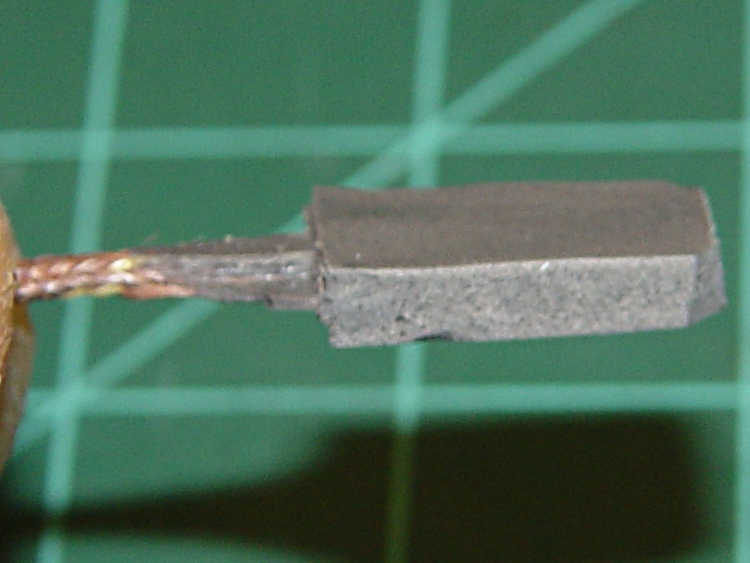
I taped that assembly to another coupon, filled the mold with JB Weld, made sure everything was saturated, and gave it a day to cure. This view shows the brick after peeling off the top coupon, so you can see the cable slot:
Removing thermocouple from mold
A bit of filing and general cleanup made it presentable:
Finished thermocouple brick
A wrap of Kapton around the brick gives the Thermal Core washer something to grab onto:
Thermocouple in place – ceramic insulation jacket
The brick could be much smaller without any penalty. There’s no issue with excessive thermal mass here, however, because the Core itself has a 10-minute time constant, so the thermocouple has plenty of time to tag along.
The red wire in the upper-left corner connects the plate above the Thermal Core directly to the static drain ground point that leads to the ATX power supply case. In the event of a resistor failure that shorts the +12 V supply to the Thermal Core, the power supply should shut down. Whether that will actually happen, I cannot tell, but now a failed resistor won’t destroy the thermistor or the Extruder Controller.
The ceramic wool insulation (from a lifetime supply of furnace chamber lining; it’s rated for direct oil burner flame impingement) may seem excessive, but I wanted measurements from a well-insulated Thermal Core at reduced power: 40 W seems to do the trick.
However, the insulation on the bottom of the Core around the Nozzle tended to catch on the ABP’s silicone wiper. The next iteration used just the original MBI ceramic cloth insulation on the bottom, protected by Kapton tape, with ceramic wool around the rest of the Core. Much better!
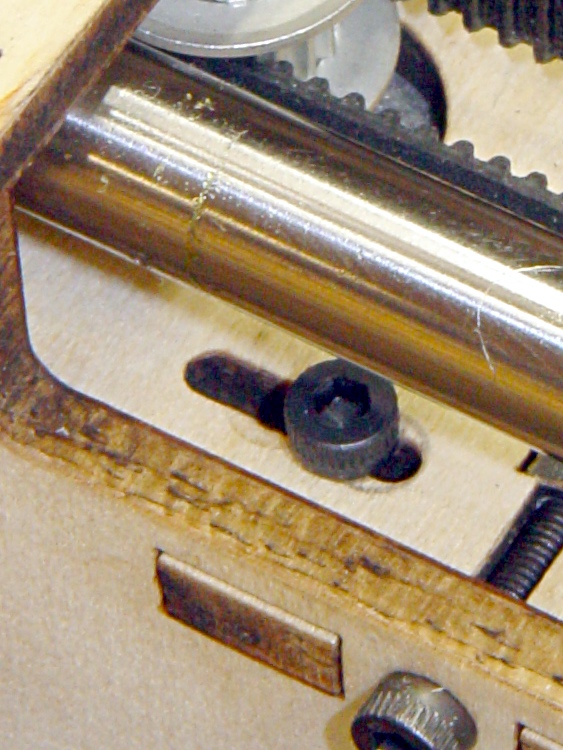
The socket-head cap screws securing the ball bearings that ride on the left-side Y stage rod prevent the X axis motor from sliding rightward along its mounting slots. The rightmost position, as enforced by the SHCS heads, makes the belt far too tight.
This suggests that the ball bearing assembly was an afterthought, perhaps solving the same overconstrained rod problem as I fixed in the X axis stage. The as-built motor position pulls the X axis belt just slightly less taut than a banjo string, which isn’t a Good Thing.
The solution is to replace the four SHCS with pan-head screws to get a bit more clearance. Fortunately, my Parts Heap had some salvaged 3 mm screws of sufficient length, so I avoided a trip to the Big Box retailer. Rather than put everything together and discover the heads were still too tall, I ground them down so just the barest hint of the slot remained:
Modified pan-head screw
That provided enough clearance to make the X axis belt entirely slack, which means I probably didn’t have to grind the heads in the first place. In any event, the proper position looks more like this:
Adjusted X axis motor position
If you look very closely, you can see the marks from the original position near the middle of the slots. Here’s a blown-up and contrast-stretched view:
X axis motor mounting slot – detail
Those few millimeters make all the difference in the world: the belt is now decently tight, the motor responds well, and all is right with the world.










 The Smell of Molten Projects in the Morning