The Smell of Molten Projects in the Morning

Ed Nisley's Blog: Shop notes, electronics, firmware, machinery, 3D printing, laser cuttery, and curiosities. Contents: 100% human thinking, 0% AI slop.

Author: Ed

  • Ampeg B-12-XY Cap Autopsy

    Before trashing (*) all those caps from the Ampeg, I marched them past a capacitance meter that gives the dissipation factor D. As D = tan δ = ESR / ¦X¦, we know ESR =  D*¦X¦ at the meter’s 1 kHz test frequency. We don’t know the magnitude of the total reactance X (the meter doesn’t tell us that) and in this case we can’t assume the ESR will be small with respect to the capacitive reactance Xc = 1/2πfC.

    Ampeg capacitors
    Ampeg capacitors

    The smaller green 0.022 µF Cornell-Dubilier caps all came in with D=0.05, so they’re marginal.

    The larger green 0.15 µF Cornell-Dubilier caps had D=0.00 and the black 0.1 µF was D=0.01. Those are OK.

    The small black caps had D=0.14. Yikes! The larger one and the yellow cap had D= 0.01 or 0.02.

    The blue Ducati (!) electrolytics ranged from 0.06 to 0.48. That was without reforming, as the last time Phil turned it on, the finals about melted down: I wasn’t going to risk that again just to find out if you can reform all the electrolytic caps without the tubes in place.

    So, yeah, some of the coupling caps were exceedingly bad. If you’d like to rub the values & data against the schematic to find out which one(s) were killing the finals, go ahead.

    All of the measured capacitance values were within spitting distance of their nominal values.

    [Update: Eks points out that I really should measure the leakage at operating voltage, so as to find the current that would drive the grids off their normal bias points. That’s a project for another day… ]

    (*) They’re in the e-waste recycling box, of course.

    The raw data, not that anybody cares:

  • Monthly Aphorism: On Complexity

    • When faced with a problem you don’t understand, do any part of it you do understand, then look at it again.

    Heinlein, of course: The Moon is a Harsh Mistress

    Yes, this algorithm can stall you at a local maximum, but that’s better than remaining stuck in the starting gate while you’re thinking too much.

    In less high-falutin’ terms: Don’t just sit there, do something!

  • Stepper Dynamometer: First Light

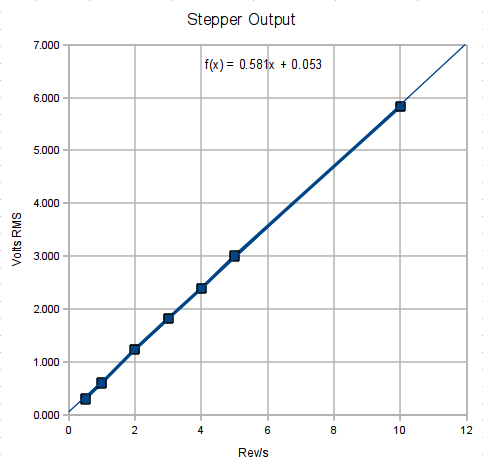
    As a quick test of the stepper dynamometer, I lashed the larger stepper to that Pololu driver hairball, connected one winding of the smaller stepper to the oscilloscope, and recorded open-circuit voltages as a function of rotational speed:

    Output voltage vs rps - open circuit
    Output voltage vs rps – open circuit

    Now, if that isn’t suspiciously linear, I don’t know what is!

    The slope is 0.583 v/(rev/s).

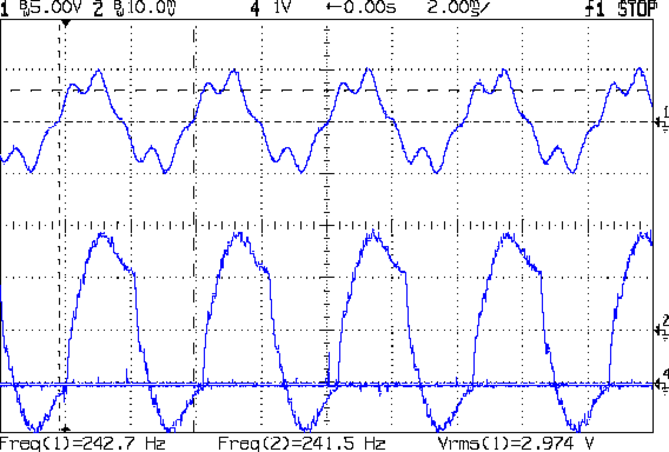
    I used the scope’s RMS trace calculator, which smushes out the non-sinusoidal nature of the lower speed waveforms. As expected, there are several nasty mechanical resonances that appear in the output waveform while they’re tormenting my ears:

    Stepper Resonance - 4.82 rps
    Stepper Resonance – 4.82 rps

    Top trace is the winding output voltage, bottom trace is the drive input current, plus a line of junk I forgot to turn off.

    Useful conversions:

    • Drive waveform frequency / 50 = rev/s
    • Drive waveform frequency * 6/5 = rev/min

    So it works. Now I must figure out how to connect load resistors with something more reliable than crappy alligator clips.

  • Antenna Decoration

    Dragonfly on antenna
    Dragonfly on antenna

    This dragonfly decided that the tip of the 2 m / 70 cm antenna on Mary’s bike was the best  place around to survey the area; it periodically zipped off to snag a meal, then returned to stand watch again.

    Those wraparound compound eyes don’t miss much!

    Dragonfly on antenna - detail
    Dragonfly on antenna – detail

    A few weeks ago, a much larger dragonfly bounced off my helmet and snagged itself in the delay line coil near the middle of the antenna: the dragonfly’s head slid 1/4 turn around the coil and latched firmly in place. Amid much buzzing of wings and thrashing of legs, I managed to unscrew the poor critter, whereupon it flew off undamaged.

  • Bicycle Water Pack Leak Repair

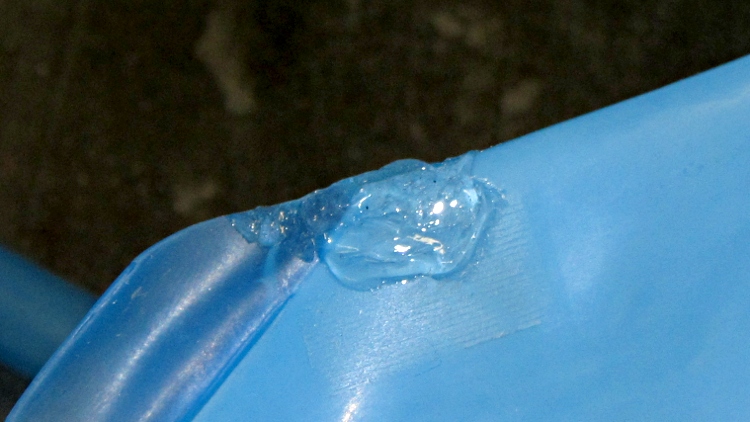
    So the hydration pack I’ve been using for a few years started piddling all over the floor, whereupon some debugging revealed a pinhole leak where the large thermally sealed flange meets the bag side. Nothing, but nothing adheres to the polyethylene (or some such) bag material, but a blob of acrylic caulk (armored with a layer of electrical tape, not shown) may suffice for a while.

    Hydration pack leak repair blob
    Hydration pack leak repair blob

    I did the same thing to the other side as a prophylactic measure…

  • High Security Access Panel

    I was really, really tempted to pocket a key, just in case it might come in handy elsewhere… but I’d have to stand on the toilet and that’s just gross.

    Locked access panel - with keys
    Locked access panel – with keys

    Back in the day, I was third-chair lockpick in my college dorm and those piddly little locks weren’t all that difficult even then.

  • Stepper Dynamometer Mechanics

    Combine two of those mounts with one of those couplers, add two NEMA 17 steppers (the one on the right is that one), slide a baseplate underneath, sprinkle with various screws, and shazam you get a stepper motor dynamometer:

    Stepper Dynamometer
    Stepper Dynamometer

    The baseplate puts the mounts 65 mm apart on the 10-32 screw centers, which is entirely a function of the coupler length, and is easy with manual CNC on the Sherline.

    Changing the motors is straightforward: loosen coupler setscrew, remove base screws, slide motor away from coupler, remove mount screws. Won’t happen that often, methinks.

    The general idea is to drive one stepper with a known current, apply a known resistive load to the other motor’s windings, and then plot torque vs. speed. It won’t be quite that simple, of course, but should produce some interesting data.