Ed Nisley's Blog: Shop notes, electronics, firmware, machinery, 3D printing, laser cuttery, and curiosities. Contents: 100% human thinking, 0% AI slop.
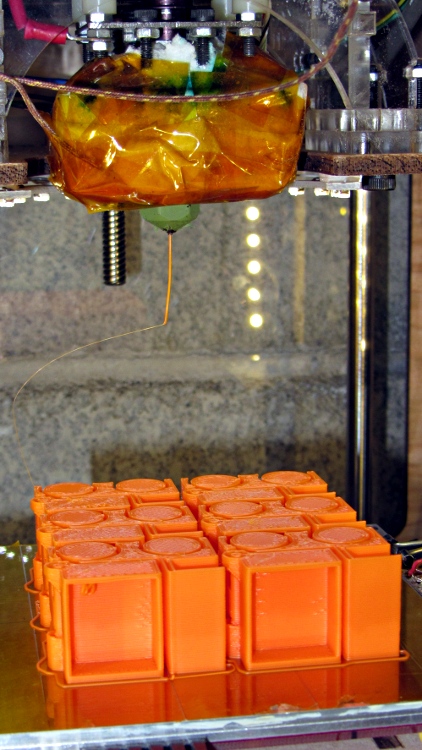
The Tiny Toy Dump Truck by madscifi makes a fine tchotchke for a presentation, serving to illustrate the risks and rewards of printing flat overhangs without support. A fleet of six printed well, after repairing some failures as those tall, tall rings and posts near the dump bed pivot fell over. I pasted them down in mid-print using ABS slurry, which is not a technique to emulate.
A closer look shows the overhang problem in the dump bed and the broken pillars behind the wheels.
Truck overhang failure – grayscale
It’s in monochrome because the camera choked on that much Safety Orange filament in the image, to the extent that no amount of color correction produced a usable result.
So it’s time for the whole pile of silica gel to go into the oven. The various packages suggested something around 12 hours at about 250 °F, so I set the oven timer for 11:59 and let it cook overnight:
Assorted Silica Gels
The granules in the trays go into sealed glass jars, where they will remain dry until needed. The assorted beads & kibble in the plates get bagged up and go in the fireproof safe along with the big bag in the front, where they ought to be good for maybe half a year. It’s a new safe, so we’ll see how that works out; I tucked a note with the weights inside the safe.
I found a “sealed” plastic bucket of assorted packages that I’d dried and weighed a decade ago and then lost in the back of the shelf. It had gained 2 ounces, but the packages have rotted out and the beads weren’t in good shape; they were the consumer-grade bags that aren’t intended to be dried and reused.
A first cut at a holder for Canon NB-5L batteries with those dimensions, with the intent of connecting them to a battery tester.
NB-5L Battery Holder Doodle
The cloud in the middle of the bottom holds pin dimensions, which I measured after I’d been doodling for a bit. They come from my heap; they’re nice heavy-gold plated male pins (yeah, I have the other gender, too) intended for a multi-pin connector. They have a convenient hole that’s normally used to verify you’ve actually soldered the wire properly. I plan to stick a music-wire spring in the hole and secure it through the bottom of the holder with a rectangular pocket below the pin that limits the travel in both directions. Drilling the hole completely through the pin to let the spring wire stick out would prevent having it fall out at the end of travel.
The spring pocket dimensions are right down around the very limit of the feature sizes my TOM can achieve. I’m not sure those blind holes will actually open up far enough.
I’m also not sure the Powerpoles will actually fit in there like that. There’s nothing wrong with pigtail leads.
It’s obviously styled after the Official Canon NB-5L charger, although they use nice bent-steel spring contacts that are trivially easy to make in mass production:
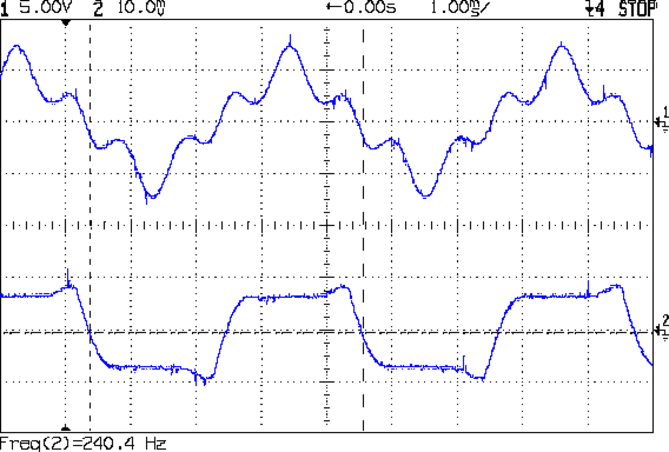
Here’s a howling 1200 Hz mechanical resonance excited by a full-step drive at 290 rpm, with the resonance running at 5 cycles for every 4 full steps.:
1 Step Res 240 Hz
[Update: top trace is voltage from big stepper-as-generator, bottom is small stepper winding current = 1 A/div.]
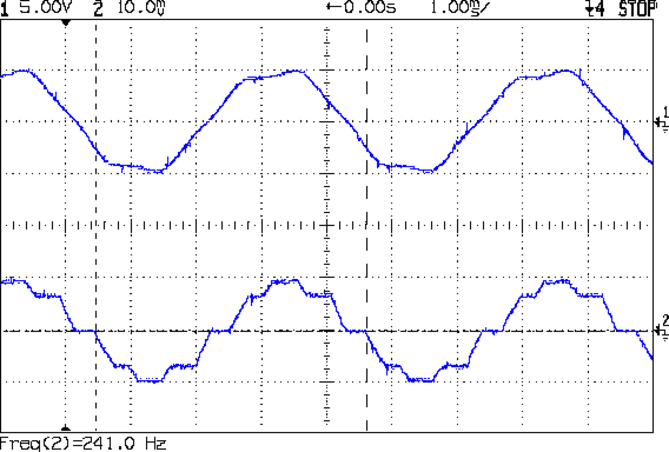
Switching to 1/2 microstepping at the same rotational speed pretty well tamps it down:
Half Step Res 240 Hz
However, here’s the same resonance excited by 1/2 microstepping at half the rotational speed, oscillating at 9 irregular cycles for every 8 half-steps:
Half res 120 Hz
The resonance was strong enough to back the setscrew completely out of the generator end of the shaft, leaving me wondering why the output was dead when the motor was obviously running. Yes, several times…
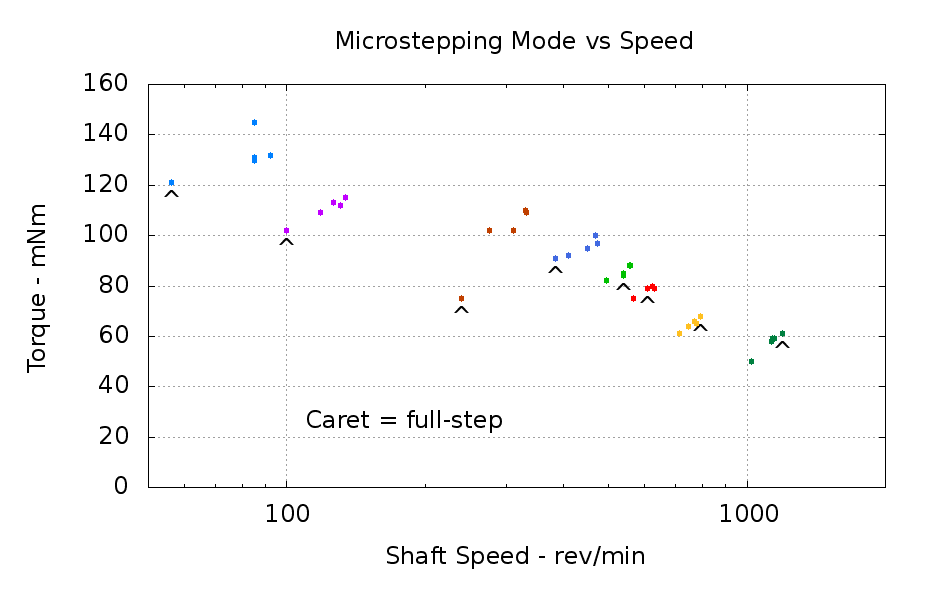
Conventional wisdom has it that stepper motor torque decreases as the number of microsteps per full step increases. One reasonably careful measurement trumps a kilo-opinion, so here’s a chart (clicky for bigger) of measurements to mull over:
Microstepping Mode vs Speed – 17PM-J034
Each group of like-colored dots marks the results for full, 1/2, 1/4, 1/8, and 1/16 microstepping with the same load resistance. The caret marks the full-step data point within each group. The load resistances range from a dead short (about 1 Ω due to winding resistance) on the left to 50 Ω on the right.
While I’ll grant the existence of the occasional data-collection error, it’s pretty obvious that:
Torque is reasonably constant regardless of microstepping mode
Full-step mode doesn’t produce more torque and, indeed, produces considerably less under heavy loads
Now, one can argue that the A4988 doesn’t operate in real full-step mode, because it energizes both windings at 1/√2 of the maximum current setting for each full step rather than energizing a single winding at the maximum current. That may be true, but conventional wisdom seems to not bother with such details when opining about torque, either…
As nearly as I can tell, 1/8 microstepping gives as much torque as you’re likely to get from the motor, while having reasonably smooth motion that avoids exciting mechanical resonances.
That chart (or one remarkably like it) will appear in an upcoming Circuit Cellar column. The tonnage of data supporting those dots suggests building an automated dynamometer would be a Good Idea …
The three pregnant does we’ve seen this season produced two pairs of twins and one set of triplets. That’s just for the does crossing our yard; we’ve seen many others around the area. The fawns are, of course, insufferably cute, but the deer have eaten everything growing on the forest floor, eaten all the tree leaves within reach, and are now working on vegetation that deer don’t normally eat.
Such as, for example, Mary’s long-suffering kiwi plants by the garden and various distasteful flowers in front of the house.
One doe maimed her starboard foreleg in an automobile collision; she was hobbling around for about a week before vanishing. Fawns, who don’t come out of the oven knowing that automobiles make fearsome predators, tend to die young; three of the seven have died on the road within walking distance of the house in the last two months.
Dead fawn at Deer Crossing sign
We recently heard a sharp bang! bang! out front, shortly followed by a police car accelerating along the road. It turns out the officer dispatched this fawn with two shots below the left ear; I think they carry a special .22 caliber gun for this very purpose. No, the fawn wasn’t standing around waiting to be shot; it had just starred in Yet Another car-on-deer collision.
This, according to the local deer huggers, is a much more desirable outcome than harvesting surplus deer and eating them. I haven’t noticed any deer huggers volunteering to pay for damages; that seems to be an externality to them.
A billboard up the road demonstrates their total lack of comprehension: a pastoral scene showing a buck (with a full rack) nuzzling a fawn. Pop quiz: who wrote that book? Bonus: how much interest do actual bucks display in their offspring at any time?
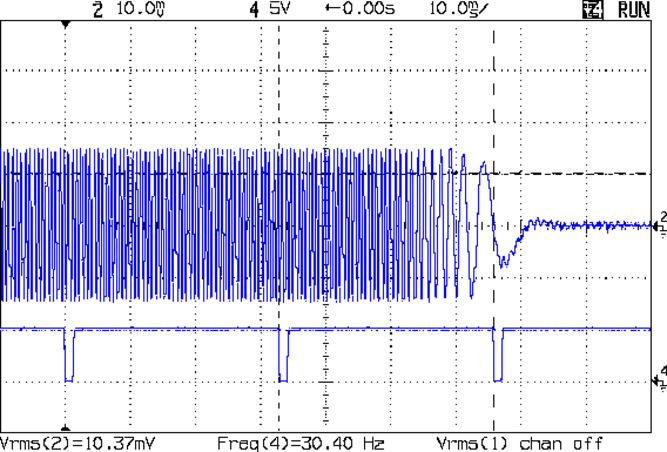
Just to see what happened, I reversed the stepper dynamometer and drove the larger (480-ish mN·m) stepper in 1/8 step mode while recording the short-circuit current from the smaller (anonymous) stepper. Slowly cranking the step frequency upward produced this trace when the stepper stalled:
48 mm motor – pullout – 30 rps
The bottom trace shows 30.4 rev/s = 191 rad/s = 1824 rev/min: a pretty good speed for a loaded stepper! The rotor began slowing just before the last sync pulse, but hadn’t lost any appreciable speed.
The current scale is 0.5 A/div (set on the Tek probe amp), which makes the winding current (500 mA/div × 10.4 mVpk / 10 mV/div) = 520 mApk. The scope’s computed rms value includes the waveform after the stall, which isn’t helpful.
The small stepper has a 2.1 Ω winding resistance, so a short-circuit load dissipates (0.52 A)2 × 2.1 Ω = 567 mWpk in each winding. The rms equivalent is half of that, so the total rms power is about half a watt, essentially all internal to the motor.
The pull-out torque depends on the peak torque load, not the rms and not the sum of the two windings, so it’s 0.6 W / (191 rad/s) = 3 mN·m, which doesn’t sound a lot for a 480 mN·m motor until you consider the screaming 6000 full step/s speed: pretty much off-scale high on most of the torque-vs-speed graphs you’ll see. Not much torque left out at that end of the curve, indeed.
In order to stall the motor at lower speeds, the load stepper must generate enough voltage into the load resistor (here, the winding resistance) to push the power/speed ratio (the torque!) above the drive motor’s ability. That implies the load stepper must always be larger than the drive stepper, which means I must conjure up a bracket for that NEMA 23 motor that’s been holding down a stack of papers on my desk…
Incidentally, the voltage required to produce that load current is 0.52 mA × 2.1 Ω = 1.1 V. The 0.58 v/(rev/s) open-circuit generator constant for the smaller motor predicts 0.58 v/rev/s × 30.4 rev/s = 17.7 V. Obviously, you can’t get from the open-circuit unloaded generator constant to the short-circuit loaded voltage… Lenz’s Law gets in the way.





 The Smell of Molten Projects in the Morning