Ed Nisley's Blog: Shop notes, electronics, firmware, machinery, 3D printing, laser cuttery, and curiosities. Contents: 100% human thinking, 0% AI slop.
My assumption that the basement document safe had an effective door seal turned out to be wrong, so I replaced the bagged desiccant with a tray of granules, sealed the door with masking tape, and tried again:
Basement Safe Humidity – 2012-01-12
The jagged black curve shows the Basement Laboratory temperature trending toward the usual mid-50s winter level. The dead-flat horizontal blue line at 15% RH shows the tray of desiccant can keep up with whatever air leakage might occur around the tape and through the floor bolts.
I cannot find the table (that I once had and know exists somewhere) which lists various desiccants and their terminal humidity levels in a sealed container. I’m pretty sure the low humidity means it’s one of the clay-based desiccants, not silica gel.
Faced with the need to measure heatsink temperature in an Arduino project and being unwilling to putz around with a MAX6675 thermocouple amp, I found a bag of thermistors in the heap. Unlike most surplus, the bag pedigreed them as Semitec 103CT-4, which led to some relevant parameters:
T0 = 25 °C
R0 = 10 kΩ
B = 3270 K
The equation for a thermistor’s resistance at a given temperature (in K, not °C) is:
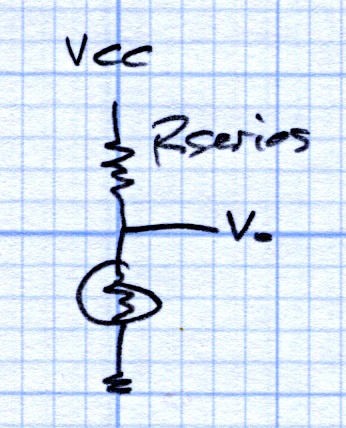
Setting Rseries = 10 KΩ and applying a bit of spreadsheet-fu produces this:
Thermistor Linearization – Rseries – Graph
Getting within +2 °C /-1 °C over -20 °C to 60 °C isn’t all that bad, but … I wondered whether there might be an easy way to get better linearization. The heatsink temperature will range from about -10 °C to 60 °C (yes, there will be a Peltier cooler involved), so the range is a bit broader than usual.
A bit of diligent rummaging turned up that description, which led to US Patent 3,316,765 from back in 1967, which teaches the concept of two different thermistors, one for low temperatures and one for high temperatures, with some resistive blending:
Patent 3316765 Fig 3
The patent includes the claim of many different thermistors, each with a series resistor, to cover a much broader temperature range.
Given a bag of identical thermistors, I wondered what might be possible. A bit more spreadsheet-fu produced this:
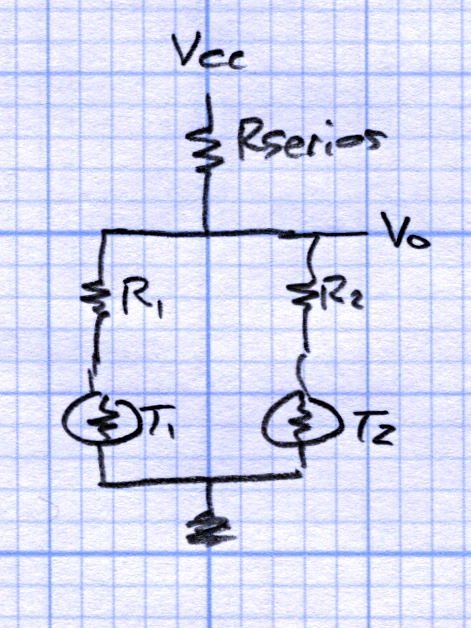
Which corresponds to this sketch, with Rseries = 6.2 kΩ, R1 = 27 kΩ, and R2 = 0.0:
Thermistor Linearization – Dual Thermistors
All in all, a nicely centered ±1 °C error from -15 °C to +60 °C can’t be beat. The output voltage even spans 0.13 to 0.71 of Vcc, about 9 of the available 10 ADC bits.
Those two resistors came from hand-tweaking with standard values, so it’s not like there’s a genetic algorithm involved. The value of Rseries wants to be a bit below the parallel combination of the two branches near 30 °C and R1 seems happiest around the 0 °C thermistor resistance. I vaguely thought about using a multivariable solver, but what’s the point?
The result seems good enough that I didn’t try three thermistors. T2, the one with R2=0, already handles the high temperature range and the low end is fine, so it seems there’s not much to be gained. If you had a stash of different thermistors and knew their characteristics, then the results would be different.
Admittedly, one could program the actual logarithmic equation to unbend a single thermistor’s voltage into temperature, but I must kludge up a thermistor mount anyway, so why not entomb two thermistors and an SMD resistor, then use a linear fit? It’s not like fancy math will give the whole lashup any greater accuracy.
The spreadsheet may be of interest. It started out as an OpenOffice spreadsheet, but WordPress doesn’t permit *.ods files, soooo it’s in MS Excel format.
After butchering that fancy Tektronix test lead thing for the SMD tweezers, I hung the bitter end in my cable tangle. Turns out I needed a power cord to bring up the brassboard of the Wouxun GPS interface, so I soldered it up, went to plug it in, and … the Tek plugs didn’t fit the plated supply jacks.
Power Supply Banana Jacks
Now, if I had to choose whether Tek plugs are oversized or Made In China jacks are undersized, well, you can probably guess my answer.
Turns out that the jacks should be 4 mm ID, which is actually a 5/32 hard-inch size because banana jacks date back to the days before millimeters became a force to be reckoned with. They were actually 3.8 mm ID, which wouldn’t usually matter except for the fact that the Tek plugs have a nice solid bullet end that’s just about exactly 4 mm OD.
So I chucked up a 5/32 inch drill, perched the power supply on a block of wood (to clear the fuse & cord in on the back panel) on the drill press table, and hand-held it while clearing out the holes with a low spindle speed. You can see the nice, shiny brass inside those jacks in the photo; they used to have lumpy silvery plating inside that was probably responsible for much of the 0.2 mm shrinkage.
The jacks also don’t have the usual crosswise hole near the base to accept a bare wire, which is an occasional nuisance. I was tempted to drill that hole, but decided I’ll leave that project for another time.
Despite the fact that nobody bothers to crack your web passwords, as it’s easier for them to crack the entire server and scoop out everyone’s personally sensitive bits like so much caviar, all websites remind / require you to pick strong passwords. So, when I registered myself on a high-value website, I did what I always do: ask my password-generation program for a dollop of entropy.
It came up with something along the lines of:
Gmaz78fb'd]
You can see where this is going, right?
Pressing Submit (which always makes me whisper Inshallah with a bad accent) produced:
The mumble.com website is temporarily unavailable. Please try again later.
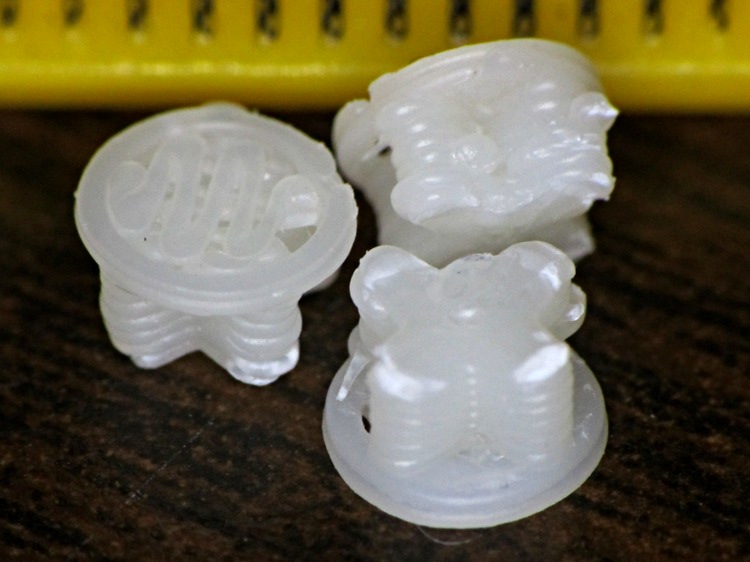
Having printed up three of those handles for Show-n-Tell, I preemptively installed one in the hasn’t-failed-yet clamp, and poked the support out of another to show how it works. They’re just the cutest little buttons:
HF bar clamp handle – support plug
The fins are a touch under 4.5 mm end-to-end and 1 mm (2 × 0.5 mm) across, with layer thickness = 0.25 mm. The first layer fill looks a bit lackadaisical, but the bottom of the surrounding handle came out glass-solid with barely visible joints between the threads, so the settings work fine for larger objects.
HF Bar Clamp – support – solid model
The tip of each fin has a scar where the overlying perimeter thread bonded to it. Skeinforge is set to extrude the perimeter first, which would squirt that circle (well, pentagon) into mid-air… which is why this support plug lies in wait below.
A friend asked me to scrub and rebuild an ancient IBM Thinkpad 760XD (there were good reasons for this task that aren’t relevant here), which led to a blast from the past:
Windows 98 Welcome
After Windows settled down from its obligatory reboots, installing the exceedingly complex MWave DSP drivers from three diskettes (!) produced this classic result:
Windows 98 – BSOD
Ordinarily, I’d suggest installing some flavor of Linux, but the 760XD’s BIOS can’t boot from either CD or USB, so you’d be forced to sneak the install files onto the hard drive, hand-craft a suitable boot diskette (!), and then perpetrate some serious fiddling around. That made even less sense than (re-)installing Windows 98.
However, given that exposing a fresh Windows 98 installation to the 2012 Internet would resemble tossing a duckling into a brush chipper, we agreed that this laptop’s next experience should be at an upcoming e-waste recycling event.
The next morning confronted me with this delightful reminder that nobody knows how to handle boot-time errors, not even on a 2011 PC:
Lenovo – USB Keyboard not found
The keyboard cable had gotten dislodged when the USB hub fell from its perch along the back edge of the desk. It’s fine now…
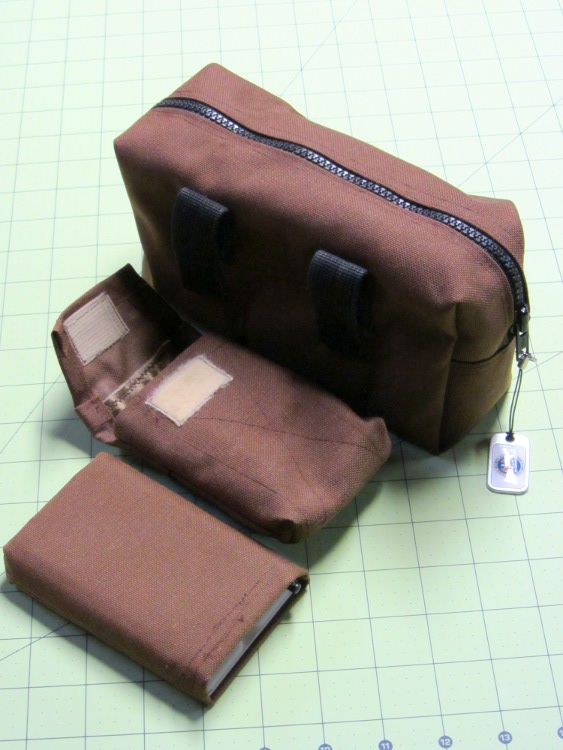
Mary made me several presents early this year: a new belt pack, a camera case for the Canon SX230HS, and a touchup for the Zire 71 case:
Belt pack – camera case – PDA case
The belt pack has an interior lining with many side pockets for the stuff I deem essential; it’s also large enough to hold both the camera and the PDA when I’m out biking around. The camera case includes a pocket nestling a battery against the camera’s front side, beside the lens cap. The Zire case, well, at some point I suppose I’ll be forced to get a phone, but, until then, this will suffice.
They’re all made from coated pack cloth, not that I expect to dunk myself in water (or that it’d do any good), but it seems to never wear out.
*hugs*
(And, yes, it probably should be “Therefor”, but …)







 The Smell of Molten Projects in the Morning