Ed Nisley's Blog: Shop notes, electronics, firmware, machinery, 3D printing, laser cuttery, and curiosities. Contents: 100% human thinking, 0% AI slop.
While I had the tooling plate off, I cleaned the crud out of the tapped holes and ran a handful of 1/4 inch stainless steel 10-32 setscrews just below the surface:
Sherline tooling plate with setscrews
They’re pretty much invisible, of course, but they’re all present. FWIW, you need a 3/32 inch hex wrench for 10-32 setscrews.
In the event that I gouge the aluminum surface (you can see the odd ding and blind hole) through a setscrew, I’ll regret doing this. Not having to remove the plate to dig swarf out of the last clamping hole after carefully aligning a part seems like a win.
Reassembling the mill provided an opportunity to move the Y axis Home switch from the rear of the axis to the front. The key discovery happened during the teardown: I can get the saddle off the Y axis dovetail by removing the gib, without sliding it off the front, which means a front switch can remain firmly glued in place.
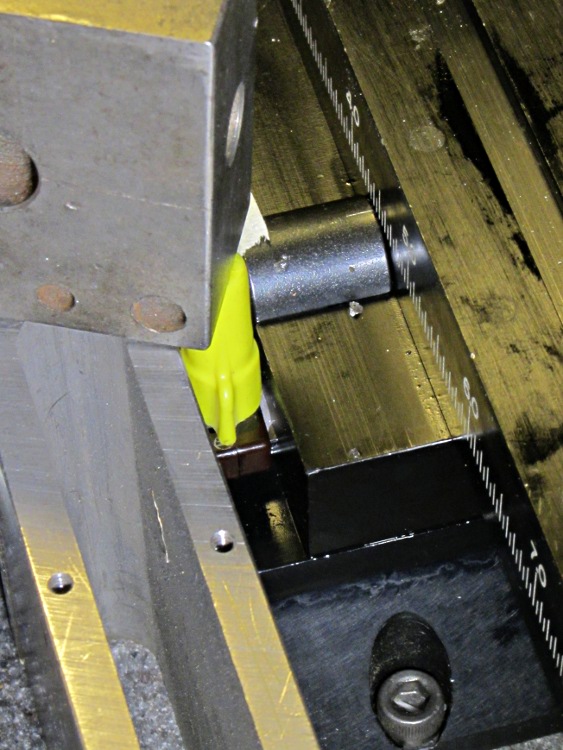
A few random hunks of steel and a wire nut held the switch in position while the epoxy cured:
Mounting Y axis home switch
The switch actuator bottoms out with the saddle just touching the preload nut, so the saddle can’t dislodge the switch: the switch trips just before the saddle hits the nut, at which point all motion stops and the motor stalls.
Moving the switch means I can remove all the gimcrackery that poked the rear switch with the tooling plate in place; I was never happy with that setup. I also removed the small block that trapped the rear end of the Y leadscrew, under the assumption that, as I haven’t yet dropped anything on the leadscrew, I probably won’t. That adds about 1/4 inch to the maximum travel and allows the tooling plate to whack into the column.
The switch wire runs along the stepper cable, a tidy technique that hasn’t introduced any glitches into the shared Home signal from the X axis drivers:
Sherline mill – X and Y axis home switches
The Y axis now seeks the Home switch in the positive Y direction, so that stanza in Sherline.ini looks like this:
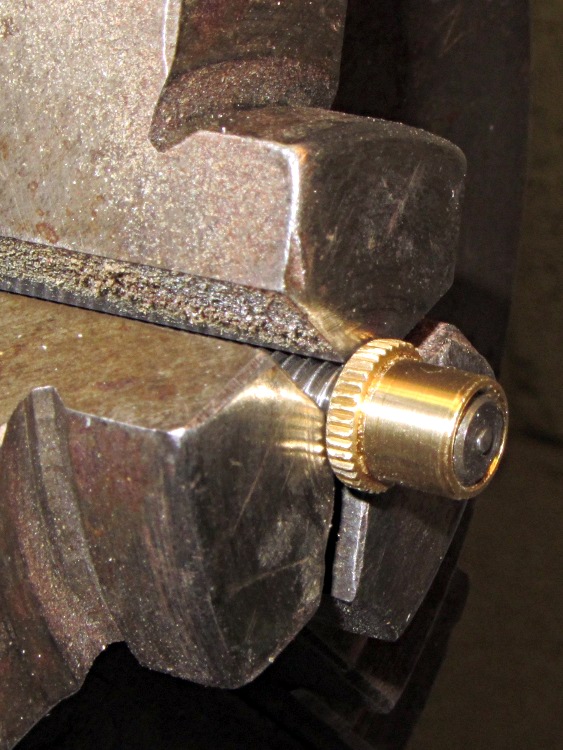
The new Y axis anti-backlash nuts for the Sherline mill have a countersink on the end that fits into the saddle. The nut on the left is as-delivered (I bought two) and the nut on the right is after cleanup:
Sherline Y axis anti-backlash nuts – original vs cleared
The thread was munged enough to jam the leadscrew; it started fine from the knurled end, but wouldn’t emerge from the countersink. This being a left-hand thread, I couldn’t just run a tap through the nut, so clearing the thread required:
Some tedious handwork to clear enough of a path until …
I could force the nut over the old leadscrew, which re-formed the thread enough that …
More tedious handwork could remove the debris and bent brass
After that, the OD of both nuts was slightly oversized: 0.316 inch, which didn’t fit in the 5/16 inch (0.3125) bore. So I mounted the nut on the old leadscrew, took advantage of the fact that a left-hand thread gets tighter with cutting force from the lathe bit[Edit: wrong! See comments], and turned it down just a hair:
Turning down anti-backlash nut OD
Purists will quibble that I should have used the four-jaw chuck. Turns out the three-jaw has under 1 mil of runout, which is as good as one could possibly want in light of the bearings.
The X axis nuts were fine, so I suspect a recent production run had a bit of a tooling problem.
[Update: The mail brings replacement nuts that look just fine. Must have been one of those glitches. No hard feelings!]
There I was, in the kitchen, minding my own business, when I felt something crawling up my shin…
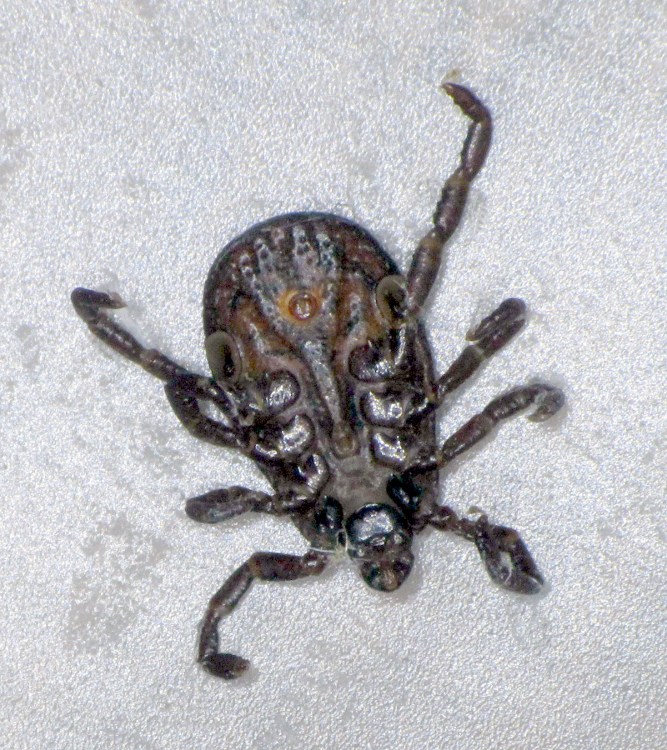
Dog Tick – Ventral
It’s 5 mm from snout to rump, so it’s most likely a dog tick, not a deer tick, not that that makes me feel much better. It’s stuck to a strip of adhesive tape to prevent it from going anywhere and was flat enough to have not fed on anybody recently.
That picture didn’t require focus stacking, although I gave it a try anyway with inconclusive results. I must conjure up a much more rigid camera mount before that works well; a mini tripod isn’t good enough.
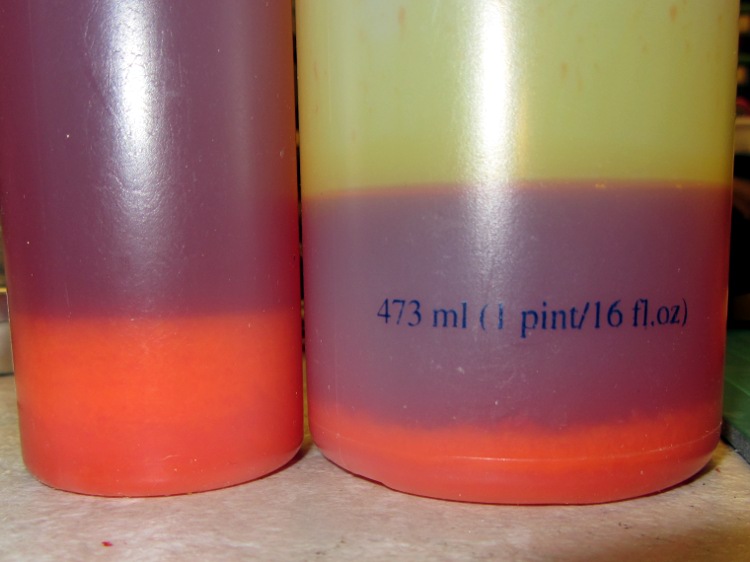
Something has gone badly wrong with the yellow bulk ink that I’m using in the Canon S630. Over the winter a precipitate formed in the bottles:
Sediment in ink bottles
And in the ink tanks:
Sediment in ink tank
But now that the Basement Laboratory has warmed up, not only does the precipitate remain, but some of it is growing:
Growth in ink tank
The picture doesn’t do it justice; it looks like pond scum in there. Only the yellow ink behaves like that, so it’s likely some contaminant in that batch. Because I buy ink in pint bottles, it’s a long time since that batch arrived and there’s no point in kvetching to the vendor. IIRC, I actually got this bottle from a friend who scrapped out his S630; he’d been refilling cartridges from the same source, too.
I ordered four sets of five tanks (CMYKK) from the usual eBay vendor for 20 bucks and will toss the old tanks & ink when those arrive.
There’s a set of four bulk ink bottles from a long-dead HP2000C printer on the shelf, but I suspect the ink chemistry differs by enough to ruin the Canon’s printhead… which is discontinued, so when the head dies, the printer dies, too.
Mary took me along on a Master Gardener tour of the plantings at Quaker Hill Native Plant Gardens (*) in Pawling, NY. We saw plenty of good-looking plants with enough light to make hand-held pictures come out wonderfully well, at least when my other mistakes canceled out.
This is an Echinacea, part of a much larger planting.
It’s cropped from the original image, resized slightly to 1050×1680, and now serves as a screen backdrop on the portrait monitor.
(*) The owners are among the 100 richest people in the country, so a staff of 70 maintaining the estate seems perfectly normal. Over the last two decades, they reshaped the entire 400-odd acre landscape to make the property look exactly right, to the extent that the many (synthetic) cliffs & (pumped) waterfalls consist of enormous boulders that a stone dresser reassembled and blended together from the largest sections that could be trucked in. The water features are visible from low earth orbit…
A hinge started squeaking, which required nothing more than a long pin punch, a soft hammer, and a dab of oil.
The unplated steel hinges in our house date back to the middle of the last century and all of them have a convenient hole in the bottom for a pin punch: much fancier than the raw edge of the folded frame and the butt end of the hinge pin. You drive the hinge pin upward with a few taps, lube it, and tap it back in again with a soft hammer (perhaps against a folded rag), and you’re done.
On the other side of door, however, lies one of our follies. For reasons that made perfect sense at the time, the hallway has five different shades of white paint:
Flat walls
Eggshell ceiling
Gloss trim
Semigloss front door
Epoxy hinges
The hallway has three branches, two openings, and ten doors. The white really sets off the hardwood floors and doors, while brightening what would otherwise be a rather dim area, but never, ever again will we make that mistake.
On the other paw, the hinges came out well. I took them off all those doors and jambs, cleaned the steel, gave ’em two rattle coats of white epoxy, and reinstalled. Much nicer than contemporary “shiny brass” plating or raw steel.





 The Smell of Molten Projects in the Morning