The Smell of Molten Projects in the Morning

Ed Nisley's Blog: Shop notes, electronics, firmware, machinery, 3D printing, laser cuttery, and curiosities. Contents: 100% human thinking, 0% AI slop.

Author: Ed

  • AMP 842448-2 HF PCB Filters: Still Alive

    A vial in the bottom of Mad Phil’s EMI Go-Kit contained a handful of these doodads:

    AMP 842448-2 HF PCB Filters
    AMP 842448-2 HF PCB Filters

    The label on the vial came from AMP with a handwritten 842448-2. Searching on the obvious terms eventually produced a Surface Mount EMI Filters catalog from Spectrum Control, with page 25 saying that it’s a 10 A DC ferrite pi filter with a 20 dB insertion loss over 100 MHz; evidently, SC bought AMP’s product line and is keeping it alive for all the Mil-Spec folks. Oddly, you can’t find that catalog using the site’s built-in search function with the part number.

    Rather than keep an entire catalog of parts I’ll never have, I used pdftk to snip out and rename the page for later reference:

    pdftk surfacemountcatalog.pdf cat 25 output "AMP 842448-2 HF PCB Filter.pdf"

    After it reaches the Internet, it never goes away…

  • Jacking Up The Microscope

    Microscope with machinists jack
    Microscope with machinists jack

    The stereo zoom microscope over the electronics bench lives on the end of long support arm that tends to be just slightly wobbly. Part of the problem is that the far end is anchored on the sponge-backed laminate flooring I put atop the bench, but it’d be slightly wobbly even with a firm base on the plywood bench top.

    So I prop up the microscope with a machinist’s jack and it’s all stable & good.

    This one happens to be from an ancient Starret 190 set that I accumulated along with some other tooling, but any of the cheap imitations would work just as well.

    The two bubble level vials help get the microscope axis exactly perpendicular to the bench surface, which makes the difference between good overall focus and a blurred image with a single line in focus. Here the jack is vertical and the microscope is tilted slightly toward the edge of the bench; the jack has a pivot below its knurled top plate.

  • Garden Dragonfly Ornament: Eye Re-Repair

    Alas, urethane glue didn’t hold the eye marbles in the garden dragonfly ornament for very long. Although the cured glue had a wonderfully smooth surface where it contacted the balls and it had plenty of contact area, that wasn’t enough.

    This time, I used acrylic caulk that should stay gummy enough to maintain a good grip:

    Garden Dragonfly ornament - re-reglued eye marbles
    Garden Dragonfly ornament – re-reglued eye marbles

    The next step, I suppose, will be to drill a hole in each ball for a stud and epoxy the things in place…

  • Monthly Subconscious: Dysfunctional Father

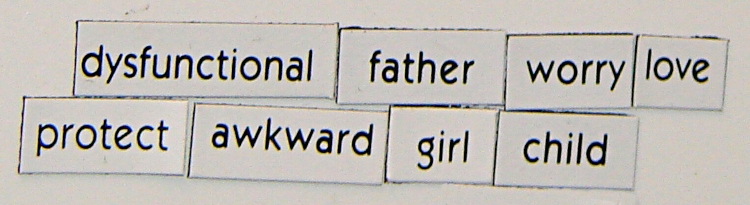
    This may be a universal truth, as seen from both sides of the divide:

    Dysfunctional Father
    Dysfunctional Father

    In text:

    dysfunctional father worry love
    protect awkward girl child

  • Fundamental 3D Printing Patents

    DIY 3D printing seems surrounded by Good Ideas that don’t happen, which led me to look up some of the early patents in the field. As nearly as I can tell, any bright idea one might have has already been patented; although you can usually get away with tinkering it up in your basement (because you’re not worth enough to interest the patent holder’s attorneys), anything beyond that will darken your skies with lawsuits.

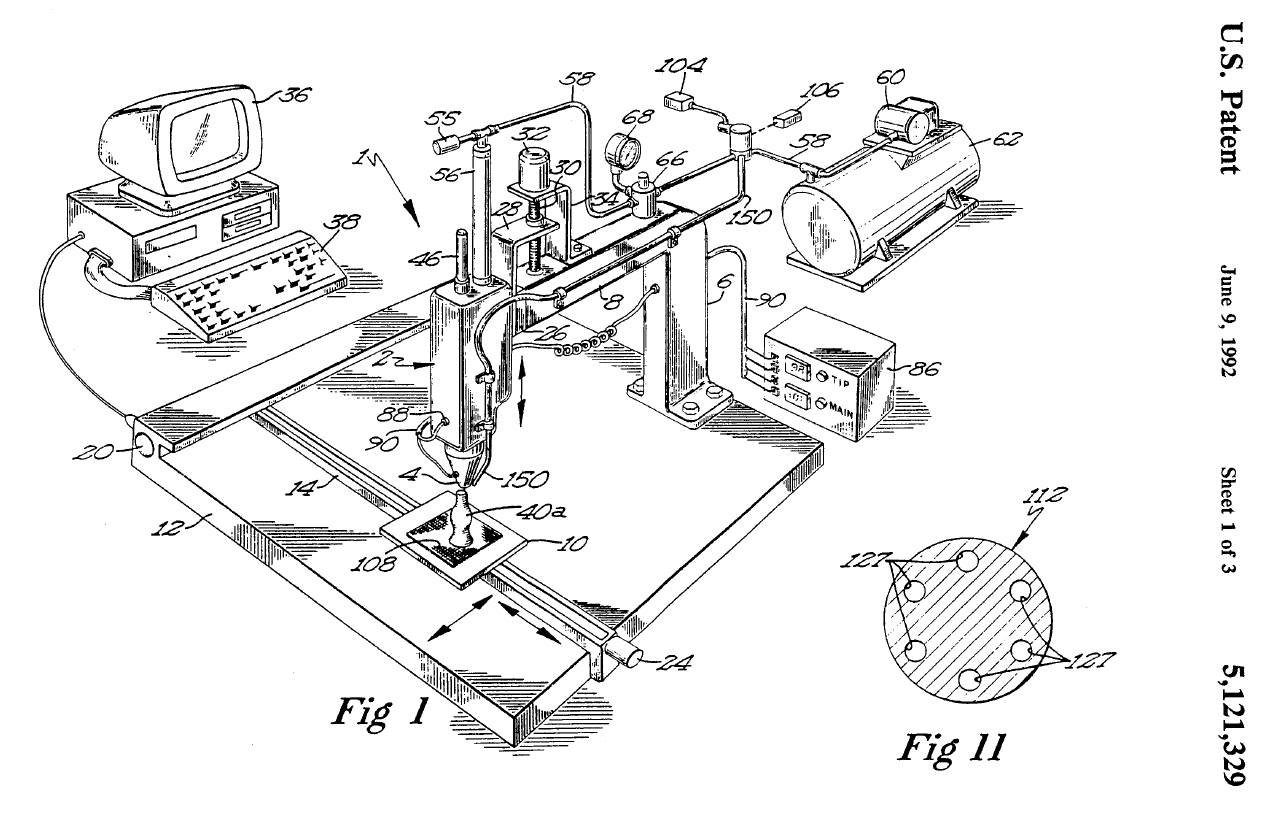
    The granddaddy of all 3D extrusion machines seems to be US5121329 (Crump → Stratasys 1992-06-09): Apparatus and method for creating three-dimensional objects

    Exploring the patents referencing that one as a foundation should keep you busy for a while; the PDF has clicky links.

    Some fine tuning on the theme:

    US6085957 (Zinniel/Batchelder → Stratasys): Volumetric feed control for flexible filament

    US5303141 (Batchelder/et al → IBM): Model generation system having closed-loop extrusion nozzle positioning

    Congealing 3D objects in a vat of goo probably starts with 4575330 (Hull → MVP 1986-03-11): Apparatus for production of three-dimensional objects by stereolithography

    Remember: I’m not a patent attorney and my opinion is worthless…

    US5121329 - Figure 1
    US5121329 – Figure 1
  • A Fork In the Path

    The original path curved away from the new Nutt MECS Center at Trinity, but even engineering bears won’t follow a path that leads in the wrong direction:

    Fork in the path at Trinity
    Fork in the path at Trinity

    An old story has it that [name of administrator] at [name of new college] had the architect remove all but the most obvious walking paths from the new campus plans. After the first year passed, then they paved the routes that people actually used.

    Vassar College has a good example of that design in the residential quad:

    Vassar Paths - Paved Quad
    Vassar Paths – Paved Quad

    But even they won’t slash diagonals across a lawn just for students:

    Vassar Paths - Grass
    Vassar Paths – Grass
  • Tektronix P6401 Logic Probe

    Mad Phil gave me his EMI Go-Kit, which contained a Tek P6401 logic probe (along with a short ton of ferrite cores):

    Tek P6401 Logic Probe - kit
    Tek P6401 Logic Probe – kit

    It’s slightly younger than dirt (copyright 1974, please forgive me) and still works fine on TTL-level logic. The red & green indicators use tiny grain-of-wheat incandescent bulbs, of course, so the thing draws nigh onto a quarter of an amp with both lights on.

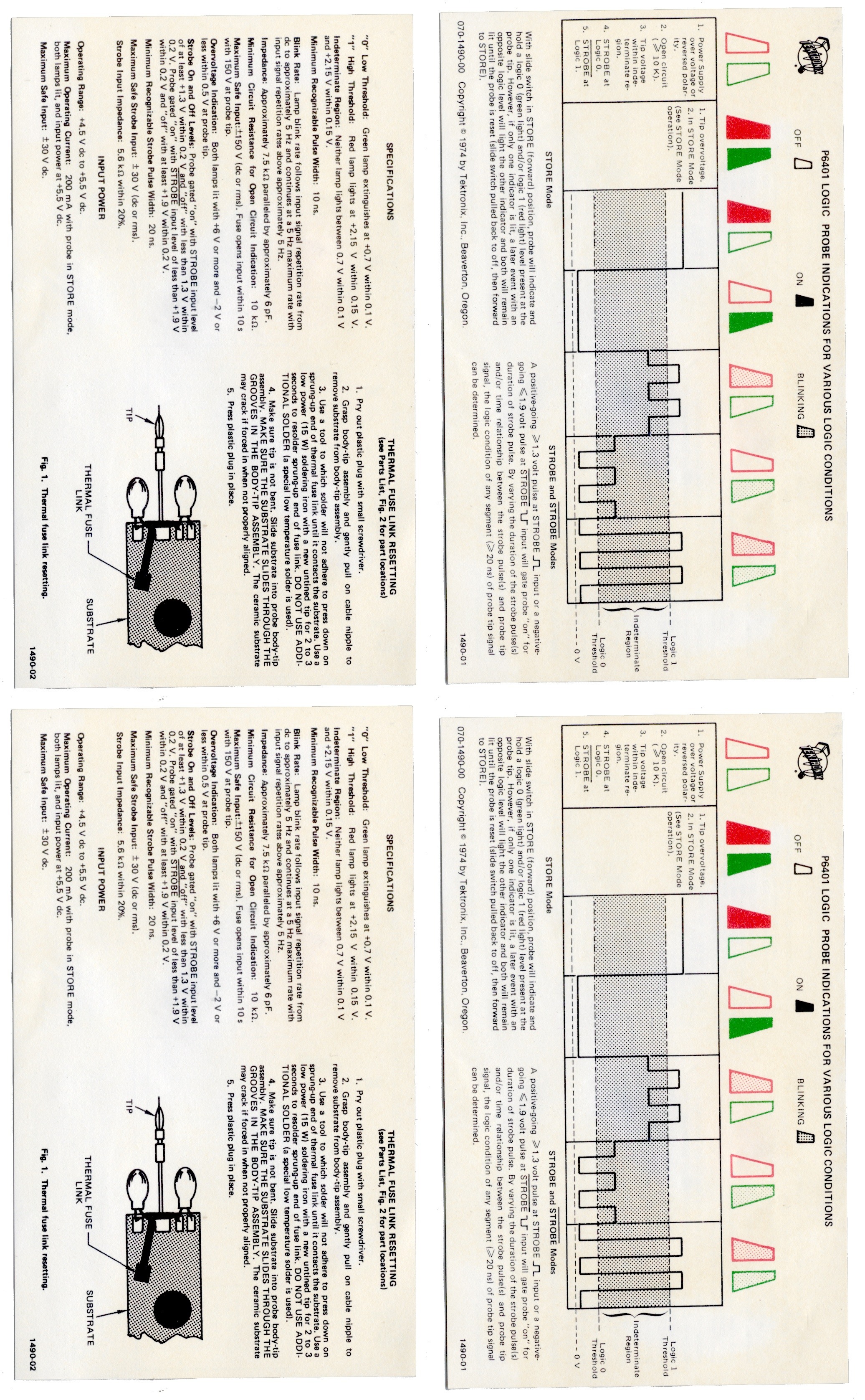
    The front of the instruction card shows what the blinky lights mean and the back gives the specs; it’s doubled up so you can pass one along to a friend:

    Tek P6401 Logic Probe - Specs and Usage Card
    Tek P6401 Logic Probe – Specs and Usage Card

    If you have one that doesn’t seem to work, check the internal thermal fuse: tack it back down with a hot dry soldering iron and it’ll probably outlive you…