The Smell of Molten Projects in the Morning

Ed Nisley's Blog: Shop notes, electronics, firmware, machinery, 3D printing, laser cuttery, and curiosities. Contents: 100% human thinking, 0% AI slop.

Author: Ed

  • Arduino Snippets: DL1414 LED Character Display

    OK, I couldn’t help myself… running two more ‘595 shift registers in parallel with the ones for the LED bargraph provides enough bits for a DL1414 four character ASCII display:
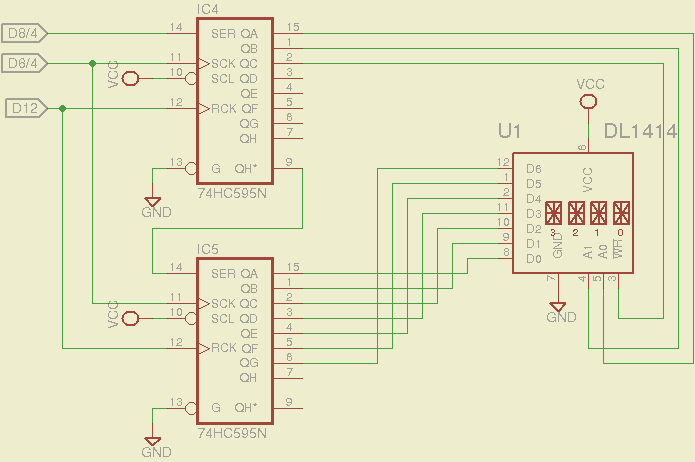
    LED Character Display
    LED Character Display

    The serial data input (SER) and serial clock (SCK) lines drive both shift register strings with the same values at the same time. The two strings have different parallel register clocks (RCK), so you twiddle only the one you want; the other string gets the same data, but it never reaches those parallel outputs.

    This being a breadboard lashup, there’s no red filter to boost the contrast; :

    DL1414 LED Character Display - breadboard
    DL1414 LED Character Display – breadboard

    A red filter would really help, as shown on my old Tek ROM readout board.

    The DL1414 datasheet seems very hard to find; that’s a clean version I fetched from datasheetarchive.com.

    They’ve also become insanely expensive these days and you don’t want to use them for a new design, but if you happen to have a NOS tube lying around and hadn’t thought of monetizing your assets, well…

    To simplify debugging, the test code blips both RCK lines after shifting the data out, which means the LED bargraph shows the actual bits driving the DL1414. Slow down the update rate, un-comment the delay(1000) statements, and you can watch the DL1414 pins in “real time”. Cheaper than a logic analyzer…

    The test routine displays HELO, then shows the low word of the running millis() value in hex every 100 ms, for lack of anything smarter.

    You could use a single shift register string with two ‘595 chips driving both the LED bargraph and the DL1414; the bars would flicker briefly when updating the DL1414, but that might not be even slightly objectionable for some geek-chic projects.

    You could put the two shift registers in series, which means you must shift twice as many bits to update the DL1414 display; you’d need only one  RCK line for both sets if you shifted the unchanging bits every time. That might not be such a big deal, even though writing each character requires three complete shift sequences.

    I used a union to overlay a word variable with a bitfield structure:

    union DL1414_ {
    	word ShiftWord;				// word overlay
    	struct {					// bitfield sent to the display
    		unsigned int Addr:2;
    		unsigned int NotWrite:1;
    		unsigned int Ctl3_7:5;			// unused bits
    		unsigned int Data:7;
    		unsigned int Data7:1;			// unused bit
    	} ShiftBits;
    };
    

    Bit-twiddling operations then work on the bitfield elements and shifting uses byte-wide chunks:

    union DL1414_ DL1414;
    
    	DL1414.ShiftBits.Data = Char & 0x7F;
    	DL1414.ShiftBits.Addr = ~CharID & 0x03;		// reverse order of chars
    
    	DL1414.ShiftBits.NotWrite = 1;				// set up data and address
    
    	shiftOut(PIN_MOSI,PIN_SCK,MSBFIRST,DL1414.ShiftWord >> 8);
    	shiftOut(PIN_MOSI,PIN_SCK,MSBFIRST,DL1414.ShiftWord & 0x00ff);
    

    I briefly thought about overlaying two bytes instead of a word, but came to my senses. I assume the compiler can optimize those byte-sized shifts out of existence, but it doesn’t really matter.

    The DL1414 address layout puts character 0 on the right, but we want it on the left to match the string subscript; just invert the address bits and move on.

    The complete Arduino source code:

    // LED Character Display
    // Ed Nisley - KE4ANU - November 2012
    // Uses obsolete DL1414 LED displays
    // Display pinout:
    // https://softsolder.com/2009/08/05/arduino-using-ancient-litronix-dl-1414-led-displays/
    // https://softsolder.com/2012/12/07/arduino-snippets-dl1414-led-character-display/
    //----------
    // Pin assignments
    // These are *software* pins for shiftOut(), not the *hardware* SPI functions
    
    const byte PIN_MOSI = 8;			// data to shift reg
    const byte PIN_SCK  = 6;			// shift clock to shift reg
    
    const byte PIN_RCKC  = 12;			// latch clock for LED character shift reg
    
    const byte PIN_RCKB  = 7;			// latch clock for LED bar bits shift reg
    
    const byte PIN_SYNC = 13;			// scope sync
    
    //----------
    // Constants
    
    const int UPDATEMS = 100;				// update LEDs only this many ms apart
    
    #define TCCRxB 0x02						// Timer prescaler
    
    #define LED_SIZE		4				// chars per LED
    #define LED_DISPLAYS	1				// number of displays
    #define LED_CHARS		(LED_DISPLAYS * LED_SIZE)
    
    //----------
    // Globals
    
    char LEDCharBuffer[LED_CHARS + 1] = "HELO";		// raw char buffer, can be used as a string
    
    union DL1414_ {
    	word ShiftWord;				// word overlay
    	struct {					// bitfield sent to the display
    		unsigned int Addr:2;
    		unsigned int NotWrite:1;
    		unsigned int Ctl3_7:5;			// unused bits
    		unsigned int Data:7;
    		unsigned int Data7:1;			// unused bit
    	} ShiftBits;
    };
    
    unsigned long MillisNow;
    unsigned long MillisThen;
    
    //-- Helper routine for printf()
    
    int s_putc(char c, FILE *t) {
      Serial.write(c);
    }
    
    //-- Write single char to DL1414
    
    void WriteLEDChar(char Char,char CharID) {
    
    union DL1414_ DL1414;
    
    	DL1414.ShiftBits.Data = Char & 0x7F;
    	DL1414.ShiftBits.Addr = ~CharID & 0x03;		// reverse order of chars
    
    	DL1414.ShiftBits.NotWrite = 1;				// set up data and address
    
    	shiftOut(PIN_MOSI,PIN_SCK,MSBFIRST,DL1414.ShiftWord >> 8);
    	shiftOut(PIN_MOSI,PIN_SCK,MSBFIRST,DL1414.ShiftWord & 0x00ff);
    	digitalWrite(PIN_RCKC,HIGH);
    	digitalWrite(PIN_RCKC,LOW);
    	digitalWrite(PIN_RCKB,HIGH);
    	digitalWrite(PIN_RCKB,LOW);
    
    //	delay(1000);
    
    	DL1414.ShiftBits.NotWrite = 0;				// write the character
    
    	shiftOut(PIN_MOSI,PIN_SCK,MSBFIRST,DL1414.ShiftWord >> 8);
    	shiftOut(PIN_MOSI,PIN_SCK,MSBFIRST,DL1414.ShiftWord & 0x00ff);
    	digitalWrite(PIN_RCKC,HIGH);
    	digitalWrite(PIN_RCKC,LOW);
    	digitalWrite(PIN_RCKB,HIGH);
    	digitalWrite(PIN_RCKB,LOW);
    
    //	delay(1000);
    
    	DL1414.ShiftBits.NotWrite = 1;				// disable write
    
    	shiftOut(PIN_MOSI,PIN_SCK,MSBFIRST,DL1414.ShiftWord >> 8);
    	shiftOut(PIN_MOSI,PIN_SCK,MSBFIRST,DL1414.ShiftWord & 0x00ff);
    	digitalWrite(PIN_RCKC,HIGH);
    	digitalWrite(PIN_RCKC,LOW);
    	digitalWrite(PIN_RCKB,HIGH);
    	digitalWrite(PIN_RCKB,LOW);
    
    //	delay(1000);
    
    }
    
    //------------------
    // Set things up
    
    void setup() {
    	pinMode(PIN_SYNC,OUTPUT);
    	digitalWrite(PIN_SYNC,LOW);	// show we arrived
    
    //	TCCR1B = TCCRxB;					// set frequency for PWM 9 & 10
    //	TCCR2B = TCCRxB;					// set frequency for PWM 3 & 11
    
    	pinMode(PIN_MOSI,OUTPUT);
    	digitalWrite(PIN_MOSI,LOW);
    
    	pinMode(PIN_SCK,OUTPUT);
    	digitalWrite(PIN_SCK,LOW);
    
    	pinMode(PIN_RCKC,OUTPUT);
    	digitalWrite(PIN_RCKC,LOW);
    
    	pinMode(PIN_RCKB,OUTPUT);
    	digitalWrite(PIN_RCKB,LOW);
    
    	Serial.begin(9600);
    	fdevopen(&s_putc,0);				// set up serial output for printf()
    
    	printf("LED Character Display - DL1414\r\nEd Nisley - KE4ZNU - November 2012\r\n");
    
    	for (byte i=0; i < LED_CHARS; ++i)
    		WriteLEDChar(LEDCharBuffer[i],i);
    	delay(1000);
    
    	MillisThen = millis();
    
    }
    
    //------------------
    // Run the test loop
    
    void loop() {
    
    	MillisNow = millis();
    
    	if ((MillisNow - MillisThen) > UPDATEMS) {
    
    		digitalWrite(PIN_SYNC,HIGH);
    		sprintf(LEDCharBuffer,"%04X",(word)MillisNow);
    		for (byte i=0; i < LED_CHARS; ++i)
    			WriteLEDChar(LEDCharBuffer[i],i);
    
    		digitalWrite(PIN_SYNC,LOW);
    
    		MillisThen = MillisNow;
    	}
    
    
    }
    

    Update: A question arrived about power for those displays …

    In your older post about driving ancient DL1414s from Arduino, did you manage to drive these solely from a USB-powered Arduino, or did they need some external power supply help?

    I got a couple of 2416s from A1, Toronto’s last surviving major surplus store. For the life of me, they won’t light. Looking back at the failure, I’m guessing the total current draw is hitting the Uno’s USB “MaxPower” [sic; it’s what lsusb says] of 100 mA.

    Still looking out for the rare DL3422, which now commands utterly pointless pricing. It can do lower case, though …

    As it happens, those displays suck juice like nothing else around!

    I have two datasheets offering either 65 or 130 mA for a DL-1414 with all the lights on; the HP datasheet says their HPDL-2416 displays cook at 170 mA and 232 mA (!) when showing four block cursors. Take your pick, any of those will drain a piddly Pi USB port dry.

    Having been burned often enough, I run Arduinos from the wall wart that also powers whatever gimmick I’m building. If the gimmick requires a relatively high voltage (9-ish V and up), I put a 7 V pre-regulator in front of the Arduino’s SMD regulator to reduce its power dissipation.

    For the vacuum tube lights I’m using now, I jam +5 V into the Nano’s VCC pin, straight into the regulator’s /output/, and just hold my nose. It works well enough for my simple needs, even if I’d have a hard time justifying that sort of thing as “common engineering practice”.

    So, yeah, you’re gonna need a separate supply for those puppies.

  • Arduino Snippets: LED Bargraph Display

    An LED bargraph display comes in handy for displaying a tuning center point, monitoring a sensor above-and-below a setpoint, and suchlike.

    Given the number of output bits, this requires a pair of ‘595 shift registers. There’s no particular need for speed, so the shiftOut() function will suffice. That means the register control bits don’t need the dedicated SPI pins and won’t soak up the precious PWM outputs required by, say, the RGB LED strip drivers.

    LED Bargraph Display
    LED Bargraph Display

    It’s Yet Another Solderless Breadboard Hairball:

    LED Bargraph Display - breadboard
    LED Bargraph Display – breadboard

    The upper LED bargraph is an HPSP-4836 RRYYGGYYRR block, the lower one is an all-green GBG1000. The bottom four LEDs aren’t connected; you could add another ‘595 shift register, but then you’d have four bits left over and you’d be forced to add more LEDs. Four bricks and five ‘595 chips would come out even, if you’re into that.

    The LEDs run at about 4 mA, which would be enough for decoration in a dim room and seems about the maximum the poor little 74HC595 chips can supply. If you need more juice, you need actual LED drivers with dimming and all that sort of stuff.

    You need not use LED bargraphs, of course, and discrete LEDs for the lower six bits make more sense. They’ll be good for mode indicators & suchlike.

    The demo code loads & shifts out alternating bits, then repeatedly scans a single bar upward through the entire array. Note that the bar is just a bit position in the two bytes that get shifted out every time the array updates (which is every 100 ms); the array is not just shifting a single position to move the bar. Verily, the bar moves opposite to the register shift direction to demonstrate that.

    The Arduino source code:

    // LED Bar Light
    // Ed Nisley - KE4ANU - November 2012
    
    //----------
    // Pin assignments
    // These are *software* pins for shiftOut(), not the *hardware* SPI functions
    
    const byte PIN_MOSI = 8;			// data to shift reg
    const byte PIN_SCK  = 6;			// shift clock to shift reg
    const byte PIN_RCK  = 7;			// latch clock
    
    const byte PIN_SYNC = 13;			// scope sync
    
    //----------
    // Constants
    
    const int UPDATEMS = 100;				// update LEDs only this many ms apart
    
    #define TCCRxB 0x02						// Timer prescaler
    
    //----------
    // Globals
    
    word LEDBits;
    
    unsigned long MillisNow;
    unsigned long MillisThen;
    
    //-- Helper routine for printf()
    
    int s_putc(char c, FILE *t) {
      Serial.write(c);
    }
    
    //-- Send bits to LED bar driver register
    
    void SetBarBits(word Pattern) {
    
    	shiftOut(PIN_MOSI,PIN_SCK,MSBFIRST,Pattern >> 8);
    	shiftOut(PIN_MOSI,PIN_SCK,MSBFIRST,Pattern & 0x00ff);
    
    	digitalWrite(PIN_RCK,HIGH);
    	digitalWrite(PIN_RCK,LOW);
    
    }
    
    //------------------
    // Set things up
    
    void setup() {
    	pinMode(PIN_SYNC,OUTPUT);
    	digitalWrite(PIN_SYNC,LOW);	// show we arrived
    
    //	TCCR1B = TCCRxB;					// set frequency for PWM 9 & 10
    //	TCCR2B = TCCRxB;					// set frequency for PWM 3 & 11
    
    	pinMode(PIN_MOSI,OUTPUT);
    	digitalWrite(PIN_MOSI,LOW);
    
    	pinMode(PIN_SCK,OUTPUT);
    	digitalWrite(PIN_SCK,LOW);
    
    	pinMode(PIN_RCK,OUTPUT);
    	digitalWrite(PIN_RCK,LOW);
    
    	Serial.begin(9600);
    	fdevopen(&s_putc,0);				// set up serial output for printf()
    
    	printf("LED Bar Light\r\nEd Nisley - KE4ZNU - November 2012\r\n");
    
    	LEDBits = 0x5555;
    	SetBarBits(LEDBits);
    	delay(1000);
    
    	MillisThen = millis();
    
    }
    
    //------------------
    // Run the test loop
    
    void loop() {
    
    	MillisNow = millis();
    
    	if ((MillisNow - MillisThen) > UPDATEMS) {
    
    		digitalWrite(PIN_SYNC,HIGH);
    		SetBarBits(LEDBits);
    		digitalWrite(PIN_SYNC,LOW);
    
    		LEDBits = LEDBits >> 1;
    		if (!LEDBits) {
    			LEDBits = 0x8000;
    			printf("LEDBits reset\n");
    		}
    
    		MillisThen = MillisNow;
    	}
    
    }
    
  • Arduino Snippets: RGB LED Strip With MOSFET Drivers

    For obvious reasons, I need some Arduino-based sensors and displays…

    First up, an RGB LED strip with MOSFET drivers:

    RGB Strip with MOSFET Drivers
    RGB Strip with MOSFET Drivers

    The MOSFETs must have logic-level gates for this to work, of course. The tiny ZVNL110A MOSFETs have a channel resistance of about 3 Ω that limits their maximum current to around 300 mA, so the LED strip can have maybe a dozen segments, tops. If you use logic-level power MOSFETs, then the sky’s the limit. This also works with a single RGB LED on the +5 V supply with dropping resistors; you probably shouldn’t drive it directly from the port pins, though, particularly with an Arduino Pro Mini’s tiny regulator, because 60-ish mA will toast the regulator.

    You may want gate pulldown resistors, 10 kΩ or so, to prevent the gates from drifting high when the outputs aren’t initialized. No harm will come with the single LED segment I’m using, but if the MOSFET gates float half-on with a dozen segments, then the transistor dissipation will get out of hand.

    The usual LED test code seems pretty boring, so I conjured up a mood light that drives the PWM outputs with three raised sinusoids having mutually prime periods: 9, 11, and 13 seconds. That makes the pattern repeat every 21 minutes, although, being male, I admit most of the colors look the same to me. The PdBase constant scales milliseconds of elapsed time to radians for the trig functions:

    const double PdBase = 1.00 * 2.0 * M_PI / 1000.0;

    For an even more mellow mood light, change the leading 1.00 to, say, 0.01: the basic period becomes 100 seconds and the repeat period covers 1.5 days. You (well, I) can’t see the color change at that rate, but it’s never the same when you look at it twice.

    All the pins / periods / intensity limits live in matching arrays, so a simple loop can do the right thing for all three colors. You could put the data into structures or classes or whatever, then pass pointers around, but I think it’s obvious enough what’s going on.

    Rather than bothering with scaling integer arithmetic and doping out CORDIC trig functions again, I just used floating point. Arduinos are seductive that way.

    The main loop runs continuously and updates the LEDs every 10 ms. There’s no good reason for that pace, but it should fit better with the other hardware I’m conjuring up.

    You can see the individual intensity steps at low duty cycles, because the 8 bit PWM step size is 0.4%. So it goes.

    Despite my loathing of solderless breadboards, it works OK:

    RGB LED Strip Driver - breadboard
    RGB LED Strip Driver – breadboard

    The MOSFETs stand almost invisibly between the drain wires to the LEDs and the gate wires to the Arduino.

    The Arduino source code:

    // RGB LED strip mood lighting
    // Ed Nisley - KE4ANU - November 2012
    
    //#include <stdio.h>
    //#include <math.h>
    
    //----------
    // Pin assignments
    
    const byte PIN_RED = 9;				// PWM - LED driver outputs +active
    const byte PIN_GREEN = 10;
    const byte PIN_BLUE = 11;
    
    const byte PIN_HEARTBEAT = 13;		// DO - Arduino LED
    
    //----------
    // Constants
    
    const int UPDATEMS = 10;						// update LEDs only this many ms apart
    
    const double PdBase = 1.00 * 2.0 * M_PI / 1000.0;		// scale time in ms to radians
    
    const byte Pins[] = {PIN_RED,PIN_GREEN,PIN_BLUE};
    const float Period[] = {(1.0/9.0) * PdBase,(1.0/11.0) * PdBase,(1.0/13.0) * PdBase};
    const float Intensity[] = {255.0,255.0,255.0};
    
    #define TCCRxB 0x02						// Timer prescaler
    
    //----------
    // Globals
    
    unsigned long MillisNow;
    unsigned long MillisThen;
    
    //-- Helper routine for printf()
    
    int s_putc(char c, FILE *t) {
      Serial.write(c);
    }
    
    byte MakePWM(float MaxValue,double SineWave) {
    	return trunc((SineWave + 1.0) * MaxValue/2.0);
    }
    
    //------------------
    // Set things up
    
    void setup() {
      pinMode(PIN_HEARTBEAT,OUTPUT);
      digitalWrite(PIN_HEARTBEAT,LOW);	// show we arrived
    
      TCCR1B = TCCRxB;					// set frequency for PWM 9 & 10
      TCCR2B = TCCRxB;					// set frequency for PWM 3 & 11
    
      pinMode(PIN_RED,OUTPUT);
      analogWrite(PIN_RED,0);			// force gate voltage = 0
    
      pinMode(PIN_GREEN,OUTPUT);
      analogWrite(PIN_GREEN,0);
    
      pinMode(PIN_BLUE,OUTPUT);
      analogWrite(PIN_BLUE,0);
    
      Serial.begin(9600);
      fdevopen(&s_putc,0);				// set up serial output for printf()
    
      printf("RGB LED Mood Lighting\r\nEd Nisley - KE4ZNU - November 2012\r\n");
    }
    
    //------------------
    // Run the test loop
    
    void loop() {
    
    	MillisNow = millis();
    
    	if ((MillisNow - MillisThen) > UPDATEMS) {
    		digitalWrite(PIN_HEARTBEAT,HIGH);
    
    		for (byte i = 0; i < 3; i++)
    			analogWrite(Pins[i],MakePWM(Intensity[i],sin(MillisNow * Period[i])));
    
    		digitalWrite(PIN_HEARTBEAT,LOW);
    
    		MillisThen = MillisNow;
    	}
    }
    
    
  • Body Modification: Magnetic Sensor

    Our Larval Engineer reports that the current techie-thing-to-do involves having a tattoo artist or other unlicensed medical technician implant a tiny bar magnet in one’s finger, a process that adds a sixth sense to one’s built-in repertoire after the anesthetic shot of whiskey wears off. Evidently, converting magnetic field variations into mechanical force tweaks those little nerve endings wonderfully well, provided that your finger doesn’t subsequently rot off.

    I point out that a magnet epoxied to a fingernail would probably get you within a few dB of the same result, minus the back-alley surgery thing. She counters that’s tacky and lacks style.

    I point out that her medical insurance (for which, harumph, we are currently paying) probably doesn’t cover self-inflicted damage. She counters that most victims people have no problems at all.

    I point out that a steampunk-style wristband incorporating a Hall effect sensor, LEDs, and maybe a vibrating pager motor would be at least as cool and probably marketable, to boot. She returns broadside fire by observing such a device requires power and she knows how I feel about batteries.

    Game, set, and match.

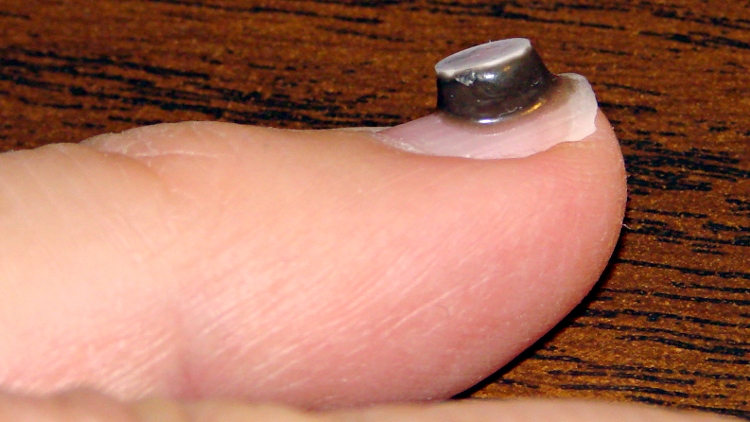
    In the interest of science and so as to not be rendered completely obsolete, I’ve epoxied a small neodymium magnet to my left little finger to discover what the world feels like. It’s surrounded by epoxy, which ought to prevent corrosion & deterioration until it eventually falls off or the nail grows out. It came with a white ceramic layer on one pole, which means it’s completely encapsulated:

    Neodymium magnet on fingernail
    Neodymium magnet on fingernail

    She’s absolutely right: it’s tacky and lacks style.

    I used JB KwikWeld fast-setting epoxy. The magnet attracted a tendril of uncured epoxy, so the “steel filled” part of the description seems accurate, and the magnetic field produced a nice smooth coat over the entire side of the disk.

    It buzzes gently inside a Sonicare toothbrush handle, snaps firmly to steel surfaces. and is otherwise inoffensive. I must run some calibration tests to figure out what sort of magnetic field intensity a fingernail can detect. I’m certain it’s less sensitive than an implanted magnet, but I’m down with that.

    Memo to Self: If you should occasionally use your little finger to ream out your ear or nose, that’s just not going to work any more…

  • Peltier Module PWM Frequency

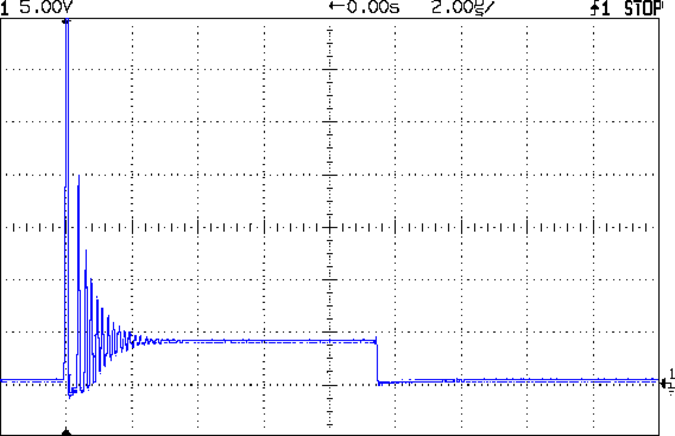
    The tech reviewer for my Circuit Cellar columns on the MOSFET tester commented that the 32 kHz PWM frequency I used for the Peltier module temperature controller was much too high:

    Peltier Noise - VDS - PWM Shutdown
    Peltier Noise – VDS – PWM Shutdown

    He thought something around 1 Hz would be more appropriate.

    Turns out we were both off by a bit. That reference suggests a PWM frequency in the 300-to-3000 Hz range. The lower limit avoids thermal cycling effects (the module’s thermal time constant is much slower) and, I presume, the higher limit avoids major losses from un-snubbed transients (they still occur, but with a very low duty cycle).

    Peltier Turn-Off Transient
    Peltier Turn-Off Transient

    The Peltier PWM drive comes from PWM 10, which uses Timer 1. The VDS and ID setpoints come from PWM 11 and PWM 3, respectively, which use Timer 2. So I can just not tweak the Timer 1 PWM frequency, take the default 488 Hz, and it’s all good. That ever-popular post has the frequency-changing details.

    I’d still use a snubber:

    Peltier Drain - 82 ohm 3.9 nF snubber
    Peltier Drain – 82 ohm 3.9 nF snubber
  • Kindle Fire Security: Burn Them. Burn Them All.

    My Kindle Fire automagically updates itself whenever Amazon decides it should. Sometimes an update produces a notice that an app (why don’t we call them “programs” these days?) needs more permissions, but the process generally goes unremarked.

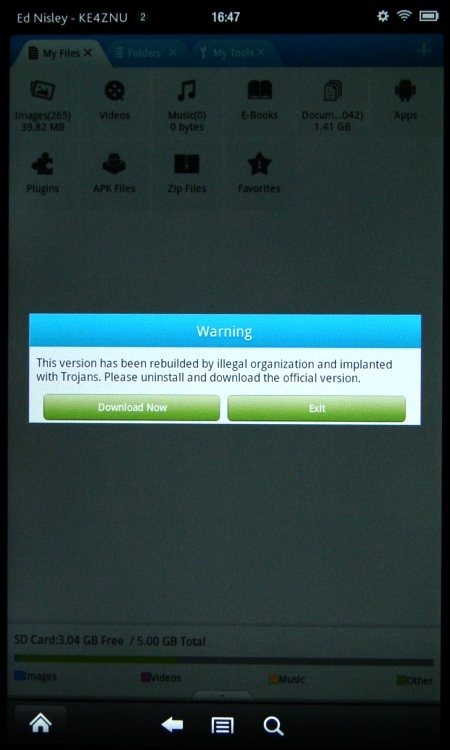
    This one wasn’t subtle at all:

    Kindle Fire - File Expert Trojan warning
    Kindle Fire – File Expert Trojan warning

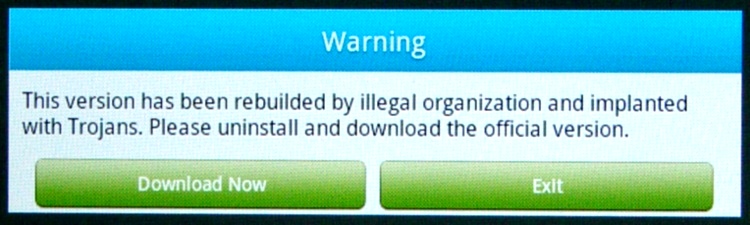
    I had just fired up File Expert, which immediately dimmed the screen and presented a dialog box with only two unpalatable choices. Here’s a closeup:

    Kindle Fire - File Expert Trojan warning - detail
    Kindle Fire – File Expert Trojan warning – detail

    Well, what would you do?

    Needless to say, I didn’t press the Download Now button; it probably wouldn’t have worked anyway, because I turned off the Allow Installation of Applications from Unknown Sources option a long time ago. Pressing Exit bails out of the program app and returns to the Home screen.

    Some questions immediately spring to mind:

    • If the app has been compromised, exactly how did it regain control and complain about the situation?
    • If this is truly a compromised app, why wouldn’t the Trojan just download malware without asking?
    • How did this pass the ahem QC and auditing that allegedly justifies having a sole-source Amazon App Store? After all, I can load random crap from the Interweb onto a PC all by myself.
    • How does one validate the origin of those random security questions that regularly appear on various computer screens? Why wouldn’t malware just pop up a random dialog box asking for the password, any password, and gleefully use whatever you type?

    This appears to be a false positive, as explained there. I assume that any malware worth its salt would also kill off any built-in integrity checking, but what do I know? It’s gone missing from the storefront, probably cast forth into the outer darkness away from the light of Kindle Fires…

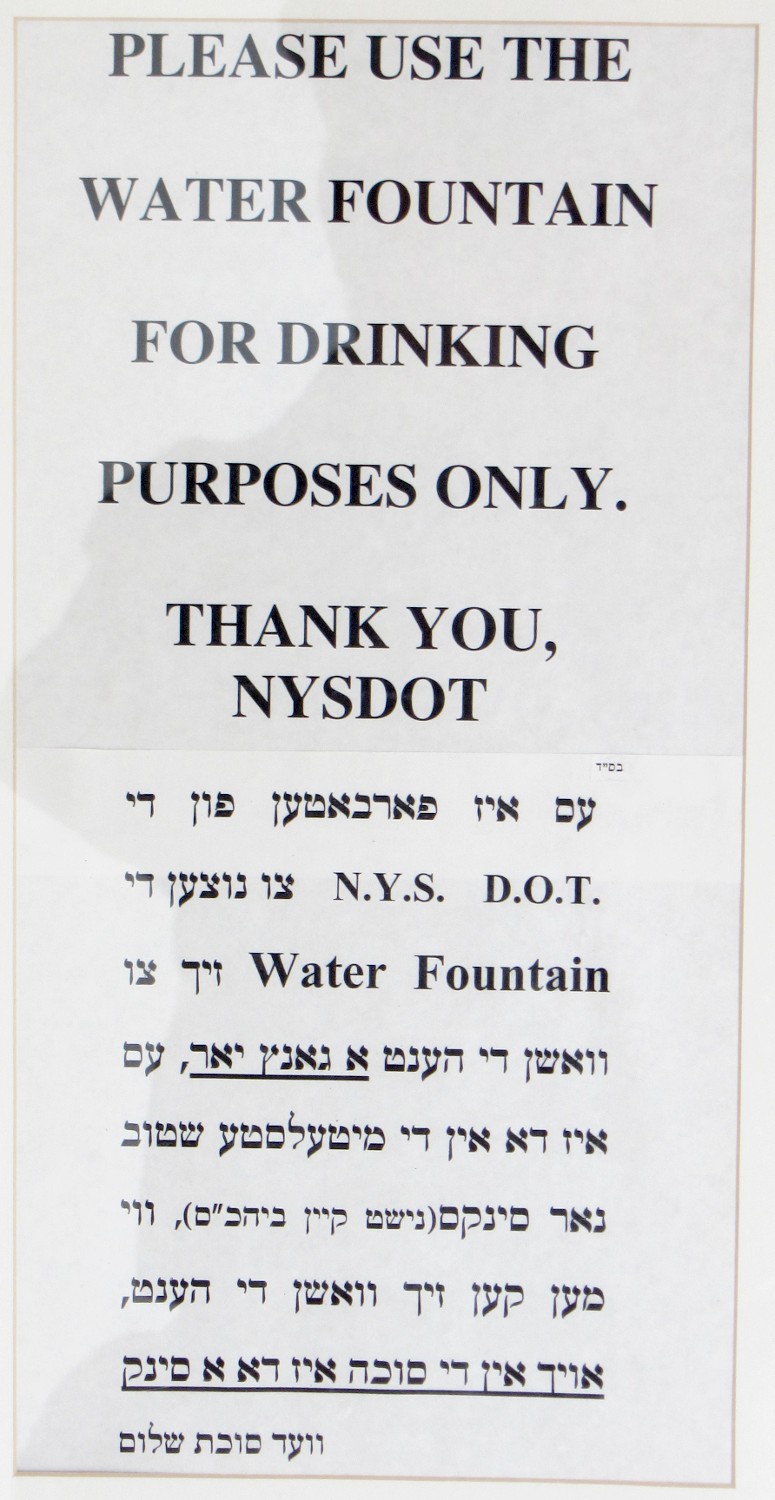
  • Please Use the Water Fountain for Drinking Purposes Only

    Please Use the Water Fountain for Drinking Purposes Only
    Please Use the Water Fountain for Drinking Purposes Only

    OK, I need some help on this one…

    I understand the English wording and suppose that the Hebrew version says roughly the same thing. What I flat-out don’t understand is why such signs appear over the water fountains in the hallways outside the toilet rooms (which have, FWIW, the expected, perfectly serviceable, sinks with hot & cold running water and soap dispensers).

    We were northbound on I-90 at the Clifton Park rest stop. Given the location, I’d pick French as the second language and maybe Spanish would be reasonable, but Hebrew?

    Is there some mysterious ritual involving water fountain misuse that happens only in upstate New York?

    Obviously, I don’t get out nearly enough…

    [Update: I will ruthlessly squash ethic & religious jokes, snide remarks, and off-point speculation. Selah.]